

Материалы доступны только для специалистов сферы здравоохранения.
Чтобы посмотреть материал полностью
Авторизуйтесь
или зарегистрируйтесь.
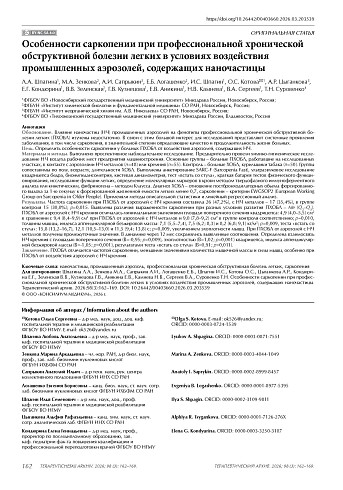
Особенности саркопении при профессиональной хронической обструктивной болезни легких в условиях воздействия промышленных аэрозолей, содержащих наночастицы
Особенности саркопении при профессиональной хронической обструктивной болезни легких в условиях воздействия промышленных аэрозолей, содержащих наночастицы
Шпагина Л.А., Зенкова М.А., Сапрыкин А.И., Логашенко Е.Б., Шпагин И.С., Котова О.С., Цыганкова А.Р., Кондюрина Е.Г., Зеленская В.В., Кузнецова Г.В., Аникина Е.В., Камнева Н.В., Сергеев В.А., Суровенко Т.Н. Особенности саркопении при профессиональной хронической обструктивной болезни легких в условиях воздействия промышленных аэрозолей, содержащих наночастицы. Терапевтический архив. 2026;98(3):162–169. DOI: 10.26442/00403660.2026.03.203539
© ООО «КОНСИЛИУМ МЕДИКУМ», 2026 г.
© ООО «КОНСИЛИУМ МЕДИКУМ», 2026 г.
________________________________________________
Материалы доступны только для специалистов сферы здравоохранения.
Чтобы посмотреть материал полностью
Авторизуйтесь
или зарегистрируйтесь.
Аннотация
Обоснование. Влияние наночастиц (НЧ) промышленных аэрозолей на фенотипы профессиональной хронической обструктивной болезни легких (ПХОБЛ) изучены недостаточно. В связи с этим большой интерес для исследований представляют системные проявления заболевания, в том числе саркопения, в значительной степени определяющие качество и продолжительность жизни больных.
Цель. Определить особенности саркопении у больных ПХОБЛ от воздействия аэрозолей, содержащих НЧ.
Материалы и методы. Выполнено проспективное наблюдательное исследование. Предварительно провели химико-гигиеническое исследование НЧ воздуха рабочих мест предприятия машиностроения. Основные группы – больные ПХОБЛ, работавшие на исследованных участках, в контакте с аэрозолями НЧ металлов (n=48) или кремния (n=55). Контроль – больные ХОБЛ, курильщики табака (n=50). Группы сопоставимы по полу, возрасту, длительности ХОБЛ. Выполнены анкетирование SARC-F (Sarcopenia Fast), ультразвуковое исследование квадрицепса бедра, биоимпедансометрия, кистевая динамометрия, тест «встать со стула», краткая батарея тестов физического функционирования, исследование функции легких, определение молекулярных маркеров в крови методом твердофазного иммуноферментного анализа или кинетическим, фибриногена – методом Клаусса. Диагноз ХОБЛ – отношение постбронходилаторных объема форсированного выдоха за 1-ю секунду к форсированной жизненной емкости легких менее 0,7, саркопении – критерии EWGSOP2 (European Working Group on Sarcopenia in Older People). Применяли методы описательной статистики и линейный регрессионный анализ.
Результаты. Частота саркопении при ПХОБЛ от аэрозолей с НЧ кремния составила 26 (47,2%), с НЧ металлов – 17 (35,4%), в группе контроля 15 (30,0%); р=0,015. Выявлены различия выраженности саркопении при разных условиях развития ПХОБЛ – Ме (Q2–Q3). ПХОБЛ от аэрозолей с НЧ кремния отличалась минимальными значениями площади поперечного сечения квадрицепса: 4,9 (4,0–5,5) см2 в сравнении с 9,4 (8,4–9,9) см2 при ПХОБЛ от аэрозолей с НЧ металлов и 9,0 (7,8–9,2) см2 в группе контроля соответственно; р=0,010, толщины мышцы, индекса аппендикулярной безжировой массы: 7,1 (5,5–7,4), 7,5 (6,2; 8,3) и 8,2 (6,8; 9,1) кг/м2; р=0,009, теста «встать со стула»: 15,8 (13,2–16,7), 12,1 (10,5–13,0) и 11,5 (9,4; 13,8) с; р=0,009, увеличением эхоплотности мышц. При ПХОБЛ от аэрозолей с НЧ металлов получены промежуточные значения. В динамике через 12 мес сохранялись выявленные соотношения. Определена взаимосвязь НЧ кремния с площадью поперечного сечения (В=-0,95; р=0,009), эхоплотностью (В=1,02; р=0,001) квадрицепса, индекса аппендикулярной безжировой массы (В=-1,05; р=0,001), результатами теста «встать со стула» (В=0,91; р=0,011).
Заключение. ПХОБЛ отличается частотой саркопении, меньшими значениями количества мышечной массы и силы мышц, особенно при ПХОБЛ от воздействия аэрозолей с НЧ кремния.
Ключевые слова: наночастицы, промышленный аэрозоль, профессиональная хроническая обструктивная болезнь легких, саркопения
Aim. To establish the features of sarcopenia in patients with COPD due to aerosols containing nanoparticles.
Materials and methods. A prospective observational study was performed. Previously, chemical and hygienic investigation of nanoparticles in the workplaces air on the machine building enterprise was done. The groups under investigation were occupational COPD patients, who were employed at the workplaces that has been investigated and contacting with aerosols containing metal (n=48) or silica (n=55) nanoparticles. Groups were matched by sex, age, COPD duration. Study procedures were Sarcopenia Fast questionnaire, ultrasound measurement of quadriceps femoris, bioelectrical impedance analysis, hand grip strength by dynamometry, sit-to-stand test, short physical performance battery, pulmonary function tests, serum molecular markers measured by enzyme-linked immunosorbent assay or by kinetic method, serum fibrinogen by Klauss method. COPD was diagnosed when postbronchodilator forced expiratory volume in one second divided by forced vital capacity was less than 0.7. Sarcopenia was diagnosed by EWGSOP2 criteria (European Working Group on Sarcopenia in Older People). Statistical analysis included descriptive methods and liner regression.
Results. Sarcopenia rate was 26 (47.2%) in COPD due to aerosols containing silica nanoparticles, 17 (35.4%) in COPD due to aerosols containing metal nanoparticles and 15 (30.0%) in control group; p=0.015. The differences of sarcopenia severity between COPD due to different environmental conditions were seen – Ме (Q2–Q3). COPD due to aerosols containing silica nanoparticels was characterized by minimal values of quadriceps cross-sectional area: 4.9 (4.0–5.5) sm2 compared with 9.4 (8.4–9.9) sm2 in COPD due to aerosols containing metal nanoparticles patients and with 9,0 (7.8; 9.2) sm2 in control group respectivel; р=0.010, quadriceps thickness, appendicular fat-free mass index: 7.1 (5.5–7.4), 7.5 (6.2–8.3) and 8.2 (6.8–9.1) kg/m2; р=0.009, sit-to-stand test 15.8 (13.2–16.7), 12.1 (10.5–13.0) and 11.5 (9.4–13.8) s; р=0.009, by elevated muscle echogenicity. COPD due to aerosols containing metal nanoparticles patients had the mid values. After 12 months these relationships were preserved. The associations of silica nanoparticles with quadriceps cross-sectional area (В=-0.95; р=0.009), echogenicity (В=1.02; р=0.001), appendicular fat-free mass index (В=-1.05; р=0.001) and sit-to-stand test (В=0.91; р=0.011) were explored.
Conclusion. Occuational COPD is characterized by sarcopenia rate, less values of muscle quantity and quality, especially pronounced in COPD due to aerosols containing silica nanoparticels.
Keywords: nanoparticles, occupational air pollutants, occupational chronic obstructive pulmonary disease, sarcopenia
Цель. Определить особенности саркопении у больных ПХОБЛ от воздействия аэрозолей, содержащих НЧ.
Материалы и методы. Выполнено проспективное наблюдательное исследование. Предварительно провели химико-гигиеническое исследование НЧ воздуха рабочих мест предприятия машиностроения. Основные группы – больные ПХОБЛ, работавшие на исследованных участках, в контакте с аэрозолями НЧ металлов (n=48) или кремния (n=55). Контроль – больные ХОБЛ, курильщики табака (n=50). Группы сопоставимы по полу, возрасту, длительности ХОБЛ. Выполнены анкетирование SARC-F (Sarcopenia Fast), ультразвуковое исследование квадрицепса бедра, биоимпедансометрия, кистевая динамометрия, тест «встать со стула», краткая батарея тестов физического функционирования, исследование функции легких, определение молекулярных маркеров в крови методом твердофазного иммуноферментного анализа или кинетическим, фибриногена – методом Клаусса. Диагноз ХОБЛ – отношение постбронходилаторных объема форсированного выдоха за 1-ю секунду к форсированной жизненной емкости легких менее 0,7, саркопении – критерии EWGSOP2 (European Working Group on Sarcopenia in Older People). Применяли методы описательной статистики и линейный регрессионный анализ.
Результаты. Частота саркопении при ПХОБЛ от аэрозолей с НЧ кремния составила 26 (47,2%), с НЧ металлов – 17 (35,4%), в группе контроля 15 (30,0%); р=0,015. Выявлены различия выраженности саркопении при разных условиях развития ПХОБЛ – Ме (Q2–Q3). ПХОБЛ от аэрозолей с НЧ кремния отличалась минимальными значениями площади поперечного сечения квадрицепса: 4,9 (4,0–5,5) см2 в сравнении с 9,4 (8,4–9,9) см2 при ПХОБЛ от аэрозолей с НЧ металлов и 9,0 (7,8–9,2) см2 в группе контроля соответственно; р=0,010, толщины мышцы, индекса аппендикулярной безжировой массы: 7,1 (5,5–7,4), 7,5 (6,2; 8,3) и 8,2 (6,8; 9,1) кг/м2; р=0,009, теста «встать со стула»: 15,8 (13,2–16,7), 12,1 (10,5–13,0) и 11,5 (9,4; 13,8) с; р=0,009, увеличением эхоплотности мышц. При ПХОБЛ от аэрозолей с НЧ металлов получены промежуточные значения. В динамике через 12 мес сохранялись выявленные соотношения. Определена взаимосвязь НЧ кремния с площадью поперечного сечения (В=-0,95; р=0,009), эхоплотностью (В=1,02; р=0,001) квадрицепса, индекса аппендикулярной безжировой массы (В=-1,05; р=0,001), результатами теста «встать со стула» (В=0,91; р=0,011).
Заключение. ПХОБЛ отличается частотой саркопении, меньшими значениями количества мышечной массы и силы мышц, особенно при ПХОБЛ от воздействия аэрозолей с НЧ кремния.
Ключевые слова: наночастицы, промышленный аэрозоль, профессиональная хроническая обструктивная болезнь легких, саркопения
________________________________________________
Aim. To establish the features of sarcopenia in patients with COPD due to aerosols containing nanoparticles.
Materials and methods. A prospective observational study was performed. Previously, chemical and hygienic investigation of nanoparticles in the workplaces air on the machine building enterprise was done. The groups under investigation were occupational COPD patients, who were employed at the workplaces that has been investigated and contacting with aerosols containing metal (n=48) or silica (n=55) nanoparticles. Groups were matched by sex, age, COPD duration. Study procedures were Sarcopenia Fast questionnaire, ultrasound measurement of quadriceps femoris, bioelectrical impedance analysis, hand grip strength by dynamometry, sit-to-stand test, short physical performance battery, pulmonary function tests, serum molecular markers measured by enzyme-linked immunosorbent assay or by kinetic method, serum fibrinogen by Klauss method. COPD was diagnosed when postbronchodilator forced expiratory volume in one second divided by forced vital capacity was less than 0.7. Sarcopenia was diagnosed by EWGSOP2 criteria (European Working Group on Sarcopenia in Older People). Statistical analysis included descriptive methods and liner regression.
Results. Sarcopenia rate was 26 (47.2%) in COPD due to aerosols containing silica nanoparticles, 17 (35.4%) in COPD due to aerosols containing metal nanoparticles and 15 (30.0%) in control group; p=0.015. The differences of sarcopenia severity between COPD due to different environmental conditions were seen – Ме (Q2–Q3). COPD due to aerosols containing silica nanoparticels was characterized by minimal values of quadriceps cross-sectional area: 4.9 (4.0–5.5) sm2 compared with 9.4 (8.4–9.9) sm2 in COPD due to aerosols containing metal nanoparticles patients and with 9,0 (7.8; 9.2) sm2 in control group respectivel; р=0.010, quadriceps thickness, appendicular fat-free mass index: 7.1 (5.5–7.4), 7.5 (6.2–8.3) and 8.2 (6.8–9.1) kg/m2; р=0.009, sit-to-stand test 15.8 (13.2–16.7), 12.1 (10.5–13.0) and 11.5 (9.4–13.8) s; р=0.009, by elevated muscle echogenicity. COPD due to aerosols containing metal nanoparticles patients had the mid values. After 12 months these relationships were preserved. The associations of silica nanoparticles with quadriceps cross-sectional area (В=-0.95; р=0.009), echogenicity (В=1.02; р=0.001), appendicular fat-free mass index (В=-1.05; р=0.001) and sit-to-stand test (В=0.91; р=0.011) were explored.
Conclusion. Occuational COPD is characterized by sarcopenia rate, less values of muscle quantity and quality, especially pronounced in COPD due to aerosols containing silica nanoparticels.
Keywords: nanoparticles, occupational air pollutants, occupational chronic obstructive pulmonary disease, sarcopenia
Полный текст
Список литературы
1. Профессиональная патология. Национальное руководство. Под ред. И.В. Бухтиярова. М.: ГЭОТАР-Медиа, 2024. 904 с. [Professional'naia patologiia. Natsional'noe rukovodstvo. Pod red. IV Bukhtiiarova. Moscow: GEOTAR-Media, 2024. 904 s. (in Russian)].
2. Федеральная служба государственной статистики. Режим доступа: https://rosstat.gov.ru/working_conditions. Ссылка активна на 05.10.2024 [Federal'naia sluzhba gosudarstvennoi statistiki. Available at: https://rosstat.gov.ru/working_conditions. Accessed: 05.10.2024 (in Russian)].
3. О состоянии санитарно-эпидемиологического благополучия населения в Российской Федерации в 2023 году. Государственный доклад. М.: Федеральная служба по надзору в сфере защиты прав потребителей и благополучия человека, 2024. 364 с. [O sostoianii sanitarno-epidemiologicheskogo blagopoluchiia naseleniia v Rossiiskoi Federatsii v 2023 godu. Gosudarstvennyi doklad. Moscow: Federal'naia sluzhba po nadzoru v sfere zashchity prav potrebitelei i blagopoluchiia cheloveka, 2024. 364 s. (in Russian)].
4. Mei F, Dalmartello M, Bonifazi M, et al. Chronic obstructive pulmonary disease (COPD) mortality trends worldwide: An update to 2019. Respirology. 2022;27(11):941-50. DOI:10.1111/resp.14328
5. Global burden of disease study 2021. Available at: https://vizhub.healthdata.org/gbd-compare/. Accessed: 27.07.2024.
6. Авдеев С.Н., Лещенко И.В., Айсанов З.Р., и др. Новые клинические рекомендации по ХОБЛ – смена парадигмы. Терапевтический архив. 2024;96(3):292-7 [Avdeev SN, Leshchenko IV, Aisanov ZR, et al., on behalf of the working group for the development and revision of Federal clinical guidelines for COPD. New clinical guidelines for COPD – a paradigm shift: A review. Terapevticheskii Arkhiv (Ter. Arkh.). 2024;96(3):292-7 (in Russian)]. DOI:10.26442/00403660.2024.03.202646
7. Шпагина Л.А., Котова О.С., Шпагин И.С., и др. Клинико-функциональные особенности хронической обструктивной болезни легких после вирус-ассоциированных обострений. Терапевтический архив. 2023;95(3):217-22 [Shpagina LA, Kotova OS, Shpagin IS, et al. Clinic and functional features of chronic obstructive pulmonary disease after virus-induced acute exacerbations. Terapevticheskii Arkhiv (Ter. Arkh.). 2023;95(3):217-22 (in Russian)]. DOI:10.26442/00403660.2023.03.202086
8. Афтанас Л.И., Шпагина Л.А., Котова О.С., и др. Клеточно-молекулярные особенности воспаления и выживаемость больных профессиональной хронической обструктивной болезнью легких в условиях воздействия неорганической пыли. Сибирский научный медицинский журнал. 2018;38(6):35-43 [Aftanas LI, Shpagina LA, Kotova OS, et al. Inflammation cell-molecular features and survival in patients with occupational chronic obstructive pulmonary disease from silica dust exposure. Sibirskij Nauchnyj Medicinskij Zhurnal. 2018;38(6):35-43 (in Russian)]. DOI:10.15372/SSMJ20180606
9. Attaway AH, Lopez R, Welch N, et al. Muscle loss phenotype in COPD is associated with adverse outcomes in the UK Biobank. BMC Pulm Med. 202417;24(1):186. DOI:10.1186/s12890-024-02999-7
10. Zhuo LB, Liu YM, Jiang Y, Yan Z. Zinc oxide nanoparticles induce acute lung injury via oxidative stress-mediated mitochondrial damage and NLRP3 inflammasome activation: In vitro and in vivo studies. Environ Pollut. 2024;341:122950. DOI:10.1016/j.envpol.2023.122950
11. Zhou S, Wang Z, Gao L, et al. C5a/C5aR1 axis as a key driver promotes epithelial-to-mesenchymal transition in airway epithelial cells in silica nanoparticles-induced pulmonary fibrosis. Int Immunopharmacol. 2023;125(Pt B):111112. DOI:10.1016/j.intimp.2023.111112
12. Fatkhutdinova LM, Gabidinova GF, Daminova AG, et al. Mechanisms related to carbon nanotubes genotoxicity in human cell lines of respiratory origin. Toxicol Appl Pharmacol. 2024;482:116784. DOI:10.1016/j.taap.2023.116784
13. Fireman Klein E, Adir Y, Krencel A, et al. Ultrafine particles in airways: A novel marker of COPD exacerbation risk and inflammatory status. Int J Chron Obstruct Pulmon Dis. 2019;14:557-64. DOI:10.2147/COPD.S187560
14. Чучалин А.Г., Авдеев С.Н., Айсанов З.Р., и др. Хроническая обструктивная болезнь легких: федеральные клинические рекомендации по диагностике и лечению. Пульмонология. 2022;32(3):356-92 [Chuchalin AG, Avdeev SN, Aisanov ZR, et al. Federal guidelines on diagnosis and treatment of chronic obstructive pulmonary disease. Pulmonologiya. 2022;32(3):356-392 (in Russian)]. DOI:10.18093/0869-0189-2022-32-3-356-392
15. Malmstrom TK, Miller DK, Simonsick EM, et al. SARC-F: A symptom score to predict persons with sarcopenia at risk for poor functional outcomes. J Cachexia Sarcopenia Muscle. 2016;7(1):28-36. DOI:10.1002/jcsm.12048
16. Deng M, Yan L, Tong R, et al. Ultrasound assessment of the rectus femoris in patients with chronic obstructive pulmonary disease predicts sarcopenia. Int J Chron Obstruct Pulmon Dis. 2022;17:2801-10. DOI:10.2147/COPD.S386278
17. Sergi G, De Rui M, Veronese N, et al. Assessing appendicular skeletal muscle mass with bioelectrical impedance analysis in free-living Caucasian older adults. Clin Nutr. 2015;34(4):667-73. DOI:10.1016/j.clnu.2014.07.010
18. Short Physical Performance Battery. Available at: https://www.nia.nih.gov/research/labs/leps/short-physical-performance-battery-sppb. Accessed: 27.07.2024.
19. Cruz-Jentoft AJ, Bahat G, Bauer J, et al. Sarcopenia: Revised European consensus on definition and diagnosis. Age Ageing. 2019;48(1):16-31. DOI:10.1093/ageing/afy169
20. Шаяхметов С.Ф., Рукавишников В.С., Лисецкая Л.Г., Меринов А.В. Характеристика образующихся аэрозольных взвесей – комплексов при традиционной и модернизированной технологиях электролиза алюминия. Медицина труда и промышленная экология. 2022;62(7):452-8 [Shayakhmetov SF, Rukavishnikov VS, Lisetskaya LG, Merinov AV. Characteristics of generated aerosol suspensions-complexes at traditional and modernized aluminum electrolysis technologies. Russian Journal of Occupational Health and Industrial Ecology. 2022;62(7):452-8 (in Russian)]. DOI:10.31089/1026-9428-2022-62-7-452-458
21. Сулейманова А.К., Сафонова Ю.А., Баранова И.А. Частота саркопении у пациентов со стабильной хронической обструктивной болезнью легких: сравнение диагностических алгоритмов Европейской рабочей группы по саркопении у пожилых людей (редакции 2010 и 2018 гг.). Пульмонология. 2019;29(5):564-70 [Suleymanova AK, Safonova YuA, Baranova IA. An incidence of sarcopenia in patients with stable chronic obstructive pulmonary disease: A comparison of diagnostic algorithms of European Working Group on Sarcopenia in Older People, 2018 versus 2010. Pulmonologiya. 2019;29(5):564-7 (in Russian)]. DOI:10.18093/0869-0189-2019-29-5-564-570
22. Wang Y, Li S, Zhang Z, et al. Accelerated loss of trunk muscle density and size at L1 vertebral level in male patients with COPD. Front Endocrinol (Lausanne). 2022;13:1087110. DOI:10.3389/fendo.2022.1087110
2. Federal'naia sluzhba gosudarstvennoi statistiki. Available at: https://rosstat.gov.ru/working_conditions. Accessed: 05.10.2024 (in Russian).
3. O sostoianii sanitarno-epidemiologicheskogo blagopoluchiia naseleniia v Rossiiskoi Federatsii v 2023 godu. Gosudarstvennyi doklad. Moscow: Federal'naia sluzhba po nadzoru v sfere zashchity prav potrebitelei i blagopoluchiia cheloveka, 2024. 364 s. (in Russian).
4. Mei F, Dalmartello M, Bonifazi M, et al. Chronic obstructive pulmonary disease (COPD) mortality trends worldwide: An update to 2019. Respirology. 2022;27(11):941-50. DOI:10.1111/resp.14328
5. Global burden of disease study 2021. Available at: https://vizhub.healthdata.org/gbd-compare/. Accessed: 27.07.2024.
6. Avdeev SN, Leshchenko IV, Aisanov ZR, et al., on behalf of the working group for the development and revision of Federal clinical guidelines for COPD. New clinical guidelines for COPD – a paradigm shift: A review. Terapevticheskii Arkhiv (Ter. Arkh.). 2024;96(3):292-7 (in Russian). DOI:10.26442/00403660.2024.03.202646
7. Shpagina LA, Kotova OS, Shpagin IS, et al. Clinic and functional features of chronic obstructive pulmonary disease after virus-induced acute exacerbations. Terapevticheskii Arkhiv (Ter. Arkh.). 2023;95(3):217-22 (in Russian). DOI:10.26442/00403660.2023.03.202086
8. Aftanas LI, Shpagina LA, Kotova OS, et al. Inflammation cell-molecular features and survival in patients with occupational chronic obstructive pulmonary disease from silica dust exposure. Sibirskij Nauchnyj Medicinskij Zhurnal. 2018;38(6):35-43 (in Russian). DOI:10.15372/SSMJ20180606
9. Attaway AH, Lopez R, Welch N, et al. Muscle loss phenotype in COPD is associated with adverse outcomes in the UK Biobank. BMC Pulm Med. 202417;24(1):186. DOI:10.1186/s12890-024-02999-7
10. Zhuo LB, Liu YM, Jiang Y, Yan Z. Zinc oxide nanoparticles induce acute lung injury via oxidative stress-mediated mitochondrial damage and NLRP3 inflammasome activation: In vitro and in vivo studies. Environ Pollut. 2024;341:122950. DOI:10.1016/j.envpol.2023.122950
11. Zhou S, Wang Z, Gao L, et al. C5a/C5aR1 axis as a key driver promotes epithelial-to-mesenchymal transition in airway epithelial cells in silica nanoparticles-induced pulmonary fibrosis. Int Immunopharmacol. 2023;125(Pt B):111112. DOI:10.1016/j.intimp.2023.111112
12. Fatkhutdinova LM, Gabidinova GF, Daminova AG, et al. Mechanisms related to carbon nanotubes genotoxicity in human cell lines of respiratory origin. Toxicol Appl Pharmacol. 2024;482:116784. DOI:10.1016/j.taap.2023.116784
13. Fireman Klein E, Adir Y, Krencel A, et al. Ultrafine particles in airways: A novel marker of COPD exacerbation risk and inflammatory status. Int J Chron Obstruct Pulmon Dis. 2019;14:557-64. DOI:10.2147/COPD.S187560
14. Chuchalin AG, Avdeev SN, Aisanov ZR, et al. Federal guidelines on diagnosis and treatment of chronic obstructive pulmonary disease. Pulmonologiya. 2022;32(3):356-392 (in Russian). DOI:10.18093/0869-0189-2022-32-3-356-392
15. Malmstrom TK, Miller DK, Simonsick EM, et al. SARC-F: A symptom score to predict persons with sarcopenia at risk for poor functional outcomes. J Cachexia Sarcopenia Muscle. 2016;7(1):28-36. DOI:10.1002/jcsm.12048
16. Deng M, Yan L, Tong R, et al. Ultrasound assessment of the rectus femoris in patients with chronic obstructive pulmonary disease predicts sarcopenia. Int J Chron Obstruct Pulmon Dis. 2022;17:2801-10. DOI:10.2147/COPD.S386278
17. Sergi G, De Rui M, Veronese N, et al. Assessing appendicular skeletal muscle mass with bioelectrical impedance analysis in free-living Caucasian older adults. Clin Nutr. 2015;34(4):667-73. DOI:10.1016/j.clnu.2014.07.010
18. Short Physical Performance Battery. Available at: https://www.nia.nih.gov/research/labs/leps/short-physical-performance-battery-sppb. Accessed: 27.07.2024.
19. Cruz-Jentoft AJ, Bahat G, Bauer J, et al. Sarcopenia: Revised European consensus on definition and diagnosis. Age Ageing. 2019;48(1):16-31. DOI:10.1093/ageing/afy169
20. Shayakhmetov SF, Rukavishnikov VS, Lisetskaya LG, Merinov AV. Characteristics of generated aerosol suspensions-complexes at traditional and modernized aluminum electrolysis technologies. Russian Journal of Occupational Health and Industrial Ecology. 2022;62(7):452-8 (in Russian). DOI:10.31089/1026-9428-2022-62-7-452-458
21. Suleymanova AK, Safonova YuA, Baranova IA. An incidence of sarcopenia in patients with stable chronic obstructive pulmonary disease: A comparison of diagnostic algorithms of European Working Group on Sarcopenia in Older People, 2018 versus 2010. Pulmonologiya. 2019;29(5):564-7 (in Russian). DOI:10.18093/0869-0189-2019-29-5-564-570
22. Wang Y, Li S, Zhang Z, et al. Accelerated loss of trunk muscle density and size at L1 vertebral level in male patients with COPD. Front Endocrinol (Lausanne). 2022;13:1087110. DOI:10.3389/fendo.2022.1087110
2. Федеральная служба государственной статистики. Режим доступа: https://rosstat.gov.ru/working_conditions. Ссылка активна на 05.10.2024 [Federal'naia sluzhba gosudarstvennoi statistiki. Available at: https://rosstat.gov.ru/working_conditions. Accessed: 05.10.2024 (in Russian)].
3. О состоянии санитарно-эпидемиологического благополучия населения в Российской Федерации в 2023 году. Государственный доклад. М.: Федеральная служба по надзору в сфере защиты прав потребителей и благополучия человека, 2024. 364 с. [O sostoianii sanitarno-epidemiologicheskogo blagopoluchiia naseleniia v Rossiiskoi Federatsii v 2023 godu. Gosudarstvennyi doklad. Moscow: Federal'naia sluzhba po nadzoru v sfere zashchity prav potrebitelei i blagopoluchiia cheloveka, 2024. 364 s. (in Russian)].
4. Mei F, Dalmartello M, Bonifazi M, et al. Chronic obstructive pulmonary disease (COPD) mortality trends worldwide: An update to 2019. Respirology. 2022;27(11):941-50. DOI:10.1111/resp.14328
5. Global burden of disease study 2021. Available at: https://vizhub.healthdata.org/gbd-compare/. Accessed: 27.07.2024.
6. Авдеев С.Н., Лещенко И.В., Айсанов З.Р., и др. Новые клинические рекомендации по ХОБЛ – смена парадигмы. Терапевтический архив. 2024;96(3):292-7 [Avdeev SN, Leshchenko IV, Aisanov ZR, et al., on behalf of the working group for the development and revision of Federal clinical guidelines for COPD. New clinical guidelines for COPD – a paradigm shift: A review. Terapevticheskii Arkhiv (Ter. Arkh.). 2024;96(3):292-7 (in Russian)]. DOI:10.26442/00403660.2024.03.202646
7. Шпагина Л.А., Котова О.С., Шпагин И.С., и др. Клинико-функциональные особенности хронической обструктивной болезни легких после вирус-ассоциированных обострений. Терапевтический архив. 2023;95(3):217-22 [Shpagina LA, Kotova OS, Shpagin IS, et al. Clinic and functional features of chronic obstructive pulmonary disease after virus-induced acute exacerbations. Terapevticheskii Arkhiv (Ter. Arkh.). 2023;95(3):217-22 (in Russian)]. DOI:10.26442/00403660.2023.03.202086
8. Афтанас Л.И., Шпагина Л.А., Котова О.С., и др. Клеточно-молекулярные особенности воспаления и выживаемость больных профессиональной хронической обструктивной болезнью легких в условиях воздействия неорганической пыли. Сибирский научный медицинский журнал. 2018;38(6):35-43 [Aftanas LI, Shpagina LA, Kotova OS, et al. Inflammation cell-molecular features and survival in patients with occupational chronic obstructive pulmonary disease from silica dust exposure. Sibirskij Nauchnyj Medicinskij Zhurnal. 2018;38(6):35-43 (in Russian)]. DOI:10.15372/SSMJ20180606
9. Attaway AH, Lopez R, Welch N, et al. Muscle loss phenotype in COPD is associated with adverse outcomes in the UK Biobank. BMC Pulm Med. 202417;24(1):186. DOI:10.1186/s12890-024-02999-7
10. Zhuo LB, Liu YM, Jiang Y, Yan Z. Zinc oxide nanoparticles induce acute lung injury via oxidative stress-mediated mitochondrial damage and NLRP3 inflammasome activation: In vitro and in vivo studies. Environ Pollut. 2024;341:122950. DOI:10.1016/j.envpol.2023.122950
11. Zhou S, Wang Z, Gao L, et al. C5a/C5aR1 axis as a key driver promotes epithelial-to-mesenchymal transition in airway epithelial cells in silica nanoparticles-induced pulmonary fibrosis. Int Immunopharmacol. 2023;125(Pt B):111112. DOI:10.1016/j.intimp.2023.111112
12. Fatkhutdinova LM, Gabidinova GF, Daminova AG, et al. Mechanisms related to carbon nanotubes genotoxicity in human cell lines of respiratory origin. Toxicol Appl Pharmacol. 2024;482:116784. DOI:10.1016/j.taap.2023.116784
13. Fireman Klein E, Adir Y, Krencel A, et al. Ultrafine particles in airways: A novel marker of COPD exacerbation risk and inflammatory status. Int J Chron Obstruct Pulmon Dis. 2019;14:557-64. DOI:10.2147/COPD.S187560
14. Чучалин А.Г., Авдеев С.Н., Айсанов З.Р., и др. Хроническая обструктивная болезнь легких: федеральные клинические рекомендации по диагностике и лечению. Пульмонология. 2022;32(3):356-92 [Chuchalin AG, Avdeev SN, Aisanov ZR, et al. Federal guidelines on diagnosis and treatment of chronic obstructive pulmonary disease. Pulmonologiya. 2022;32(3):356-392 (in Russian)]. DOI:10.18093/0869-0189-2022-32-3-356-392
15. Malmstrom TK, Miller DK, Simonsick EM, et al. SARC-F: A symptom score to predict persons with sarcopenia at risk for poor functional outcomes. J Cachexia Sarcopenia Muscle. 2016;7(1):28-36. DOI:10.1002/jcsm.12048
16. Deng M, Yan L, Tong R, et al. Ultrasound assessment of the rectus femoris in patients with chronic obstructive pulmonary disease predicts sarcopenia. Int J Chron Obstruct Pulmon Dis. 2022;17:2801-10. DOI:10.2147/COPD.S386278
17. Sergi G, De Rui M, Veronese N, et al. Assessing appendicular skeletal muscle mass with bioelectrical impedance analysis in free-living Caucasian older adults. Clin Nutr. 2015;34(4):667-73. DOI:10.1016/j.clnu.2014.07.010
18. Short Physical Performance Battery. Available at: https://www.nia.nih.gov/research/labs/leps/short-physical-performance-battery-sppb. Accessed: 27.07.2024.
19. Cruz-Jentoft AJ, Bahat G, Bauer J, et al. Sarcopenia: Revised European consensus on definition and diagnosis. Age Ageing. 2019;48(1):16-31. DOI:10.1093/ageing/afy169
20. Шаяхметов С.Ф., Рукавишников В.С., Лисецкая Л.Г., Меринов А.В. Характеристика образующихся аэрозольных взвесей – комплексов при традиционной и модернизированной технологиях электролиза алюминия. Медицина труда и промышленная экология. 2022;62(7):452-8 [Shayakhmetov SF, Rukavishnikov VS, Lisetskaya LG, Merinov AV. Characteristics of generated aerosol suspensions-complexes at traditional and modernized aluminum electrolysis technologies. Russian Journal of Occupational Health and Industrial Ecology. 2022;62(7):452-8 (in Russian)]. DOI:10.31089/1026-9428-2022-62-7-452-458
21. Сулейманова А.К., Сафонова Ю.А., Баранова И.А. Частота саркопении у пациентов со стабильной хронической обструктивной болезнью легких: сравнение диагностических алгоритмов Европейской рабочей группы по саркопении у пожилых людей (редакции 2010 и 2018 гг.). Пульмонология. 2019;29(5):564-70 [Suleymanova AK, Safonova YuA, Baranova IA. An incidence of sarcopenia in patients with stable chronic obstructive pulmonary disease: A comparison of diagnostic algorithms of European Working Group on Sarcopenia in Older People, 2018 versus 2010. Pulmonologiya. 2019;29(5):564-7 (in Russian)]. DOI:10.18093/0869-0189-2019-29-5-564-570
22. Wang Y, Li S, Zhang Z, et al. Accelerated loss of trunk muscle density and size at L1 vertebral level in male patients with COPD. Front Endocrinol (Lausanne). 2022;13:1087110. DOI:10.3389/fendo.2022.1087110
________________________________________________
2. Federal'naia sluzhba gosudarstvennoi statistiki. Available at: https://rosstat.gov.ru/working_conditions. Accessed: 05.10.2024 (in Russian).
3. O sostoianii sanitarno-epidemiologicheskogo blagopoluchiia naseleniia v Rossiiskoi Federatsii v 2023 godu. Gosudarstvennyi doklad. Moscow: Federal'naia sluzhba po nadzoru v sfere zashchity prav potrebitelei i blagopoluchiia cheloveka, 2024. 364 s. (in Russian).
4. Mei F, Dalmartello M, Bonifazi M, et al. Chronic obstructive pulmonary disease (COPD) mortality trends worldwide: An update to 2019. Respirology. 2022;27(11):941-50. DOI:10.1111/resp.14328
5. Global burden of disease study 2021. Available at: https://vizhub.healthdata.org/gbd-compare/. Accessed: 27.07.2024.
6. Avdeev SN, Leshchenko IV, Aisanov ZR, et al., on behalf of the working group for the development and revision of Federal clinical guidelines for COPD. New clinical guidelines for COPD – a paradigm shift: A review. Terapevticheskii Arkhiv (Ter. Arkh.). 2024;96(3):292-7 (in Russian). DOI:10.26442/00403660.2024.03.202646
7. Shpagina LA, Kotova OS, Shpagin IS, et al. Clinic and functional features of chronic obstructive pulmonary disease after virus-induced acute exacerbations. Terapevticheskii Arkhiv (Ter. Arkh.). 2023;95(3):217-22 (in Russian). DOI:10.26442/00403660.2023.03.202086
8. Aftanas LI, Shpagina LA, Kotova OS, et al. Inflammation cell-molecular features and survival in patients with occupational chronic obstructive pulmonary disease from silica dust exposure. Sibirskij Nauchnyj Medicinskij Zhurnal. 2018;38(6):35-43 (in Russian). DOI:10.15372/SSMJ20180606
9. Attaway AH, Lopez R, Welch N, et al. Muscle loss phenotype in COPD is associated with adverse outcomes in the UK Biobank. BMC Pulm Med. 202417;24(1):186. DOI:10.1186/s12890-024-02999-7
10. Zhuo LB, Liu YM, Jiang Y, Yan Z. Zinc oxide nanoparticles induce acute lung injury via oxidative stress-mediated mitochondrial damage and NLRP3 inflammasome activation: In vitro and in vivo studies. Environ Pollut. 2024;341:122950. DOI:10.1016/j.envpol.2023.122950
11. Zhou S, Wang Z, Gao L, et al. C5a/C5aR1 axis as a key driver promotes epithelial-to-mesenchymal transition in airway epithelial cells in silica nanoparticles-induced pulmonary fibrosis. Int Immunopharmacol. 2023;125(Pt B):111112. DOI:10.1016/j.intimp.2023.111112
12. Fatkhutdinova LM, Gabidinova GF, Daminova AG, et al. Mechanisms related to carbon nanotubes genotoxicity in human cell lines of respiratory origin. Toxicol Appl Pharmacol. 2024;482:116784. DOI:10.1016/j.taap.2023.116784
13. Fireman Klein E, Adir Y, Krencel A, et al. Ultrafine particles in airways: A novel marker of COPD exacerbation risk and inflammatory status. Int J Chron Obstruct Pulmon Dis. 2019;14:557-64. DOI:10.2147/COPD.S187560
14. Chuchalin AG, Avdeev SN, Aisanov ZR, et al. Federal guidelines on diagnosis and treatment of chronic obstructive pulmonary disease. Pulmonologiya. 2022;32(3):356-392 (in Russian). DOI:10.18093/0869-0189-2022-32-3-356-392
15. Malmstrom TK, Miller DK, Simonsick EM, et al. SARC-F: A symptom score to predict persons with sarcopenia at risk for poor functional outcomes. J Cachexia Sarcopenia Muscle. 2016;7(1):28-36. DOI:10.1002/jcsm.12048
16. Deng M, Yan L, Tong R, et al. Ultrasound assessment of the rectus femoris in patients with chronic obstructive pulmonary disease predicts sarcopenia. Int J Chron Obstruct Pulmon Dis. 2022;17:2801-10. DOI:10.2147/COPD.S386278
17. Sergi G, De Rui M, Veronese N, et al. Assessing appendicular skeletal muscle mass with bioelectrical impedance analysis in free-living Caucasian older adults. Clin Nutr. 2015;34(4):667-73. DOI:10.1016/j.clnu.2014.07.010
18. Short Physical Performance Battery. Available at: https://www.nia.nih.gov/research/labs/leps/short-physical-performance-battery-sppb. Accessed: 27.07.2024.
19. Cruz-Jentoft AJ, Bahat G, Bauer J, et al. Sarcopenia: Revised European consensus on definition and diagnosis. Age Ageing. 2019;48(1):16-31. DOI:10.1093/ageing/afy169
20. Shayakhmetov SF, Rukavishnikov VS, Lisetskaya LG, Merinov AV. Characteristics of generated aerosol suspensions-complexes at traditional and modernized aluminum electrolysis technologies. Russian Journal of Occupational Health and Industrial Ecology. 2022;62(7):452-8 (in Russian). DOI:10.31089/1026-9428-2022-62-7-452-458
21. Suleymanova AK, Safonova YuA, Baranova IA. An incidence of sarcopenia in patients with stable chronic obstructive pulmonary disease: A comparison of diagnostic algorithms of European Working Group on Sarcopenia in Older People, 2018 versus 2010. Pulmonologiya. 2019;29(5):564-7 (in Russian). DOI:10.18093/0869-0189-2019-29-5-564-570
22. Wang Y, Li S, Zhang Z, et al. Accelerated loss of trunk muscle density and size at L1 vertebral level in male patients with COPD. Front Endocrinol (Lausanne). 2022;13:1087110. DOI:10.3389/fendo.2022.1087110
Авторы
Л.А. Шпагина1, М.А. Зенкова2, А.И. Сапрыкин3, Е.Б. Логашенко2, И.С. Шпагин1, О.С. Котова*1, А.Р. Цыганкова3, Е.Г. Кондюрина1, В.В. Зеленская1, Г.В. Кузнецова1, Е.В. Аникина1, Н.В. Камнева1, В.А. Сергеев1, Т.Н. Суровенко4
1ФГБОУ ВО «Новосибирский государственный медицинский университет» Минздрава России, Новосибирск, Россия;
2ФГБУН «Институт химической биологии и фундаментальной медицины» СО РАН, Новосибирск, Россия;
3ФГБУН «Институт неорганической химии им. А.В. Николаева» СО РАН, Новосибирск, Россия;
4ФГБОУ ВО «Тихоокеанский государственный медицинский университет» Минздрава России, Владивосток, Россия
*ok526@yandex.ru
1Novosibirsk State Medical University, Novosibirsk, Russia;
2Institute of Chemical Biology and Fundamental Medicine, Novosibirsk, Russia;
3Nikolaev Institute of Inorganic Chemistry, Novosibirsk, Russia;
4Pacific State Medical University, Vladivostok, Russia
*ok526@yandex.ru
1ФГБОУ ВО «Новосибирский государственный медицинский университет» Минздрава России, Новосибирск, Россия;
2ФГБУН «Институт химической биологии и фундаментальной медицины» СО РАН, Новосибирск, Россия;
3ФГБУН «Институт неорганической химии им. А.В. Николаева» СО РАН, Новосибирск, Россия;
4ФГБОУ ВО «Тихоокеанский государственный медицинский университет» Минздрава России, Владивосток, Россия
*ok526@yandex.ru
________________________________________________
1Novosibirsk State Medical University, Novosibirsk, Russia;
2Institute of Chemical Biology and Fundamental Medicine, Novosibirsk, Russia;
3Nikolaev Institute of Inorganic Chemistry, Novosibirsk, Russia;
4Pacific State Medical University, Vladivostok, Russia
*ok526@yandex.ru
Цель портала OmniDoctor – предоставление профессиональной информации врачам, провизорам и фармацевтам.