

Материалы доступны только для специалистов сферы здравоохранения.
Чтобы посмотреть материал полностью
Авторизуйтесь
или зарегистрируйтесь.
Анализ доступности и качества организации амбулаторно-поликлинического этапа кардиореабилитации больных с острым инфарктом миокарда: результаты анкетирования пациентов
Анализ доступности и качества организации амбулаторно-поликлинического этапа кардиореабилитации больных с острым инфарктом миокарда: результаты анкетирования пациентов
Головенкин С.Е., Никулина С.Ю., Бубнова М.Г., Савицкий И.В. Анализ доступности и качества организации амбулаторно-поликлинического этапа кардиореабилитации больных с острым инфарктом миокарда: результаты анкетирования пациентов // CardioСоматика. 2025. Т. 16, № 2. С. 127–136. DOI: 10.17816/CS677063 EDN: ZOQDGB
________________________________________________
Материалы доступны только для специалистов сферы здравоохранения.
Чтобы посмотреть материал полностью
Авторизуйтесь
или зарегистрируйтесь.
Аннотация
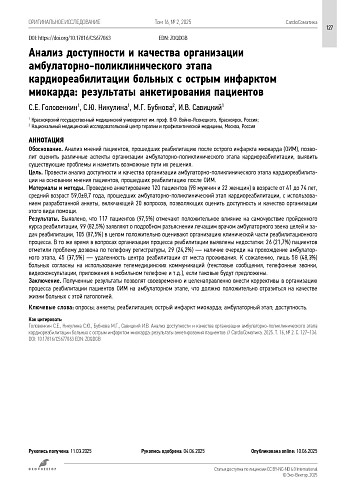
Обоснование. Анализ мнений пациентов, прошедших реабилитацию после острого инфаркта миокарда (ОИМ), позволит оценить различные аспекты организации амбулаторно-поликлинического этапа кардиореабилитации, выявить существующие проблемы и наметить возможные пути их решения.
Цель. Провести анализ доступности и качества организации амбулаторно-поликлинического этапа кардиореабилитации на основании мнения пациентов, прошедших реабилитацию после ОИМ.
Материалы и методы. Проведено анкетирование 120 пациентов (98 мужчин и 22 женщин) в возрасте от 41 до 74 лет, средний возраст 59,0±8,7 года, прошедших амбулаторно-поликлинический этап кардиореабилитации, с использованием разработанной анкеты, включающей 20 вопросов, позволяющих оценить доступность и качество организации этого вида помощи.
Результаты. Выявлено, что 117 пациентов (97,5%) отмечают положительное влияние на самочувствие пройденного курса реабилитации, 99 (82,5%) заявляют о подробном разъяснении лечащим врачом амбулаторного звена целей и задач реабилитации, 105 (87,5%) в целом положительно оценивают организацию клинической части реабилитационного процесса. В то же время в вопросах организации процесса реабилитации выявлены недостатки: 26 (21,7%) пациентов отметили проблему дозвона по телефону регистратуры, 29 (24,2%) — наличие очереди на прохождение амбулаторного этапа, 45 (37,5%) — удаленность центра реабилитации от места проживания. К сожалению, лишь 58 (48,3%) больных согласны на использование телемедицинских коммуникаций (текстовые сообщения, телефонные звонки, видеоконсультации, приложения в мобильном телефоне и т.д.), если таковые будут предложены.
Заключение. Полученные результаты позволят своевременно и целенаправленно внести коррективы в организацию процесса реабилитации пациентов ОИМ на амбулаторном этапе, что должно положительно отразиться на качестве жизни больных с этой патологией.
Ключевые слова: опросы, анкеты, реабилитация, острый инфаркт миокарда, амбулаторный этап, доступность
AIM: The work aimed to assess the accessibility and quality of the outpatient stage of cardiac rehabilitation based on the opinions of patients who completed rehabilitation after AMI.
METHODS: A survey was conducted among 120 patients (98 men and 22 women) aged 41 to 74 years (mean age, 59.0 ± 8.7 years) who had undergone outpatient cardiac rehabilitation. A custom-designed 20-item questionnaire was used to evaluate the accessibility and quality of care.
RESULTS: A total of 117 patients (97.5%) reported a positive effect of the rehabilitation program on their well-being. Ninety‑nine patients (82.5%) indicated that the goals and objectives of rehabilitation had been clearly explained by their outpatient physician. Overall, 105 patients (87.5%) evaluated the clinical component of rehabilitation positively. However, certain organizational shortcomings were identified: 26 patients (21.7%) reported difficulty reaching the clinic by phone; 29 (24.2%) mentioned waiting lists; and 45 (37.5%) noted long distances to the rehabilitation center. Unfortunately, only 58 patients (48.3%) expressed willingness to use telemedicine options (text messaging, phone calls, video consultations, mobile apps, etc.) if such services were available.
CONCLUSION: The findings may support timely and targeted adjustments to the organization of outpatient rehabilitation for patients with AMI, potentially improving their quality of life.
Keywords: surveys, questionnaires, rehabilitation, myocardial infarction, ambulatory care, health services accessibility
Цель. Провести анализ доступности и качества организации амбулаторно-поликлинического этапа кардиореабилитации на основании мнения пациентов, прошедших реабилитацию после ОИМ.
Материалы и методы. Проведено анкетирование 120 пациентов (98 мужчин и 22 женщин) в возрасте от 41 до 74 лет, средний возраст 59,0±8,7 года, прошедших амбулаторно-поликлинический этап кардиореабилитации, с использованием разработанной анкеты, включающей 20 вопросов, позволяющих оценить доступность и качество организации этого вида помощи.
Результаты. Выявлено, что 117 пациентов (97,5%) отмечают положительное влияние на самочувствие пройденного курса реабилитации, 99 (82,5%) заявляют о подробном разъяснении лечащим врачом амбулаторного звена целей и задач реабилитации, 105 (87,5%) в целом положительно оценивают организацию клинической части реабилитационного процесса. В то же время в вопросах организации процесса реабилитации выявлены недостатки: 26 (21,7%) пациентов отметили проблему дозвона по телефону регистратуры, 29 (24,2%) — наличие очереди на прохождение амбулаторного этапа, 45 (37,5%) — удаленность центра реабилитации от места проживания. К сожалению, лишь 58 (48,3%) больных согласны на использование телемедицинских коммуникаций (текстовые сообщения, телефонные звонки, видеоконсультации, приложения в мобильном телефоне и т.д.), если таковые будут предложены.
Заключение. Полученные результаты позволят своевременно и целенаправленно внести коррективы в организацию процесса реабилитации пациентов ОИМ на амбулаторном этапе, что должно положительно отразиться на качестве жизни больных с этой патологией.
Ключевые слова: опросы, анкеты, реабилитация, острый инфаркт миокарда, амбулаторный этап, доступность
________________________________________________
AIM: The work aimed to assess the accessibility and quality of the outpatient stage of cardiac rehabilitation based on the opinions of patients who completed rehabilitation after AMI.
METHODS: A survey was conducted among 120 patients (98 men and 22 women) aged 41 to 74 years (mean age, 59.0 ± 8.7 years) who had undergone outpatient cardiac rehabilitation. A custom-designed 20-item questionnaire was used to evaluate the accessibility and quality of care.
RESULTS: A total of 117 patients (97.5%) reported a positive effect of the rehabilitation program on their well-being. Ninety‑nine patients (82.5%) indicated that the goals and objectives of rehabilitation had been clearly explained by their outpatient physician. Overall, 105 patients (87.5%) evaluated the clinical component of rehabilitation positively. However, certain organizational shortcomings were identified: 26 patients (21.7%) reported difficulty reaching the clinic by phone; 29 (24.2%) mentioned waiting lists; and 45 (37.5%) noted long distances to the rehabilitation center. Unfortunately, only 58 patients (48.3%) expressed willingness to use telemedicine options (text messaging, phone calls, video consultations, mobile apps, etc.) if such services were available.
CONCLUSION: The findings may support timely and targeted adjustments to the organization of outpatient rehabilitation for patients with AMI, potentially improving their quality of life.
Keywords: surveys, questionnaires, rehabilitation, myocardial infarction, ambulatory care, health services accessibility
Полный текст
Список литературы
1. Ambrosetti M, Abreu A, Corra U, et al. Secondary prevention through comprehensive cardiovascular rehabilitation: From knowledge to implementation. 2020 update. A position paper from the Secondary Prevention and Rehabilitation Section of the European Association of Prev Cardiology. Eur J Prev Cardiol. 2021;28(5):460–495. doi: 10.1177/2047487320913379
2. Iliou MC. How can we increase the participation of patients in cardiac rehabilitation programmes? Eur J Prev Cardiol. 2018;25(18):1923–1924. doi: 10.1177/2047487318806698 EDN: ENNSAV
3. Acute myocardial infarction with ST segment elevation electrocardiograms: rehabilitation and secondary prevention. Russian clinical guidelines. CardioSomatica. 2014;S1:5–41. doi: 10.15829/1560-4071-2015-1-6-52
4. O'Gara PT, Kushner FG, Ascheim DD, et al. American College of Cardiology Foundation / American Heart Association Task Force on Practice Guidelines. 2013 ACCF/AHA guideline for the management of ST-elevation myocardial infarction: a report of the American College of Cardiology Foundation/American Heart Association Task Force on Practice Guidelines. Circulation. 2013;127(4):e362–425. doi: 10.1161/CIR.0b013e3182742cf6
5. Aronov DM. Cardiorehabilitation and secondary prevention. Moscow: GEOTAR‑media, 2021. P. 464. (In Russ.) doi: 10.33029/9704-6218-8-CAR-2021-1-464
6. Bubnova MG. Relevant problems of participation and education of patients in cardiac rehabilitation and secondary prevention programs. Cardiovasc Ther Prev. 2020;19(6):2649. doi: 10.15829/1728-8800-2020-2649 EDN: GRLOQC
7. Doimo S, Fabris E, Piepoli M, et al. Impact of ambulatory cardiac rehabilitation on cardiovascular outcomes: a long-term follow-up study. Eur Heart J. 2019;40(8):678–685. doi: 10.1093/eurheartj/ehy417 EDN: NXYVOK
8. Kusunoki S, Maruji A, Kobayashi K, et al. Subjective barriers to adherence to cardiac rehabilitation program after hospital discharge in patients with acute myocardial infarction [in Japanese]. J Jpn Coron Assoc. 2008;14:206–210.
9. Grace S, Chessex C, Arthur H, et al. Systematizing inpatient referral to cardiac rehabilitation 2010: Canadian Association of Cardiac Rehabilitation and Canadian Cardiovascular Society joint position paper. J Cardiopulm Rehabil. 2011;31:E1–E8. doi: 10.1097/HCR.0b013e318219721f
10. Higgins RO, Murphy BM, Goble AJ, et al. Cardiac rehabilitation program attendance after coronary artery bypass surgery: overcoming the barriers. Med J Aust. 2008;188:712–714. doi: 10.5694/j.1326-5377.2008.tb01852.x
11. Mueller E, Savage PD, Schneider DJ, et al. Effect of a computerized referral at hospital discharge on cardiac rehabilitation participation rates. J Cardiopulm Rehabil Prev. 2009;29:365–369. doi: 10.1097/HCR.0b013e3181b4ca75
12. Turk-Adawi KI, Oldridge NB, Tarima SS, et al. Cardiac Rehabilitation Enrollment Among Referred Patients. Ratient and organizational factors. J Cardiopulm Rehabilit Prev. 2014;34:114–122. doi: 10.1097/HCR.0000000000000017
13. Bubnova MG, Novikova NK, Aronov DM. Clinical 16-year Follow-up of patients after acute myocardial infarction: the phenomenon of high commitment to physical rehabilitation. Vestnik vosstanovitelnoi meditsiny. 2016;(4):12–19. EDN: WMQNDN
14. Barbarash Ol, Bezzubova VA, Shibanova IA, Pomeshkina SA. Patients opinion about the necessity of cardiological rehabilitation after coronary shunting. Sibirskoe meditsinskoe obozrenie. 2018;(1):79–82. doi: 10.20333/2500136-2018-1-79-82 EDN: YXPIJQ
15. Pomeshkina SA, Borovik IV, Zavyrylina IN, et al. Adherence to Therapy as a Factor Determining Prognosis of Coronary Artery Bypass Grafting. Kardiologiia. 2015;(5):48–53. DOI:10.18565/cardio.2015.5.48-53.
16. Bubnova MG, Aronov DM, Krasnitsky VB, et al. A home exercise training program after acute coronary syndrome and/or endovascular coronary intervention: efficiency and a patient motivation problem. Terapevticheskiy arkhiv. 2014;86(1):23–32. EDN: RTZPKD
17. Bubnova MG, Aronov DM, Novikova NK, et al. Study of awarenessof risk factors and attitudes towards health in patients with coronary heart disease. New rehabilitation counseling technology: the first experience. Preventive Medicine. 2019;22(4):114–123. doi: 10.17116/profmed2019119081114
18. Arnett DK, Blumenthal RS, Albert MA, et al. ACC/AHA guideline on the primary prevention of cardiovascular disease: a report of the American College of Cardiology/American Heart Association Task Force on Clinical Practice Guidelines. J Am Coll Cardiol. 2019;74(10):e177–e232. doi: 10.1016/j.jacc.2019.03.010
19. Martsevich SYu, Zolotareva NP, Zagrebelnyy AV, et al. Refusal of prescribed drug therapy (absolute non-adherence) after acute myocardial infarction/unstable angina: data from prospective observation in the LIS‑3 registry. Rational Pharmacotherapy in Cardiology. 2023;19(6):572–578. DOI:10.20996/1819-6446-2023-2988. EDN: QVNHXA
20. Aronov DM, Bubnova MG, Drapkina OM. Non-pharmacological therapy of patients with cardiovascular diseases in cardiac rehabilitation programs. Russian Journal of Preventive Medicine. 2020;23(6–2):57–64. doi: 10.17116/profmed20202306257
21. Newcombe RG. Two-sided confidence intervals for the single proportion: Comparison of seven methods. Statistics in Medicine. 1998;17(8):857–872. doi: 10.1002/(sici)1097-0258(19980430)17:8<857::aid-sim777>3.0.co;2-e
22. Hanley JA, Lippman-Hand А. If nothing goes wrong, is everything alright? JAMA. 1983;249(13):1743–1745. doi: 10.1001/jama.1983.03330370053031
23. Bubnova MG, Aronov DM, Novikova NK, et al. Study of awareness of risk factors and attitudes towards health in patients with coronary heart disease. New rehabilitation counseling technology: the first experience. Rus J Prev Med. 2019;22(4):114–123. doi: 10.17116/profmed201922041114
24. Zubko AV, Sabgayda TP, Zemlyanova EV, et al. Social portrait of patients of the cardio-rehabilitation unit of a large cardio-surgical center. Health care of the Russian Federation. 2020;64(3):124–131. doi: 10.46563/0044-197X-2020-64-3-124-131
25. Novikova IA, Khlynova OV, Nekrutenko LA. Risk factors profile for myocardial infarction: focus at a young age. Health Risk Analysis. 2021;3(160–166). doi: 10.21668/health.risk/2021.3.16.eng
26. Guryanova EA, Shamitova EN. Efficiency of cardiorehabilitation of patients with acute myocardial infarction after interventions. Modern problems of science and education. 2020;(4):135. doi: 10.17513/spno.30057 EDN: XVSUPO
27. Anderson L, Oldridge N, Thompson DR, et al. Exercise based cardiac rehabilitation for coronary heart disease. Cochrane Database Syst Rev. 2016;1:CD001800. doi: 10.1002/14651858.CD001800.pub3
28. Ades PA, Keteyian SJ, Wright JS, et al. Increasing cardiac rehabilitation participation from 20% to 70%: A road map from the Million Hearts Cardiac Rehabilitation Collaborative. Mayo Clin Proc. 2017;92(2):234–242. doi: 10.1016./j.mayocp.2016.10.014
29. Pack QR, Mansour M, Barboza JS, et al. An early appointment to outpatient cardiac rehabilitation at hospital discharge improves attendance at orientation: a randomized, single-blind, controlled trial. Circulation. 2013;127(3):349–355. doi: 10.1161/CIRCULATIOM AHA.112.121996
30. Soroush A, Heydarpour B, Komasi S, et al. Barriers for the referral to outpatient cardiac rehabilitation: A predictive model including actual and perceived risk factors and perceived control. Ann Card Anaesth. 2018;21(3):249–254. doi: 10.4103/aca.ACA_87_17
31. De Vos C, Li X, Vlaenderen I, et al. Participating or not in a cardiac rehabilitation programme: factors influencing a patient’s decision. Eur J Prev Cardiol. 2013;20(2):341–348. doi: 10.1177/2047487312437057
32. Endo N, Goto A, Suzuki T, et al. Factors Associated With Enrollment and Adherence in Outpatient Cardiac Rehabilitation in Japan. J Cardiopulm Rehabil Prev. 2015;35:186–192. doi: 10.1097/HCR.0000000000000103
33. Beatty AL, Fukuoka Y, Whooley MA. Using mobile technology for cardiac rehabilitation: a review and framework for development and evaluation. J Am Heart Assoc. 2013;2(6):e000568. doi: 10.1161/JAHA.113.000568
34. Lyamina NP, Kharytonov SV. Digital wearable devices in cardiac rehabilitation: patient need and satisfaction. Literature Review. Cardiosomatics. 2022;13(1):23–30. EDN: UOYKGE doi: 10.17816/22217185.2022.1.201471
35. Lyamina NP, Somov DA, Sorokina EV, Peresada AK. Effekty programmy domashnikh trenirovok u patsientov, perenesshikh ostryi infarkt miokarda i endovaskulyarnoe vmeshatelstvo. Voprosy kurortologii, fizioterapii i lechebnoi fizicheskoi kultury. 2023;100:(5-2):23. EDN: TQERSV
36. Larina VN, Lunev VI, Fedorova EV, et al. Treatment adherence priorities: Results of an online survey of doctors providing outpatient services. CardioSomatics. 2024;15(3):201–210. doi: 10.17816/CS626967
37. Bustamante MJ, Valentino G, Kramer V, et al. Patient Adherence to a Cardiovascular Rehabilitation Program: What Factors Are Involved? Int J Clin Med. 2015;6:605–614. doi: 10.4236/ijcm.2015.69081
38. Balady GJ, Ades PA, Bittner VA, et al. Referral, Enrollment, and Delivery of Cardiac Rehabilitation/Secondary Prevention Programs at Clinical Centers and Beyond: A Presidential Advisory from the American Heart Association. Circulation. 2011;124(25):2951–2960. doi: 10.1161/CIR.0b013e31823b21e2
2. Iliou MC. How can we increase the participation of patients in cardiac rehabilitation programmes? Eur J Prev Cardiol. 2018;25(18):1923–1924. doi: 10.1177/2047487318806698 EDN: ENNSAV
3. Acute myocardial infarction with ST segment elevation electrocardiograms: rehabilitation and secondary prevention. Russian clinical guidelines. CardioSomatica. 2014;S1:5–41. doi: 10.15829/1560-4071-2015-1-6-52
4. O'Gara PT, Kushner FG, Ascheim DD, et al. American College of Cardiology Foundation / American Heart Association Task Force on Practice Guidelines. 2013 ACCF/AHA guideline for the management of ST-elevation myocardial infarction: a report of the American College of Cardiology Foundation/American Heart Association Task Force on Practice Guidelines. Circulation. 2013;127(4):e362–425. doi: 10.1161/CIR.0b013e3182742cf6
5. Aronov DM. Cardiorehabilitation and secondary prevention. Moscow: GEOTAR‑media, 2021. P. 464. (In Russ.) doi: 10.33029/9704-6218-8-CAR-2021-1-464
6. Bubnova MG. Relevant problems of participation and education of patients in cardiac rehabilitation and secondary prevention programs. Cardiovasc Ther Prev. 2020;19(6):2649. doi: 10.15829/1728-8800-2020-2649 EDN: GRLOQC
7. Doimo S, Fabris E, Piepoli M, et al. Impact of ambulatory cardiac rehabilitation on cardiovascular outcomes: a long-term follow-up study. Eur Heart J. 2019;40(8):678–685. doi: 10.1093/eurheartj/ehy417 EDN: NXYVOK
8. Kusunoki S, Maruji A, Kobayashi K, et al. Subjective barriers to adherence to cardiac rehabilitation program after hospital discharge in patients with acute myocardial infarction [in Japanese]. J Jpn Coron Assoc. 2008;14:206–210.
9. Grace S, Chessex C, Arthur H, et al. Systematizing inpatient referral to cardiac rehabilitation 2010: Canadian Association of Cardiac Rehabilitation and Canadian Cardiovascular Society joint position paper. J Cardiopulm Rehabil. 2011;31:E1–E8. doi: 10.1097/HCR.0b013e318219721f
10. Higgins RO, Murphy BM, Goble AJ, et al. Cardiac rehabilitation program attendance after coronary artery bypass surgery: overcoming the barriers. Med J Aust. 2008;188:712–714. doi: 10.5694/j.1326-5377.2008.tb01852.x
11. Mueller E, Savage PD, Schneider DJ, et al. Effect of a computerized referral at hospital discharge on cardiac rehabilitation participation rates. J Cardiopulm Rehabil Prev. 2009;29:365–369. doi: 10.1097/HCR.0b013e3181b4ca75
12. Turk-Adawi KI, Oldridge NB, Tarima SS, et al. Cardiac Rehabilitation Enrollment Among Referred Patients. Ratient and organizational factors. J Cardiopulm Rehabilit Prev. 2014;34:114–122. doi: 10.1097/HCR.0000000000000017
13. Bubnova MG, Novikova NK, Aronov DM. Clinical 16-year Follow-up of patients after acute myocardial infarction: the phenomenon of high commitment to physical rehabilitation. Vestnik vosstanovitelnoi meditsiny. 2016;(4):12–19. EDN: WMQNDN
14. Barbarash Ol, Bezzubova VA, Shibanova IA, Pomeshkina SA. Patients opinion about the necessity of cardiological rehabilitation after coronary shunting. Sibirskoe meditsinskoe obozrenie. 2018;(1):79–82. doi: 10.20333/2500136-2018-1-79-82 EDN: YXPIJQ
15. Pomeshkina SA, Borovik IV, Zavyrylina IN, et al. Adherence to Therapy as a Factor Determining Prognosis of Coronary Artery Bypass Grafting. Kardiologiia. 2015;(5):48–53. DOI:10.18565/cardio.2015.5.48-53.
16. Bubnova MG, Aronov DM, Krasnitsky VB, et al. A home exercise training program after acute coronary syndrome and/or endovascular coronary intervention: efficiency and a patient motivation problem. Terapevticheskiy arkhiv. 2014;86(1):23–32. EDN: RTZPKD
17. Bubnova MG, Aronov DM, Novikova NK, et al. Study of awarenessof risk factors and attitudes towards health in patients with coronary heart disease. New rehabilitation counseling technology: the first experience. Preventive Medicine. 2019;22(4):114–123. doi: 10.17116/profmed2019119081114
18. Arnett DK, Blumenthal RS, Albert MA, et al. ACC/AHA guideline on the primary prevention of cardiovascular disease: a report of the American College of Cardiology/American Heart Association Task Force on Clinical Practice Guidelines. J Am Coll Cardiol. 2019;74(10):e177–e232. doi: 10.1016/j.jacc.2019.03.010
19. Martsevich SYu, Zolotareva NP, Zagrebelnyy AV, et al. Refusal of prescribed drug therapy (absolute non-adherence) after acute myocardial infarction/unstable angina: data from prospective observation in the LIS‑3 registry. Rational Pharmacotherapy in Cardiology. 2023;19(6):572–578. DOI:10.20996/1819-6446-2023-2988. EDN: QVNHXA
20. Aronov DM, Bubnova MG, Drapkina OM. Non-pharmacological therapy of patients with cardiovascular diseases in cardiac rehabilitation programs. Russian Journal of Preventive Medicine. 2020;23(6–2):57–64. doi: 10.17116/profmed20202306257
21. Newcombe RG. Two-sided confidence intervals for the single proportion: Comparison of seven methods. Statistics in Medicine. 1998;17(8):857–872. doi: 10.1002/(sici)1097-0258(19980430)17:8<857::aid-sim777>3.0.co;2-e
22. Hanley JA, Lippman-Hand А. If nothing goes wrong, is everything alright? JAMA. 1983;249(13):1743–1745. doi: 10.1001/jama.1983.03330370053031
23. Bubnova MG, Aronov DM, Novikova NK, et al. Study of awareness of risk factors and attitudes towards health in patients with coronary heart disease. New rehabilitation counseling technology: the first experience. Rus J Prev Med. 2019;22(4):114–123. doi: 10.17116/profmed201922041114
24. Zubko AV, Sabgayda TP, Zemlyanova EV, et al. Social portrait of patients of the cardio-rehabilitation unit of a large cardio-surgical center. Health care of the Russian Federation. 2020;64(3):124–131. doi: 10.46563/0044-197X-2020-64-3-124-131
25. Novikova IA, Khlynova OV, Nekrutenko LA. Risk factors profile for myocardial infarction: focus at a young age. Health Risk Analysis. 2021;3(160–166). doi: 10.21668/health.risk/2021.3.16.eng
26. Guryanova EA, Shamitova EN. Efficiency of cardiorehabilitation of patients with acute myocardial infarction after interventions. Modern problems of science and education. 2020;(4):135. doi: 10.17513/spno.30057 EDN: XVSUPO
27. Anderson L, Oldridge N, Thompson DR, et al. Exercise based cardiac rehabilitation for coronary heart disease. Cochrane Database Syst Rev. 2016;1:CD001800. doi: 10.1002/14651858.CD001800.pub3
28. Ades PA, Keteyian SJ, Wright JS, et al. Increasing cardiac rehabilitation participation from 20% to 70%: A road map from the Million Hearts Cardiac Rehabilitation Collaborative. Mayo Clin Proc. 2017;92(2):234–242. doi: 10.1016./j.mayocp.2016.10.014
29. Pack QR, Mansour M, Barboza JS, et al. An early appointment to outpatient cardiac rehabilitation at hospital discharge improves attendance at orientation: a randomized, single-blind, controlled trial. Circulation. 2013;127(3):349–355. doi: 10.1161/CIRCULATIOM AHA.112.121996
30. Soroush A, Heydarpour B, Komasi S, et al. Barriers for the referral to outpatient cardiac rehabilitation: A predictive model including actual and perceived risk factors and perceived control. Ann Card Anaesth. 2018;21(3):249–254. doi: 10.4103/aca.ACA_87_17
31. De Vos C, Li X, Vlaenderen I, et al. Participating or not in a cardiac rehabilitation programme: factors influencing a patient’s decision. Eur J Prev Cardiol. 2013;20(2):341–348. doi: 10.1177/2047487312437057
32. Endo N, Goto A, Suzuki T, et al. Factors Associated With Enrollment and Adherence in Outpatient Cardiac Rehabilitation in Japan. J Cardiopulm Rehabil Prev. 2015;35:186–192. doi: 10.1097/HCR.0000000000000103
33. Beatty AL, Fukuoka Y, Whooley MA. Using mobile technology for cardiac rehabilitation: a review and framework for development and evaluation. J Am Heart Assoc. 2013;2(6):e000568. doi: 10.1161/JAHA.113.000568
34. Lyamina NP, Kharytonov SV. Digital wearable devices in cardiac rehabilitation: patient need and satisfaction. Literature Review. Cardiosomatics. 2022;13(1):23–30. EDN: UOYKGE doi: 10.17816/22217185.2022.1.201471
35. Lyamina NP, Somov DA, Sorokina EV, Peresada AK. Effekty programmy domashnikh trenirovok u patsientov, perenesshikh ostryi infarkt miokarda i endovaskulyarnoe vmeshatelstvo. Voprosy kurortologii, fizioterapii i lechebnoi fizicheskoi kultury. 2023;100:(5-2):23. EDN: TQERSV
36. Larina VN, Lunev VI, Fedorova EV, et al. Treatment adherence priorities: Results of an online survey of doctors providing outpatient services. CardioSomatics. 2024;15(3):201–210. doi: 10.17816/CS626967
37. Bustamante MJ, Valentino G, Kramer V, et al. Patient Adherence to a Cardiovascular Rehabilitation Program: What Factors Are Involved? Int J Clin Med. 2015;6:605–614. doi: 10.4236/ijcm.2015.69081
38. Balady GJ, Ades PA, Bittner VA, et al. Referral, Enrollment, and Delivery of Cardiac Rehabilitation/Secondary Prevention Programs at Clinical Centers and Beyond: A Presidential Advisory from the American Heart Association. Circulation. 2011;124(25):2951–2960. doi: 10.1161/CIR.0b013e31823b21e2
2. Iliou MC. How can we increase the participation of patients in cardiac rehabilitation programmes? Eur J Prev Cardiol. 2018;25(18):1923–1924. doi: 10.1177/2047487318806698 EDN: ENNSAV
3. Acute myocardial infarction with ST segment elevation electrocardiograms: rehabilitation and secondary prevention. Russian clinical guidelines. CardioSomatica. 2014;S1:5–41. doi: 10.15829/1560-4071-2015-1-6-52
4. O'Gara PT, Kushner FG, Ascheim DD, et al. American College of Cardiology Foundation / American Heart Association Task Force on Practice Guidelines. 2013 ACCF/AHA guideline for the management of ST-elevation myocardial infarction: a report of the American College of Cardiology Foundation/American Heart Association Task Force on Practice Guidelines. Circulation. 2013;127(4):e362–425. doi: 10.1161/CIR.0b013e3182742cf6
5. Aronov DM. Cardiorehabilitation and secondary prevention. Moscow: GEOTAR‑media, 2021. P. 464. (In Russ.) doi: 10.33029/9704-6218-8-CAR-2021-1-464
6. Bubnova MG. Relevant problems of participation and education of patients in cardiac rehabilitation and secondary prevention programs. Cardiovasc Ther Prev. 2020;19(6):2649. doi: 10.15829/1728-8800-2020-2649 EDN: GRLOQC
7. Doimo S, Fabris E, Piepoli M, et al. Impact of ambulatory cardiac rehabilitation on cardiovascular outcomes: a long-term follow-up study. Eur Heart J. 2019;40(8):678–685. doi: 10.1093/eurheartj/ehy417 EDN: NXYVOK
8. Kusunoki S, Maruji A, Kobayashi K, et al. Subjective barriers to adherence to cardiac rehabilitation program after hospital discharge in patients with acute myocardial infarction [in Japanese]. J Jpn Coron Assoc. 2008;14:206–210.
9. Grace S, Chessex C, Arthur H, et al. Systematizing inpatient referral to cardiac rehabilitation 2010: Canadian Association of Cardiac Rehabilitation and Canadian Cardiovascular Society joint position paper. J Cardiopulm Rehabil. 2011;31:E1–E8. doi: 10.1097/HCR.0b013e318219721f
10. Higgins RO, Murphy BM, Goble AJ, et al. Cardiac rehabilitation program attendance after coronary artery bypass surgery: overcoming the barriers. Med J Aust. 2008;188:712–714. doi: 10.5694/j.1326-5377.2008.tb01852.x
11. Mueller E, Savage PD, Schneider DJ, et al. Effect of a computerized referral at hospital discharge on cardiac rehabilitation participation rates. J Cardiopulm Rehabil Prev. 2009;29:365–369. doi: 10.1097/HCR.0b013e3181b4ca75
12. Turk-Adawi KI, Oldridge NB, Tarima SS, et al. Cardiac Rehabilitation Enrollment Among Referred Patients. Ratient and organizational factors. J Cardiopulm Rehabilit Prev. 2014;34:114–122. doi: 10.1097/HCR.0000000000000017
13. Bubnova MG, Novikova NK, Aronov DM. Clinical 16-year Follow-up of patients after acute myocardial infarction: the phenomenon of high commitment to physical rehabilitation. Vestnik vosstanovitelnoi meditsiny. 2016;(4):12–19. EDN: WMQNDN
14. Barbarash Ol, Bezzubova VA, Shibanova IA, Pomeshkina SA. Patients opinion about the necessity of cardiological rehabilitation after coronary shunting. Sibirskoe meditsinskoe obozrenie. 2018;(1):79–82. doi: 10.20333/2500136-2018-1-79-82 EDN: YXPIJQ
15. Pomeshkina SA, Borovik IV, Zavyrylina IN, et al. Adherence to Therapy as a Factor Determining Prognosis of Coronary Artery Bypass Grafting. Kardiologiia. 2015;(5):48–53. DOI:10.18565/cardio.2015.5.48-53.
16. Bubnova MG, Aronov DM, Krasnitsky VB, et al. A home exercise training program after acute coronary syndrome and/or endovascular coronary intervention: efficiency and a patient motivation problem. Terapevticheskiy arkhiv. 2014;86(1):23–32. EDN: RTZPKD
17. Bubnova MG, Aronov DM, Novikova NK, et al. Study of awarenessof risk factors and attitudes towards health in patients with coronary heart disease. New rehabilitation counseling technology: the first experience. Preventive Medicine. 2019;22(4):114–123. doi: 10.17116/profmed2019119081114
18. Arnett DK, Blumenthal RS, Albert MA, et al. ACC/AHA guideline on the primary prevention of cardiovascular disease: a report of the American College of Cardiology/American Heart Association Task Force on Clinical Practice Guidelines. J Am Coll Cardiol. 2019;74(10):e177–e232. doi: 10.1016/j.jacc.2019.03.010
19. Martsevich SYu, Zolotareva NP, Zagrebelnyy AV, et al. Refusal of prescribed drug therapy (absolute non-adherence) after acute myocardial infarction/unstable angina: data from prospective observation in the LIS‑3 registry. Rational Pharmacotherapy in Cardiology. 2023;19(6):572–578. DOI:10.20996/1819-6446-2023-2988. EDN: QVNHXA
20. Aronov DM, Bubnova MG, Drapkina OM. Non-pharmacological therapy of patients with cardiovascular diseases in cardiac rehabilitation programs. Russian Journal of Preventive Medicine. 2020;23(6–2):57–64. doi: 10.17116/profmed20202306257
21. Newcombe RG. Two-sided confidence intervals for the single proportion: Comparison of seven methods. Statistics in Medicine. 1998;17(8):857–872. doi: 10.1002/(sici)1097-0258(19980430)17:8<857::aid-sim777>3.0.co;2-e
22. Hanley JA, Lippman-Hand А. If nothing goes wrong, is everything alright? JAMA. 1983;249(13):1743–1745. doi: 10.1001/jama.1983.03330370053031
23. Bubnova MG, Aronov DM, Novikova NK, et al. Study of awareness of risk factors and attitudes towards health in patients with coronary heart disease. New rehabilitation counseling technology: the first experience. Rus J Prev Med. 2019;22(4):114–123. doi: 10.17116/profmed201922041114
24. Zubko AV, Sabgayda TP, Zemlyanova EV, et al. Social portrait of patients of the cardio-rehabilitation unit of a large cardio-surgical center. Health care of the Russian Federation. 2020;64(3):124–131. doi: 10.46563/0044-197X-2020-64-3-124-131
25. Novikova IA, Khlynova OV, Nekrutenko LA. Risk factors profile for myocardial infarction: focus at a young age. Health Risk Analysis. 2021;3(160–166). doi: 10.21668/health.risk/2021.3.16.eng
26. Guryanova EA, Shamitova EN. Efficiency of cardiorehabilitation of patients with acute myocardial infarction after interventions. Modern problems of science and education. 2020;(4):135. doi: 10.17513/spno.30057 EDN: XVSUPO
27. Anderson L, Oldridge N, Thompson DR, et al. Exercise based cardiac rehabilitation for coronary heart disease. Cochrane Database Syst Rev. 2016;1:CD001800. doi: 10.1002/14651858.CD001800.pub3
28. Ades PA, Keteyian SJ, Wright JS, et al. Increasing cardiac rehabilitation participation from 20% to 70%: A road map from the Million Hearts Cardiac Rehabilitation Collaborative. Mayo Clin Proc. 2017;92(2):234–242. doi: 10.1016./j.mayocp.2016.10.014
29. Pack QR, Mansour M, Barboza JS, et al. An early appointment to outpatient cardiac rehabilitation at hospital discharge improves attendance at orientation: a randomized, single-blind, controlled trial. Circulation. 2013;127(3):349–355. doi: 10.1161/CIRCULATIOM AHA.112.121996
30. Soroush A, Heydarpour B, Komasi S, et al. Barriers for the referral to outpatient cardiac rehabilitation: A predictive model including actual and perceived risk factors and perceived control. Ann Card Anaesth. 2018;21(3):249–254. doi: 10.4103/aca.ACA_87_17
31. De Vos C, Li X, Vlaenderen I, et al. Participating or not in a cardiac rehabilitation programme: factors influencing a patient’s decision. Eur J Prev Cardiol. 2013;20(2):341–348. doi: 10.1177/2047487312437057
32. Endo N, Goto A, Suzuki T, et al. Factors Associated With Enrollment and Adherence in Outpatient Cardiac Rehabilitation in Japan. J Cardiopulm Rehabil Prev. 2015;35:186–192. doi: 10.1097/HCR.0000000000000103
33. Beatty AL, Fukuoka Y, Whooley MA. Using mobile technology for cardiac rehabilitation: a review and framework for development and evaluation. J Am Heart Assoc. 2013;2(6):e000568. doi: 10.1161/JAHA.113.000568
34. Lyamina NP, Kharytonov SV. Digital wearable devices in cardiac rehabilitation: patient need and satisfaction. Literature Review. Cardiosomatics. 2022;13(1):23–30. EDN: UOYKGE doi: 10.17816/22217185.2022.1.201471
35. Lyamina NP, Somov DA, Sorokina EV, Peresada AK. Effekty programmy domashnikh trenirovok u patsientov, perenesshikh ostryi infarkt miokarda i endovaskulyarnoe vmeshatelstvo. Voprosy kurortologii, fizioterapii i lechebnoi fizicheskoi kultury. 2023;100:(5-2):23. EDN: TQERSV
36. Larina VN, Lunev VI, Fedorova EV, et al. Treatment adherence priorities: Results of an online survey of doctors providing outpatient services. CardioSomatics. 2024;15(3):201–210. doi: 10.17816/CS626967
37. Bustamante MJ, Valentino G, Kramer V, et al. Patient Adherence to a Cardiovascular Rehabilitation Program: What Factors Are Involved? Int J Clin Med. 2015;6:605–614. doi: 10.4236/ijcm.2015.69081
38. Balady GJ, Ades PA, Bittner VA, et al. Referral, Enrollment, and Delivery of Cardiac Rehabilitation/Secondary Prevention Programs at Clinical Centers and Beyond: A Presidential Advisory from the American Heart Association. Circulation. 2011;124(25):2951–2960. doi: 10.1161/CIR.0b013e31823b21e2
________________________________________________
2. Iliou MC. How can we increase the participation of patients in cardiac rehabilitation programmes? Eur J Prev Cardiol. 2018;25(18):1923–1924. doi: 10.1177/2047487318806698 EDN: ENNSAV
3. Acute myocardial infarction with ST segment elevation electrocardiograms: rehabilitation and secondary prevention. Russian clinical guidelines. CardioSomatica. 2014;S1:5–41. doi: 10.15829/1560-4071-2015-1-6-52
4. O'Gara PT, Kushner FG, Ascheim DD, et al. American College of Cardiology Foundation / American Heart Association Task Force on Practice Guidelines. 2013 ACCF/AHA guideline for the management of ST-elevation myocardial infarction: a report of the American College of Cardiology Foundation/American Heart Association Task Force on Practice Guidelines. Circulation. 2013;127(4):e362–425. doi: 10.1161/CIR.0b013e3182742cf6
5. Aronov DM. Cardiorehabilitation and secondary prevention. Moscow: GEOTAR‑media, 2021. P. 464. (In Russ.) doi: 10.33029/9704-6218-8-CAR-2021-1-464
6. Bubnova MG. Relevant problems of participation and education of patients in cardiac rehabilitation and secondary prevention programs. Cardiovasc Ther Prev. 2020;19(6):2649. doi: 10.15829/1728-8800-2020-2649 EDN: GRLOQC
7. Doimo S, Fabris E, Piepoli M, et al. Impact of ambulatory cardiac rehabilitation on cardiovascular outcomes: a long-term follow-up study. Eur Heart J. 2019;40(8):678–685. doi: 10.1093/eurheartj/ehy417 EDN: NXYVOK
8. Kusunoki S, Maruji A, Kobayashi K, et al. Subjective barriers to adherence to cardiac rehabilitation program after hospital discharge in patients with acute myocardial infarction [in Japanese]. J Jpn Coron Assoc. 2008;14:206–210.
9. Grace S, Chessex C, Arthur H, et al. Systematizing inpatient referral to cardiac rehabilitation 2010: Canadian Association of Cardiac Rehabilitation and Canadian Cardiovascular Society joint position paper. J Cardiopulm Rehabil. 2011;31:E1–E8. doi: 10.1097/HCR.0b013e318219721f
10. Higgins RO, Murphy BM, Goble AJ, et al. Cardiac rehabilitation program attendance after coronary artery bypass surgery: overcoming the barriers. Med J Aust. 2008;188:712–714. doi: 10.5694/j.1326-5377.2008.tb01852.x
11. Mueller E, Savage PD, Schneider DJ, et al. Effect of a computerized referral at hospital discharge on cardiac rehabilitation participation rates. J Cardiopulm Rehabil Prev. 2009;29:365–369. doi: 10.1097/HCR.0b013e3181b4ca75
12. Turk-Adawi KI, Oldridge NB, Tarima SS, et al. Cardiac Rehabilitation Enrollment Among Referred Patients. Ratient and organizational factors. J Cardiopulm Rehabilit Prev. 2014;34:114–122. doi: 10.1097/HCR.0000000000000017
13. Bubnova MG, Novikova NK, Aronov DM. Clinical 16-year Follow-up of patients after acute myocardial infarction: the phenomenon of high commitment to physical rehabilitation. Vestnik vosstanovitelnoi meditsiny. 2016;(4):12–19. EDN: WMQNDN
14. Barbarash Ol, Bezzubova VA, Shibanova IA, Pomeshkina SA. Patients opinion about the necessity of cardiological rehabilitation after coronary shunting. Sibirskoe meditsinskoe obozrenie. 2018;(1):79–82. doi: 10.20333/2500136-2018-1-79-82 EDN: YXPIJQ
15. Pomeshkina SA, Borovik IV, Zavyrylina IN, et al. Adherence to Therapy as a Factor Determining Prognosis of Coronary Artery Bypass Grafting. Kardiologiia. 2015;(5):48–53. DOI:10.18565/cardio.2015.5.48-53.
16. Bubnova MG, Aronov DM, Krasnitsky VB, et al. A home exercise training program after acute coronary syndrome and/or endovascular coronary intervention: efficiency and a patient motivation problem. Terapevticheskiy arkhiv. 2014;86(1):23–32. EDN: RTZPKD
17. Bubnova MG, Aronov DM, Novikova NK, et al. Study of awarenessof risk factors and attitudes towards health in patients with coronary heart disease. New rehabilitation counseling technology: the first experience. Preventive Medicine. 2019;22(4):114–123. doi: 10.17116/profmed2019119081114
18. Arnett DK, Blumenthal RS, Albert MA, et al. ACC/AHA guideline on the primary prevention of cardiovascular disease: a report of the American College of Cardiology/American Heart Association Task Force on Clinical Practice Guidelines. J Am Coll Cardiol. 2019;74(10):e177–e232. doi: 10.1016/j.jacc.2019.03.010
19. Martsevich SYu, Zolotareva NP, Zagrebelnyy AV, et al. Refusal of prescribed drug therapy (absolute non-adherence) after acute myocardial infarction/unstable angina: data from prospective observation in the LIS‑3 registry. Rational Pharmacotherapy in Cardiology. 2023;19(6):572–578. DOI:10.20996/1819-6446-2023-2988. EDN: QVNHXA
20. Aronov DM, Bubnova MG, Drapkina OM. Non-pharmacological therapy of patients with cardiovascular diseases in cardiac rehabilitation programs. Russian Journal of Preventive Medicine. 2020;23(6–2):57–64. doi: 10.17116/profmed20202306257
21. Newcombe RG. Two-sided confidence intervals for the single proportion: Comparison of seven methods. Statistics in Medicine. 1998;17(8):857–872. doi: 10.1002/(sici)1097-0258(19980430)17:8<857::aid-sim777>3.0.co;2-e
22. Hanley JA, Lippman-Hand А. If nothing goes wrong, is everything alright? JAMA. 1983;249(13):1743–1745. doi: 10.1001/jama.1983.03330370053031
23. Bubnova MG, Aronov DM, Novikova NK, et al. Study of awareness of risk factors and attitudes towards health in patients with coronary heart disease. New rehabilitation counseling technology: the first experience. Rus J Prev Med. 2019;22(4):114–123. doi: 10.17116/profmed201922041114
24. Zubko AV, Sabgayda TP, Zemlyanova EV, et al. Social portrait of patients of the cardio-rehabilitation unit of a large cardio-surgical center. Health care of the Russian Federation. 2020;64(3):124–131. doi: 10.46563/0044-197X-2020-64-3-124-131
25. Novikova IA, Khlynova OV, Nekrutenko LA. Risk factors profile for myocardial infarction: focus at a young age. Health Risk Analysis. 2021;3(160–166). doi: 10.21668/health.risk/2021.3.16.eng
26. Guryanova EA, Shamitova EN. Efficiency of cardiorehabilitation of patients with acute myocardial infarction after interventions. Modern problems of science and education. 2020;(4):135. doi: 10.17513/spno.30057 EDN: XVSUPO
27. Anderson L, Oldridge N, Thompson DR, et al. Exercise based cardiac rehabilitation for coronary heart disease. Cochrane Database Syst Rev. 2016;1:CD001800. doi: 10.1002/14651858.CD001800.pub3
28. Ades PA, Keteyian SJ, Wright JS, et al. Increasing cardiac rehabilitation participation from 20% to 70%: A road map from the Million Hearts Cardiac Rehabilitation Collaborative. Mayo Clin Proc. 2017;92(2):234–242. doi: 10.1016./j.mayocp.2016.10.014
29. Pack QR, Mansour M, Barboza JS, et al. An early appointment to outpatient cardiac rehabilitation at hospital discharge improves attendance at orientation: a randomized, single-blind, controlled trial. Circulation. 2013;127(3):349–355. doi: 10.1161/CIRCULATIOM AHA.112.121996
30. Soroush A, Heydarpour B, Komasi S, et al. Barriers for the referral to outpatient cardiac rehabilitation: A predictive model including actual and perceived risk factors and perceived control. Ann Card Anaesth. 2018;21(3):249–254. doi: 10.4103/aca.ACA_87_17
31. De Vos C, Li X, Vlaenderen I, et al. Participating or not in a cardiac rehabilitation programme: factors influencing a patient’s decision. Eur J Prev Cardiol. 2013;20(2):341–348. doi: 10.1177/2047487312437057
32. Endo N, Goto A, Suzuki T, et al. Factors Associated With Enrollment and Adherence in Outpatient Cardiac Rehabilitation in Japan. J Cardiopulm Rehabil Prev. 2015;35:186–192. doi: 10.1097/HCR.0000000000000103
33. Beatty AL, Fukuoka Y, Whooley MA. Using mobile technology for cardiac rehabilitation: a review and framework for development and evaluation. J Am Heart Assoc. 2013;2(6):e000568. doi: 10.1161/JAHA.113.000568
34. Lyamina NP, Kharytonov SV. Digital wearable devices in cardiac rehabilitation: patient need and satisfaction. Literature Review. Cardiosomatics. 2022;13(1):23–30. EDN: UOYKGE doi: 10.17816/22217185.2022.1.201471
35. Lyamina NP, Somov DA, Sorokina EV, Peresada AK. Effekty programmy domashnikh trenirovok u patsientov, perenesshikh ostryi infarkt miokarda i endovaskulyarnoe vmeshatelstvo. Voprosy kurortologii, fizioterapii i lechebnoi fizicheskoi kultury. 2023;100:(5-2):23. EDN: TQERSV
36. Larina VN, Lunev VI, Fedorova EV, et al. Treatment adherence priorities: Results of an online survey of doctors providing outpatient services. CardioSomatics. 2024;15(3):201–210. doi: 10.17816/CS626967
37. Bustamante MJ, Valentino G, Kramer V, et al. Patient Adherence to a Cardiovascular Rehabilitation Program: What Factors Are Involved? Int J Clin Med. 2015;6:605–614. doi: 10.4236/ijcm.2015.69081
38. Balady GJ, Ades PA, Bittner VA, et al. Referral, Enrollment, and Delivery of Cardiac Rehabilitation/Secondary Prevention Programs at Clinical Centers and Beyond: A Presidential Advisory from the American Heart Association. Circulation. 2011;124(25):2951–2960. doi: 10.1161/CIR.0b013e31823b21e2
Авторы
С.Е. Головенкин*1, С.Ю. Никулина1, М.Г. Бубнова2, И.В. Савицкий1
1Красноярский государственный медицинский университет им. проф. В.Ф. Войно-Ясенецкого, Красноярск, Россия;
2Национальный медицинский исследовательский центр терапии и профилактической медицины, Москва, Россия
*gse2008@mail.ru
1Voino-Yasenetsky Krasnoyarsk State Medical University, Krasnoyarsk, Russia;
2National Medical Research Center for Therapy and Preventive Medicine, Moscow, Russia
*gse2008@mail.ru
1Красноярский государственный медицинский университет им. проф. В.Ф. Войно-Ясенецкого, Красноярск, Россия;
2Национальный медицинский исследовательский центр терапии и профилактической медицины, Москва, Россия
*gse2008@mail.ru
________________________________________________
1Voino-Yasenetsky Krasnoyarsk State Medical University, Krasnoyarsk, Russia;
2National Medical Research Center for Therapy and Preventive Medicine, Moscow, Russia
*gse2008@mail.ru
Цель портала OmniDoctor – предоставление профессиональной информации врачам, провизорам и фармацевтам.