

Материалы доступны только для специалистов сферы здравоохранения.
Чтобы посмотреть материал полностью
Авторизуйтесь
или зарегистрируйтесь.
Эпидемиология острого инфаркта миокарда в Российской Федерации и за рубежом в период с 2017 по 2024 гг.
Эпидемиология острого инфаркта миокарда в Российской Федерации и за рубежом в период с 2017 по 2024 гг.
Петрова М.М., Анохина А.Р., Устюгов С.А., Каскаева Д.С., Евсюков А.А., Шнайдер Н.А. Эпидемиология острого инфаркта миокарда в Российской Федерации и за рубежом в период с 2017 по 2024 гг. // CardioСоматика. 2025. Т. 16, № 3. С. 263–274. DOI: 10.17816/CS646514 EDN: GZDWKY
________________________________________________
Материалы доступны только для специалистов сферы здравоохранения.
Чтобы посмотреть материал полностью
Авторизуйтесь
или зарегистрируйтесь.
Аннотация
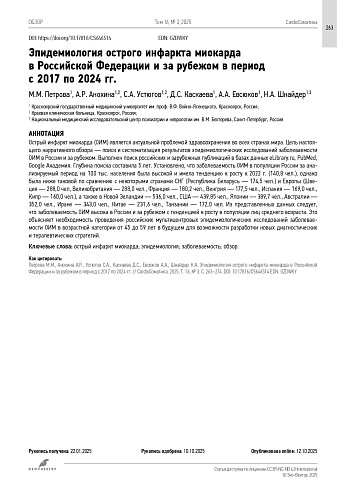
Острый инфаркт миокарда (ОИМ) является актуальной проблемой здравоохранения во всех странах мира. Цель настоящего нарративного обзора — поиск и систематизация результатов эпидемиологических исследований заболеваемости ОИМ в России и за рубежом. Выполнен поиск российских и зарубежных публикаций в базах данных eLibrary.ru, PubMed, Google Академия. Глубина поиска составила 5 лет. Установлено, что заболеваемость ОИМ в популяции России за анализируемый период на 100 тыс. населения была высокой и имела тенденцию к росту к 2022 г. (140,8 чел.), однако была ниже таковой по сравнению с некоторыми странами СНГ (Республика Беларусь — 174,5 чел.) и Европы (Швеция — 288,0 чел, Великобритания — 288,0 чел., Франция — 180,2 чел., Венгрия — 177,5 чел., Испания — 169,0 чел., Кипр — 160,0 чел.), а также в Новой Зеландии — 536,0 чел., США — 439,85 чел., Японии — 389,7 чел., Австралии — 352,0 чел., Иране — 343,0 чел., Китае — 231,6 чел., Танзании — 172,0 чел. Из представленных данных следует, что заболеваемость ОИМ высока в России и за рубежом с тенденцией к росту в популяции лиц среднего возраста. Это объясняет необходимость проведения российских мультицентровых эпидемиологических исследований заболеваемости ОИМ в возрастной категории от 45 до 59 лет в будущем для возможности разработки новых диагностических и терапевтических стратегий.
Ключевые слова: острый инфаркт миокарда, эпидемиология, заболеваемость, обзор
Keywords: acute myocardial infarction, epidemiology, incidence, review
Ключевые слова: острый инфаркт миокарда, эпидемиология, заболеваемость, обзор
________________________________________________
Keywords: acute myocardial infarction, epidemiology, incidence, review
Полный текст
Список литературы
1. Khan MA, Hashim MJ, Mustafa H, et al. Global Epidemiology of Ischemic Heart Disease: Results from the Global Burden of Disease Study. Cureus. 2020;12(7):e9349. doi: 10.7759/cureus.9349
2. Liu X, Wang L, Wang Y, et al. Myocardial infarction complexity: A multi-omics approach. Clin Chim Acta. 2024;552:117680. doi: 10.1016/j.cca.2023.117680
3. Boytsov SA, Shalnova SA, Deev AD. Mortality from cardiovascular diseases in the Russian Federation and possible mechanisms of its change. Journal of Neurology and Psychiatry S.S. Korsakov. 2018(8):98–103. doi: 10.17116/jnevro201811808198 EDN: YABJQD
4. Thygesen K, Alpert JS, Jaffe AS, et al; Executive Group on behalf of the Joint European Society of Cardiology (ESC)/American College of Cardiology (ACC)/American Heart Association (AHA)/World Heart Federation (WHF) Task Force for the Universal Definition of Myocardial Infarction. Fourth Universal Definition of Myocardial Infarction (2018). Circulation. 2018;138(20):e618-e651. doi: 10.1161/CIR.0000000000000617
5. Pereverzeva KG, Galus AS, Peregudova NN, et al. Myocardial infarction in centenarians: features of the clinical picture, management tactics, outcomes. Medical Bulletin of the North Caucasus. 2023;18(1):1–5. doi: 10.14300/mnnc.2023.1800 EDN: PSPGWM
6. Topalyan KV, Kalininskaya AA. Incidence of acute coronary syndrome in the Russian Federation and the Republic of Bashkortostan. Healthcare Manager. 2023;12:98–106. doi: 10.21045/1811-0185-2023-12-98-106 EDN: FCKKAS
7. Prokhorikhin AA, Peshkilev VD, Zubarev DD, et al. Clinical case of acute myocardial infarction against the background of complete well-being in a 16-year-old teenager. Translational Medicine. 2023;10(2):105–115. doi: 10.18705/2311-4495-202310-2-105-115 EDN: OLWDAC
8. Kinsara AJ, Aljehani R, Wolszakiewicz J, et al. The Prevention and Cardiac Rehabilitation Group of the Saudi Heart Association Recommendations Regarding Establishing a Cardiac Rehabilitation Service. J Saudi Heart Assoc. 2023;35(3):205–213. doi: 10.37616/2212-5043.1346
9. Salari N, Morddarvanjoghi F, Abdolmaleki A, et al. The global prevalence of myocardial infarction: a systematic review and meta-analysis. BMC Cardiovasc Disord. 2023;23(1):206. doi: 10.1186/s12872-023-03231-w
10. Yao H, Ekou A, Niamkey T, et al. Acute Coronary Syndromes in Sub-Saharan Africa: A 10-Year Systematic Review. J Am Heart Assoc. 2022;11(1):e021107. doi: 10.1161/JAHA.120.021107
11. Kumar R, Ammar A, Qayyum D, et al. Increasing Incidence of ST-Elevation Acute Coronary Syndrome in Young South Asian Population, a Challenge for the World? An Assessment of Clinical and Angiographic Patterns and Hospital Course of Premature Acute Myocardial Infarction. Am J Cardiol. 2023:205:190–197. doi: 10.1016/j.amjcard.2023.07.138
12. Savina AA, Feiginova SI. Dynamics of incidence of diseases of the circulatory system in the adult population of the Russian Federation in 2007–2019. Social aspects of public health. 2021;67(2):1. doi: 10.21045/2071-5021-2021-67-2-1
13. Masyuk NN, Usacheva EV, Kulikova OM. Socio-economic indicators of regions and the incidence of myocardial infarction in the population. Problems of Social Hygiene, Health Care and History of Medicine. 2020;28(4):568–575. doi: 10.32687/0869-866X-2020-28-4-568-575 EDN: HGKQWJ
14. Enina EN, Stupak VS, Ivanova MA, Vankov DV. Dynamics of primary incidence rates of acute and repeated myocardial infarction and acute cerebrovascular accidents in the adult population in the constituent entities of the Russian Federation during the COVID-19 pandemic. Modern Problems of Health Care and Medical Statistics. 2023;(4):253–272. doi: 10.24412/2312-2935-2023-4-253-272 EDN: AQQYAV
15. Gudinova ZhV, Usacheva EV, Berezhnoy KO. Incidence of myocardial infarction in the Russian Federation, the Siberian Federal District and the Omsk Region. Problems of social hygiene, health care and history of medicine. 2018;26(6):397–400. doi: 10.32687/0869-866X-2018-26-6-397-400 EDN: YVWRSX
16. Savina AA, Feiginova SI, Grigorov AA, et al. The effectiveness of programs for the prevention of myocardial infarction in terms of mortality from this cause. Problems of Social Hygiene, Health Care and History of Medicine. 2023;31(S2):1146–1152. doi: 10.32687/0869-866X-2023-31-s2-1146-1152 EDN: MFYYCJ
17. Savelyeva TA, Vorontsova AA, Popova NM. Analysis of the incidence of acute myocardial infarction in the population of the Udmurt Republic for 2018. Modern Science. 2020;11(3):305–311. EDN: WSGOYL
18. Voronov MV, Kapustina EN, Skrypnik NN. Incidence of myocardial infarction in the Lugansk People's Republic and its laboratory diagnosis. Bulletin of Lugansk State Pedagogical University. Series 4. Biology. Medicine. Chemistry. 2022;1(75):35–39. EDN: UZSDKP
19. Deev IA, Kobyakova OS, Starodubov VI, et al. Collection of statistical materials on diseases of the circulatory system in the Russian Federation in 2022 statistical materials. FSBI „TsNIIOIZ“ Ministry of Health of Russia, 2023. ISBN 978-5-94116-131-7
20. Petrov AG, Abramov NV, Makarov SA, et al. Dynamics of the incidence of myocardial infarction in the population of Kuzbass and the Russian Federation for the period 2011-2019. Medicine in Kuzbass. 2022;21(1):33–38. doi: 10.24412/2687-0053-2022-1-33-38 EDN: BOWTKJ
21. Bruno F, Moirano G, Budano C, et al. Incidence trends and long-term outcomes of myocardial infarction in young adults: Does gender matter? Int J Cardiol. 2022;357:134–139. doi: 10.1016/j.ijcard.2022.03.012
22. Azizov VA, Khatamzade EM, Nuriev AA, et al. Age and Sex Risk of Mortality Due to Myocardial Infarction in Azerbaijan. Medical News. 2020;306(3):78–80. Available from: https://cyberleninka.ru/article/n/vozrastno-polovoy-risk-smertnosti-vsledstvie-infarkta-miokarda-v-a... Accessed: 09.05.2024.
23. Jortveit J, Pripp AH, Langorgen J, Halvorsen S. Incidence, risk factors and outcome of young patients with myocardial infarction. Heart. 2020;106(18):1420–1426. doi: 10.1136/heartjnl-2019-316067
24. Gautadottir K, Gudmundsdottir IJ, Sigurdsson MI, Andersen K. Acute myocardial infarction in young adults: incidence, risk factors and prognosis]. Laeknabladid. 2022;108(10):439–445. doi: 10.17992/lbl.2022.10.709
25. Kuhn J, Olie V, Grave C, et al. Estimating the Future Burden of Myocardial Infarction in France Until 2035: An Illness-Death Model-Based Approach. Clin Epidemiol. 2022;14:255–264. doi: 10.2147/CLEP.S340031
26. Zhelyazko VV, Sokol OA. Analysis of long-term dynamics of the incidence of myocardial infarction in the population of the Republic of Belarus for 2010–2016. Belarusian State University, MGEI named after. A.D. Sakharova BSU, Minsk. Available from: https://rep.bsmu.by/bitstream/handle/BSMU/22264/p928.pdf?sequence=1&isAllowed=y Accessed: 15.06.2024.
27. Antoniades L, Christodoulides T, Georgiou P, et al. Epidemiology of acute coronary syndromes in the Mediterranean island of Cyprus (CYPACS study, Cyprus study of acute coronary syndromes). Hellenic J Cardiol. 2014;55(2):139–49.
28. Helgestad OKL, Josiassen J, Hassager C, et al. Temporal trends in incidence and patient characteristics in cardiogenic shock following acute myocardial infarction from 2010 to 2017: a Danish cohort study. Eur J Heart Fail. 2019;21(11):1370–1378. doi: 10.1002/ejhf.1566
29. Janosi A, Pach FP, Erdos G, et al. Incidence, pre-hospital delay and prognosis of acute myocardial infarction in big regions of Hungary: Population data from the Hungarian myocardial infarction registry. Int J Clin Pract. 2021;75(11):e14831. doi: 10.1111/ijcp.14831
30. Snorrason EL, Johannnesdottir BK, Aspelund T, et al. Long-term survival of patients with acute myocardial infarction in Iceland. Laeknabladid. 2018;104(11):491–497. doi: 10.17992/lbl.2018.11.203
31. Abdrakhmanova SA, Zhangazieva KKh, Tuyakova NS, et al. Risk factors for recurrent myocardial infarction in the Kazakh population. Atherosclerosis. 2023;19(3):263–264. doi: 10.52727/2078-256X-2023-19-3-263-264 EDN: PUWTOB
32. Vazquez-Oliva G, Zamora A, Ramos R, et al. Acute Myocardial Infarction Population Incidence and Mortality Rates, and 28-day Case-fatality in Older Adults. The REGICOR Study. Rev Esp Cardiol (Engl Ed). 2018;71(9):718–725. doi: 10.1016/j.rec.2017.10.019
33. Amannepesov NK, Ergeshov MB. Incidence of acute myocardial infarction and cerebral infarction as an indicator of the effectiveness of the fight against chronic non-infectious diseases in Turkmenistan. National Health Care. 2023;4(2):33–39. doi: 10.47093/2713-069X.2023.4.2.33-39 EDN: NWONFP
34. Asaria P, Elliott P, Douglass M, et al. Acute myocardial infarction hospital admissions and deaths in England: a national follow-back and follow‑forward record-linkage study. 2017;2(4):e191–e201. doi: 10.1016/S2468-2667(17)30032-4
35. Nazzal C, Lefian A, Alonso F. Incidencia de infarto agudo de miocardio en Chile, 2008-2016. Rev Med Chil. 2021;149(3):323–329. doi: 10.4067/s0034-98872021000300323
36. Odoi EW, Nagle N, Zaretzki R, et al. Sociodemographic Determinants of Acute Myocardial Infarction Hospitalization Risks in Florida. J Am Heart Assoc. 2020;9(11):e012712. doi: 10.1161/JAHA.119.012712
37. Hertz JT, Madut DB, Rubach MP, et al. Incidence of Acute Myocardial Infarction in Northern Tanzania: A Modeling Approach Within a Prospective Observational Study. J Am Heart Assoc. 2021;10(15). doi: 10.1161/JAHA.121.021004
38. Isezuo S, Sani MU, Talle A, et al; RACE-Nigeria Registry Investigators. Registry for Acute Coronary Events in Nigeria (RACE-Nigeria): Clinical Characterization, Management, and Outcome. J Am Heart Assoc. 2022;11(1):e020244. doi: 10.1161/JAHA.120.020244
39. Cilliers JCD, Joubert L, Beyers B, et al. The incidence and outcomes of high-risk acute coronary syndromes in Western Cape Province, South Africa: A prospective cohort study. S Afr Med J. 2023;113(5):25–29. doi: 10.7196/SAMJ.2023.v113i5.16764
40. Soleimani M, Bagheri N. Spatial and temporal analysis of myocardial infarction incidence in Zanjan province, Iran. BMC Public Health. 2021;1667(21). doi: 10.1186/s12889-021-11695-8.
41. Al-Shamsi S, Regmi D, Govender RD. Incidence of cardiovascular disease and its associated risk factors in at-risk men and women in the United Arab Emirates: a 9-year retrospective cohort study. BMC Cardiovasc Disord. 2019;19(1):148. doi: 10.1186/s12872-019-1131-2
42. Ho JSY, Ho AFW, Jou E, et al. Association between the extension of smoke-free legislation and incident acute myocardial infarctions in Singapore from 2010 to 2019: an interrupted time-series analysis. BMJ Glob Health. 2023;8(10): e012339. doi: 10.1136/bmjgh-2023-012339
43. Camacho X, Nedkoff L, Wright LF, et al. Relative contribution of trends in myocardial infarction event rates and case fatality to declines in mortality: an international comparative study of 1·95 million events in 80·4 million people in four countries. Lancet Public Health. 2022;7(3):e229-e239. doi: 10.1016/S2468-2667(22)00006-8
44. Chew NWS, Chong B, Kuo SM, et al. Trends and predictions of metabolic risk factors for acute myocardial infarction: findings from a multiethnic nationwide cohort. Lancet Reg Health West Pac. 2023;37:100803. doi: 10.1016/j.lanwpc.2023.100803
45. Sawayama Y, Takashima N, Harada A, et al. Incidence and In-Hospital Mortality of Acute Myocardial Infarction: A Report from a Population‑Based Registry in Japan. J Atheroscler Thromb. 2023;30(10):1407–1419. doi: 10.5551/jat.63888
46. Kim RB, Kim JR, Hwang JY. Epidemiology of myocardial infarction in Korea: hospitalization incidence, prevalence, and mortality. Epidemiol Health. 2022;44:e2022057. doi: 10.4178/epih.e2022057
47. Hoa L, Quyen T, Hoang V, et al. Characteristics, in-hospital management, and complications of acute myocardial infarction in northern and Central Vietnam. Int J Cardiol. 2022:364:133–138. doi: 10.1016/j.ijcard.2022.06.044
48. Seo Y, Moon J, Lee HH, et al. Incidence and case fatality of acute myocardial infarction in Korea, 2011-2020. Epidemiol Health. 2024;46:e2024002. doi: 10.4178/epih.e2024002
49. Chang J, Deng Q, Guo M, et al. Trends and Inequalities in the Incidence of Acute Myocardial Infarction among Beijing Townships, 2007-2018. Int J Environ Res Public Health. 2021;18(23):12276. doi: 10.3390/ijerph182312276
50. Kondrikova NV, Pomeshkina SA, Barbarash OL. Patient after coronary artery bypass surgery: focus on restoration of working capacity. Siberian Medical Review. 2017;5(107):109–114. doi: 10.20333/2500136-2017-5-109-114
51. Arora S, Stouffer GA, Kucharska-Newton AM, et al. Twenty Year Trends and Sex Differences in Young Adults Hospitalized With Acute Myocardial Infarction. Circulation. 2019;139(8):1047–1056. doi: 10.1161/CIRCULATIONAHA.118.037137
52. Shalnova SA, Drapkina OM, Kutsenko VA, et al. Myocardial infarction in the population of some regions of Russia and its prognostic significance. Russ J Cardiol. 2022;27(6):9–19. doi: 10.15829/1560-4071-2022-4952 EDN: OCPROJ
2. Liu X, Wang L, Wang Y, et al. Myocardial infarction complexity: A multi-omics approach. Clin Chim Acta. 2024;552:117680. doi: 10.1016/j.cca.2023.117680
3. Boytsov SA, Shalnova SA, Deev AD. Mortality from cardiovascular diseases in the Russian Federation and possible mechanisms of its change. Journal of Neurology and Psychiatry S.S. Korsakov. 2018(8):98–103. doi: 10.17116/jnevro201811808198 EDN: YABJQD
4. Thygesen K, Alpert JS, Jaffe AS, et al; Executive Group on behalf of the Joint European Society of Cardiology (ESC)/American College of Cardiology (ACC)/American Heart Association (AHA)/World Heart Federation (WHF) Task Force for the Universal Definition of Myocardial Infarction. Fourth Universal Definition of Myocardial Infarction (2018). Circulation. 2018;138(20):e618-e651. doi: 10.1161/CIR.0000000000000617
5. Pereverzeva KG, Galus AS, Peregudova NN, et al. Myocardial infarction in centenarians: features of the clinical picture, management tactics, outcomes. Medical Bulletin of the North Caucasus. 2023;18(1):1–5. doi: 10.14300/mnnc.2023.1800 EDN: PSPGWM
6. Topalyan KV, Kalininskaya AA. Incidence of acute coronary syndrome in the Russian Federation and the Republic of Bashkortostan. Healthcare Manager. 2023;12:98–106. doi: 10.21045/1811-0185-2023-12-98-106 EDN: FCKKAS
7. Prokhorikhin AA, Peshkilev VD, Zubarev DD, et al. Clinical case of acute myocardial infarction against the background of complete well-being in a 16-year-old teenager. Translational Medicine. 2023;10(2):105–115. doi: 10.18705/2311-4495-202310-2-105-115 EDN: OLWDAC
8. Kinsara AJ, Aljehani R, Wolszakiewicz J, et al. The Prevention and Cardiac Rehabilitation Group of the Saudi Heart Association Recommendations Regarding Establishing a Cardiac Rehabilitation Service. J Saudi Heart Assoc. 2023;35(3):205–213. doi: 10.37616/2212-5043.1346
9. Salari N, Morddarvanjoghi F, Abdolmaleki A, et al. The global prevalence of myocardial infarction: a systematic review and meta-analysis. BMC Cardiovasc Disord. 2023;23(1):206. doi: 10.1186/s12872-023-03231-w
10. Yao H, Ekou A, Niamkey T, et al. Acute Coronary Syndromes in Sub-Saharan Africa: A 10-Year Systematic Review. J Am Heart Assoc. 2022;11(1):e021107. doi: 10.1161/JAHA.120.021107
11. Kumar R, Ammar A, Qayyum D, et al. Increasing Incidence of ST-Elevation Acute Coronary Syndrome in Young South Asian Population, a Challenge for the World? An Assessment of Clinical and Angiographic Patterns and Hospital Course of Premature Acute Myocardial Infarction. Am J Cardiol. 2023:205:190–197. doi: 10.1016/j.amjcard.2023.07.138
12. Savina AA, Feiginova SI. Dynamics of incidence of diseases of the circulatory system in the adult population of the Russian Federation in 2007–2019. Social aspects of public health. 2021;67(2):1. doi: 10.21045/2071-5021-2021-67-2-1
13. Masyuk NN, Usacheva EV, Kulikova OM. Socio-economic indicators of regions and the incidence of myocardial infarction in the population. Problems of Social Hygiene, Health Care and History of Medicine. 2020;28(4):568–575. doi: 10.32687/0869-866X-2020-28-4-568-575 EDN: HGKQWJ
14. Enina EN, Stupak VS, Ivanova MA, Vankov DV. Dynamics of primary incidence rates of acute and repeated myocardial infarction and acute cerebrovascular accidents in the adult population in the constituent entities of the Russian Federation during the COVID-19 pandemic. Modern Problems of Health Care and Medical Statistics. 2023;(4):253–272. doi: 10.24412/2312-2935-2023-4-253-272 EDN: AQQYAV
15. Gudinova ZhV, Usacheva EV, Berezhnoy KO. Incidence of myocardial infarction in the Russian Federation, the Siberian Federal District and the Omsk Region. Problems of social hygiene, health care and history of medicine. 2018;26(6):397–400. doi: 10.32687/0869-866X-2018-26-6-397-400 EDN: YVWRSX
16. Savina AA, Feiginova SI, Grigorov AA, et al. The effectiveness of programs for the prevention of myocardial infarction in terms of mortality from this cause. Problems of Social Hygiene, Health Care and History of Medicine. 2023;31(S2):1146–1152. doi: 10.32687/0869-866X-2023-31-s2-1146-1152 EDN: MFYYCJ
17. Savelyeva TA, Vorontsova AA, Popova NM. Analysis of the incidence of acute myocardial infarction in the population of the Udmurt Republic for 2018. Modern Science. 2020;11(3):305–311. EDN: WSGOYL
18. Voronov MV, Kapustina EN, Skrypnik NN. Incidence of myocardial infarction in the Lugansk People's Republic and its laboratory diagnosis. Bulletin of Lugansk State Pedagogical University. Series 4. Biology. Medicine. Chemistry. 2022;1(75):35–39. EDN: UZSDKP
19. Deev IA, Kobyakova OS, Starodubov VI, et al. Collection of statistical materials on diseases of the circulatory system in the Russian Federation in 2022 statistical materials. FSBI „TsNIIOIZ“ Ministry of Health of Russia, 2023. ISBN 978-5-94116-131-7
20. Petrov AG, Abramov NV, Makarov SA, et al. Dynamics of the incidence of myocardial infarction in the population of Kuzbass and the Russian Federation for the period 2011-2019. Medicine in Kuzbass. 2022;21(1):33–38. doi: 10.24412/2687-0053-2022-1-33-38 EDN: BOWTKJ
21. Bruno F, Moirano G, Budano C, et al. Incidence trends and long-term outcomes of myocardial infarction in young adults: Does gender matter? Int J Cardiol. 2022;357:134–139. doi: 10.1016/j.ijcard.2022.03.012
22. Azizov VA, Khatamzade EM, Nuriev AA, et al. Age and Sex Risk of Mortality Due to Myocardial Infarction in Azerbaijan. Medical News. 2020;306(3):78–80. Available from: https://cyberleninka.ru/article/n/vozrastno-polovoy-risk-smertnosti-vsledstvie-infarkta-miokarda-v-a... Accessed: 09.05.2024.
23. Jortveit J, Pripp AH, Langorgen J, Halvorsen S. Incidence, risk factors and outcome of young patients with myocardial infarction. Heart. 2020;106(18):1420–1426. doi: 10.1136/heartjnl-2019-316067
24. Gautadottir K, Gudmundsdottir IJ, Sigurdsson MI, Andersen K. Acute myocardial infarction in young adults: incidence, risk factors and prognosis]. Laeknabladid. 2022;108(10):439–445. doi: 10.17992/lbl.2022.10.709
25. Kuhn J, Olie V, Grave C, et al. Estimating the Future Burden of Myocardial Infarction in France Until 2035: An Illness-Death Model-Based Approach. Clin Epidemiol. 2022;14:255–264. doi: 10.2147/CLEP.S340031
26. Zhelyazko VV, Sokol OA. Analysis of long-term dynamics of the incidence of myocardial infarction in the population of the Republic of Belarus for 2010–2016. Belarusian State University, MGEI named after. A.D. Sakharova BSU, Minsk. Available from: https://rep.bsmu.by/bitstream/handle/BSMU/22264/p928.pdf?sequence=1&isAllowed=y Accessed: 15.06.2024.
27. Antoniades L, Christodoulides T, Georgiou P, et al. Epidemiology of acute coronary syndromes in the Mediterranean island of Cyprus (CYPACS study, Cyprus study of acute coronary syndromes). Hellenic J Cardiol. 2014;55(2):139–49.
28. Helgestad OKL, Josiassen J, Hassager C, et al. Temporal trends in incidence and patient characteristics in cardiogenic shock following acute myocardial infarction from 2010 to 2017: a Danish cohort study. Eur J Heart Fail. 2019;21(11):1370–1378. doi: 10.1002/ejhf.1566
29. Janosi A, Pach FP, Erdos G, et al. Incidence, pre-hospital delay and prognosis of acute myocardial infarction in big regions of Hungary: Population data from the Hungarian myocardial infarction registry. Int J Clin Pract. 2021;75(11):e14831. doi: 10.1111/ijcp.14831
30. Snorrason EL, Johannnesdottir BK, Aspelund T, et al. Long-term survival of patients with acute myocardial infarction in Iceland. Laeknabladid. 2018;104(11):491–497. doi: 10.17992/lbl.2018.11.203
31. Abdrakhmanova SA, Zhangazieva KKh, Tuyakova NS, et al. Risk factors for recurrent myocardial infarction in the Kazakh population. Atherosclerosis. 2023;19(3):263–264. doi: 10.52727/2078-256X-2023-19-3-263-264 EDN: PUWTOB
32. Vazquez-Oliva G, Zamora A, Ramos R, et al. Acute Myocardial Infarction Population Incidence and Mortality Rates, and 28-day Case-fatality in Older Adults. The REGICOR Study. Rev Esp Cardiol (Engl Ed). 2018;71(9):718–725. doi: 10.1016/j.rec.2017.10.019
33. Amannepesov NK, Ergeshov MB. Incidence of acute myocardial infarction and cerebral infarction as an indicator of the effectiveness of the fight against chronic non-infectious diseases in Turkmenistan. National Health Care. 2023;4(2):33–39. doi: 10.47093/2713-069X.2023.4.2.33-39 EDN: NWONFP
34. Asaria P, Elliott P, Douglass M, et al. Acute myocardial infarction hospital admissions and deaths in England: a national follow-back and follow‑forward record-linkage study. 2017;2(4):e191–e201. doi: 10.1016/S2468-2667(17)30032-4
35. Nazzal C, Lefian A, Alonso F. Incidencia de infarto agudo de miocardio en Chile, 2008-2016. Rev Med Chil. 2021;149(3):323–329. doi: 10.4067/s0034-98872021000300323
36. Odoi EW, Nagle N, Zaretzki R, et al. Sociodemographic Determinants of Acute Myocardial Infarction Hospitalization Risks in Florida. J Am Heart Assoc. 2020;9(11):e012712. doi: 10.1161/JAHA.119.012712
37. Hertz JT, Madut DB, Rubach MP, et al. Incidence of Acute Myocardial Infarction in Northern Tanzania: A Modeling Approach Within a Prospective Observational Study. J Am Heart Assoc. 2021;10(15). doi: 10.1161/JAHA.121.021004
38. Isezuo S, Sani MU, Talle A, et al; RACE-Nigeria Registry Investigators. Registry for Acute Coronary Events in Nigeria (RACE-Nigeria): Clinical Characterization, Management, and Outcome. J Am Heart Assoc. 2022;11(1):e020244. doi: 10.1161/JAHA.120.020244
39. Cilliers JCD, Joubert L, Beyers B, et al. The incidence and outcomes of high-risk acute coronary syndromes in Western Cape Province, South Africa: A prospective cohort study. S Afr Med J. 2023;113(5):25–29. doi: 10.7196/SAMJ.2023.v113i5.16764
40. Soleimani M, Bagheri N. Spatial and temporal analysis of myocardial infarction incidence in Zanjan province, Iran. BMC Public Health. 2021;1667(21). doi: 10.1186/s12889-021-11695-8.
41. Al-Shamsi S, Regmi D, Govender RD. Incidence of cardiovascular disease and its associated risk factors in at-risk men and women in the United Arab Emirates: a 9-year retrospective cohort study. BMC Cardiovasc Disord. 2019;19(1):148. doi: 10.1186/s12872-019-1131-2
42. Ho JSY, Ho AFW, Jou E, et al. Association between the extension of smoke-free legislation and incident acute myocardial infarctions in Singapore from 2010 to 2019: an interrupted time-series analysis. BMJ Glob Health. 2023;8(10): e012339. doi: 10.1136/bmjgh-2023-012339
43. Camacho X, Nedkoff L, Wright LF, et al. Relative contribution of trends in myocardial infarction event rates and case fatality to declines in mortality: an international comparative study of 1·95 million events in 80·4 million people in four countries. Lancet Public Health. 2022;7(3):e229-e239. doi: 10.1016/S2468-2667(22)00006-8
44. Chew NWS, Chong B, Kuo SM, et al. Trends and predictions of metabolic risk factors for acute myocardial infarction: findings from a multiethnic nationwide cohort. Lancet Reg Health West Pac. 2023;37:100803. doi: 10.1016/j.lanwpc.2023.100803
45. Sawayama Y, Takashima N, Harada A, et al. Incidence and In-Hospital Mortality of Acute Myocardial Infarction: A Report from a Population‑Based Registry in Japan. J Atheroscler Thromb. 2023;30(10):1407–1419. doi: 10.5551/jat.63888
46. Kim RB, Kim JR, Hwang JY. Epidemiology of myocardial infarction in Korea: hospitalization incidence, prevalence, and mortality. Epidemiol Health. 2022;44:e2022057. doi: 10.4178/epih.e2022057
47. Hoa L, Quyen T, Hoang V, et al. Characteristics, in-hospital management, and complications of acute myocardial infarction in northern and Central Vietnam. Int J Cardiol. 2022:364:133–138. doi: 10.1016/j.ijcard.2022.06.044
48. Seo Y, Moon J, Lee HH, et al. Incidence and case fatality of acute myocardial infarction in Korea, 2011-2020. Epidemiol Health. 2024;46:e2024002. doi: 10.4178/epih.e2024002
49. Chang J, Deng Q, Guo M, et al. Trends and Inequalities in the Incidence of Acute Myocardial Infarction among Beijing Townships, 2007-2018. Int J Environ Res Public Health. 2021;18(23):12276. doi: 10.3390/ijerph182312276
50. Kondrikova NV, Pomeshkina SA, Barbarash OL. Patient after coronary artery bypass surgery: focus on restoration of working capacity. Siberian Medical Review. 2017;5(107):109–114. doi: 10.20333/2500136-2017-5-109-114
51. Arora S, Stouffer GA, Kucharska-Newton AM, et al. Twenty Year Trends and Sex Differences in Young Adults Hospitalized With Acute Myocardial Infarction. Circulation. 2019;139(8):1047–1056. doi: 10.1161/CIRCULATIONAHA.118.037137
52. Shalnova SA, Drapkina OM, Kutsenko VA, et al. Myocardial infarction in the population of some regions of Russia and its prognostic significance. Russ J Cardiol. 2022;27(6):9–19. doi: 10.15829/1560-4071-2022-4952 EDN: OCPROJ
2. Liu X, Wang L, Wang Y, et al. Myocardial infarction complexity: A multi-omics approach. Clin Chim Acta. 2024;552:117680. doi: 10.1016/j.cca.2023.117680
3. Boytsov SA, Shalnova SA, Deev AD. Mortality from cardiovascular diseases in the Russian Federation and possible mechanisms of its change. Journal of Neurology and Psychiatry S.S. Korsakov. 2018(8):98–103. doi: 10.17116/jnevro201811808198 EDN: YABJQD
4. Thygesen K, Alpert JS, Jaffe AS, et al; Executive Group on behalf of the Joint European Society of Cardiology (ESC)/American College of Cardiology (ACC)/American Heart Association (AHA)/World Heart Federation (WHF) Task Force for the Universal Definition of Myocardial Infarction. Fourth Universal Definition of Myocardial Infarction (2018). Circulation. 2018;138(20):e618-e651. doi: 10.1161/CIR.0000000000000617
5. Pereverzeva KG, Galus AS, Peregudova NN, et al. Myocardial infarction in centenarians: features of the clinical picture, management tactics, outcomes. Medical Bulletin of the North Caucasus. 2023;18(1):1–5. doi: 10.14300/mnnc.2023.1800 EDN: PSPGWM
6. Topalyan KV, Kalininskaya AA. Incidence of acute coronary syndrome in the Russian Federation and the Republic of Bashkortostan. Healthcare Manager. 2023;12:98–106. doi: 10.21045/1811-0185-2023-12-98-106 EDN: FCKKAS
7. Prokhorikhin AA, Peshkilev VD, Zubarev DD, et al. Clinical case of acute myocardial infarction against the background of complete well-being in a 16-year-old teenager. Translational Medicine. 2023;10(2):105–115. doi: 10.18705/2311-4495-202310-2-105-115 EDN: OLWDAC
8. Kinsara AJ, Aljehani R, Wolszakiewicz J, et al. The Prevention and Cardiac Rehabilitation Group of the Saudi Heart Association Recommendations Regarding Establishing a Cardiac Rehabilitation Service. J Saudi Heart Assoc. 2023;35(3):205–213. doi: 10.37616/2212-5043.1346
9. Salari N, Morddarvanjoghi F, Abdolmaleki A, et al. The global prevalence of myocardial infarction: a systematic review and meta-analysis. BMC Cardiovasc Disord. 2023;23(1):206. doi: 10.1186/s12872-023-03231-w
10. Yao H, Ekou A, Niamkey T, et al. Acute Coronary Syndromes in Sub-Saharan Africa: A 10-Year Systematic Review. J Am Heart Assoc. 2022;11(1):e021107. doi: 10.1161/JAHA.120.021107
11. Kumar R, Ammar A, Qayyum D, et al. Increasing Incidence of ST-Elevation Acute Coronary Syndrome in Young South Asian Population, a Challenge for the World? An Assessment of Clinical and Angiographic Patterns and Hospital Course of Premature Acute Myocardial Infarction. Am J Cardiol. 2023:205:190–197. doi: 10.1016/j.amjcard.2023.07.138
12. Savina AA, Feiginova SI. Dynamics of incidence of diseases of the circulatory system in the adult population of the Russian Federation in 2007–2019. Social aspects of public health. 2021;67(2):1. doi: 10.21045/2071-5021-2021-67-2-1
13. Masyuk NN, Usacheva EV, Kulikova OM. Socio-economic indicators of regions and the incidence of myocardial infarction in the population. Problems of Social Hygiene, Health Care and History of Medicine. 2020;28(4):568–575. doi: 10.32687/0869-866X-2020-28-4-568-575 EDN: HGKQWJ
14. Enina EN, Stupak VS, Ivanova MA, Vankov DV. Dynamics of primary incidence rates of acute and repeated myocardial infarction and acute cerebrovascular accidents in the adult population in the constituent entities of the Russian Federation during the COVID-19 pandemic. Modern Problems of Health Care and Medical Statistics. 2023;(4):253–272. doi: 10.24412/2312-2935-2023-4-253-272 EDN: AQQYAV
15. Gudinova ZhV, Usacheva EV, Berezhnoy KO. Incidence of myocardial infarction in the Russian Federation, the Siberian Federal District and the Omsk Region. Problems of social hygiene, health care and history of medicine. 2018;26(6):397–400. doi: 10.32687/0869-866X-2018-26-6-397-400 EDN: YVWRSX
16. Savina AA, Feiginova SI, Grigorov AA, et al. The effectiveness of programs for the prevention of myocardial infarction in terms of mortality from this cause. Problems of Social Hygiene, Health Care and History of Medicine. 2023;31(S2):1146–1152. doi: 10.32687/0869-866X-2023-31-s2-1146-1152 EDN: MFYYCJ
17. Savelyeva TA, Vorontsova AA, Popova NM. Analysis of the incidence of acute myocardial infarction in the population of the Udmurt Republic for 2018. Modern Science. 2020;11(3):305–311. EDN: WSGOYL
18. Voronov MV, Kapustina EN, Skrypnik NN. Incidence of myocardial infarction in the Lugansk People's Republic and its laboratory diagnosis. Bulletin of Lugansk State Pedagogical University. Series 4. Biology. Medicine. Chemistry. 2022;1(75):35–39. EDN: UZSDKP
19. Deev IA, Kobyakova OS, Starodubov VI, et al. Collection of statistical materials on diseases of the circulatory system in the Russian Federation in 2022 statistical materials. FSBI „TsNIIOIZ“ Ministry of Health of Russia, 2023. ISBN 978-5-94116-131-7
20. Petrov AG, Abramov NV, Makarov SA, et al. Dynamics of the incidence of myocardial infarction in the population of Kuzbass and the Russian Federation for the period 2011-2019. Medicine in Kuzbass. 2022;21(1):33–38. doi: 10.24412/2687-0053-2022-1-33-38 EDN: BOWTKJ
21. Bruno F, Moirano G, Budano C, et al. Incidence trends and long-term outcomes of myocardial infarction in young adults: Does gender matter? Int J Cardiol. 2022;357:134–139. doi: 10.1016/j.ijcard.2022.03.012
22. Azizov VA, Khatamzade EM, Nuriev AA, et al. Age and Sex Risk of Mortality Due to Myocardial Infarction in Azerbaijan. Medical News. 2020;306(3):78–80. Available from: https://cyberleninka.ru/article/n/vozrastno-polovoy-risk-smertnosti-vsledstvie-infarkta-miokarda-v-a... Accessed: 09.05.2024.
23. Jortveit J, Pripp AH, Langorgen J, Halvorsen S. Incidence, risk factors and outcome of young patients with myocardial infarction. Heart. 2020;106(18):1420–1426. doi: 10.1136/heartjnl-2019-316067
24. Gautadottir K, Gudmundsdottir IJ, Sigurdsson MI, Andersen K. Acute myocardial infarction in young adults: incidence, risk factors and prognosis]. Laeknabladid. 2022;108(10):439–445. doi: 10.17992/lbl.2022.10.709
25. Kuhn J, Olie V, Grave C, et al. Estimating the Future Burden of Myocardial Infarction in France Until 2035: An Illness-Death Model-Based Approach. Clin Epidemiol. 2022;14:255–264. doi: 10.2147/CLEP.S340031
26. Zhelyazko VV, Sokol OA. Analysis of long-term dynamics of the incidence of myocardial infarction in the population of the Republic of Belarus for 2010–2016. Belarusian State University, MGEI named after. A.D. Sakharova BSU, Minsk. Available from: https://rep.bsmu.by/bitstream/handle/BSMU/22264/p928.pdf?sequence=1&isAllowed=y Accessed: 15.06.2024.
27. Antoniades L, Christodoulides T, Georgiou P, et al. Epidemiology of acute coronary syndromes in the Mediterranean island of Cyprus (CYPACS study, Cyprus study of acute coronary syndromes). Hellenic J Cardiol. 2014;55(2):139–49.
28. Helgestad OKL, Josiassen J, Hassager C, et al. Temporal trends in incidence and patient characteristics in cardiogenic shock following acute myocardial infarction from 2010 to 2017: a Danish cohort study. Eur J Heart Fail. 2019;21(11):1370–1378. doi: 10.1002/ejhf.1566
29. Janosi A, Pach FP, Erdos G, et al. Incidence, pre-hospital delay and prognosis of acute myocardial infarction in big regions of Hungary: Population data from the Hungarian myocardial infarction registry. Int J Clin Pract. 2021;75(11):e14831. doi: 10.1111/ijcp.14831
30. Snorrason EL, Johannnesdottir BK, Aspelund T, et al. Long-term survival of patients with acute myocardial infarction in Iceland. Laeknabladid. 2018;104(11):491–497. doi: 10.17992/lbl.2018.11.203
31. Abdrakhmanova SA, Zhangazieva KKh, Tuyakova NS, et al. Risk factors for recurrent myocardial infarction in the Kazakh population. Atherosclerosis. 2023;19(3):263–264. doi: 10.52727/2078-256X-2023-19-3-263-264 EDN: PUWTOB
32. Vazquez-Oliva G, Zamora A, Ramos R, et al. Acute Myocardial Infarction Population Incidence and Mortality Rates, and 28-day Case-fatality in Older Adults. The REGICOR Study. Rev Esp Cardiol (Engl Ed). 2018;71(9):718–725. doi: 10.1016/j.rec.2017.10.019
33. Amannepesov NK, Ergeshov MB. Incidence of acute myocardial infarction and cerebral infarction as an indicator of the effectiveness of the fight against chronic non-infectious diseases in Turkmenistan. National Health Care. 2023;4(2):33–39. doi: 10.47093/2713-069X.2023.4.2.33-39 EDN: NWONFP
34. Asaria P, Elliott P, Douglass M, et al. Acute myocardial infarction hospital admissions and deaths in England: a national follow-back and follow‑forward record-linkage study. 2017;2(4):e191–e201. doi: 10.1016/S2468-2667(17)30032-4
35. Nazzal C, Lefian A, Alonso F. Incidencia de infarto agudo de miocardio en Chile, 2008-2016. Rev Med Chil. 2021;149(3):323–329. doi: 10.4067/s0034-98872021000300323
36. Odoi EW, Nagle N, Zaretzki R, et al. Sociodemographic Determinants of Acute Myocardial Infarction Hospitalization Risks in Florida. J Am Heart Assoc. 2020;9(11):e012712. doi: 10.1161/JAHA.119.012712
37. Hertz JT, Madut DB, Rubach MP, et al. Incidence of Acute Myocardial Infarction in Northern Tanzania: A Modeling Approach Within a Prospective Observational Study. J Am Heart Assoc. 2021;10(15). doi: 10.1161/JAHA.121.021004
38. Isezuo S, Sani MU, Talle A, et al; RACE-Nigeria Registry Investigators. Registry for Acute Coronary Events in Nigeria (RACE-Nigeria): Clinical Characterization, Management, and Outcome. J Am Heart Assoc. 2022;11(1):e020244. doi: 10.1161/JAHA.120.020244
39. Cilliers JCD, Joubert L, Beyers B, et al. The incidence and outcomes of high-risk acute coronary syndromes in Western Cape Province, South Africa: A prospective cohort study. S Afr Med J. 2023;113(5):25–29. doi: 10.7196/SAMJ.2023.v113i5.16764
40. Soleimani M, Bagheri N. Spatial and temporal analysis of myocardial infarction incidence in Zanjan province, Iran. BMC Public Health. 2021;1667(21). doi: 10.1186/s12889-021-11695-8.
41. Al-Shamsi S, Regmi D, Govender RD. Incidence of cardiovascular disease and its associated risk factors in at-risk men and women in the United Arab Emirates: a 9-year retrospective cohort study. BMC Cardiovasc Disord. 2019;19(1):148. doi: 10.1186/s12872-019-1131-2
42. Ho JSY, Ho AFW, Jou E, et al. Association between the extension of smoke-free legislation and incident acute myocardial infarctions in Singapore from 2010 to 2019: an interrupted time-series analysis. BMJ Glob Health. 2023;8(10): e012339. doi: 10.1136/bmjgh-2023-012339
43. Camacho X, Nedkoff L, Wright LF, et al. Relative contribution of trends in myocardial infarction event rates and case fatality to declines in mortality: an international comparative study of 1·95 million events in 80·4 million people in four countries. Lancet Public Health. 2022;7(3):e229-e239. doi: 10.1016/S2468-2667(22)00006-8
44. Chew NWS, Chong B, Kuo SM, et al. Trends and predictions of metabolic risk factors for acute myocardial infarction: findings from a multiethnic nationwide cohort. Lancet Reg Health West Pac. 2023;37:100803. doi: 10.1016/j.lanwpc.2023.100803
45. Sawayama Y, Takashima N, Harada A, et al. Incidence and In-Hospital Mortality of Acute Myocardial Infarction: A Report from a Population‑Based Registry in Japan. J Atheroscler Thromb. 2023;30(10):1407–1419. doi: 10.5551/jat.63888
46. Kim RB, Kim JR, Hwang JY. Epidemiology of myocardial infarction in Korea: hospitalization incidence, prevalence, and mortality. Epidemiol Health. 2022;44:e2022057. doi: 10.4178/epih.e2022057
47. Hoa L, Quyen T, Hoang V, et al. Characteristics, in-hospital management, and complications of acute myocardial infarction in northern and Central Vietnam. Int J Cardiol. 2022:364:133–138. doi: 10.1016/j.ijcard.2022.06.044
48. Seo Y, Moon J, Lee HH, et al. Incidence and case fatality of acute myocardial infarction in Korea, 2011-2020. Epidemiol Health. 2024;46:e2024002. doi: 10.4178/epih.e2024002
49. Chang J, Deng Q, Guo M, et al. Trends and Inequalities in the Incidence of Acute Myocardial Infarction among Beijing Townships, 2007-2018. Int J Environ Res Public Health. 2021;18(23):12276. doi: 10.3390/ijerph182312276
50. Kondrikova NV, Pomeshkina SA, Barbarash OL. Patient after coronary artery bypass surgery: focus on restoration of working capacity. Siberian Medical Review. 2017;5(107):109–114. doi: 10.20333/2500136-2017-5-109-114
51. Arora S, Stouffer GA, Kucharska-Newton AM, et al. Twenty Year Trends and Sex Differences in Young Adults Hospitalized With Acute Myocardial Infarction. Circulation. 2019;139(8):1047–1056. doi: 10.1161/CIRCULATIONAHA.118.037137
52. Shalnova SA, Drapkina OM, Kutsenko VA, et al. Myocardial infarction in the population of some regions of Russia and its prognostic significance. Russ J Cardiol. 2022;27(6):9–19. doi: 10.15829/1560-4071-2022-4952 EDN: OCPROJ
________________________________________________
2. Liu X, Wang L, Wang Y, et al. Myocardial infarction complexity: A multi-omics approach. Clin Chim Acta. 2024;552:117680. doi: 10.1016/j.cca.2023.117680
3. Boytsov SA, Shalnova SA, Deev AD. Mortality from cardiovascular diseases in the Russian Federation and possible mechanisms of its change. Journal of Neurology and Psychiatry S.S. Korsakov. 2018(8):98–103. doi: 10.17116/jnevro201811808198 EDN: YABJQD
4. Thygesen K, Alpert JS, Jaffe AS, et al; Executive Group on behalf of the Joint European Society of Cardiology (ESC)/American College of Cardiology (ACC)/American Heart Association (AHA)/World Heart Federation (WHF) Task Force for the Universal Definition of Myocardial Infarction. Fourth Universal Definition of Myocardial Infarction (2018). Circulation. 2018;138(20):e618-e651. doi: 10.1161/CIR.0000000000000617
5. Pereverzeva KG, Galus AS, Peregudova NN, et al. Myocardial infarction in centenarians: features of the clinical picture, management tactics, outcomes. Medical Bulletin of the North Caucasus. 2023;18(1):1–5. doi: 10.14300/mnnc.2023.1800 EDN: PSPGWM
6. Topalyan KV, Kalininskaya AA. Incidence of acute coronary syndrome in the Russian Federation and the Republic of Bashkortostan. Healthcare Manager. 2023;12:98–106. doi: 10.21045/1811-0185-2023-12-98-106 EDN: FCKKAS
7. Prokhorikhin AA, Peshkilev VD, Zubarev DD, et al. Clinical case of acute myocardial infarction against the background of complete well-being in a 16-year-old teenager. Translational Medicine. 2023;10(2):105–115. doi: 10.18705/2311-4495-202310-2-105-115 EDN: OLWDAC
8. Kinsara AJ, Aljehani R, Wolszakiewicz J, et al. The Prevention and Cardiac Rehabilitation Group of the Saudi Heart Association Recommendations Regarding Establishing a Cardiac Rehabilitation Service. J Saudi Heart Assoc. 2023;35(3):205–213. doi: 10.37616/2212-5043.1346
9. Salari N, Morddarvanjoghi F, Abdolmaleki A, et al. The global prevalence of myocardial infarction: a systematic review and meta-analysis. BMC Cardiovasc Disord. 2023;23(1):206. doi: 10.1186/s12872-023-03231-w
10. Yao H, Ekou A, Niamkey T, et al. Acute Coronary Syndromes in Sub-Saharan Africa: A 10-Year Systematic Review. J Am Heart Assoc. 2022;11(1):e021107. doi: 10.1161/JAHA.120.021107
11. Kumar R, Ammar A, Qayyum D, et al. Increasing Incidence of ST-Elevation Acute Coronary Syndrome in Young South Asian Population, a Challenge for the World? An Assessment of Clinical and Angiographic Patterns and Hospital Course of Premature Acute Myocardial Infarction. Am J Cardiol. 2023:205:190–197. doi: 10.1016/j.amjcard.2023.07.138
12. Savina AA, Feiginova SI. Dynamics of incidence of diseases of the circulatory system in the adult population of the Russian Federation in 2007–2019. Social aspects of public health. 2021;67(2):1. doi: 10.21045/2071-5021-2021-67-2-1
13. Masyuk NN, Usacheva EV, Kulikova OM. Socio-economic indicators of regions and the incidence of myocardial infarction in the population. Problems of Social Hygiene, Health Care and History of Medicine. 2020;28(4):568–575. doi: 10.32687/0869-866X-2020-28-4-568-575 EDN: HGKQWJ
14. Enina EN, Stupak VS, Ivanova MA, Vankov DV. Dynamics of primary incidence rates of acute and repeated myocardial infarction and acute cerebrovascular accidents in the adult population in the constituent entities of the Russian Federation during the COVID-19 pandemic. Modern Problems of Health Care and Medical Statistics. 2023;(4):253–272. doi: 10.24412/2312-2935-2023-4-253-272 EDN: AQQYAV
15. Gudinova ZhV, Usacheva EV, Berezhnoy KO. Incidence of myocardial infarction in the Russian Federation, the Siberian Federal District and the Omsk Region. Problems of social hygiene, health care and history of medicine. 2018;26(6):397–400. doi: 10.32687/0869-866X-2018-26-6-397-400 EDN: YVWRSX
16. Savina AA, Feiginova SI, Grigorov AA, et al. The effectiveness of programs for the prevention of myocardial infarction in terms of mortality from this cause. Problems of Social Hygiene, Health Care and History of Medicine. 2023;31(S2):1146–1152. doi: 10.32687/0869-866X-2023-31-s2-1146-1152 EDN: MFYYCJ
17. Savelyeva TA, Vorontsova AA, Popova NM. Analysis of the incidence of acute myocardial infarction in the population of the Udmurt Republic for 2018. Modern Science. 2020;11(3):305–311. EDN: WSGOYL
18. Voronov MV, Kapustina EN, Skrypnik NN. Incidence of myocardial infarction in the Lugansk People's Republic and its laboratory diagnosis. Bulletin of Lugansk State Pedagogical University. Series 4. Biology. Medicine. Chemistry. 2022;1(75):35–39. EDN: UZSDKP
19. Deev IA, Kobyakova OS, Starodubov VI, et al. Collection of statistical materials on diseases of the circulatory system in the Russian Federation in 2022 statistical materials. FSBI „TsNIIOIZ“ Ministry of Health of Russia, 2023. ISBN 978-5-94116-131-7
20. Petrov AG, Abramov NV, Makarov SA, et al. Dynamics of the incidence of myocardial infarction in the population of Kuzbass and the Russian Federation for the period 2011-2019. Medicine in Kuzbass. 2022;21(1):33–38. doi: 10.24412/2687-0053-2022-1-33-38 EDN: BOWTKJ
21. Bruno F, Moirano G, Budano C, et al. Incidence trends and long-term outcomes of myocardial infarction in young adults: Does gender matter? Int J Cardiol. 2022;357:134–139. doi: 10.1016/j.ijcard.2022.03.012
22. Azizov VA, Khatamzade EM, Nuriev AA, et al. Age and Sex Risk of Mortality Due to Myocardial Infarction in Azerbaijan. Medical News. 2020;306(3):78–80. Available from: https://cyberleninka.ru/article/n/vozrastno-polovoy-risk-smertnosti-vsledstvie-infarkta-miokarda-v-a... Accessed: 09.05.2024.
23. Jortveit J, Pripp AH, Langorgen J, Halvorsen S. Incidence, risk factors and outcome of young patients with myocardial infarction. Heart. 2020;106(18):1420–1426. doi: 10.1136/heartjnl-2019-316067
24. Gautadottir K, Gudmundsdottir IJ, Sigurdsson MI, Andersen K. Acute myocardial infarction in young adults: incidence, risk factors and prognosis]. Laeknabladid. 2022;108(10):439–445. doi: 10.17992/lbl.2022.10.709
25. Kuhn J, Olie V, Grave C, et al. Estimating the Future Burden of Myocardial Infarction in France Until 2035: An Illness-Death Model-Based Approach. Clin Epidemiol. 2022;14:255–264. doi: 10.2147/CLEP.S340031
26. Zhelyazko VV, Sokol OA. Analysis of long-term dynamics of the incidence of myocardial infarction in the population of the Republic of Belarus for 2010–2016. Belarusian State University, MGEI named after. A.D. Sakharova BSU, Minsk. Available from: https://rep.bsmu.by/bitstream/handle/BSMU/22264/p928.pdf?sequence=1&isAllowed=y Accessed: 15.06.2024.
27. Antoniades L, Christodoulides T, Georgiou P, et al. Epidemiology of acute coronary syndromes in the Mediterranean island of Cyprus (CYPACS study, Cyprus study of acute coronary syndromes). Hellenic J Cardiol. 2014;55(2):139–49.
28. Helgestad OKL, Josiassen J, Hassager C, et al. Temporal trends in incidence and patient characteristics in cardiogenic shock following acute myocardial infarction from 2010 to 2017: a Danish cohort study. Eur J Heart Fail. 2019;21(11):1370–1378. doi: 10.1002/ejhf.1566
29. Janosi A, Pach FP, Erdos G, et al. Incidence, pre-hospital delay and prognosis of acute myocardial infarction in big regions of Hungary: Population data from the Hungarian myocardial infarction registry. Int J Clin Pract. 2021;75(11):e14831. doi: 10.1111/ijcp.14831
30. Snorrason EL, Johannnesdottir BK, Aspelund T, et al. Long-term survival of patients with acute myocardial infarction in Iceland. Laeknabladid. 2018;104(11):491–497. doi: 10.17992/lbl.2018.11.203
31. Abdrakhmanova SA, Zhangazieva KKh, Tuyakova NS, et al. Risk factors for recurrent myocardial infarction in the Kazakh population. Atherosclerosis. 2023;19(3):263–264. doi: 10.52727/2078-256X-2023-19-3-263-264 EDN: PUWTOB
32. Vazquez-Oliva G, Zamora A, Ramos R, et al. Acute Myocardial Infarction Population Incidence and Mortality Rates, and 28-day Case-fatality in Older Adults. The REGICOR Study. Rev Esp Cardiol (Engl Ed). 2018;71(9):718–725. doi: 10.1016/j.rec.2017.10.019
33. Amannepesov NK, Ergeshov MB. Incidence of acute myocardial infarction and cerebral infarction as an indicator of the effectiveness of the fight against chronic non-infectious diseases in Turkmenistan. National Health Care. 2023;4(2):33–39. doi: 10.47093/2713-069X.2023.4.2.33-39 EDN: NWONFP
34. Asaria P, Elliott P, Douglass M, et al. Acute myocardial infarction hospital admissions and deaths in England: a national follow-back and follow‑forward record-linkage study. 2017;2(4):e191–e201. doi: 10.1016/S2468-2667(17)30032-4
35. Nazzal C, Lefian A, Alonso F. Incidencia de infarto agudo de miocardio en Chile, 2008-2016. Rev Med Chil. 2021;149(3):323–329. doi: 10.4067/s0034-98872021000300323
36. Odoi EW, Nagle N, Zaretzki R, et al. Sociodemographic Determinants of Acute Myocardial Infarction Hospitalization Risks in Florida. J Am Heart Assoc. 2020;9(11):e012712. doi: 10.1161/JAHA.119.012712
37. Hertz JT, Madut DB, Rubach MP, et al. Incidence of Acute Myocardial Infarction in Northern Tanzania: A Modeling Approach Within a Prospective Observational Study. J Am Heart Assoc. 2021;10(15). doi: 10.1161/JAHA.121.021004
38. Isezuo S, Sani MU, Talle A, et al; RACE-Nigeria Registry Investigators. Registry for Acute Coronary Events in Nigeria (RACE-Nigeria): Clinical Characterization, Management, and Outcome. J Am Heart Assoc. 2022;11(1):e020244. doi: 10.1161/JAHA.120.020244
39. Cilliers JCD, Joubert L, Beyers B, et al. The incidence and outcomes of high-risk acute coronary syndromes in Western Cape Province, South Africa: A prospective cohort study. S Afr Med J. 2023;113(5):25–29. doi: 10.7196/SAMJ.2023.v113i5.16764
40. Soleimani M, Bagheri N. Spatial and temporal analysis of myocardial infarction incidence in Zanjan province, Iran. BMC Public Health. 2021;1667(21). doi: 10.1186/s12889-021-11695-8.
41. Al-Shamsi S, Regmi D, Govender RD. Incidence of cardiovascular disease and its associated risk factors in at-risk men and women in the United Arab Emirates: a 9-year retrospective cohort study. BMC Cardiovasc Disord. 2019;19(1):148. doi: 10.1186/s12872-019-1131-2
42. Ho JSY, Ho AFW, Jou E, et al. Association between the extension of smoke-free legislation and incident acute myocardial infarctions in Singapore from 2010 to 2019: an interrupted time-series analysis. BMJ Glob Health. 2023;8(10): e012339. doi: 10.1136/bmjgh-2023-012339
43. Camacho X, Nedkoff L, Wright LF, et al. Relative contribution of trends in myocardial infarction event rates and case fatality to declines in mortality: an international comparative study of 1·95 million events in 80·4 million people in four countries. Lancet Public Health. 2022;7(3):e229-e239. doi: 10.1016/S2468-2667(22)00006-8
44. Chew NWS, Chong B, Kuo SM, et al. Trends and predictions of metabolic risk factors for acute myocardial infarction: findings from a multiethnic nationwide cohort. Lancet Reg Health West Pac. 2023;37:100803. doi: 10.1016/j.lanwpc.2023.100803
45. Sawayama Y, Takashima N, Harada A, et al. Incidence and In-Hospital Mortality of Acute Myocardial Infarction: A Report from a Population‑Based Registry in Japan. J Atheroscler Thromb. 2023;30(10):1407–1419. doi: 10.5551/jat.63888
46. Kim RB, Kim JR, Hwang JY. Epidemiology of myocardial infarction in Korea: hospitalization incidence, prevalence, and mortality. Epidemiol Health. 2022;44:e2022057. doi: 10.4178/epih.e2022057
47. Hoa L, Quyen T, Hoang V, et al. Characteristics, in-hospital management, and complications of acute myocardial infarction in northern and Central Vietnam. Int J Cardiol. 2022:364:133–138. doi: 10.1016/j.ijcard.2022.06.044
48. Seo Y, Moon J, Lee HH, et al. Incidence and case fatality of acute myocardial infarction in Korea, 2011-2020. Epidemiol Health. 2024;46:e2024002. doi: 10.4178/epih.e2024002
49. Chang J, Deng Q, Guo M, et al. Trends and Inequalities in the Incidence of Acute Myocardial Infarction among Beijing Townships, 2007-2018. Int J Environ Res Public Health. 2021;18(23):12276. doi: 10.3390/ijerph182312276
50. Kondrikova NV, Pomeshkina SA, Barbarash OL. Patient after coronary artery bypass surgery: focus on restoration of working capacity. Siberian Medical Review. 2017;5(107):109–114. doi: 10.20333/2500136-2017-5-109-114
51. Arora S, Stouffer GA, Kucharska-Newton AM, et al. Twenty Year Trends and Sex Differences in Young Adults Hospitalized With Acute Myocardial Infarction. Circulation. 2019;139(8):1047–1056. doi: 10.1161/CIRCULATIONAHA.118.037137
52. Shalnova SA, Drapkina OM, Kutsenko VA, et al. Myocardial infarction in the population of some regions of Russia and its prognostic significance. Russ J Cardiol. 2022;27(6):9–19. doi: 10.15829/1560-4071-2022-4952 EDN: OCPROJ
Авторы
М.М. Петрова1, А.Р. Анохина*1,2, С.А. Устюгов1,2, Д.С. Каскаева1, А.А. Евсюков1, Н.А. Шнайдер1,3
1Красноярский государственный медицинский университет им. проф. В.Ф. Войно-Ясенецкого, Красноярск, Россия;
2Краевая клиническая больница, Красноярск, Россия;
3Национальный медицинский исследовательский центр психиатрии и неврологии им. В.М. Бехтерева, Санкт-Петербург, Россия
*alena.anohina.rus@yandex.ru
1Voino-Yasenetsky Krasnoyarsk State Medical University, Krasnoyarsk, Russia;
2Regional Clinical Hospital, Krasnoyarsk, Russia;
3Bekhterev National Medical Research Center for Psychiatry and Neurology, Saint Petersburg, Russia
*alena.anohina.rus@yandex.ru
1Красноярский государственный медицинский университет им. проф. В.Ф. Войно-Ясенецкого, Красноярск, Россия;
2Краевая клиническая больница, Красноярск, Россия;
3Национальный медицинский исследовательский центр психиатрии и неврологии им. В.М. Бехтерева, Санкт-Петербург, Россия
*alena.anohina.rus@yandex.ru
________________________________________________
1Voino-Yasenetsky Krasnoyarsk State Medical University, Krasnoyarsk, Russia;
2Regional Clinical Hospital, Krasnoyarsk, Russia;
3Bekhterev National Medical Research Center for Psychiatry and Neurology, Saint Petersburg, Russia
*alena.anohina.rus@yandex.ru
Цель портала OmniDoctor – предоставление профессиональной информации врачам, провизорам и фармацевтам.