

Материалы доступны только для специалистов сферы здравоохранения.
Чтобы посмотреть материал полностью
Авторизуйтесь
или зарегистрируйтесь.
Влияние стимуляции α2-адренорецепторов на изолированное сердце крыс после острого инфаркта миокарда
Влияние стимуляции α2-адренорецепторов на изолированное сердце крыс после острого инфаркта миокарда
Купцова А.М., Зиятдинова Н.И., Садыков А.М., Зефиров Т.Л. Влияние стимуляции α2-адренорецепторов на изолированное сердце крыс после острого инфаркта миокарда // CardioСоматика. 2025. Т. 16, № 3. С. 219–229. DOI: 10.17816/CS678242 EDN: DFXJXU
________________________________________________
Материалы доступны только для специалистов сферы здравоохранения.
Чтобы посмотреть материал полностью
Авторизуйтесь
или зарегистрируйтесь.
Аннотация
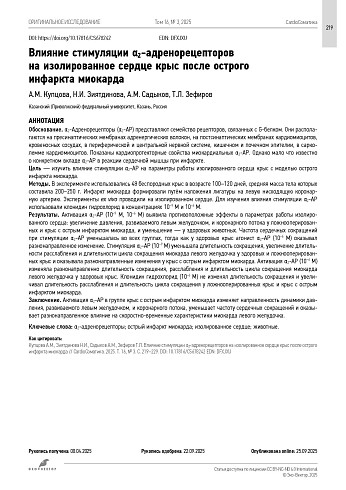
Обоснование. α2-Адренорецепторы (α2-AР) представляют семейство рецепторов, связанных с G-белком. Они располагаются на пресинаптических мембранах адренергических волокон, на постсинаптических мембранах кардиомиоцитов, кровеносных сосудах, в периферической и центральной нервной системе, кишечном и почечном эпителии, в сарколемме кардиомиоцитов. Показаны кардиопротекторные свойства миокардиальных α2-AР. Однако мало что известно о конкретном вкладе α2-AР в реакции сердечной мышцы при инфаркте.
Цель — изучить влияние стимуляции α2-AР на параметры работы изолированного сердца крыс с моделью острого инфаркта миокарда.
Методы. В эксперименте использовались 48 беспородных крыс в возрасте 100–120 дней, средняя масса тела которых составила 200–250 г. Инфаркт миокарда формировали путём наложения лигатуры на левую нисходящую коронарную артерию. Эксперименты ex vivo проводили на изолированном сердце. Для изучения влияния стимуляции α2-AР использовали клонидин гидрохлорид в концентрациях 10−9 М и 10−6 М.
Результаты. Активация α2-АР (10−9 М, 10−6 М) выявила противоположные эффекты в параметрах работы изолированного сердца: увеличение давления, развиваемого левым желудочком, и коронарного потока у ложнооперированных и крыс с острым инфарктом миокарда, и уменьшение — у здоровых животных. Частота сердечных сокращений при стимуляции α2-АР уменьшалась во всех группах, тогда как у здоровых крыс агонист α2-АР (10−6 М) оказывал разнонаправленное изменение. Стимуляция α2-АР (10−9 М) уменьшала длительность сокращения, увеличение длительности расслабления и длительности цикла сокращения миокарда левого желудочка у здоровых и ложнооперированных крыс и оказывала разнонаправленные изменения у крыс с острым инфарктом миокарда. Активация α2-АР (10−6 М) изменяла разнонаправленно длительность сокращения, расслабления и длительность цикла сокращения миокарда левого желудочка у здоровых крыс. Клонидин гидрохлорид (10−6 М) не изменял длительность сокращения и увеличивал длительность расслабления и длительность цикла сокращения у ложнооперированных крыс и крыс с острым инфарктом миокарда.
Заключение. Активация α2-АР в группе крыс с острым инфарктом миокарда изменяет направленность динамики давления, развиваемого левым желудочком, и коронарного потока, уменьшает частоту сердечных сокращений и оказывает разнонаправленное влияние на скоростно-временные характеристики миокарда левого желудочка.
Ключевые слова: α2-адренорецепторы, острый инфаркт миокарда, изолированное сердце, животные
AIM: The work aimed to investigate the effect of α2-AR stimulation on functional parameters of the isolated rat heart in a model of acute myocardial infarction.
METHODS: The experiment involved 48 outbred rats aged 100–120 days with a mean body weight of 200–250 g. Myocardial infarction was induced by ligation of the left anterior descending coronary artery. Ex vivo experiments were performed on isolated hearts. To evaluate the effects of α2-AR stimulation, clonidine hydrochloride was administered at concentrations of 10–9 M and 10–6 M.
RESULTS: Activation of α2-ARs (10–9 M, 10–6 M) produced opposite effects on the functional parameters of the isolated heart: it increased left ventricular developed pressure and coronary flow in sham-operated rats and those with acute myocardial infarction, whereas it decreased these parameters in healthy animals. Heart rate decreased in all groups during α2-AR stimulation, whereas in healthy rats the α2-AR agonist (10–6 M) induced bidirectional changes. Stimulation of α2-ARs (10–9 M) reduced contraction duration and increased relaxation and total contraction cycle duration of the left ventricular myocardium in healthy and sham-operated rats, whereas bidirectional effects were observed in rats with acute myocardial infarction. Activation of α2-ARs (10–6 M) induced bidirectional changes in contraction, relaxation, and contraction cycle duration of the left ventricular myocardium in healthy rats. Clonidine hydrochloride (10–6 M) did not affect contraction duration but increased relaxation and total contraction cycle duration in sham-operated rats and in those with acute myocardial infarction.
CONCLUSION: Activation of α2-ARs in rats with acute myocardial infarction alters the parameters of left ventricular developed pressure and coronary flow, decreases heart rate, and exerts bidirectional effects on the time–velocity characteristics of the left ventricular myocardium.
Keywords: α2-adrenoceptors, acute myocardial infarction, isolated heart preparation, animals
Цель — изучить влияние стимуляции α2-AР на параметры работы изолированного сердца крыс с моделью острого инфаркта миокарда.
Методы. В эксперименте использовались 48 беспородных крыс в возрасте 100–120 дней, средняя масса тела которых составила 200–250 г. Инфаркт миокарда формировали путём наложения лигатуры на левую нисходящую коронарную артерию. Эксперименты ex vivo проводили на изолированном сердце. Для изучения влияния стимуляции α2-AР использовали клонидин гидрохлорид в концентрациях 10−9 М и 10−6 М.
Результаты. Активация α2-АР (10−9 М, 10−6 М) выявила противоположные эффекты в параметрах работы изолированного сердца: увеличение давления, развиваемого левым желудочком, и коронарного потока у ложнооперированных и крыс с острым инфарктом миокарда, и уменьшение — у здоровых животных. Частота сердечных сокращений при стимуляции α2-АР уменьшалась во всех группах, тогда как у здоровых крыс агонист α2-АР (10−6 М) оказывал разнонаправленное изменение. Стимуляция α2-АР (10−9 М) уменьшала длительность сокращения, увеличение длительности расслабления и длительности цикла сокращения миокарда левого желудочка у здоровых и ложнооперированных крыс и оказывала разнонаправленные изменения у крыс с острым инфарктом миокарда. Активация α2-АР (10−6 М) изменяла разнонаправленно длительность сокращения, расслабления и длительность цикла сокращения миокарда левого желудочка у здоровых крыс. Клонидин гидрохлорид (10−6 М) не изменял длительность сокращения и увеличивал длительность расслабления и длительность цикла сокращения у ложнооперированных крыс и крыс с острым инфарктом миокарда.
Заключение. Активация α2-АР в группе крыс с острым инфарктом миокарда изменяет направленность динамики давления, развиваемого левым желудочком, и коронарного потока, уменьшает частоту сердечных сокращений и оказывает разнонаправленное влияние на скоростно-временные характеристики миокарда левого желудочка.
Ключевые слова: α2-адренорецепторы, острый инфаркт миокарда, изолированное сердце, животные
________________________________________________
AIM: The work aimed to investigate the effect of α2-AR stimulation on functional parameters of the isolated rat heart in a model of acute myocardial infarction.
METHODS: The experiment involved 48 outbred rats aged 100–120 days with a mean body weight of 200–250 g. Myocardial infarction was induced by ligation of the left anterior descending coronary artery. Ex vivo experiments were performed on isolated hearts. To evaluate the effects of α2-AR stimulation, clonidine hydrochloride was administered at concentrations of 10–9 M and 10–6 M.
RESULTS: Activation of α2-ARs (10–9 M, 10–6 M) produced opposite effects on the functional parameters of the isolated heart: it increased left ventricular developed pressure and coronary flow in sham-operated rats and those with acute myocardial infarction, whereas it decreased these parameters in healthy animals. Heart rate decreased in all groups during α2-AR stimulation, whereas in healthy rats the α2-AR agonist (10–6 M) induced bidirectional changes. Stimulation of α2-ARs (10–9 M) reduced contraction duration and increased relaxation and total contraction cycle duration of the left ventricular myocardium in healthy and sham-operated rats, whereas bidirectional effects were observed in rats with acute myocardial infarction. Activation of α2-ARs (10–6 M) induced bidirectional changes in contraction, relaxation, and contraction cycle duration of the left ventricular myocardium in healthy rats. Clonidine hydrochloride (10–6 M) did not affect contraction duration but increased relaxation and total contraction cycle duration in sham-operated rats and in those with acute myocardial infarction.
CONCLUSION: Activation of α2-ARs in rats with acute myocardial infarction alters the parameters of left ventricular developed pressure and coronary flow, decreases heart rate, and exerts bidirectional effects on the time–velocity characteristics of the left ventricular myocardium.
Keywords: α2-adrenoceptors, acute myocardial infarction, isolated heart preparation, animals
Полный текст
Список литературы
1. Brodde OE, Bruck H, Leineweber K, et al. Presence, distribution and physiological function of adrenergic and muscarinic receptor subtypes in the human heart. Basic Res Cardiol. 2001;96:528–538. doi: 10.1007/s003950170003 EDN: LJXFCM
2. Kokoz YM, Evdokimovskii EV, Maltsev AV. Upregulation of α2-adrenoceptor synthesis in SHR cardiomyocytes: Recompense without sense — Increased amounts, impaired commands. Arch Biochem Biophys. 2019;674:108109. doi: 10.1016/j.abb.2019.108109 EDN: ABCIEM
3. Schlicker E, FeuersteinT. Human presynaptic receptors. Pharmacol. Ther. 2017;172:1–21. doi: 10.1016/j.pharmthera.2016.11.005
4. Kaye AD, Chernobylsky DJ, Thakur P, et al. Dexmedetomidine in Enhanced Recovery After Surgery (ERAS) Protocols for Postoperative Pain. Curr Pain Headache Rep. 2020;24:21. doi: 10.1007/s11916-020-00853-z EDN: JFGQSV
5. Bilotta F, Pugliese F. The evolving clinical use of dexmedetomidine. Lancet. 2020;396(10245):145–147. doi: 10.1016/s0140-6736(20)30902-8
6. Gilsbach R, Hein L. Are the pharmacology and physiology of α2-adrenoceptors determined by α2-heteroreceptors and autoreceptors respectively? Br J Pharmacol. 2011;165(1):90–102. doi: 10.1111/j.1476-5381.2011.01533.x
7. Gilsbach R, Schneider J, Lother A, et al. Sympathetic alpha2-adrenoceptors prevent cardiac hypertrophy and fibrosis in mice at baseline but not after chronic pressure overload. Cardiovasc Res. 2010;86(3):432–442. doi: 10.1093/cvr/cvq014 EDN: NZPRLX
8. Ziyatdinova NI, Kuptsova AM, Faskhutdinov LI, et al. Effect of α2-Adrenoceptor Stimulation on Functional Parameters of Langendorff‑Isolated Rat Heart. Bulletin of Experimental Biology and Medicine. 2018;165(5):593–596. doi: 10.1007/s10517-018-4220-9 EDN: MAUZED
9. Zefirov TL, Ziatdinova NI, Khisamieva LI, Zefirov AL. Comparative Analysis of the Impact of α1- and α2-Adrenoreceptor Blockade on Cardiac Function in Rats during Postnatal Ontogeny. Bulletin of Experimental Biology and Medicine. 2011;151(6):664–666. doi: 10.1007/s10517-011-1410-0 EDN: PEELUZ
10. Korotaeva YuV, Tsirkin VI. Alpha2-adrenergic receptors of myocardium (Review). Proceedings of THE Komi Science centre of the Ural division of the Russian Academy of Sciences. 2015;2(22):57–64. EDN: TXJHMT
11. Zefirov TL, Ziyatdinova NI, Khisamieva LI, Zefirov AL. Effect of α2-Adrenoceptor Stimulation on Cardiac Activity in Rats. Bulletin of Experimental Biology and Medicine. 2014;157(2):194–197. doi: 10.1007/s10517-014-2523-z EDN: UEJENT
12. Kuptsova AM, Zaripova RI, Hisamieva LI, et al. Yohimbine influence on myocardium contractile activity among newborn rats. International Journal of Advanced Biotechnology and Research. 2016;7(4):1305–1309.
13. Nahrendorf M, Wiesmann F, Hiller KH, et al. Serial cine-magnetic resonance imaging of left ventricular remodeling after myocardial infarction in rats. J Magn Reson Imaging. 2001:14(5):547–555. doi: 10.1002/jmri.1218
14. Pimenov OY, Galimova MH, Evdokimovskii EV, et al. Myocardial α2-Adrenoceptors as Therapeutic Targets to Prevent Cardiac Hypertrophy and Heart Failure. Biophysics. 2019;64(5):917–932. doi: 10.1134/S0006302919050120 EDN: THCLQM
15. Cai JJ, Morgan DA, Haynes WG, et al. Alpha2-Adrenergic stimulation is protective against ischemia-reperfusion-induced ventricular arrhythmias in vivo. Am J Physiol Heart Circ Physiol. 2002;283(6):H2606–2611. doi: 10.1152/ajpheart.00156.2002
16. Yoshikawa Y, Hirata N, Kawaguchi R, et al. Dexmedetomidine maintains its direct cardioprotective effect against ischemia/reperfusion injury in hypertensive hypertrophied myocardium. Anesthesia and Analgesia. 2018;126(2):443–452. doi: 10.1213/ANE.0000000000002452 EDN: VIAJTN
17. Takahashi K, Yoshikawa Y, Kanda M, et al. Dexmedetomidine as a cardioprotective drug: a narrative review. Journal of Anesthesia. 2023;37:961–970. doi: 10.1007/s00540-023-03261-w EDN: ONEYNT
18. Kuptsova AM, Bugrov RK, Khabibrakhmanov II, et al. Role of α2-adrenoceptors in Rat Heart with the Model of myocardial Infarction. J Chem Health Risks. 2021;11(2):129–134. doi: 10.22034/jchr.2021.682031 EDN: GUPDYB
19. Mill JG, Stefanon I, Santos L, Baldo MP. Remodeling in the ischemic heart: the stepwise progression for heart failure. Brazilian Journal of Medical and Biological Research. 2011;44(9):890–898. doi: 10.1590/S0100-879X2011007500096
20. Grin VK, Konoplyanko VA, Mikhailichenko VYu. Peculiarities of chronotropic response to the stress in rats with a model of myocardial infarction. Vestnik neotlozhnoy i vosstanovitel'noy meditsiny. 2006;7(1):102–104.
21. Kuptsova AM, Bugrov RK, Ziyatdinova NI, Zefrov TL. Langendorff‑Isolated Rat Heart after Acute Еxperimental Myocardial Infarction. Вulletin of Experimental Biology and Medicine. 2022;173(6):719–722. doi: 10.1007/s10517-022-05623-y EDN: ANEHGK
22. Kuptsova AM, Bugrov RK, Ziyatdinova NI, Zefirov TL. Peracute Myocardial Infarction: Features of the Influence of α2-Adrenoreceptor Stimulation on the Isolated Heart. Вulletin of Experimental Biology and Medicine. 2024;176(3):315–320. doi: 10.1007/s10517-024-06015-0 EDN: HFBNXC
23. Kozlovskiy VI. The role of endothelium in vasodilation mediated by different subtypes of adrenoceptors. Journal of the Grodno state medical university. 2010;1:32–35. EDN: QAVKED
24. Nikulina NA, Dotsenko EA, Nerovnya AM, et al. Experimental myocardial infarction in rats: features of modeling and course within the first 48 hours after coronary artery ligation. Problems of health and ecology. 2020;2(64):91–96. doi: 10.51523/2708-6011.2020-17-2-13 EDN: YFXOSR
2. Kokoz YM, Evdokimovskii EV, Maltsev AV. Upregulation of α2-adrenoceptor synthesis in SHR cardiomyocytes: Recompense without sense — Increased amounts, impaired commands. Arch Biochem Biophys. 2019;674:108109. doi: 10.1016/j.abb.2019.108109 EDN: ABCIEM
3. Schlicker E, FeuersteinT. Human presynaptic receptors. Pharmacol. Ther. 2017;172:1–21. doi: 10.1016/j.pharmthera.2016.11.005
4. Kaye AD, Chernobylsky DJ, Thakur P, et al. Dexmedetomidine in Enhanced Recovery After Surgery (ERAS) Protocols for Postoperative Pain. Curr Pain Headache Rep. 2020;24:21. doi: 10.1007/s11916-020-00853-z EDN: JFGQSV
5. Bilotta F, Pugliese F. The evolving clinical use of dexmedetomidine. Lancet. 2020;396(10245):145–147. doi: 10.1016/s0140-6736(20)30902-8
6. Gilsbach R, Hein L. Are the pharmacology and physiology of α2-adrenoceptors determined by α2-heteroreceptors and autoreceptors respectively? Br J Pharmacol. 2011;165(1):90–102. doi: 10.1111/j.1476-5381.2011.01533.x
7. Gilsbach R, Schneider J, Lother A, et al. Sympathetic alpha2-adrenoceptors prevent cardiac hypertrophy and fibrosis in mice at baseline but not after chronic pressure overload. Cardiovasc Res. 2010;86(3):432–442. doi: 10.1093/cvr/cvq014 EDN: NZPRLX
8. Ziyatdinova NI, Kuptsova AM, Faskhutdinov LI, et al. Effect of α2-Adrenoceptor Stimulation on Functional Parameters of Langendorff‑Isolated Rat Heart. Bulletin of Experimental Biology and Medicine. 2018;165(5):593–596. doi: 10.1007/s10517-018-4220-9 EDN: MAUZED
9. Zefirov TL, Ziatdinova NI, Khisamieva LI, Zefirov AL. Comparative Analysis of the Impact of α1- and α2-Adrenoreceptor Blockade on Cardiac Function in Rats during Postnatal Ontogeny. Bulletin of Experimental Biology and Medicine. 2011;151(6):664–666. doi: 10.1007/s10517-011-1410-0 EDN: PEELUZ
10. Korotaeva YuV, Tsirkin VI. Alpha2-adrenergic receptors of myocardium (Review). Proceedings of THE Komi Science centre of the Ural division of the Russian Academy of Sciences. 2015;2(22):57–64. EDN: TXJHMT
11. Zefirov TL, Ziyatdinova NI, Khisamieva LI, Zefirov AL. Effect of α2-Adrenoceptor Stimulation on Cardiac Activity in Rats. Bulletin of Experimental Biology and Medicine. 2014;157(2):194–197. doi: 10.1007/s10517-014-2523-z EDN: UEJENT
12. Kuptsova AM, Zaripova RI, Hisamieva LI, et al. Yohimbine influence on myocardium contractile activity among newborn rats. International Journal of Advanced Biotechnology and Research. 2016;7(4):1305–1309.
13. Nahrendorf M, Wiesmann F, Hiller KH, et al. Serial cine-magnetic resonance imaging of left ventricular remodeling after myocardial infarction in rats. J Magn Reson Imaging. 2001:14(5):547–555. doi: 10.1002/jmri.1218
14. Pimenov OY, Galimova MH, Evdokimovskii EV, et al. Myocardial α2-Adrenoceptors as Therapeutic Targets to Prevent Cardiac Hypertrophy and Heart Failure. Biophysics. 2019;64(5):917–932. doi: 10.1134/S0006302919050120 EDN: THCLQM
15. Cai JJ, Morgan DA, Haynes WG, et al. Alpha2-Adrenergic stimulation is protective against ischemia-reperfusion-induced ventricular arrhythmias in vivo. Am J Physiol Heart Circ Physiol. 2002;283(6):H2606–2611. doi: 10.1152/ajpheart.00156.2002
16. Yoshikawa Y, Hirata N, Kawaguchi R, et al. Dexmedetomidine maintains its direct cardioprotective effect against ischemia/reperfusion injury in hypertensive hypertrophied myocardium. Anesthesia and Analgesia. 2018;126(2):443–452. doi: 10.1213/ANE.0000000000002452 EDN: VIAJTN
17. Takahashi K, Yoshikawa Y, Kanda M, et al. Dexmedetomidine as a cardioprotective drug: a narrative review. Journal of Anesthesia. 2023;37:961–970. doi: 10.1007/s00540-023-03261-w EDN: ONEYNT
18. Kuptsova AM, Bugrov RK, Khabibrakhmanov II, et al. Role of α2-adrenoceptors in Rat Heart with the Model of myocardial Infarction. J Chem Health Risks. 2021;11(2):129–134. doi: 10.22034/jchr.2021.682031 EDN: GUPDYB
19. Mill JG, Stefanon I, Santos L, Baldo MP. Remodeling in the ischemic heart: the stepwise progression for heart failure. Brazilian Journal of Medical and Biological Research. 2011;44(9):890–898. doi: 10.1590/S0100-879X2011007500096
20. Grin VK, Konoplyanko VA, Mikhailichenko VYu. Peculiarities of chronotropic response to the stress in rats with a model of myocardial infarction. Vestnik neotlozhnoy i vosstanovitel'noy meditsiny. 2006;7(1):102–104.
21. Kuptsova AM, Bugrov RK, Ziyatdinova NI, Zefrov TL. Langendorff‑Isolated Rat Heart after Acute Еxperimental Myocardial Infarction. Вulletin of Experimental Biology and Medicine. 2022;173(6):719–722. doi: 10.1007/s10517-022-05623-y EDN: ANEHGK
22. Kuptsova AM, Bugrov RK, Ziyatdinova NI, Zefirov TL. Peracute Myocardial Infarction: Features of the Influence of α2-Adrenoreceptor Stimulation on the Isolated Heart. Вulletin of Experimental Biology and Medicine. 2024;176(3):315–320. doi: 10.1007/s10517-024-06015-0 EDN: HFBNXC
23. Kozlovskiy VI. The role of endothelium in vasodilation mediated by different subtypes of adrenoceptors. Journal of the Grodno state medical university. 2010;1:32–35. EDN: QAVKED
24. Nikulina NA, Dotsenko EA, Nerovnya AM, et al. Experimental myocardial infarction in rats: features of modeling and course within the first 48 hours after coronary artery ligation. Problems of health and ecology. 2020;2(64):91–96. doi: 10.51523/2708-6011.2020-17-2-13 EDN: YFXOSR
2. Kokoz YM, Evdokimovskii EV, Maltsev AV. Upregulation of α2-adrenoceptor synthesis in SHR cardiomyocytes: Recompense without sense — Increased amounts, impaired commands. Arch Biochem Biophys. 2019;674:108109. doi: 10.1016/j.abb.2019.108109 EDN: ABCIEM
3. Schlicker E, FeuersteinT. Human presynaptic receptors. Pharmacol. Ther. 2017;172:1–21. doi: 10.1016/j.pharmthera.2016.11.005
4. Kaye AD, Chernobylsky DJ, Thakur P, et al. Dexmedetomidine in Enhanced Recovery After Surgery (ERAS) Protocols for Postoperative Pain. Curr Pain Headache Rep. 2020;24:21. doi: 10.1007/s11916-020-00853-z EDN: JFGQSV
5. Bilotta F, Pugliese F. The evolving clinical use of dexmedetomidine. Lancet. 2020;396(10245):145–147. doi: 10.1016/s0140-6736(20)30902-8
6. Gilsbach R, Hein L. Are the pharmacology and physiology of α2-adrenoceptors determined by α2-heteroreceptors and autoreceptors respectively? Br J Pharmacol. 2011;165(1):90–102. doi: 10.1111/j.1476-5381.2011.01533.x
7. Gilsbach R, Schneider J, Lother A, et al. Sympathetic alpha2-adrenoceptors prevent cardiac hypertrophy and fibrosis in mice at baseline but not after chronic pressure overload. Cardiovasc Res. 2010;86(3):432–442. doi: 10.1093/cvr/cvq014 EDN: NZPRLX
8. Ziyatdinova NI, Kuptsova AM, Faskhutdinov LI, et al. Effect of α2-Adrenoceptor Stimulation on Functional Parameters of Langendorff‑Isolated Rat Heart. Bulletin of Experimental Biology and Medicine. 2018;165(5):593–596. doi: 10.1007/s10517-018-4220-9 EDN: MAUZED
9. Zefirov TL, Ziatdinova NI, Khisamieva LI, Zefirov AL. Comparative Analysis of the Impact of α1- and α2-Adrenoreceptor Blockade on Cardiac Function in Rats during Postnatal Ontogeny. Bulletin of Experimental Biology and Medicine. 2011;151(6):664–666. doi: 10.1007/s10517-011-1410-0 EDN: PEELUZ
10. Korotaeva YuV, Tsirkin VI. Alpha2-adrenergic receptors of myocardium (Review). Proceedings of THE Komi Science centre of the Ural division of the Russian Academy of Sciences. 2015;2(22):57–64. EDN: TXJHMT
11. Zefirov TL, Ziyatdinova NI, Khisamieva LI, Zefirov AL. Effect of α2-Adrenoceptor Stimulation on Cardiac Activity in Rats. Bulletin of Experimental Biology and Medicine. 2014;157(2):194–197. doi: 10.1007/s10517-014-2523-z EDN: UEJENT
12. Kuptsova AM, Zaripova RI, Hisamieva LI, et al. Yohimbine influence on myocardium contractile activity among newborn rats. International Journal of Advanced Biotechnology and Research. 2016;7(4):1305–1309.
13. Nahrendorf M, Wiesmann F, Hiller KH, et al. Serial cine-magnetic resonance imaging of left ventricular remodeling after myocardial infarction in rats. J Magn Reson Imaging. 2001:14(5):547–555. doi: 10.1002/jmri.1218
14. Pimenov OY, Galimova MH, Evdokimovskii EV, et al. Myocardial α2-Adrenoceptors as Therapeutic Targets to Prevent Cardiac Hypertrophy and Heart Failure. Biophysics. 2019;64(5):917–932. doi: 10.1134/S0006302919050120 EDN: THCLQM
15. Cai JJ, Morgan DA, Haynes WG, et al. Alpha2-Adrenergic stimulation is protective against ischemia-reperfusion-induced ventricular arrhythmias in vivo. Am J Physiol Heart Circ Physiol. 2002;283(6):H2606–2611. doi: 10.1152/ajpheart.00156.2002
16. Yoshikawa Y, Hirata N, Kawaguchi R, et al. Dexmedetomidine maintains its direct cardioprotective effect against ischemia/reperfusion injury in hypertensive hypertrophied myocardium. Anesthesia and Analgesia. 2018;126(2):443–452. doi: 10.1213/ANE.0000000000002452 EDN: VIAJTN
17. Takahashi K, Yoshikawa Y, Kanda M, et al. Dexmedetomidine as a cardioprotective drug: a narrative review. Journal of Anesthesia. 2023;37:961–970. doi: 10.1007/s00540-023-03261-w EDN: ONEYNT
18. Kuptsova AM, Bugrov RK, Khabibrakhmanov II, et al. Role of α2-adrenoceptors in Rat Heart with the Model of myocardial Infarction. J Chem Health Risks. 2021;11(2):129–134. doi: 10.22034/jchr.2021.682031 EDN: GUPDYB
19. Mill JG, Stefanon I, Santos L, Baldo MP. Remodeling in the ischemic heart: the stepwise progression for heart failure. Brazilian Journal of Medical and Biological Research. 2011;44(9):890–898. doi: 10.1590/S0100-879X2011007500096
20. Grin VK, Konoplyanko VA, Mikhailichenko VYu. Peculiarities of chronotropic response to the stress in rats with a model of myocardial infarction. Vestnik neotlozhnoy i vosstanovitel'noy meditsiny. 2006;7(1):102–104.
21. Kuptsova AM, Bugrov RK, Ziyatdinova NI, Zefrov TL. Langendorff‑Isolated Rat Heart after Acute Еxperimental Myocardial Infarction. Вulletin of Experimental Biology and Medicine. 2022;173(6):719–722. doi: 10.1007/s10517-022-05623-y EDN: ANEHGK
22. Kuptsova AM, Bugrov RK, Ziyatdinova NI, Zefirov TL. Peracute Myocardial Infarction: Features of the Influence of α2-Adrenoreceptor Stimulation on the Isolated Heart. Вulletin of Experimental Biology and Medicine. 2024;176(3):315–320. doi: 10.1007/s10517-024-06015-0 EDN: HFBNXC
23. Kozlovskiy VI. The role of endothelium in vasodilation mediated by different subtypes of adrenoceptors. Journal of the Grodno state medical university. 2010;1:32–35. EDN: QAVKED
24. Nikulina NA, Dotsenko EA, Nerovnya AM, et al. Experimental myocardial infarction in rats: features of modeling and course within the first 48 hours after coronary artery ligation. Problems of health and ecology. 2020;2(64):91–96. doi: 10.51523/2708-6011.2020-17-2-13 EDN: YFXOSR
________________________________________________
2. Kokoz YM, Evdokimovskii EV, Maltsev AV. Upregulation of α2-adrenoceptor synthesis in SHR cardiomyocytes: Recompense without sense — Increased amounts, impaired commands. Arch Biochem Biophys. 2019;674:108109. doi: 10.1016/j.abb.2019.108109 EDN: ABCIEM
3. Schlicker E, FeuersteinT. Human presynaptic receptors. Pharmacol. Ther. 2017;172:1–21. doi: 10.1016/j.pharmthera.2016.11.005
4. Kaye AD, Chernobylsky DJ, Thakur P, et al. Dexmedetomidine in Enhanced Recovery After Surgery (ERAS) Protocols for Postoperative Pain. Curr Pain Headache Rep. 2020;24:21. doi: 10.1007/s11916-020-00853-z EDN: JFGQSV
5. Bilotta F, Pugliese F. The evolving clinical use of dexmedetomidine. Lancet. 2020;396(10245):145–147. doi: 10.1016/s0140-6736(20)30902-8
6. Gilsbach R, Hein L. Are the pharmacology and physiology of α2-adrenoceptors determined by α2-heteroreceptors and autoreceptors respectively? Br J Pharmacol. 2011;165(1):90–102. doi: 10.1111/j.1476-5381.2011.01533.x
7. Gilsbach R, Schneider J, Lother A, et al. Sympathetic alpha2-adrenoceptors prevent cardiac hypertrophy and fibrosis in mice at baseline but not after chronic pressure overload. Cardiovasc Res. 2010;86(3):432–442. doi: 10.1093/cvr/cvq014 EDN: NZPRLX
8. Ziyatdinova NI, Kuptsova AM, Faskhutdinov LI, et al. Effect of α2-Adrenoceptor Stimulation on Functional Parameters of Langendorff‑Isolated Rat Heart. Bulletin of Experimental Biology and Medicine. 2018;165(5):593–596. doi: 10.1007/s10517-018-4220-9 EDN: MAUZED
9. Zefirov TL, Ziatdinova NI, Khisamieva LI, Zefirov AL. Comparative Analysis of the Impact of α1- and α2-Adrenoreceptor Blockade on Cardiac Function in Rats during Postnatal Ontogeny. Bulletin of Experimental Biology and Medicine. 2011;151(6):664–666. doi: 10.1007/s10517-011-1410-0 EDN: PEELUZ
10. Korotaeva YuV, Tsirkin VI. Alpha2-adrenergic receptors of myocardium (Review). Proceedings of THE Komi Science centre of the Ural division of the Russian Academy of Sciences. 2015;2(22):57–64. EDN: TXJHMT
11. Zefirov TL, Ziyatdinova NI, Khisamieva LI, Zefirov AL. Effect of α2-Adrenoceptor Stimulation on Cardiac Activity in Rats. Bulletin of Experimental Biology and Medicine. 2014;157(2):194–197. doi: 10.1007/s10517-014-2523-z EDN: UEJENT
12. Kuptsova AM, Zaripova RI, Hisamieva LI, et al. Yohimbine influence on myocardium contractile activity among newborn rats. International Journal of Advanced Biotechnology and Research. 2016;7(4):1305–1309.
13. Nahrendorf M, Wiesmann F, Hiller KH, et al. Serial cine-magnetic resonance imaging of left ventricular remodeling after myocardial infarction in rats. J Magn Reson Imaging. 2001:14(5):547–555. doi: 10.1002/jmri.1218
14. Pimenov OY, Galimova MH, Evdokimovskii EV, et al. Myocardial α2-Adrenoceptors as Therapeutic Targets to Prevent Cardiac Hypertrophy and Heart Failure. Biophysics. 2019;64(5):917–932. doi: 10.1134/S0006302919050120 EDN: THCLQM
15. Cai JJ, Morgan DA, Haynes WG, et al. Alpha2-Adrenergic stimulation is protective against ischemia-reperfusion-induced ventricular arrhythmias in vivo. Am J Physiol Heart Circ Physiol. 2002;283(6):H2606–2611. doi: 10.1152/ajpheart.00156.2002
16. Yoshikawa Y, Hirata N, Kawaguchi R, et al. Dexmedetomidine maintains its direct cardioprotective effect against ischemia/reperfusion injury in hypertensive hypertrophied myocardium. Anesthesia and Analgesia. 2018;126(2):443–452. doi: 10.1213/ANE.0000000000002452 EDN: VIAJTN
17. Takahashi K, Yoshikawa Y, Kanda M, et al. Dexmedetomidine as a cardioprotective drug: a narrative review. Journal of Anesthesia. 2023;37:961–970. doi: 10.1007/s00540-023-03261-w EDN: ONEYNT
18. Kuptsova AM, Bugrov RK, Khabibrakhmanov II, et al. Role of α2-adrenoceptors in Rat Heart with the Model of myocardial Infarction. J Chem Health Risks. 2021;11(2):129–134. doi: 10.22034/jchr.2021.682031 EDN: GUPDYB
19. Mill JG, Stefanon I, Santos L, Baldo MP. Remodeling in the ischemic heart: the stepwise progression for heart failure. Brazilian Journal of Medical and Biological Research. 2011;44(9):890–898. doi: 10.1590/S0100-879X2011007500096
20. Grin VK, Konoplyanko VA, Mikhailichenko VYu. Peculiarities of chronotropic response to the stress in rats with a model of myocardial infarction. Vestnik neotlozhnoy i vosstanovitel'noy meditsiny. 2006;7(1):102–104.
21. Kuptsova AM, Bugrov RK, Ziyatdinova NI, Zefrov TL. Langendorff‑Isolated Rat Heart after Acute Еxperimental Myocardial Infarction. Вulletin of Experimental Biology and Medicine. 2022;173(6):719–722. doi: 10.1007/s10517-022-05623-y EDN: ANEHGK
22. Kuptsova AM, Bugrov RK, Ziyatdinova NI, Zefirov TL. Peracute Myocardial Infarction: Features of the Influence of α2-Adrenoreceptor Stimulation on the Isolated Heart. Вulletin of Experimental Biology and Medicine. 2024;176(3):315–320. doi: 10.1007/s10517-024-06015-0 EDN: HFBNXC
23. Kozlovskiy VI. The role of endothelium in vasodilation mediated by different subtypes of adrenoceptors. Journal of the Grodno state medical university. 2010;1:32–35. EDN: QAVKED
24. Nikulina NA, Dotsenko EA, Nerovnya AM, et al. Experimental myocardial infarction in rats: features of modeling and course within the first 48 hours after coronary artery ligation. Problems of health and ecology. 2020;2(64):91–96. doi: 10.51523/2708-6011.2020-17-2-13 EDN: YFXOSR
Авторы
А.М. Купцова*, Н.И. Зиятдинова, А.М. Садыков, Т.Л. Зефиров
Казанский (Приволжский) федеральный университет, Казань, Россия
*anuta0285@mail.ru
Kazan (Volga Region) Federal University, Kazan, Russia
*anuta0285@mail.ru
Казанский (Приволжский) федеральный университет, Казань, Россия
*anuta0285@mail.ru
________________________________________________
Kazan (Volga Region) Federal University, Kazan, Russia
*anuta0285@mail.ru
Цель портала OmniDoctor – предоставление профессиональной информации врачам, провизорам и фармацевтам.