

Материалы доступны только для специалистов сферы здравоохранения.
Чтобы посмотреть материал полностью
Авторизуйтесь
или зарегистрируйтесь.
Опыт применения лираглутида у подростков с экзогенно-конституциональным ожирением. Анализ клинических исходов
Опыт применения лираглутида у подростков с экзогенно-конституциональным ожирением. Анализ клинических исходов
Чередникова К.А., Болотова Н.В., Филина Н.Ю., Поляков В.К., Шарапова М.А., Компаниец О.В., Аверьянов А.П. Опыт применения лираглутида у подростков с экзогенно-конституциональным ожирением. Анализ клинических исходов. Педиатрия. Consilium Medicum. 2025;3:282–289. DOI: 10.26442/26586630.2025.3.203357
© ООО «КОНСИЛИУМ МЕДИКУМ», 2025 г.
© ООО «КОНСИЛИУМ МЕДИКУМ», 2025 г.
________________________________________________
Материалы доступны только для специалистов сферы здравоохранения.
Чтобы посмотреть материал полностью
Авторизуйтесь
или зарегистрируйтесь.
Аннотация
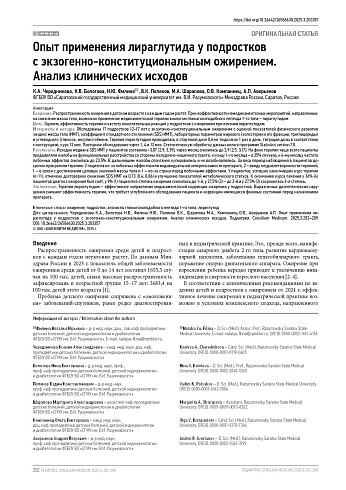
Введение. Распространенность ожирения в детском возрасте с каждым годом растет. При неэффективности немедикаментозных мероприятий, направленных на снижение массы тела, возможно применение медикаментозной терапии аналогом глюкагоноподобного пептида 1-го типа – лираглутидом.
Цель. Оценить эффективность терапии и частоту нежелательных реакций у подростков с ожирением при лечении лираглутидом.
Материалы и методы. Обследованы 17 подростков 12–17 лет с экзогенно-конституциональным ожирением с оценкой показателей физического развития [индекс массы тела (ИМТ), коэффициент стандартного отклонения (SDS) ИМТ], лабораторных параметров жирового (холестерин и его фракции, триглицериды) и углеводного (глюкоза, инсулин) обмена. Терапия лираглутидом проводилась в стартовой дозе 0,6 мг подкожно 1 раз в день, титрация дозы в соответствии с инструкцией, курс 12 мес. Повторное обследование через 1, 4 и 12 мес. Статистическую обработку данных вели в программе Statistics version 7.0.
Результаты. Исходно медиана SDS ИМТ у пациентов составила +3,07 [2,9; 3,39], через месяц снизилась до 2,9 [2,5; 3,17]. На фоне терапии чаще всего пациенты предъявляли жалобы на функциональные расстройства со стороны желудочно-кишечного тракта: к концу 1-го месяца – в 35% случаев, к 4-му месяцу частота побочных эффектов снизилась до 23,5%. В дальнейшем жалобы спонтанно купировались и не возобновлялись. За весь период наблюдения 6 пациентов досрочно прекратили терапию: 2 пациента из-за побочных эффектов или индивидуальной непереносимости препарата, 2 – ввиду неудовлетворенности терапией, 1 – в связи с достижением целевых значений массы тела и 1 – из-за cтраха перед побочными эффектами. У пациентов, успешно закончивших курс терапии (n=11), отмечено достоверное снижение SDS ИМТ на 0,73 [0,4; 0,86] и улучшение показателей метаболического статуса. К окончанию курса лечения у 36% (4) пациентов диагноз ожирения был снят, у 9% (1) пациентов степень ожирения снизилась до 1-й, у 27,5% (3) – до 2-й и у 27,5% (3) сохранилась 3-я степень.
Заключение. Терапия лираглутидом – эффективное направление медикаментозной коррекции ожирения у подростков. Выраженные диспептические нарушения снижают эффективность терапии, что требует углубленного обследования пациента и коррекции имеющихся фоновых состояний перед назначением препарата.
Ключевые слова: ожирение, подростки, агонисты глюкагоноподобного пептида 1-го типа, лираглутид
Аim. To evaluate the effectiveness of therapy and frequency of adverse reactions in obese adolescents treated with liraglutide.
Matherials and methods. 17 adolescents aged 12–17 years with exogenous constitutional obesity were examined with an assessment of physical development indicators (BMI, SDS BMI), laboratory parameters of fat (cholesterol and its fractions, triglycerides) and carbohydrate (glucose, insulin) metabolism. Liraglutide therapy was performed at a starting dose of 0.6 mg daily, dose titration according to the instructions, and the course of therapy was 12 months. Repeated examination after 1, 4 and 12 months. Statistical data processing – Statistics version 7.0.
Results. The initial SDS BMI in patients was +3.07 [2.9; 3.39]. After a month, SDS BMI decreased to 2.9 [2.5; 3.17]. Against the background of therapy, patients most often complained of functional disorders of the gastrointestinal tract: by the end of the first month, in 35% of cases, by the 4th month, the frequency of side effects decreased to 23.5%. In the future, the complaints were spontaneously stopped and did not resume. During the entire follow-up period, 6 patients stopped therapy ahead of schedule: 2 patients due to side effects or individual intolerance to the medication, 2 patients due to dissatisfaction with therapy, 1 patient due to achieving target weight values and 1 patient due to fear of side effects. In patients who successfully completed the course of therapy (n=11), there was a significant decrease in SDS BMI by 0.73 [0.4; 0.86] and an improvement in metabolic status. By the end of the course of therapy, 36% (4) of patients had been diagnosed with obesity, 9% (1) of patients had a reduction in the degree of obesity to the first, 27.5% (3) to the second, and 27.5% (3) retained the third degree.
Conclusion. liraglutide therapy is an effective direction of drug correction of obesity in adolescents. Severe dyspeptic disorders reduce the effectiveness of therapy, which requires an in-depth examination of the patient and correction of existing background conditions before prescribing the drug.
Keywords: obesity, adolescents, Glucagon-like peptide-1, liraglutide
Цель. Оценить эффективность терапии и частоту нежелательных реакций у подростков с ожирением при лечении лираглутидом.
Материалы и методы. Обследованы 17 подростков 12–17 лет с экзогенно-конституциональным ожирением с оценкой показателей физического развития [индекс массы тела (ИМТ), коэффициент стандартного отклонения (SDS) ИМТ], лабораторных параметров жирового (холестерин и его фракции, триглицериды) и углеводного (глюкоза, инсулин) обмена. Терапия лираглутидом проводилась в стартовой дозе 0,6 мг подкожно 1 раз в день, титрация дозы в соответствии с инструкцией, курс 12 мес. Повторное обследование через 1, 4 и 12 мес. Статистическую обработку данных вели в программе Statistics version 7.0.
Результаты. Исходно медиана SDS ИМТ у пациентов составила +3,07 [2,9; 3,39], через месяц снизилась до 2,9 [2,5; 3,17]. На фоне терапии чаще всего пациенты предъявляли жалобы на функциональные расстройства со стороны желудочно-кишечного тракта: к концу 1-го месяца – в 35% случаев, к 4-му месяцу частота побочных эффектов снизилась до 23,5%. В дальнейшем жалобы спонтанно купировались и не возобновлялись. За весь период наблюдения 6 пациентов досрочно прекратили терапию: 2 пациента из-за побочных эффектов или индивидуальной непереносимости препарата, 2 – ввиду неудовлетворенности терапией, 1 – в связи с достижением целевых значений массы тела и 1 – из-за cтраха перед побочными эффектами. У пациентов, успешно закончивших курс терапии (n=11), отмечено достоверное снижение SDS ИМТ на 0,73 [0,4; 0,86] и улучшение показателей метаболического статуса. К окончанию курса лечения у 36% (4) пациентов диагноз ожирения был снят, у 9% (1) пациентов степень ожирения снизилась до 1-й, у 27,5% (3) – до 2-й и у 27,5% (3) сохранилась 3-я степень.
Заключение. Терапия лираглутидом – эффективное направление медикаментозной коррекции ожирения у подростков. Выраженные диспептические нарушения снижают эффективность терапии, что требует углубленного обследования пациента и коррекции имеющихся фоновых состояний перед назначением препарата.
Ключевые слова: ожирение, подростки, агонисты глюкагоноподобного пептида 1-го типа, лираглутид
________________________________________________
Аim. To evaluate the effectiveness of therapy and frequency of adverse reactions in obese adolescents treated with liraglutide.
Matherials and methods. 17 adolescents aged 12–17 years with exogenous constitutional obesity were examined with an assessment of physical development indicators (BMI, SDS BMI), laboratory parameters of fat (cholesterol and its fractions, triglycerides) and carbohydrate (glucose, insulin) metabolism. Liraglutide therapy was performed at a starting dose of 0.6 mg daily, dose titration according to the instructions, and the course of therapy was 12 months. Repeated examination after 1, 4 and 12 months. Statistical data processing – Statistics version 7.0.
Results. The initial SDS BMI in patients was +3.07 [2.9; 3.39]. After a month, SDS BMI decreased to 2.9 [2.5; 3.17]. Against the background of therapy, patients most often complained of functional disorders of the gastrointestinal tract: by the end of the first month, in 35% of cases, by the 4th month, the frequency of side effects decreased to 23.5%. In the future, the complaints were spontaneously stopped and did not resume. During the entire follow-up period, 6 patients stopped therapy ahead of schedule: 2 patients due to side effects or individual intolerance to the medication, 2 patients due to dissatisfaction with therapy, 1 patient due to achieving target weight values and 1 patient due to fear of side effects. In patients who successfully completed the course of therapy (n=11), there was a significant decrease in SDS BMI by 0.73 [0.4; 0.86] and an improvement in metabolic status. By the end of the course of therapy, 36% (4) of patients had been diagnosed with obesity, 9% (1) of patients had a reduction in the degree of obesity to the first, 27.5% (3) to the second, and 27.5% (3) retained the third degree.
Conclusion. liraglutide therapy is an effective direction of drug correction of obesity in adolescents. Severe dyspeptic disorders reduce the effectiveness of therapy, which requires an in-depth examination of the patient and correction of existing background conditions before prescribing the drug.
Keywords: obesity, adolescents, Glucagon-like peptide-1, liraglutide
Полный текст
Список литературы
1. Миргородская О.В., Голубев Н.А., Огрызко Е.В., Шелепова Е.А. Заболеваемость ожирением у детей в возрасте 0-17 лет в Российской Федерации в период с 2018 по 2023 год. Современные проблемы здравоохранения и медицинской статистики. 2024;(3):236-51 [Mirgorodskaya OV, Golubev NA, Ogryzko EV, Shelepova EA. Morbidity of Obesity in Children Aged 0-17 Years in the Russian Federation in the Period 2018-2023. Sovremennye Problemy Zdravookhraneniia i Meditsinskoi Statistiki. 2024;(3):236-51 (in Russian)]. DOI:10.24412/2312-2935-2024-3-236-251
2. Панова Е.И., Морозова Е.П., Конышева М.С. Механизмы формирования и прогрессирования кардиоваскулярной патологии при ожирении. Клиническая медицина. 2024;102(11-12):800-11 [Panova EI, Morozova EP, Konysheva MS. Mechanisms of formation and progression of cardiovascular pathology in obesity. Klinicheskaia Meditsina. 2024;102(11-12):800-11 (in Russian)]. DOI:10.30629/0023-2149-2024-102-11-12-800-811
3. Twig G, Yaniv G, Levine H, et al. Body-Mass Index in 2.3 Million Adolescents and Cardiovascular Death in Adulthood. N Engl J Med. 2016;374(25):2430-40. DOI:10.1056/NEJMoa1503840
4. Бережная И.В., Симакова М.А., Захарова И.Н. Ожирение – важная педиатрическая проблема, которой педиатры и эндокринологи должны заниматься вместе. Педиатрия. Consilium Medicum. 2021;4:346-50 [Berezhnaya IV, Simakova MA, Zakharova IN. Obesity is an important paediatric problem that paediatricians and endocrinologists should address together. Pediatrics. Consilium Medicum. 2021;4:346-50 (in Russian)]. DOI:10.26442/26586630.2021.4.201354
5. Васюкова О.В., Окороков П.Л., Малиевский О.А., и др. Клинические рекомендации «Ожирение у детей». Ожирение и метаболизм. 2024;21(4):439-53 [Vasyukova OV, Okorokov PL, Malievskij OA, et al. Klinicheskie rekomendatsii „Ozhirenie u detei“. Obesity and Metabolism. 2024;21(4):439-53 (in Russian)]. DOI:10.14341/omet13194
6. Васюкова О.В., Окороков П.Л., Безлепкина О.Б. Современные стратегии лечения ожирения у детей. Проблемы эндокринологии. 2022;68(6):131-6 [Vasyukova OV, Okorokov PL, Bezlepkina OB. Modern strategies for the treatment of childhood obesity. Problemy Endokrinologii. 2022;68(6):131-6 (in Russian)]. DOI:10.14341/probl13208
7. Halford JCG, Bereket A, Bin-Abbas B, et al. Misalignment among adolescents living with obesity, caregivers, and healthcare professionals: ACTION Teens global survey study. Pediatr Obes. 2022;17(11):e12957. DOI:10.1111/ijpo.12957
8. Витебская А.В., Попович А.В. Опыт применения лираглутида у подростков с простым ожирением и сопутствующими заболеваниями ЖКТ. Ожирение и метаболизм. 2023;20(2):124-30 [Vitebskaya AV, Popovich AV. Liraglutide in adolescents with simple obesity and gastrointestinal comorbidities: treatment experience. Obesity and Metabolism. 2023;20(2):124-30 (in Russian)]. DOI:10.14341/omet12922
9. Colquitt JL, Loveman E, O'Malley C, et al. Diet, physical activity, and behavioural interventions for the treatment of overweight or obesity in preschool children up to the age of 6 years. Cochrane Database Syst Rev. 2016;3(3):CD012105. DOI:10.1002/14651858.CD012105
10. Петеркова В.А., Безлепкина О.Б., Болотова Н.В., и др. Клинические рекомендации «Ожирение у детей». Проблемы эндокринологии. 2021;67(5):67-83 [Peterkova VA, Bezlepkina OB, Bolotova NV, et al. Klinicheskie rekomendacii „Ozhirenie u detei“. Problemy Endokrinologii. 2021;67(5):67-83 (in Russian)]. DOI:10.14341/probl12802
11. Farr OM, Sofopoulos M, Tsoukas MA, et al. GLP-1 receptors exist in the parietal cortex, hypothalamus and medulla of human brains and the GLP-1 analogue liraglutide alters brain activity related to highly desirable food cues in individuals with diabetes: a crossover, randomised, placebo-controlled trial. Diabetologia. 2016;59(5):954-65. DOI:10.1007/s00125-016-3874-y
12. Nicolucci A, Maffeis C. The adolescent with obesity: what perspectives for treatment? Ital J Pediatr. 2022;48(1):9. DOI:10.1186/s13052-022-01205-w
13. Kelly AS, Auerbach P, Barrientos-Perez M, et al; NN8022-4180 Trial Investigators. A Randomized, Controlled Trial of Liraglutide for Adolescents with Obesity. N Engl J Med. 2020;382(22):2117-28. DOI:10.1056/NEJMoa1916038
14. Ryan PM, Seltzer S, Hayward NE, et al. Safety and Efficacy of Glucagon-Like Peptide-1 Receptor Agonists in Children and Adolescents with Obesity: A Meta-Analysis. J Pediatr. 2021;236:137-47. DOI:10.1016/j.jpeds.2021.05.009
15. Евдокимова Н.В. Роль лираглутида в лечении ожирения у детей. Университетский терапевтический вестник. 2023;5(2):96-104 [Evdokimova NV. Role Of Liraglutide In The Treatment Of Obesity In Children. Universitetskii Terapevticheskii Vestnik. 2023;5(2):96-104 (in Russian)]. DOI:10.56871/UTJ.2023.36.20.009
16. Шаршова О.Г., Чубаров Т.В., Петеркова В.А., Жданова О.А. Влияние терапии лираглутидом на массу тела и показатели углеводного и жирового обмена у детей с ожирением. Медицинский Совет. 2024;(19):131-7 [Sharshova OG, Chubarov TV, Peterkova VA, Zhdanova OA. The effect of liraglutide therapy on body weight and carbohydrate metabolism and lipid profile in obese children. Meditsinskiy sovet = Medical Council. 2024;(19):131-37 (in Russian)]. DOI:10.21518/ms2024-476
17. Yugar LBT, Sedenho-Prado LG, da Silva Ferreira IMC, et al. The efficacy and safety of GLP-1 receptor agonists in youth with type 2 diabetes: a meta-analysis. Diabetol Metab Syndr. 2024;16(1):92. DOI:10.1186/s13098-024-01337-5
18. Zhou QX, Wang ZY, Zhao HF, Wang S. The effects of GLP-1 analogues on pre-diabetes of the children. Exp Ther Med. 2017;13(4):1426-30. DOI:10.3892/etm.2017.4129
19. Wharton S, Lau DCW, Vallis M, et al. Obesity in adults: a clinical practice guideline. CMAJ. 2020;192(31):E875-91. DOI:10.1503/cmaj.191707
20. Kosiborod MN, Bhatta M, Davies M, et al. Semaglutide improves cardiometabolic risk factors in adults with overweight or obesity: STEP 1 and 4 exploratory analyses. Diabetes Obes Metab. 2023;25(2):468-78. DOI:10.1111/dom.14890
21. Overgaard RV, Hertz CL, Ingwersen SH, et al. Levels of circulating semaglutide determine reductions in HbA1c and body weight in people with type 2 diabetes. Cell Rep Med. 2021;2(9):100387. DOI:10.1016/j.xcrm.2021.100387
22. Saxenda. European Medicines Agency (EMA). Available at: https://www.ema.europa.eu/en/medicines/human/variation/saxenda. Accessed: 17.04.2025.
23. Liu L, Chen J, Wang L, et al. Association between different GLP-1 receptor agonists and gastrointestinal adverse reactions: A real-world disproportionality study based on FDA adverse event reporting system database. Front Endocrinol (Lausanne). 2022;13:1043789. DOI:10.3389/fendo.2022.1043789
24. Anthony MS, Aroda VR, Parlett LE, et al. Risk of Anaphylaxis Among New Users of GLP-1 Receptor Agonists: A Cohort Study. Diabetes Care. 2024;47(4):712-9. DOI:10.2337/dc23-1911
25. Wharton S, Davies M, Dicker D, et al. Managing the gastrointestinal side effects of GLP-1 receptor agonists in obesity: recommendations for clinical practice. Postgrad Med. 2022;134(1):14-9. DOI:10.1080/00325481.2021.2002616
2. Panova EI, Morozova EP, Konysheva MS. Mechanisms of formation and progression of cardiovascular pathology in obesity. Klinicheskaia Meditsina. 2024;102(11-12):800-11 (in Russian). DOI:10.30629/0023-2149-2024-102-11-12-800-811
3. Twig G, Yaniv G, Levine H, et al. Body-Mass Index in 2.3 Million Adolescents and Cardiovascular Death in Adulthood. N Engl J Med. 2016;374(25):2430-40. DOI:10.1056/NEJMoa1503840
4. Berezhnaya IV, Simakova MA, Zakharova IN. Obesity is an important paediatric problem that paediatricians and endocrinologists should address together. Pediatrics. Consilium Medicum. 2021;4:346-50 (in Russian). DOI:10.26442/26586630.2021.4.201354
5. Vasyukova OV, Okorokov PL, Malievskij OA, et al. Klinicheskie rekomendatsii „Ozhirenie u detei“. Obesity and Metabolism. 2024;21(4):439-53 (in Russian). DOI:10.14341/omet13194
6. Vasyukova OV, Okorokov PL, Bezlepkina OB. Modern strategies for the treatment of childhood obesity. Problemy Endokrinologii. 2022;68(6):131-6 (in Russian). DOI:10.14341/probl13208
7. Halford JCG, Bereket A, Bin-Abbas B, et al. Misalignment among adolescents living with obesity, caregivers, and healthcare professionals: ACTION Teens global survey study. Pediatr Obes. 2022;17(11):e12957. DOI:10.1111/ijpo.12957
8. Vitebskaya AV, Popovich AV. Liraglutide in adolescents with simple obesity and gastrointestinal comorbidities: treatment experience. Obesity and Metabolism. 2023;20(2):124-30 (in Russian). DOI:10.14341/omet12922
9. Colquitt JL, Loveman E, O'Malley C, et al. Diet, physical activity, and behavioural interventions for the treatment of overweight or obesity in preschool children up to the age of 6 years. Cochrane Database Syst Rev. 2016;3(3):CD012105. DOI:10.1002/14651858.CD012105
10. Peterkova VA, Bezlepkina OB, Bolotova NV, et al. Klinicheskie rekomendacii „Ozhirenie u detei“. Problemy Endokrinologii. 2021;67(5):67-83 (in Russian). DOI:10.14341/probl12802
11. Farr OM, Sofopoulos M, Tsoukas MA, et al. GLP-1 receptors exist in the parietal cortex, hypothalamus and medulla of human brains and the GLP-1 analogue liraglutide alters brain activity related to highly desirable food cues in individuals with diabetes: a crossover, randomised, placebo-controlled trial. Diabetologia. 2016;59(5):954-65. DOI:10.1007/s00125-016-3874-y
12. Nicolucci A, Maffeis C. The adolescent with obesity: what perspectives for treatment? Ital J Pediatr. 2022;48(1):9. DOI:10.1186/s13052-022-01205-w
13. Kelly AS, Auerbach P, Barrientos-Perez M, et al; NN8022-4180 Trial Investigators. A Randomized, Controlled Trial of Liraglutide for Adolescents with Obesity. N Engl J Med. 2020;382(22):2117-28. DOI:10.1056/NEJMoa1916038
14. Ryan PM, Seltzer S, Hayward NE, et al. Safety and Efficacy of Glucagon-Like Peptide-1 Receptor Agonists in Children and Adolescents with Obesity: A Meta-Analysis. J Pediatr. 2021;236:137-47. DOI:10.1016/j.jpeds.2021.05.009
15. Evdokimova NV. Role Of Liraglutide In The Treatment Of Obesity In Children. Universitetskii Terapevticheskii Vestnik. 2023;5(2):96-104 (in Russian). DOI:10.56871/UTJ.2023.36.20.009
16. Sharshova OG, Chubarov TV, Peterkova VA, Zhdanova OA. The effect of liraglutide therapy on body weight and carbohydrate metabolism and lipid profile in obese children. Meditsinskiy sovet = Medical Council. 2024;(19):131-37 (in Russian). DOI:10.21518/ms2024-476
17. Yugar LBT, Sedenho-Prado LG, da Silva Ferreira IMC, et al. The efficacy and safety of GLP-1 receptor agonists in youth with type 2 diabetes: a meta-analysis. Diabetol Metab Syndr. 2024;16(1):92. DOI:10.1186/s13098-024-01337-5
18. Zhou QX, Wang ZY, Zhao HF, Wang S. The effects of GLP-1 analogues on pre-diabetes of the children. Exp Ther Med. 2017;13(4):1426-30. DOI:10.3892/etm.2017.4129
19. Wharton S, Lau DCW, Vallis M, et al. Obesity in adults: a clinical practice guideline. CMAJ. 2020;192(31):E875-91. DOI:10.1503/cmaj.191707
20. Kosiborod MN, Bhatta M, Davies M, et al. Semaglutide improves cardiometabolic risk factors in adults with overweight or obesity: STEP 1 and 4 exploratory analyses. Diabetes Obes Metab. 2023;25(2):468-78. DOI:10.1111/dom.14890
21. Overgaard RV, Hertz CL, Ingwersen SH, et al. Levels of circulating semaglutide determine reductions in HbA1c and body weight in people with type 2 diabetes. Cell Rep Med. 2021;2(9):100387. DOI:10.1016/j.xcrm.2021.100387
22. Saxenda. European Medicines Agency (EMA). Available at: https://www.ema.europa.eu/en/medicines/human/variation/saxenda. Accessed: 17.04.2025.
23. Liu L, Chen J, Wang L, et al. Association between different GLP-1 receptor agonists and gastrointestinal adverse reactions: A real-world disproportionality study based on FDA adverse event reporting system database. Front Endocrinol (Lausanne). 2022;13:1043789. DOI:10.3389/fendo.2022.1043789
24. Anthony MS, Aroda VR, Parlett LE, et al. Risk of Anaphylaxis Among New Users of GLP-1 Receptor Agonists: A Cohort Study. Diabetes Care. 2024;47(4):712-9. DOI:10.2337/dc23-1911
25. Wharton S, Davies M, Dicker D, et al. Managing the gastrointestinal side effects of GLP-1 receptor agonists in obesity: recommendations for clinical practice. Postgrad Med. 2022;134(1):14-9. DOI:10.1080/00325481.2021.2002616
2. Панова Е.И., Морозова Е.П., Конышева М.С. Механизмы формирования и прогрессирования кардиоваскулярной патологии при ожирении. Клиническая медицина. 2024;102(11-12):800-11 [Panova EI, Morozova EP, Konysheva MS. Mechanisms of formation and progression of cardiovascular pathology in obesity. Klinicheskaia Meditsina. 2024;102(11-12):800-11 (in Russian)]. DOI:10.30629/0023-2149-2024-102-11-12-800-811
3. Twig G, Yaniv G, Levine H, et al. Body-Mass Index in 2.3 Million Adolescents and Cardiovascular Death in Adulthood. N Engl J Med. 2016;374(25):2430-40. DOI:10.1056/NEJMoa1503840
4. Бережная И.В., Симакова М.А., Захарова И.Н. Ожирение – важная педиатрическая проблема, которой педиатры и эндокринологи должны заниматься вместе. Педиатрия. Consilium Medicum. 2021;4:346-50 [Berezhnaya IV, Simakova MA, Zakharova IN. Obesity is an important paediatric problem that paediatricians and endocrinologists should address together. Pediatrics. Consilium Medicum. 2021;4:346-50 (in Russian)]. DOI:10.26442/26586630.2021.4.201354
5. Васюкова О.В., Окороков П.Л., Малиевский О.А., и др. Клинические рекомендации «Ожирение у детей». Ожирение и метаболизм. 2024;21(4):439-53 [Vasyukova OV, Okorokov PL, Malievskij OA, et al. Klinicheskie rekomendatsii „Ozhirenie u detei“. Obesity and Metabolism. 2024;21(4):439-53 (in Russian)]. DOI:10.14341/omet13194
6. Васюкова О.В., Окороков П.Л., Безлепкина О.Б. Современные стратегии лечения ожирения у детей. Проблемы эндокринологии. 2022;68(6):131-6 [Vasyukova OV, Okorokov PL, Bezlepkina OB. Modern strategies for the treatment of childhood obesity. Problemy Endokrinologii. 2022;68(6):131-6 (in Russian)]. DOI:10.14341/probl13208
7. Halford JCG, Bereket A, Bin-Abbas B, et al. Misalignment among adolescents living with obesity, caregivers, and healthcare professionals: ACTION Teens global survey study. Pediatr Obes. 2022;17(11):e12957. DOI:10.1111/ijpo.12957
8. Витебская А.В., Попович А.В. Опыт применения лираглутида у подростков с простым ожирением и сопутствующими заболеваниями ЖКТ. Ожирение и метаболизм. 2023;20(2):124-30 [Vitebskaya AV, Popovich AV. Liraglutide in adolescents with simple obesity and gastrointestinal comorbidities: treatment experience. Obesity and Metabolism. 2023;20(2):124-30 (in Russian)]. DOI:10.14341/omet12922
9. Colquitt JL, Loveman E, O'Malley C, et al. Diet, physical activity, and behavioural interventions for the treatment of overweight or obesity in preschool children up to the age of 6 years. Cochrane Database Syst Rev. 2016;3(3):CD012105. DOI:10.1002/14651858.CD012105
10. Петеркова В.А., Безлепкина О.Б., Болотова Н.В., и др. Клинические рекомендации «Ожирение у детей». Проблемы эндокринологии. 2021;67(5):67-83 [Peterkova VA, Bezlepkina OB, Bolotova NV, et al. Klinicheskie rekomendacii „Ozhirenie u detei“. Problemy Endokrinologii. 2021;67(5):67-83 (in Russian)]. DOI:10.14341/probl12802
11. Farr OM, Sofopoulos M, Tsoukas MA, et al. GLP-1 receptors exist in the parietal cortex, hypothalamus and medulla of human brains and the GLP-1 analogue liraglutide alters brain activity related to highly desirable food cues in individuals with diabetes: a crossover, randomised, placebo-controlled trial. Diabetologia. 2016;59(5):954-65. DOI:10.1007/s00125-016-3874-y
12. Nicolucci A, Maffeis C. The adolescent with obesity: what perspectives for treatment? Ital J Pediatr. 2022;48(1):9. DOI:10.1186/s13052-022-01205-w
13. Kelly AS, Auerbach P, Barrientos-Perez M, et al; NN8022-4180 Trial Investigators. A Randomized, Controlled Trial of Liraglutide for Adolescents with Obesity. N Engl J Med. 2020;382(22):2117-28. DOI:10.1056/NEJMoa1916038
14. Ryan PM, Seltzer S, Hayward NE, et al. Safety and Efficacy of Glucagon-Like Peptide-1 Receptor Agonists in Children and Adolescents with Obesity: A Meta-Analysis. J Pediatr. 2021;236:137-47. DOI:10.1016/j.jpeds.2021.05.009
15. Евдокимова Н.В. Роль лираглутида в лечении ожирения у детей. Университетский терапевтический вестник. 2023;5(2):96-104 [Evdokimova NV. Role Of Liraglutide In The Treatment Of Obesity In Children. Universitetskii Terapevticheskii Vestnik. 2023;5(2):96-104 (in Russian)]. DOI:10.56871/UTJ.2023.36.20.009
16. Шаршова О.Г., Чубаров Т.В., Петеркова В.А., Жданова О.А. Влияние терапии лираглутидом на массу тела и показатели углеводного и жирового обмена у детей с ожирением. Медицинский Совет. 2024;(19):131-7 [Sharshova OG, Chubarov TV, Peterkova VA, Zhdanova OA. The effect of liraglutide therapy on body weight and carbohydrate metabolism and lipid profile in obese children. Meditsinskiy sovet = Medical Council. 2024;(19):131-37 (in Russian)]. DOI:10.21518/ms2024-476
17. Yugar LBT, Sedenho-Prado LG, da Silva Ferreira IMC, et al. The efficacy and safety of GLP-1 receptor agonists in youth with type 2 diabetes: a meta-analysis. Diabetol Metab Syndr. 2024;16(1):92. DOI:10.1186/s13098-024-01337-5
18. Zhou QX, Wang ZY, Zhao HF, Wang S. The effects of GLP-1 analogues on pre-diabetes of the children. Exp Ther Med. 2017;13(4):1426-30. DOI:10.3892/etm.2017.4129
19. Wharton S, Lau DCW, Vallis M, et al. Obesity in adults: a clinical practice guideline. CMAJ. 2020;192(31):E875-91. DOI:10.1503/cmaj.191707
20. Kosiborod MN, Bhatta M, Davies M, et al. Semaglutide improves cardiometabolic risk factors in adults with overweight or obesity: STEP 1 and 4 exploratory analyses. Diabetes Obes Metab. 2023;25(2):468-78. DOI:10.1111/dom.14890
21. Overgaard RV, Hertz CL, Ingwersen SH, et al. Levels of circulating semaglutide determine reductions in HbA1c and body weight in people with type 2 diabetes. Cell Rep Med. 2021;2(9):100387. DOI:10.1016/j.xcrm.2021.100387
22. Saxenda. European Medicines Agency (EMA). Available at: https://www.ema.europa.eu/en/medicines/human/variation/saxenda. Accessed: 17.04.2025.
23. Liu L, Chen J, Wang L, et al. Association between different GLP-1 receptor agonists and gastrointestinal adverse reactions: A real-world disproportionality study based on FDA adverse event reporting system database. Front Endocrinol (Lausanne). 2022;13:1043789. DOI:10.3389/fendo.2022.1043789
24. Anthony MS, Aroda VR, Parlett LE, et al. Risk of Anaphylaxis Among New Users of GLP-1 Receptor Agonists: A Cohort Study. Diabetes Care. 2024;47(4):712-9. DOI:10.2337/dc23-1911
25. Wharton S, Davies M, Dicker D, et al. Managing the gastrointestinal side effects of GLP-1 receptor agonists in obesity: recommendations for clinical practice. Postgrad Med. 2022;134(1):14-9. DOI:10.1080/00325481.2021.2002616
________________________________________________
2. Panova EI, Morozova EP, Konysheva MS. Mechanisms of formation and progression of cardiovascular pathology in obesity. Klinicheskaia Meditsina. 2024;102(11-12):800-11 (in Russian). DOI:10.30629/0023-2149-2024-102-11-12-800-811
3. Twig G, Yaniv G, Levine H, et al. Body-Mass Index in 2.3 Million Adolescents and Cardiovascular Death in Adulthood. N Engl J Med. 2016;374(25):2430-40. DOI:10.1056/NEJMoa1503840
4. Berezhnaya IV, Simakova MA, Zakharova IN. Obesity is an important paediatric problem that paediatricians and endocrinologists should address together. Pediatrics. Consilium Medicum. 2021;4:346-50 (in Russian). DOI:10.26442/26586630.2021.4.201354
5. Vasyukova OV, Okorokov PL, Malievskij OA, et al. Klinicheskie rekomendatsii „Ozhirenie u detei“. Obesity and Metabolism. 2024;21(4):439-53 (in Russian). DOI:10.14341/omet13194
6. Vasyukova OV, Okorokov PL, Bezlepkina OB. Modern strategies for the treatment of childhood obesity. Problemy Endokrinologii. 2022;68(6):131-6 (in Russian). DOI:10.14341/probl13208
7. Halford JCG, Bereket A, Bin-Abbas B, et al. Misalignment among adolescents living with obesity, caregivers, and healthcare professionals: ACTION Teens global survey study. Pediatr Obes. 2022;17(11):e12957. DOI:10.1111/ijpo.12957
8. Vitebskaya AV, Popovich AV. Liraglutide in adolescents with simple obesity and gastrointestinal comorbidities: treatment experience. Obesity and Metabolism. 2023;20(2):124-30 (in Russian). DOI:10.14341/omet12922
9. Colquitt JL, Loveman E, O'Malley C, et al. Diet, physical activity, and behavioural interventions for the treatment of overweight or obesity in preschool children up to the age of 6 years. Cochrane Database Syst Rev. 2016;3(3):CD012105. DOI:10.1002/14651858.CD012105
10. Peterkova VA, Bezlepkina OB, Bolotova NV, et al. Klinicheskie rekomendacii „Ozhirenie u detei“. Problemy Endokrinologii. 2021;67(5):67-83 (in Russian). DOI:10.14341/probl12802
11. Farr OM, Sofopoulos M, Tsoukas MA, et al. GLP-1 receptors exist in the parietal cortex, hypothalamus and medulla of human brains and the GLP-1 analogue liraglutide alters brain activity related to highly desirable food cues in individuals with diabetes: a crossover, randomised, placebo-controlled trial. Diabetologia. 2016;59(5):954-65. DOI:10.1007/s00125-016-3874-y
12. Nicolucci A, Maffeis C. The adolescent with obesity: what perspectives for treatment? Ital J Pediatr. 2022;48(1):9. DOI:10.1186/s13052-022-01205-w
13. Kelly AS, Auerbach P, Barrientos-Perez M, et al; NN8022-4180 Trial Investigators. A Randomized, Controlled Trial of Liraglutide for Adolescents with Obesity. N Engl J Med. 2020;382(22):2117-28. DOI:10.1056/NEJMoa1916038
14. Ryan PM, Seltzer S, Hayward NE, et al. Safety and Efficacy of Glucagon-Like Peptide-1 Receptor Agonists in Children and Adolescents with Obesity: A Meta-Analysis. J Pediatr. 2021;236:137-47. DOI:10.1016/j.jpeds.2021.05.009
15. Evdokimova NV. Role Of Liraglutide In The Treatment Of Obesity In Children. Universitetskii Terapevticheskii Vestnik. 2023;5(2):96-104 (in Russian). DOI:10.56871/UTJ.2023.36.20.009
16. Sharshova OG, Chubarov TV, Peterkova VA, Zhdanova OA. The effect of liraglutide therapy on body weight and carbohydrate metabolism and lipid profile in obese children. Meditsinskiy sovet = Medical Council. 2024;(19):131-37 (in Russian). DOI:10.21518/ms2024-476
17. Yugar LBT, Sedenho-Prado LG, da Silva Ferreira IMC, et al. The efficacy and safety of GLP-1 receptor agonists in youth with type 2 diabetes: a meta-analysis. Diabetol Metab Syndr. 2024;16(1):92. DOI:10.1186/s13098-024-01337-5
18. Zhou QX, Wang ZY, Zhao HF, Wang S. The effects of GLP-1 analogues on pre-diabetes of the children. Exp Ther Med. 2017;13(4):1426-30. DOI:10.3892/etm.2017.4129
19. Wharton S, Lau DCW, Vallis M, et al. Obesity in adults: a clinical practice guideline. CMAJ. 2020;192(31):E875-91. DOI:10.1503/cmaj.191707
20. Kosiborod MN, Bhatta M, Davies M, et al. Semaglutide improves cardiometabolic risk factors in adults with overweight or obesity: STEP 1 and 4 exploratory analyses. Diabetes Obes Metab. 2023;25(2):468-78. DOI:10.1111/dom.14890
21. Overgaard RV, Hertz CL, Ingwersen SH, et al. Levels of circulating semaglutide determine reductions in HbA1c and body weight in people with type 2 diabetes. Cell Rep Med. 2021;2(9):100387. DOI:10.1016/j.xcrm.2021.100387
22. Saxenda. European Medicines Agency (EMA). Available at: https://www.ema.europa.eu/en/medicines/human/variation/saxenda. Accessed: 17.04.2025.
23. Liu L, Chen J, Wang L, et al. Association between different GLP-1 receptor agonists and gastrointestinal adverse reactions: A real-world disproportionality study based on FDA adverse event reporting system database. Front Endocrinol (Lausanne). 2022;13:1043789. DOI:10.3389/fendo.2022.1043789
24. Anthony MS, Aroda VR, Parlett LE, et al. Risk of Anaphylaxis Among New Users of GLP-1 Receptor Agonists: A Cohort Study. Diabetes Care. 2024;47(4):712-9. DOI:10.2337/dc23-1911
25. Wharton S, Davies M, Dicker D, et al. Managing the gastrointestinal side effects of GLP-1 receptor agonists in obesity: recommendations for clinical practice. Postgrad Med. 2022;134(1):14-9. DOI:10.1080/00325481.2021.2002616
Авторы
К.А. Чередникова, Н.В. Болотова, Н.Ю. Филина*, В.К. Поляков, М.А. Шарапова, О.В. Компаниец, А.П. Аверьянов
ФГБОУ ВО «Саратовский государственный медицинский университет им. В.И. Разумовского» Минздрава России, Саратов, Россия
*natalya-filina@rambler.ru
Razumovsky Saratov State Medical University, Saratov, Russia
*natalya-filina@rambler.ru
ФГБОУ ВО «Саратовский государственный медицинский университет им. В.И. Разумовского» Минздрава России, Саратов, Россия
*natalya-filina@rambler.ru
________________________________________________
Razumovsky Saratov State Medical University, Saratov, Russia
*natalya-filina@rambler.ru
Цель портала OmniDoctor – предоставление профессиональной информации врачам, провизорам и фармацевтам.