

Материалы доступны только для специалистов сферы здравоохранения.
Чтобы посмотреть материал полностью
Авторизуйтесь
или зарегистрируйтесь.
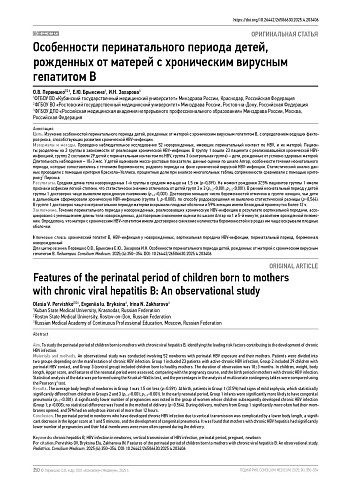
Особенности перинатального периода детей, рожденных от матерей с хроническим вирусным гепатитом В
Особенности перинатального периода детей, рожденных от матерей с хроническим вирусным гепатитом В
Первишко О.В., Брыксина Е.Ю., Захарова И.Н. Особенности перинатального периода детей, рожденных от матерей с хроническим вирусным гепатитом В. Педиатрия. Consilium Medicum. 2025;(4):350–354. DOI: 10.26442/26586630.2025.4.203406
________________________________________________
Материалы доступны только для специалистов сферы здравоохранения.
Чтобы посмотреть материал полностью
Авторизуйтесь
или зарегистрируйтесь.
Аннотация
Цель. Изучение особенностей перинатального периода детей, рожденных от матерей с хроническим вирусным гепатитом В, с определением ведущих факторов риска, способствующих развитию хронической HBV-инфекции.
Материалы и методы. Проведено наблюдательное исследование 52 новорожденных, имеющих перинатальный контакт по HBV, и их матерей. Пациенты разделены на 2 группы в зависимости от реализации хронической HBV-инфекции. В группу 1 вошли 23 пациента с реализовавшейся хронической HBV-инфекцией, группу 2 составили 29 детей с перинатальным контактом по HBV, группа 3 (контрольная группа) – дети, рожденные от условно здоровых матерей. Длительность наблюдения – 18±3 мес. У детей оценивали массо-ростовые показатели, данные оценки по шкале Апгар, особенности течения неонатального периода, которые сопоставлялись с течением беременности, родового периода на фоне хронической вирусной HBV-инфекции. Статистический анализ данных проводили с помощью критерия Краскела–Уоллиса, процентные доли при анализе многопольных таблиц сопряженности сравнивали с помощью критерия χ2 Пирсона.
Результаты. Средняя длина тела новорожденных 1-й группы в среднем меньше на 1,5 см (p=0,891). На момент рождения 37,5% пациентов группы 1 имели признаки асфиксии легкой степени, что статистически значимо отличалось от детей групп 2 и 3 (p1–2<0,001; p2–3<0,001). В ранний неонатальный период у детей группы 1 достоверно чаще выявляли врожденную пневмонию (p1–2<0,001). Достоверно меньшее число беременностей отмечено в группе женщин, чьи дети в дальнейшем сформировали хроническую HBV-инфекцию (группа 1; p<0,008), по способу родоразрешения не выявлено статистической разницы (р=0,564). В группе 1 достоверно чаще в интранатальном периоде матерям вскрывали плодные оболочки и 59% женщин имели безводный промежуток более 12 ч.
Заключение. Течение перинатального периода у новорожденных, реализовавших хроническую HBV-инфекцию в результате вертикальной передачи, ассоциировано с уменьшением длины тела новорожденных, достоверным снижением оценки по шкале Апгар на 1 и 5-й минуте, развитием врожденной пневмонии. Определено, что матери с хроническим HBV-гепатитом имели достоверное снижение количества беременностей и в родах им чаще вскрывали плодные оболочки.
Ключевые слова: хронический гепатит В, HBV-инфекция у новорожденных, вертикальная передача HBV-инфекции, перинатальный период, беременная, новорожденный
Materials and methods. An observational study was conducted involving 52 newborns with perinatal HBV exposure and their mothers. Patients were divided into two groups depending on the manifestation of chronic HBV infection. Group 1 included 23 patients with active chronic HBV infection, Group 2 included 29 children with perinatal HBV contact, and Group 3 (control group) included children born to healthy mothers. The duration of observation was 18±3 months. In children, weight, body length, Apgar score, and features of the neonatal period were assessed, comparing with the pregnancy course, and the birth period in mothers with chronic HBV infection. Statistical analysis of the data was performed using the Kruskal–Wallis test, and the percentages in the analysis of multivariate contingency tables were compared using the Pearson χ2 test.
Results. The average body length of newborns in Group 1 was 1.5 cm less (p=0.891). At birth, patients in Group 1 (37.5%) had signs of mild asphyxia, which statistically significantly differed from children in Groups 2 and 3 (p1–2<0.001; p2–3<0.001). In the early neonatal period, Group 1 infants were significantly more likely to have congenital pneumonia (p1–2<0.001). A significantly lower number of pregnancies was noted in the group of women whose children subsequently developed chronic HBV infection (Group 1; p<0.008); no statistical difference was found in the method of delivery (p=0.564). During delivery, mothers from Group 1 significantly more often had their membranes opened, and 59% had an anhydrous interval of more than 12 hours.
Conclusion. The perinatal period in newborns who have developed chronic HBV infection due to vertical transmission was complicated by a lower body length, a significant decrease in the Apgar score at 1 and 5 minutes, and the development of congenital pneumonia. It was found that mothers with chronic HBV hepatitis had significantly lower number of pregnancies and their fetal membranes were more often opened during the delivery.
Keywords: chronic hepatitis B, HBV infection in newborns, vertical transmission of HBV infection, perinatal period, pregnant, newborn
Материалы и методы. Проведено наблюдательное исследование 52 новорожденных, имеющих перинатальный контакт по HBV, и их матерей. Пациенты разделены на 2 группы в зависимости от реализации хронической HBV-инфекции. В группу 1 вошли 23 пациента с реализовавшейся хронической HBV-инфекцией, группу 2 составили 29 детей с перинатальным контактом по HBV, группа 3 (контрольная группа) – дети, рожденные от условно здоровых матерей. Длительность наблюдения – 18±3 мес. У детей оценивали массо-ростовые показатели, данные оценки по шкале Апгар, особенности течения неонатального периода, которые сопоставлялись с течением беременности, родового периода на фоне хронической вирусной HBV-инфекции. Статистический анализ данных проводили с помощью критерия Краскела–Уоллиса, процентные доли при анализе многопольных таблиц сопряженности сравнивали с помощью критерия χ2 Пирсона.
Результаты. Средняя длина тела новорожденных 1-й группы в среднем меньше на 1,5 см (p=0,891). На момент рождения 37,5% пациентов группы 1 имели признаки асфиксии легкой степени, что статистически значимо отличалось от детей групп 2 и 3 (p1–2<0,001; p2–3<0,001). В ранний неонатальный период у детей группы 1 достоверно чаще выявляли врожденную пневмонию (p1–2<0,001). Достоверно меньшее число беременностей отмечено в группе женщин, чьи дети в дальнейшем сформировали хроническую HBV-инфекцию (группа 1; p<0,008), по способу родоразрешения не выявлено статистической разницы (р=0,564). В группе 1 достоверно чаще в интранатальном периоде матерям вскрывали плодные оболочки и 59% женщин имели безводный промежуток более 12 ч.
Заключение. Течение перинатального периода у новорожденных, реализовавших хроническую HBV-инфекцию в результате вертикальной передачи, ассоциировано с уменьшением длины тела новорожденных, достоверным снижением оценки по шкале Апгар на 1 и 5-й минуте, развитием врожденной пневмонии. Определено, что матери с хроническим HBV-гепатитом имели достоверное снижение количества беременностей и в родах им чаще вскрывали плодные оболочки.
Ключевые слова: хронический гепатит В, HBV-инфекция у новорожденных, вертикальная передача HBV-инфекции, перинатальный период, беременная, новорожденный
________________________________________________
Materials and methods. An observational study was conducted involving 52 newborns with perinatal HBV exposure and their mothers. Patients were divided into two groups depending on the manifestation of chronic HBV infection. Group 1 included 23 patients with active chronic HBV infection, Group 2 included 29 children with perinatal HBV contact, and Group 3 (control group) included children born to healthy mothers. The duration of observation was 18±3 months. In children, weight, body length, Apgar score, and features of the neonatal period were assessed, comparing with the pregnancy course, and the birth period in mothers with chronic HBV infection. Statistical analysis of the data was performed using the Kruskal–Wallis test, and the percentages in the analysis of multivariate contingency tables were compared using the Pearson χ2 test.
Results. The average body length of newborns in Group 1 was 1.5 cm less (p=0.891). At birth, patients in Group 1 (37.5%) had signs of mild asphyxia, which statistically significantly differed from children in Groups 2 and 3 (p1–2<0.001; p2–3<0.001). In the early neonatal period, Group 1 infants were significantly more likely to have congenital pneumonia (p1–2<0.001). A significantly lower number of pregnancies was noted in the group of women whose children subsequently developed chronic HBV infection (Group 1; p<0.008); no statistical difference was found in the method of delivery (p=0.564). During delivery, mothers from Group 1 significantly more often had their membranes opened, and 59% had an anhydrous interval of more than 12 hours.
Conclusion. The perinatal period in newborns who have developed chronic HBV infection due to vertical transmission was complicated by a lower body length, a significant decrease in the Apgar score at 1 and 5 minutes, and the development of congenital pneumonia. It was found that mothers with chronic HBV hepatitis had significantly lower number of pregnancies and their fetal membranes were more often opened during the delivery.
Keywords: chronic hepatitis B, HBV infection in newborns, vertical transmission of HBV infection, perinatal period, pregnant, newborn
Полный текст
Список литературы
1. World Health Organization. Interim guidance for country validation of viral hepatitis elimination. 2023. Available at: https://www.who.int/publications/i/item/9789240078635. Accessed: 15.01.2025.
2. Цапяк Т.А., Кляритская И.Л., Григоренко Е.И., и др. Особенности взглядов и подходов к ведению вирусных гепатитов во время беременности (часть 2). Крымский терапевтический журнал. 2022;(2):20-6 [Tsapyak TA, Kliaritskaia IL, Grigorenko EI. Features of the course and approaches to the management of viral hepatitis during pregnancy (part 2). Krymskii Terapevticheskii Zhurnal. 2022;(2):20-6 (in Russian)]. DOI:10.37279/2307-5236
3. Шилова И.В., Горячева Л.Г., Ефремова Н.А., Эсауленко Е.В. Успехи и проблемы профилактики гепатита В у детей. Новые пути решения. Медицина экстремальных ситуаций. 2019;21(3):403-9 [Shilova IV, Goriacheva LG, Efremova NA, Esaulenko EV. Successes and problems of hepatitis b prophylaxis in children. New approaches for a solution. Meditsina Ekstremalnykh Situatsii. 2019;21(3):403-9 (in Russian)]. EDN:CPWUGO
4. Chen HL, Jourdain G. Prevention of HBV infection. Clin Liv Dis (Hoboken). 2024;23(1):e0194. DOI:10.1097/CLD.0000000000000194
5. Yang TU, Vargas-Zambrano JC, Park HA, et al. Effect of the interval between birth and second dose of hepatitis B vaccine on perinatal transmission of hepatitis B virus. Hum Vaccin Immunother. 2023;19(3):2278940. DOI:10.1080/21645515.2023.2278940
6. Lao TT. Hepatitis B - chronic carrier status and pregnancy outcomes: an obstetric perspective. Best Pract Res Clin Obstet Gynaecol. 2020;68:66-77. DOI:10.1016/j.bpobgyn.2020.03.006
7. Nemoda Z, Szyf M. Epigenetic alterations and prenatal maternal depression. Birth Defects Res. 2017;109(12):888-97. DOI:10.1002/bdr2.1081
8. Vanwolleghem T, Adomati T, Van Hees S, Janssen H. Humoral immunity in hepatitis B virus infection: Rehabilitating the B in HBV. JHEP Rep. 2021;4(2):100398. DOI:10.1016/j.jhepr.2021.100398
9. Wang H, Fang JW, Gu ZW, et al. Application of hepatitis B immunoglobulin in prevention of mother-to-child transmission of chronic hepatitis B in HBsAg- and HBeAg-positive mother. J Obstet Gynaecol. 2022;42(5):877-82. DOI:10.1080/01443615.2021.1946495
10. Liang C, Li N, Song S, et al. The effect of the time of combined immunoprophylaxis on the prevention of transmission of hepatitis B virus from mother to child: a retrospective study. J Matern Fetal Neonatal Med. 2023;36(2):2257837. DOI:10.1080/14767058.2023.2278940
11. Safir A, Levy A, Sikuler E, Sheiner E. Maternal hepatitis B virus or hepatitis C virus carrier status as an independent risk factor for adverse perinatal outcome. Liver Int. 2010;30(5):765-70. DOI:10.1111/j.1478-3231.2010.02218.x
12. Sun Q, Lao TT, Du M, et al. Chronic maternal hepatitis B virus infection and pregnancy outcome: a single center study in Kunming, China. BMC Infect Dis. 2021;21(1):253. DOI:10.1186/s12879-021-05946-7
13. Jourdain G, Ngo-Giang-Huong N, Harrison L, et al. Tenofovir versus placebo to prevent perinatal transmission of hepatitis B. N Engl J Med. 2018;378(10):911-23. DOI:10.1056/NEJMoa1708131
14. Perepelitsa SA. Etiologic and Pathogenic Perinatal Factors for the Development of Intrauterine Infections in Newborns (Review). General Reanimatology. 2018;14(3):54-67. DOI:10.15360/1813-9779-2018-3-54-67
15. Hong M, Sandalova E, Low D, et al. Trained immunity in newborn infants of HBV-infected mothers. Nat Commun. 2015;6(6588). DOI:10.1038/ncomms7588
16. Bai H, Zhang L, Ma L, et al. Relationship of hepatitis B virus infection of placental barrier and hepatitis B virus intra-uterine transmission mechanism. World J Gastroenterol. 2007;13(26):3625-30. DOI:10.3748/wjg.v13.i26.3625
17. Yi W, Pan CQ, Hao J, et al. Risk of vertical transmission of hepatitis B after amniocentesis in HBs antigen-positive mothers. J Hepatol. 2014;60(3):523-9. DOI:10.1016/j.jhep.2013.11.008
18. Siakwa M, Kpikpitse Mupepi D, Mohamed SS. Neonatal sepsis in rural Ghana: a case control study of risk factors in a birth cohort. Int J Res Med Health Sci. 2014;4(5):77-88.
2. Tsapyak TA, Kliaritskaia IL, Grigorenko EI. Features of the course and approaches to the management of viral hepatitis during pregnancy (part 2). Krymskii Terapevticheskii Zhurnal. 2022;(2):20-6 (in Russian). DOI:10.37279/2307-5236
3. Shilova IV, Goriacheva LG, Efremova NA, Esaulenko EV. Successes and problems of hepatitis b prophylaxis in children. New approaches for a solution. Meditsina Ekstremalnykh Situatsii. 2019;21(3):403-9 (in Russian). EDN:CPWUGO
4. Chen HL, Jourdain G. Prevention of HBV infection. Clin Liv Dis (Hoboken). 2024;23(1):e0194. DOI:10.1097/CLD.0000000000000194
5. Yang TU, Vargas-Zambrano JC, Park HA, et al. Effect of the interval between birth and second dose of hepatitis B vaccine on perinatal transmission of hepatitis B virus. Hum Vaccin Immunother. 2023;19(3):2278940. DOI:10.1080/21645515.2023.2278940
6. Lao TT. Hepatitis B - chronic carrier status and pregnancy outcomes: an obstetric perspective. Best Pract Res Clin Obstet Gynaecol. 2020;68:66-77. DOI:10.1016/j.bpobgyn.2020.03.006
7. Nemoda Z, Szyf M. Epigenetic alterations and prenatal maternal depression. Birth Defects Res. 2017;109(12):888-97. DOI:10.1002/bdr2.1081
8. Vanwolleghem T, Adomati T, Van Hees S, Janssen H. Humoral immunity in hepatitis B virus infection: Rehabilitating the B in HBV. JHEP Rep. 2021;4(2):100398. DOI:10.1016/j.jhepr.2021.100398
9. Wang H, Fang JW, Gu ZW, et al. Application of hepatitis B immunoglobulin in prevention of mother-to-child transmission of chronic hepatitis B in HBsAg- and HBeAg-positive mother. J Obstet Gynaecol. 2022;42(5):877-82. DOI:10.1080/01443615.2021.1946495
10. Liang C, Li N, Song S, et al. The effect of the time of combined immunoprophylaxis on the prevention of transmission of hepatitis B virus from mother to child: a retrospective study. J Matern Fetal Neonatal Med. 2023;36(2):2257837. DOI:10.1080/14767058.2023.2278940
11. Safir A, Levy A, Sikuler E, Sheiner E. Maternal hepatitis B virus or hepatitis C virus carrier status as an independent risk factor for adverse perinatal outcome. Liver Int. 2010;30(5):765-70. DOI:10.1111/j.1478-3231.2010.02218.x
12. Sun Q, Lao TT, Du M, et al. Chronic maternal hepatitis B virus infection and pregnancy outcome: a single center study in Kunming, China. BMC Infect Dis. 2021;21(1):253. DOI:10.1186/s12879-021-05946-7
13. Jourdain G, Ngo-Giang-Huong N, Harrison L, et al. Tenofovir versus placebo to prevent perinatal transmission of hepatitis B. N Engl J Med. 2018;378(10):911-23. DOI:10.1056/NEJMoa1708131
14. Perepelitsa SA. Etiologic and Pathogenic Perinatal Factors for the Development of Intrauterine Infections in Newborns (Review). General Reanimatology. 2018;14(3):54-67. DOI:10.15360/1813-9779-2018-3-54-67
15. Hong M, Sandalova E, Low D, et al. Trained immunity in newborn infants of HBV-infected mothers. Nat Commun. 2015;6(6588). DOI:10.1038/ncomms7588
16. Bai H, Zhang L, Ma L, et al. Relationship of hepatitis B virus infection of placental barrier and hepatitis B virus intra-uterine transmission mechanism. World J Gastroenterol. 2007;13(26):3625-30. DOI:10.3748/wjg.v13.i26.3625
17. Yi W, Pan CQ, Hao J, et al. Risk of vertical transmission of hepatitis B after amniocentesis in HBs antigen-positive mothers. J Hepatol. 2014;60(3):523-9. DOI:10.1016/j.jhep.2013.11.008
18. Siakwa M, Kpikpitse Mupepi D, Mohamed SS. Neonatal sepsis in rural Ghana: a case control study of risk factors in a birth cohort. Int J Res Med Health Sci. 2014;4(5):77-88.
2. Цапяк Т.А., Кляритская И.Л., Григоренко Е.И., и др. Особенности взглядов и подходов к ведению вирусных гепатитов во время беременности (часть 2). Крымский терапевтический журнал. 2022;(2):20-6 [Tsapyak TA, Kliaritskaia IL, Grigorenko EI. Features of the course and approaches to the management of viral hepatitis during pregnancy (part 2). Krymskii Terapevticheskii Zhurnal. 2022;(2):20-6 (in Russian)]. DOI:10.37279/2307-5236
3. Шилова И.В., Горячева Л.Г., Ефремова Н.А., Эсауленко Е.В. Успехи и проблемы профилактики гепатита В у детей. Новые пути решения. Медицина экстремальных ситуаций. 2019;21(3):403-9 [Shilova IV, Goriacheva LG, Efremova NA, Esaulenko EV. Successes and problems of hepatitis b prophylaxis in children. New approaches for a solution. Meditsina Ekstremalnykh Situatsii. 2019;21(3):403-9 (in Russian)]. EDN:CPWUGO
4. Chen HL, Jourdain G. Prevention of HBV infection. Clin Liv Dis (Hoboken). 2024;23(1):e0194. DOI:10.1097/CLD.0000000000000194
5. Yang TU, Vargas-Zambrano JC, Park HA, et al. Effect of the interval between birth and second dose of hepatitis B vaccine on perinatal transmission of hepatitis B virus. Hum Vaccin Immunother. 2023;19(3):2278940. DOI:10.1080/21645515.2023.2278940
6. Lao TT. Hepatitis B - chronic carrier status and pregnancy outcomes: an obstetric perspective. Best Pract Res Clin Obstet Gynaecol. 2020;68:66-77. DOI:10.1016/j.bpobgyn.2020.03.006
7. Nemoda Z, Szyf M. Epigenetic alterations and prenatal maternal depression. Birth Defects Res. 2017;109(12):888-97. DOI:10.1002/bdr2.1081
8. Vanwolleghem T, Adomati T, Van Hees S, Janssen H. Humoral immunity in hepatitis B virus infection: Rehabilitating the B in HBV. JHEP Rep. 2021;4(2):100398. DOI:10.1016/j.jhepr.2021.100398
9. Wang H, Fang JW, Gu ZW, et al. Application of hepatitis B immunoglobulin in prevention of mother-to-child transmission of chronic hepatitis B in HBsAg- and HBeAg-positive mother. J Obstet Gynaecol. 2022;42(5):877-82. DOI:10.1080/01443615.2021.1946495
10. Liang C, Li N, Song S, et al. The effect of the time of combined immunoprophylaxis on the prevention of transmission of hepatitis B virus from mother to child: a retrospective study. J Matern Fetal Neonatal Med. 2023;36(2):2257837. DOI:10.1080/14767058.2023.2278940
11. Safir A, Levy A, Sikuler E, Sheiner E. Maternal hepatitis B virus or hepatitis C virus carrier status as an independent risk factor for adverse perinatal outcome. Liver Int. 2010;30(5):765-70. DOI:10.1111/j.1478-3231.2010.02218.x
12. Sun Q, Lao TT, Du M, et al. Chronic maternal hepatitis B virus infection and pregnancy outcome: a single center study in Kunming, China. BMC Infect Dis. 2021;21(1):253. DOI:10.1186/s12879-021-05946-7
13. Jourdain G, Ngo-Giang-Huong N, Harrison L, et al. Tenofovir versus placebo to prevent perinatal transmission of hepatitis B. N Engl J Med. 2018;378(10):911-23. DOI:10.1056/NEJMoa1708131
14. Perepelitsa SA. Etiologic and Pathogenic Perinatal Factors for the Development of Intrauterine Infections in Newborns (Review). General Reanimatology. 2018;14(3):54-67. DOI:10.15360/1813-9779-2018-3-54-67
15. Hong M, Sandalova E, Low D, et al. Trained immunity in newborn infants of HBV-infected mothers. Nat Commun. 2015;6(6588). DOI:10.1038/ncomms7588
16. Bai H, Zhang L, Ma L, et al. Relationship of hepatitis B virus infection of placental barrier and hepatitis B virus intra-uterine transmission mechanism. World J Gastroenterol. 2007;13(26):3625-30. DOI:10.3748/wjg.v13.i26.3625
17. Yi W, Pan CQ, Hao J, et al. Risk of vertical transmission of hepatitis B after amniocentesis in HBs antigen-positive mothers. J Hepatol. 2014;60(3):523-9. DOI:10.1016/j.jhep.2013.11.008
18. Siakwa M, Kpikpitse Mupepi D, Mohamed SS. Neonatal sepsis in rural Ghana: a case control study of risk factors in a birth cohort. Int J Res Med Health Sci. 2014;4(5):77-88.
________________________________________________
2. Tsapyak TA, Kliaritskaia IL, Grigorenko EI. Features of the course and approaches to the management of viral hepatitis during pregnancy (part 2). Krymskii Terapevticheskii Zhurnal. 2022;(2):20-6 (in Russian). DOI:10.37279/2307-5236
3. Shilova IV, Goriacheva LG, Efremova NA, Esaulenko EV. Successes and problems of hepatitis b prophylaxis in children. New approaches for a solution. Meditsina Ekstremalnykh Situatsii. 2019;21(3):403-9 (in Russian). EDN:CPWUGO
4. Chen HL, Jourdain G. Prevention of HBV infection. Clin Liv Dis (Hoboken). 2024;23(1):e0194. DOI:10.1097/CLD.0000000000000194
5. Yang TU, Vargas-Zambrano JC, Park HA, et al. Effect of the interval between birth and second dose of hepatitis B vaccine on perinatal transmission of hepatitis B virus. Hum Vaccin Immunother. 2023;19(3):2278940. DOI:10.1080/21645515.2023.2278940
6. Lao TT. Hepatitis B - chronic carrier status and pregnancy outcomes: an obstetric perspective. Best Pract Res Clin Obstet Gynaecol. 2020;68:66-77. DOI:10.1016/j.bpobgyn.2020.03.006
7. Nemoda Z, Szyf M. Epigenetic alterations and prenatal maternal depression. Birth Defects Res. 2017;109(12):888-97. DOI:10.1002/bdr2.1081
8. Vanwolleghem T, Adomati T, Van Hees S, Janssen H. Humoral immunity in hepatitis B virus infection: Rehabilitating the B in HBV. JHEP Rep. 2021;4(2):100398. DOI:10.1016/j.jhepr.2021.100398
9. Wang H, Fang JW, Gu ZW, et al. Application of hepatitis B immunoglobulin in prevention of mother-to-child transmission of chronic hepatitis B in HBsAg- and HBeAg-positive mother. J Obstet Gynaecol. 2022;42(5):877-82. DOI:10.1080/01443615.2021.1946495
10. Liang C, Li N, Song S, et al. The effect of the time of combined immunoprophylaxis on the prevention of transmission of hepatitis B virus from mother to child: a retrospective study. J Matern Fetal Neonatal Med. 2023;36(2):2257837. DOI:10.1080/14767058.2023.2278940
11. Safir A, Levy A, Sikuler E, Sheiner E. Maternal hepatitis B virus or hepatitis C virus carrier status as an independent risk factor for adverse perinatal outcome. Liver Int. 2010;30(5):765-70. DOI:10.1111/j.1478-3231.2010.02218.x
12. Sun Q, Lao TT, Du M, et al. Chronic maternal hepatitis B virus infection and pregnancy outcome: a single center study in Kunming, China. BMC Infect Dis. 2021;21(1):253. DOI:10.1186/s12879-021-05946-7
13. Jourdain G, Ngo-Giang-Huong N, Harrison L, et al. Tenofovir versus placebo to prevent perinatal transmission of hepatitis B. N Engl J Med. 2018;378(10):911-23. DOI:10.1056/NEJMoa1708131
14. Perepelitsa SA. Etiologic and Pathogenic Perinatal Factors for the Development of Intrauterine Infections in Newborns (Review). General Reanimatology. 2018;14(3):54-67. DOI:10.15360/1813-9779-2018-3-54-67
15. Hong M, Sandalova E, Low D, et al. Trained immunity in newborn infants of HBV-infected mothers. Nat Commun. 2015;6(6588). DOI:10.1038/ncomms7588
16. Bai H, Zhang L, Ma L, et al. Relationship of hepatitis B virus infection of placental barrier and hepatitis B virus intra-uterine transmission mechanism. World J Gastroenterol. 2007;13(26):3625-30. DOI:10.3748/wjg.v13.i26.3625
17. Yi W, Pan CQ, Hao J, et al. Risk of vertical transmission of hepatitis B after amniocentesis in HBs antigen-positive mothers. J Hepatol. 2014;60(3):523-9. DOI:10.1016/j.jhep.2013.11.008
18. Siakwa M, Kpikpitse Mupepi D, Mohamed SS. Neonatal sepsis in rural Ghana: a case control study of risk factors in a birth cohort. Int J Res Med Health Sci. 2014;4(5):77-88.
Авторы
О.В. Первишко*1, Е.Ю. Брыксина2, И.Н. Захарова3
1ФГБОУ ВО «Кубанский государственный медицинский университет» Минздрава России, Краснодар, Российская Федерация
2ФГБОУ ВО «Ростовский государственный медицинский университет» Минздрава России, Ростов-на-Дону, Российская Федерация
3ФГБОУ ДПО «Российская медицинская академия непрерывного профессионального образования» Минздрава России, Москва, Российская Федерация
*ole-pervishko@yandex.ru
1Kuban State Medical University, Krasnodar, Russian Federation
2Rostov State Medical University, Rostov-on-Don, Russian Federation
3Russian Medical Academy of Continuous Professional Education, Moscow, Russian Federation
*ole-pervishko@yandex.ru
1ФГБОУ ВО «Кубанский государственный медицинский университет» Минздрава России, Краснодар, Российская Федерация
2ФГБОУ ВО «Ростовский государственный медицинский университет» Минздрава России, Ростов-на-Дону, Российская Федерация
3ФГБОУ ДПО «Российская медицинская академия непрерывного профессионального образования» Минздрава России, Москва, Российская Федерация
*ole-pervishko@yandex.ru
________________________________________________
1Kuban State Medical University, Krasnodar, Russian Federation
2Rostov State Medical University, Rostov-on-Don, Russian Federation
3Russian Medical Academy of Continuous Professional Education, Moscow, Russian Federation
*ole-pervishko@yandex.ru
Цель портала OmniDoctor – предоставление профессиональной информации врачам, провизорам и фармацевтам.