

Материалы доступны только для специалистов сферы здравоохранения.
Чтобы посмотреть материал полностью
Авторизуйтесь
или зарегистрируйтесь.
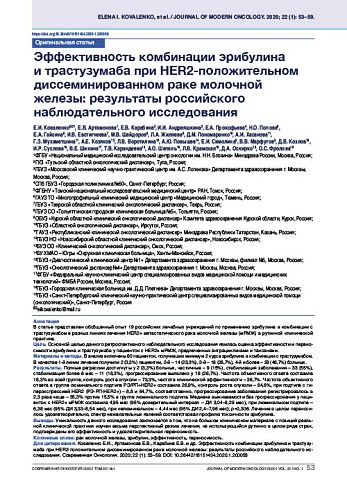
Эффективность комбинации эрибулина и трастузумаба при HER2-положительном диссеминированном раке молочной железы: результаты российского наблюдательного исследования
Эффективность комбинации эрибулина и трастузумаба при HER2-положительном диссеминированном раке молочной железы: результаты российского наблюдательного исследования
Коваленко Е.И., Артамонова Е.В., Карабина Е.В. и др. Эффективность комбинации эрибулина и трастузумаба при HER2-положительном диссеминированном раке молочной железы: результаты российского наблюдательного исследования. Современная Онкология. 2020; 22 (1): 29–35. DOI: 10.26442/18151434.2020.1.200058
________________________________________________
Материалы доступны только для специалистов сферы здравоохранения.
Чтобы посмотреть материал полностью
Авторизуйтесь
или зарегистрируйтесь.
Аннотация
В статье представлен обобщенный опыт 19 российских лечебных учреждений по применению эрибулина в комбинации с
трастузумабом в разных линиях лечения HER2+ метастатического рака молочной железы (мРМЖ) в рутинной клинической практике.
Цель. Основной целью данного ретроспективного наблюдательного исследования явилась оценка эффективности и переносимости эрибулина и трастузумаба у пациенток с HER2+ мРМЖ, предлеченных антрациклинами и таксанами.
Материалы и методы. В анализ включены 60 пациенток, получивших минимум 2 курса эрибулина в комбинации с трастузумабом. В качестве 1-й линии лечение получили 2 (3,3%) пациентки, 2-й – 14 (23,3%), 3-й – 16 (26,7%), 4-й и более – 28 (46,7%) больных.
Результаты. Полные регрессии достигнуты у 2 (3,3%) больных, частичные – 9 (15%), стабилизация заболевания – 33 (55%), стабилизация более 6 мес – 11 (18,3%), прогрессирование выявлено у 16 (26,7%). Частота объективного ответа составила 18,3% во всей группе, контроль роста опухоли – 73,3%, частота клинической эффективности – 36,7%. Частота объективного ответа в группе люминального подтипа РЭ/РП+HER2+ составила 26,9%, контроль роста опухоли – 84,6%, при подтипе с гиперэкспрессией HER2 (РЭ-РП-HER2+) – 8,8 и 64,7%, соответственно, прогрессирование заболевания регистрировалось в
2,3 раза чаще – 35,3% против 15,5% в группе люминального подтипа. Медиана выживаемости без прогрессирования у пациенток с HER2+ мРМЖ составила 4,95 мес (95% доверительный интервал – ДИ 3,04–8,29 мес), при люминальном подтипе – 6,38 мес (95% ДИ 3,33–8,54 мес), при нелюминальном – 4,44 мес (95% ДИ 2,4–7,96 мес); р=0,306. Лечение в целом переносилось удовлетворительно, спектр нежелательных явлений соответствовал профилю токсичности эрибулина.
Выводы. Уникальность данного исследования заключается в том, что на большом клиническом материале с позиций реальной клинической практики изучен весьма перспективный режим лечения, не использующийся рутинно в целом ряде стран, подтверждены его эффективность и удовлетворительная переносимость.
Ключевые слова: рак молочной железы, эрибулин, эффективность, переносимость.
Для цитирования:
Aim. The main objective of this retrospective observational study was to evaluate the efficacy and tolerability of eribulin and trastuzumab combo in HER2+ breast cancer patients pretreated with anthracyclines and taxanes. The analysis included 60 patients who received at least 2 cycles of eribulin in combination with trastuzumab. 2 patients (3.3%) received treatment as the 1st line, as the 2nd – 14 (23.3%), as the 3rd – 16 (26.7%), and as the 4th and more – 28 (46.7%).
Materials and methods. Complete response was achieved in 2 (3.3%) patients, partial response in 9 (15%), stable disease in 33 (55%), stabilization for more than 6 months in 11 (18.3%), disease progression was detected in 16 (26.7%) patients. The objective response rate was 18.3% in the whole group, the clinical benefit rate – 36.7%.
Results. The objective response rate in the group of the luminal subtype (ER/PR+HER2+) was 26.9%, in HER2-overexpressed subtype (ER-PR-HER2+) – 8.8% and 64.7%, respectively, disease progression was recorded 2.3 times more often – 35.3% versus 15.5% in the luminal subtype group. The median progression-free survival in patients with HER2+ breast cancer was 4.95 months (95% confidence interval – CI 3.04–8.29 months), in luminal subtype – 6.38 months (95% CI 3.33–8.54 months), in non-luminal – 4.44 months (95% CI 2.4–7.96 months); p=0.306. The treatment was well tolerated, the spectrum of adverse events corresponded to the eribulin toxicity profile.
Conclusions. The uniqueness of this study lies in the fact that on a large clinical material from the standpoint of real clinical practice, a very promising treatment regimen that is not used routinely in a number of countries has been studied, its effectiveness and satisfactory tolerance have been confirmed.
Key words: breast cancer, eribulin, efficacy, tolerance.
трастузумабом в разных линиях лечения HER2+ метастатического рака молочной железы (мРМЖ) в рутинной клинической практике.
Цель. Основной целью данного ретроспективного наблюдательного исследования явилась оценка эффективности и переносимости эрибулина и трастузумаба у пациенток с HER2+ мРМЖ, предлеченных антрациклинами и таксанами.
Материалы и методы. В анализ включены 60 пациенток, получивших минимум 2 курса эрибулина в комбинации с трастузумабом. В качестве 1-й линии лечение получили 2 (3,3%) пациентки, 2-й – 14 (23,3%), 3-й – 16 (26,7%), 4-й и более – 28 (46,7%) больных.
Результаты. Полные регрессии достигнуты у 2 (3,3%) больных, частичные – 9 (15%), стабилизация заболевания – 33 (55%), стабилизация более 6 мес – 11 (18,3%), прогрессирование выявлено у 16 (26,7%). Частота объективного ответа составила 18,3% во всей группе, контроль роста опухоли – 73,3%, частота клинической эффективности – 36,7%. Частота объективного ответа в группе люминального подтипа РЭ/РП+HER2+ составила 26,9%, контроль роста опухоли – 84,6%, при подтипе с гиперэкспрессией HER2 (РЭ-РП-HER2+) – 8,8 и 64,7%, соответственно, прогрессирование заболевания регистрировалось в
2,3 раза чаще – 35,3% против 15,5% в группе люминального подтипа. Медиана выживаемости без прогрессирования у пациенток с HER2+ мРМЖ составила 4,95 мес (95% доверительный интервал – ДИ 3,04–8,29 мес), при люминальном подтипе – 6,38 мес (95% ДИ 3,33–8,54 мес), при нелюминальном – 4,44 мес (95% ДИ 2,4–7,96 мес); р=0,306. Лечение в целом переносилось удовлетворительно, спектр нежелательных явлений соответствовал профилю токсичности эрибулина.
Выводы. Уникальность данного исследования заключается в том, что на большом клиническом материале с позиций реальной клинической практики изучен весьма перспективный режим лечения, не использующийся рутинно в целом ряде стран, подтверждены его эффективность и удовлетворительная переносимость.
Ключевые слова: рак молочной железы, эрибулин, эффективность, переносимость.
Для цитирования:
________________________________________________
Aim. The main objective of this retrospective observational study was to evaluate the efficacy and tolerability of eribulin and trastuzumab combo in HER2+ breast cancer patients pretreated with anthracyclines and taxanes. The analysis included 60 patients who received at least 2 cycles of eribulin in combination with trastuzumab. 2 patients (3.3%) received treatment as the 1st line, as the 2nd – 14 (23.3%), as the 3rd – 16 (26.7%), and as the 4th and more – 28 (46.7%).
Materials and methods. Complete response was achieved in 2 (3.3%) patients, partial response in 9 (15%), stable disease in 33 (55%), stabilization for more than 6 months in 11 (18.3%), disease progression was detected in 16 (26.7%) patients. The objective response rate was 18.3% in the whole group, the clinical benefit rate – 36.7%.
Results. The objective response rate in the group of the luminal subtype (ER/PR+HER2+) was 26.9%, in HER2-overexpressed subtype (ER-PR-HER2+) – 8.8% and 64.7%, respectively, disease progression was recorded 2.3 times more often – 35.3% versus 15.5% in the luminal subtype group. The median progression-free survival in patients with HER2+ breast cancer was 4.95 months (95% confidence interval – CI 3.04–8.29 months), in luminal subtype – 6.38 months (95% CI 3.33–8.54 months), in non-luminal – 4.44 months (95% CI 2.4–7.96 months); p=0.306. The treatment was well tolerated, the spectrum of adverse events corresponded to the eribulin toxicity profile.
Conclusions. The uniqueness of this study lies in the fact that on a large clinical material from the standpoint of real clinical practice, a very promising treatment regimen that is not used routinely in a number of countries has been studied, its effectiveness and satisfactory tolerance have been confirmed.
Key words: breast cancer, eribulin, efficacy, tolerance.
Полный текст
Список литературы
1. Slamon DJ, Clark GM, Wong SG et al. Human breast cancer: correlation of relapse and survival with amplification of the HER-2/neu oncogene. Science 1987; 235: 177–82.
2. Slamon DJ, Leyland-Jones B, Shak S et al. Use of chemotherapy plus a monoclonal antibody against HER2 for metastatic breast cancer that overexpresses HER2. N Engl J Med 2001; 334: 783–92.
3. Keefe DL. Trastuzumab-associated cardiotoxicity. Cancer 2002; 95: 1592–600.
4. Cortazar P, Johnson JR, Justice R, Pazdur R. Metastatic breast cancer (MBC): FDA approval overview. Proc. ASCO 2008. J Clin Oncol 2008; 26: 15S (аbstr. 1013).
5. Peacock NW, Infante JR, Yardley DA et al. Phase II trial of weekly docetaxel, vinorelbine and trastuzumab in the first-line treatment of patients (pts) with HER-2-positive metastatic breast cancer (MBC). Proc. ASCO 2008. J Clin Oncol 2008; 26: 49S (abstr. 1032).
6. Kash J, Barlow WE, Albain KS et al. Phase II Southwest Oncology Group study of docetaxel and vinorelbine plus filgrastim with weekly trastuzumab for HER-2-positive stage IV breast cancer. Proc. ASCO 2008. J Clin Oncol 2008; 26: 49S (abstr. 1033).
7. Geyer CE, Forster J, Lindquist D et al. Lapatinib plus capecitabine for HER2-positive advanced breast cancer. N Engl J Med 2006; 355: 2733–43.
8. Swain SM, Baselga J, Kim SB et al. Pertuzumab, trastuzumab, and docetaxel in HER2-positive metastatic breast cancer. N Engl J Med 2015; 372: 724–34.
9. Lewis Phillips GD, Li G, Dugger DL et al. Targeting HER2-positive breast cancer with trastuzumab-DM1, an antibody-cytotoxic drug conjugate. Cancer Res 2008; 68: 9280–90.
10. Barok M, Tanner M, Koninki K et al. Trastuzumab-DM1 causes tumour growth inhibition by mitotic catastrophe in trastuzumab-resistant breast cancer cells in vivo. Breast Cancer Res 2011; 13: R46.
11. Verma S, Miles D, Gianni L et al. Trastuzumab emtansine for HER2-positive advanced breast cancer. N Engl J Med 2012; 367: 1783–91.
12. Krop IE, Kim SB, Martin AG et al. Trastuzumab emtansine versus treatment of physician’s choice in patients with previously treated HER2-positive metastatic breast cancer (TH3RESA): final overall survival results from a randomised open-label phase 3 trial. Lancet Oncol 2017; 18: 743–54.
13. Giordano SH, Temin S, Chandarlapaty S et al. Systemic Therapy for Patients With Advanced Human Epidermal Growth Factor Receptor 2–Positive Breast Cancer: ASCO Clinical Practice Guideline Update.
J Clin Oncol 2018; 36 (26): 2736–40.
14. Kaufman PA, Cortes J, Awada A et al. A phase III, open-label, randomized study of eribulin mesylate versus capecitabine in patients with locally advanced or metastatic breast cancer previously treated with anthracyclines and taxanes: subgroup analyses. J Clin Oncol 2013; 31 (Suppl.; abstr. 1049).
15. Twelves C, Cortes J, Vandat L et al. Efficacy of eribulin in women with metastatic breast cancer: a pooled analysis of two phase 3 studies. Breast Cancer Res Treat 2014; 148: 553–61.
16. Pivot Х, Marmé F, Koenigsberg R et al. Pooled analyses of eribulin in metastatic breast cancer patients with at least one prior chemotherapy. Ann Oncol 2016; 27 (8): 1525–31.
17. Wilks S, Puhalla S, O'Shaughnessy S et al. Phase 2, Multicenter, Single-Arm Study of Eribulin Mesylate With Trastuzumab as First-Line Therapy for Locally Recurrent or Metastatic HER2-Positive Breast Cancer. Clin Breast Cancer 2014; 14 (6): 405–12.
18. Халавен. Инструкция по применению лекарственного препарата для медицинского применения, утвержденная Минздравом России 15.06.2016.
[Khalaven. Instruktsiia po primeneniiu lekarstvennogo preparata dlia meditsinskogo primeneniia, utverzhdennaia Minzdravom Rossii 15.06.2016 (in Russian).]
19. Krop IE, Kim SB, González-Martín A et al. Trastuzumab emtansine versus treatment of physician's choice for pretreated HER2-positive advanced breast cancer (TH3RESA): a randomised, open-label, phase 3 trial. Lancet Oncol 2014; 15: 689–99.
20. Lutrino SE, Orlando L, Fontanella C et al. Eribulin plus trastuzumab in pretreated HER2-positive advanced breast cancer (ABC) patients: Results on safety and efficacy – An Italian multicenter experience.
J Clin Oncol 2016; 34 (Suppl. 15): e12087.
21. Mougalian SS, Copher R, McAllister L et al. Outcomes of real-world use of eribulin plus trastuzumab for HER2-positive metastatic breast cancer [abstract]. In: Proceedings of the 2018 San Antonio Breast Cancer Symposium; 2018 Dec 4–8; San Antonio, TX. Philadelphia (PA): AACR; Cancer Res 2019; 79 (Suppl. 4): Abstr. nr P6-17-28.
2. Slamon DJ, Leyland-Jones B, Shak S et al. Use of chemotherapy plus a monoclonal antibody against HER2 for metastatic breast cancer that overexpresses HER2. N Engl J Med 2001; 334: 783–92.
3. Keefe DL. Trastuzumab-associated cardiotoxicity. Cancer 2002; 95: 1592–600.
4. Cortazar P, Johnson JR, Justice R, Pazdur R. Metastatic breast cancer (MBC): FDA approval overview. Proc. ASCO 2008. J Clin Oncol 2008; 26: 15S (аbstr. 1013).
5. Peacock NW, Infante JR, Yardley DA et al. Phase II trial of weekly docetaxel, vinorelbine and trastuzumab in the first-line treatment of patients (pts) with HER-2-positive metastatic breast cancer (MBC). Proc. ASCO 2008. J Clin Oncol 2008; 26: 49S (abstr. 1032).
6. Kash J, Barlow WE, Albain KS et al. Phase II Southwest Oncology Group study of docetaxel and vinorelbine plus filgrastim with weekly trastuzumab for HER-2-positive stage IV breast cancer. Proc. ASCO 2008. J Clin Oncol 2008; 26: 49S (abstr. 1033).
7. Geyer CE, Forster J, Lindquist D et al. Lapatinib plus capecitabine for HER2-positive advanced breast cancer. N Engl J Med 2006; 355: 2733–43.
8. Swain SM, Baselga J, Kim SB et al. Pertuzumab, trastuzumab, and docetaxel in HER2-positive metastatic breast cancer. N Engl J Med 2015; 372: 724–34.
9. Lewis Phillips GD, Li G, Dugger DL et al. Targeting HER2-positive breast cancer with trastuzumab-DM1, an antibody-cytotoxic drug conjugate. Cancer Res 2008; 68: 9280–90.
10. Barok M, Tanner M, Koninki K et al. Trastuzumab-DM1 causes tumour growth inhibition by mitotic catastrophe in trastuzumab-resistant breast cancer cells in vivo. Breast Cancer Res 2011; 13: R46.
11. Verma S, Miles D, Gianni L et al. Trastuzumab emtansine for HER2-positive advanced breast cancer. N Engl J Med 2012; 367: 1783–91.
12. Krop IE, Kim SB, Martin AG et al. Trastuzumab emtansine versus treatment of physician’s choice in patients with previously treated HER2-positive metastatic breast cancer (TH3RESA): final overall survival results from a randomised open-label phase 3 trial. Lancet Oncol 2017; 18: 743–54.
13. Giordano SH, Temin S, Chandarlapaty S et al. Systemic Therapy for Patients With Advanced Human Epidermal Growth Factor Receptor 2–Positive Breast Cancer: ASCO Clinical Practice Guideline Update.
J Clin Oncol 2018; 36 (26): 2736–40.
14. Kaufman PA, Cortes J, Awada A et al. A phase III, open-label, randomized study of eribulin mesylate versus capecitabine in patients with locally advanced or metastatic breast cancer previously treated with anthracyclines and taxanes: subgroup analyses. J Clin Oncol 2013; 31 (Suppl.; abstr. 1049).
15. Twelves C, Cortes J, Vandat L et al. Efficacy of eribulin in women with metastatic breast cancer: a pooled analysis of two phase 3 studies. Breast Cancer Res Treat 2014; 148: 553–61.
16. Pivot Х, Marmé F, Koenigsberg R et al. Pooled analyses of eribulin in metastatic breast cancer patients with at least one prior chemotherapy. Ann Oncol 2016; 27 (8): 1525–31.
17. Wilks S, Puhalla S, O'Shaughnessy S et al. Phase 2, Multicenter, Single-Arm Study of Eribulin Mesylate With Trastuzumab as First-Line Therapy for Locally Recurrent or Metastatic HER2-Positive Breast Cancer. Clin Breast Cancer 2014; 14 (6): 405–12.
18. Khalaven. Instruktsiia po primeneniiu lekarstvennogo preparata dlia meditsinskogo primeneniia, utverzhdennaia Minzdravom Rossii 15.06.2016 (in Russian).
19. Krop IE, Kim SB, González-Martín A et al. Trastuzumab emtansine versus treatment of physician's choice for pretreated HER2-positive advanced breast cancer (TH3RESA): a randomised, open-label, phase 3 trial. Lancet Oncol 2014; 15: 689–99.
20. Lutrino SE, Orlando L, Fontanella C et al. Eribulin plus trastuzumab in pretreated HER2-positive advanced breast cancer (ABC) patients: Results on safety and efficacy – An Italian multicenter experience.
J Clin Oncol 2016; 34 (Suppl. 15): e12087.
21. Mougalian SS, Copher R, McAllister L et al. Outcomes of real-world use of eribulin plus trastuzumab for HER2-positive metastatic breast cancer [abstract]. In: Proceedings of the 2018 San Antonio Breast Cancer Symposium; 2018 Dec 4–8; San Antonio, TX. Philadelphia (PA): AACR; Cancer Res 2019; 79 (Suppl. 4): Abstr. nr P6-17-28.
2. Slamon DJ, Leyland-Jones B, Shak S et al. Use of chemotherapy plus a monoclonal antibody against HER2 for metastatic breast cancer that overexpresses HER2. N Engl J Med 2001; 334: 783–92.
3. Keefe DL. Trastuzumab-associated cardiotoxicity. Cancer 2002; 95: 1592–600.
4. Cortazar P, Johnson JR, Justice R, Pazdur R. Metastatic breast cancer (MBC): FDA approval overview. Proc. ASCO 2008. J Clin Oncol 2008; 26: 15S (аbstr. 1013).
5. Peacock NW, Infante JR, Yardley DA et al. Phase II trial of weekly docetaxel, vinorelbine and trastuzumab in the first-line treatment of patients (pts) with HER-2-positive metastatic breast cancer (MBC). Proc. ASCO 2008. J Clin Oncol 2008; 26: 49S (abstr. 1032).
6. Kash J, Barlow WE, Albain KS et al. Phase II Southwest Oncology Group study of docetaxel and vinorelbine plus filgrastim with weekly trastuzumab for HER-2-positive stage IV breast cancer. Proc. ASCO 2008. J Clin Oncol 2008; 26: 49S (abstr. 1033).
7. Geyer CE, Forster J, Lindquist D et al. Lapatinib plus capecitabine for HER2-positive advanced breast cancer. N Engl J Med 2006; 355: 2733–43.
8. Swain SM, Baselga J, Kim SB et al. Pertuzumab, trastuzumab, and docetaxel in HER2-positive metastatic breast cancer. N Engl J Med 2015; 372: 724–34.
9. Lewis Phillips GD, Li G, Dugger DL et al. Targeting HER2-positive breast cancer with trastuzumab-DM1, an antibody-cytotoxic drug conjugate. Cancer Res 2008; 68: 9280–90.
10. Barok M, Tanner M, Koninki K et al. Trastuzumab-DM1 causes tumour growth inhibition by mitotic catastrophe in trastuzumab-resistant breast cancer cells in vivo. Breast Cancer Res 2011; 13: R46.
11. Verma S, Miles D, Gianni L et al. Trastuzumab emtansine for HER2-positive advanced breast cancer. N Engl J Med 2012; 367: 1783–91.
12. Krop IE, Kim SB, Martin AG et al. Trastuzumab emtansine versus treatment of physician’s choice in patients with previously treated HER2-positive metastatic breast cancer (TH3RESA): final overall survival results from a randomised open-label phase 3 trial. Lancet Oncol 2017; 18: 743–54.
13. Giordano SH, Temin S, Chandarlapaty S et al. Systemic Therapy for Patients With Advanced Human Epidermal Growth Factor Receptor 2–Positive Breast Cancer: ASCO Clinical Practice Guideline Update.
J Clin Oncol 2018; 36 (26): 2736–40.
14. Kaufman PA, Cortes J, Awada A et al. A phase III, open-label, randomized study of eribulin mesylate versus capecitabine in patients with locally advanced or metastatic breast cancer previously treated with anthracyclines and taxanes: subgroup analyses. J Clin Oncol 2013; 31 (Suppl.; abstr. 1049).
15. Twelves C, Cortes J, Vandat L et al. Efficacy of eribulin in women with metastatic breast cancer: a pooled analysis of two phase 3 studies. Breast Cancer Res Treat 2014; 148: 553–61.
16. Pivot Х, Marmé F, Koenigsberg R et al. Pooled analyses of eribulin in metastatic breast cancer patients with at least one prior chemotherapy. Ann Oncol 2016; 27 (8): 1525–31.
17. Wilks S, Puhalla S, O'Shaughnessy S et al. Phase 2, Multicenter, Single-Arm Study of Eribulin Mesylate With Trastuzumab as First-Line Therapy for Locally Recurrent or Metastatic HER2-Positive Breast Cancer. Clin Breast Cancer 2014; 14 (6): 405–12.
18. Халавен. Инструкция по применению лекарственного препарата для медицинского применения, утвержденная Минздравом России 15.06.2016.
[Khalaven. Instruktsiia po primeneniiu lekarstvennogo preparata dlia meditsinskogo primeneniia, utverzhdennaia Minzdravom Rossii 15.06.2016 (in Russian).]
19. Krop IE, Kim SB, González-Martín A et al. Trastuzumab emtansine versus treatment of physician's choice for pretreated HER2-positive advanced breast cancer (TH3RESA): a randomised, open-label, phase 3 trial. Lancet Oncol 2014; 15: 689–99.
20. Lutrino SE, Orlando L, Fontanella C et al. Eribulin plus trastuzumab in pretreated HER2-positive advanced breast cancer (ABC) patients: Results on safety and efficacy – An Italian multicenter experience.
J Clin Oncol 2016; 34 (Suppl. 15): e12087.
21. Mougalian SS, Copher R, McAllister L et al. Outcomes of real-world use of eribulin plus trastuzumab for HER2-positive metastatic breast cancer [abstract]. In: Proceedings of the 2018 San Antonio Breast Cancer Symposium; 2018 Dec 4–8; San Antonio, TX. Philadelphia (PA): AACR; Cancer Res 2019; 79 (Suppl. 4): Abstr. nr P6-17-28.
________________________________________________
2. Slamon DJ, Leyland-Jones B, Shak S et al. Use of chemotherapy plus a monoclonal antibody against HER2 for metastatic breast cancer that overexpresses HER2. N Engl J Med 2001; 334: 783–92.
3. Keefe DL. Trastuzumab-associated cardiotoxicity. Cancer 2002; 95: 1592–600.
4. Cortazar P, Johnson JR, Justice R, Pazdur R. Metastatic breast cancer (MBC): FDA approval overview. Proc. ASCO 2008. J Clin Oncol 2008; 26: 15S (аbstr. 1013).
5. Peacock NW, Infante JR, Yardley DA et al. Phase II trial of weekly docetaxel, vinorelbine and trastuzumab in the first-line treatment of patients (pts) with HER-2-positive metastatic breast cancer (MBC). Proc. ASCO 2008. J Clin Oncol 2008; 26: 49S (abstr. 1032).
6. Kash J, Barlow WE, Albain KS et al. Phase II Southwest Oncology Group study of docetaxel and vinorelbine plus filgrastim with weekly trastuzumab for HER-2-positive stage IV breast cancer. Proc. ASCO 2008. J Clin Oncol 2008; 26: 49S (abstr. 1033).
7. Geyer CE, Forster J, Lindquist D et al. Lapatinib plus capecitabine for HER2-positive advanced breast cancer. N Engl J Med 2006; 355: 2733–43.
8. Swain SM, Baselga J, Kim SB et al. Pertuzumab, trastuzumab, and docetaxel in HER2-positive metastatic breast cancer. N Engl J Med 2015; 372: 724–34.
9. Lewis Phillips GD, Li G, Dugger DL et al. Targeting HER2-positive breast cancer with trastuzumab-DM1, an antibody-cytotoxic drug conjugate. Cancer Res 2008; 68: 9280–90.
10. Barok M, Tanner M, Koninki K et al. Trastuzumab-DM1 causes tumour growth inhibition by mitotic catastrophe in trastuzumab-resistant breast cancer cells in vivo. Breast Cancer Res 2011; 13: R46.
11. Verma S, Miles D, Gianni L et al. Trastuzumab emtansine for HER2-positive advanced breast cancer. N Engl J Med 2012; 367: 1783–91.
12. Krop IE, Kim SB, Martin AG et al. Trastuzumab emtansine versus treatment of physician’s choice in patients with previously treated HER2-positive metastatic breast cancer (TH3RESA): final overall survival results from a randomised open-label phase 3 trial. Lancet Oncol 2017; 18: 743–54.
13. Giordano SH, Temin S, Chandarlapaty S et al. Systemic Therapy for Patients With Advanced Human Epidermal Growth Factor Receptor 2–Positive Breast Cancer: ASCO Clinical Practice Guideline Update.
J Clin Oncol 2018; 36 (26): 2736–40.
14. Kaufman PA, Cortes J, Awada A et al. A phase III, open-label, randomized study of eribulin mesylate versus capecitabine in patients with locally advanced or metastatic breast cancer previously treated with anthracyclines and taxanes: subgroup analyses. J Clin Oncol 2013; 31 (Suppl.; abstr. 1049).
15. Twelves C, Cortes J, Vandat L et al. Efficacy of eribulin in women with metastatic breast cancer: a pooled analysis of two phase 3 studies. Breast Cancer Res Treat 2014; 148: 553–61.
16. Pivot Х, Marmé F, Koenigsberg R et al. Pooled analyses of eribulin in metastatic breast cancer patients with at least one prior chemotherapy. Ann Oncol 2016; 27 (8): 1525–31.
17. Wilks S, Puhalla S, O'Shaughnessy S et al. Phase 2, Multicenter, Single-Arm Study of Eribulin Mesylate With Trastuzumab as First-Line Therapy for Locally Recurrent or Metastatic HER2-Positive Breast Cancer. Clin Breast Cancer 2014; 14 (6): 405–12.
18. Khalaven. Instruktsiia po primeneniiu lekarstvennogo preparata dlia meditsinskogo primeneniia, utverzhdennaia Minzdravom Rossii 15.06.2016 (in Russian).
19. Krop IE, Kim SB, González-Martín A et al. Trastuzumab emtansine versus treatment of physician's choice for pretreated HER2-positive advanced breast cancer (TH3RESA): a randomised, open-label, phase 3 trial. Lancet Oncol 2014; 15: 689–99.
20. Lutrino SE, Orlando L, Fontanella C et al. Eribulin plus trastuzumab in pretreated HER2-positive advanced breast cancer (ABC) patients: Results on safety and efficacy – An Italian multicenter experience.
J Clin Oncol 2016; 34 (Suppl. 15): e12087.
21. Mougalian SS, Copher R, McAllister L et al. Outcomes of real-world use of eribulin plus trastuzumab for HER2-positive metastatic breast cancer [abstract]. In: Proceedings of the 2018 San Antonio Breast Cancer Symposium; 2018 Dec 4–8; San Antonio, TX. Philadelphia (PA): AACR; Cancer Res 2019; 79 (Suppl. 4): Abstr. nr P6-17-28.
Авторы
Е.И. Коваленко*1, Е.В. Артамонова1, Е.В. Карабина2, И.И. Андреяшкина3, Е.А. Прокофьева4, Н.О. Попова5, Е.А. Гайсина6, И.В. Евстигнеева7, М.В. Шайдоров8, Л.А. Жиляева9, Д.М. Пономаренко10, А.И. Хасанова11, Г.З. Мухаметшина11, А.Е. Козяков12, Л.В. Воротилина13, А.Ю. Повышев14, Е.И. Симолина5, В.В. Марфутов3, Д.В. Козлов15, И.Р. Суслова16, В.Е. Шикина17, Т.В. Карандеева18, А.О. Шепель18, Л.В. Крамская18, Д.А. Оскирко18, О.С. Фролова19
1 ФГБУ «Национальный медицинский исследовательский центр онкологии им. Н.Н. Блохина» Минздрава России, Москва, Россия;
2 ГУЗ «Тульский областной онкологический диспансер», Тула, Россия;
3 ГБУЗ «Московский клинический научно-практический центр им. А.С. Логинова» Департамента здравоохранения г. Москвы, Москва, Россия;
4 СПб ГБУЗ «Городская поликлиника №60», Санкт-Петербург, Россия;
5 ФГБНУ «Томский национальный исследовательский медицинский центр» РАН, Томск, Россия;
6 ГАУЗ ТО «Многопрофильный клинический медицинский центр «Медицинский город», Тюмень, Россия;
7 ГБУЗ «Тверской областной клинический онкологический диспансер», Тверь, Россия;
8 ГБУЗ СО «Тольяттинская городская клиническая больница №5», Тольятти, Россия;
9 ОБУЗ «Курский областной клинический онкологический диспансер» Комитета здравоохранения Курской области, Курск, Россия;
10 ГБУЗ «Областной онкологический диспансер», Иркутск, Россия;
11 ГАУЗ «Республиканский клинический онкологический диспансер» Минздрава Республики Татарстан, Казань, Россия;
12 ГБУЗ НО «Новосибирский областной клинический онкологический диспансер», Новосибирск, Россия;
13 БУЗ ОО «Клинический онкологический диспансер», Омск, Россия;
14 БУ ХМАО – Югры «Окружная клиническая больница», Ханты-Мансийск, Россия;
15 ГБУЗ «Диагностический клинический центр №1» Департамента здравоохранения г. Москвы, филиал №5, Москва, Россия;
16 ГБУЗ «Онкологический диспансер №4» Департамента здравоохранения г. Москвы, Москва, Россия;
17 ФГБУ «Федеральный научно-клинический центр специализированных видов медицинской помощи и медицинских технологий» ФМБА России, Москва, Россия;
18 ГБУЗ «Городская клиническая больница им. Д.Д. Плетнева» Департамента здравоохранения г. Москвы, Москва, Россия;
19 ГБУЗ «Санкт-Петербургский клинический научно-практический центр специализированных видов медицинской помощи (онкологический)», Санкт-Петербург, Россия
*eikovalenko@mail.ru
1 Blokhin National Medical Research Center of Oncology, Moscow, Russia;
2 Tula Regional Oncologic Dispensary, Tula, Russia;
3 Loginov Moscow Clinical Scientific Practical Center, Moscow, Russia;
4 City Clinic №60, Saint Petersburg, Russia;
5 Tomsk National Research Medical Center, Tomsk, Russia;
6 Multidisciplinary Clinical Medical Center "Medical City", Tyumen, Russia;
7 Tver Regional Clinical Oncology Center, Tver, Russia;
8 Togliatti City Clinical Hospital №5, Togliatti, Russia;
9 Kursk Regional Clinical Oncology Center, Kursk, Russia;
10 Regional Oncology Center, Irkutsk, Russia;
11 Republican Clinical Oncology Center, Kazan, Russia;
12 Novosibirsk Regional Clinical Oncology Center, Novosibirsk, Russia;
13 Clinical Oncology Center, Omsk, Russia;
14 District Clinical Hospital, Khanty-Mansiysk, Russia;
15 Diagnostic Clinical Center №1, branch №5, Moscow, Russia;
16 Oncology Center №4, Moscow, Russia;
17 Federal Research Center for Specialized Types of Medical Assistance and Medical Technologies, Moscow, Russia;
18 Pletnev City Clinical Hospital, Moscow, Russia;
19 Saint Petersburg Clinical Scientific and Practical Center for Specialized Types of Medical Care (Oncology), Saint Petersburg, Russia
*eikovalenko@mail.ru
1 ФГБУ «Национальный медицинский исследовательский центр онкологии им. Н.Н. Блохина» Минздрава России, Москва, Россия;
2 ГУЗ «Тульский областной онкологический диспансер», Тула, Россия;
3 ГБУЗ «Московский клинический научно-практический центр им. А.С. Логинова» Департамента здравоохранения г. Москвы, Москва, Россия;
4 СПб ГБУЗ «Городская поликлиника №60», Санкт-Петербург, Россия;
5 ФГБНУ «Томский национальный исследовательский медицинский центр» РАН, Томск, Россия;
6 ГАУЗ ТО «Многопрофильный клинический медицинский центр «Медицинский город», Тюмень, Россия;
7 ГБУЗ «Тверской областной клинический онкологический диспансер», Тверь, Россия;
8 ГБУЗ СО «Тольяттинская городская клиническая больница №5», Тольятти, Россия;
9 ОБУЗ «Курский областной клинический онкологический диспансер» Комитета здравоохранения Курской области, Курск, Россия;
10 ГБУЗ «Областной онкологический диспансер», Иркутск, Россия;
11 ГАУЗ «Республиканский клинический онкологический диспансер» Минздрава Республики Татарстан, Казань, Россия;
12 ГБУЗ НО «Новосибирский областной клинический онкологический диспансер», Новосибирск, Россия;
13 БУЗ ОО «Клинический онкологический диспансер», Омск, Россия;
14 БУ ХМАО – Югры «Окружная клиническая больница», Ханты-Мансийск, Россия;
15 ГБУЗ «Диагностический клинический центр №1» Департамента здравоохранения г. Москвы, филиал №5, Москва, Россия;
16 ГБУЗ «Онкологический диспансер №4» Департамента здравоохранения г. Москвы, Москва, Россия;
17 ФГБУ «Федеральный научно-клинический центр специализированных видов медицинской помощи и медицинских технологий» ФМБА России, Москва, Россия;
18 ГБУЗ «Городская клиническая больница им. Д.Д. Плетнева» Департамента здравоохранения г. Москвы, Москва, Россия;
19 ГБУЗ «Санкт-Петербургский клинический научно-практический центр специализированных видов медицинской помощи (онкологический)», Санкт-Петербург, Россия
*eikovalenko@mail.ru
________________________________________________
1 Blokhin National Medical Research Center of Oncology, Moscow, Russia;
2 Tula Regional Oncologic Dispensary, Tula, Russia;
3 Loginov Moscow Clinical Scientific Practical Center, Moscow, Russia;
4 City Clinic №60, Saint Petersburg, Russia;
5 Tomsk National Research Medical Center, Tomsk, Russia;
6 Multidisciplinary Clinical Medical Center "Medical City", Tyumen, Russia;
7 Tver Regional Clinical Oncology Center, Tver, Russia;
8 Togliatti City Clinical Hospital №5, Togliatti, Russia;
9 Kursk Regional Clinical Oncology Center, Kursk, Russia;
10 Regional Oncology Center, Irkutsk, Russia;
11 Republican Clinical Oncology Center, Kazan, Russia;
12 Novosibirsk Regional Clinical Oncology Center, Novosibirsk, Russia;
13 Clinical Oncology Center, Omsk, Russia;
14 District Clinical Hospital, Khanty-Mansiysk, Russia;
15 Diagnostic Clinical Center №1, branch №5, Moscow, Russia;
16 Oncology Center №4, Moscow, Russia;
17 Federal Research Center for Specialized Types of Medical Assistance and Medical Technologies, Moscow, Russia;
18 Pletnev City Clinical Hospital, Moscow, Russia;
19 Saint Petersburg Clinical Scientific and Practical Center for Specialized Types of Medical Care (Oncology), Saint Petersburg, Russia
*eikovalenko@mail.ru
Цель портала OmniDoctor – предоставление профессиональной информации врачам, провизорам и фармацевтам.