

Материалы доступны только для специалистов сферы здравоохранения.
Чтобы посмотреть материал полностью
Авторизуйтесь
или зарегистрируйтесь.
Базальноклеточный рак кожи. Эпидемиология местно-распространенных и метастатических форм по данным ФГБУ «НМИЦ онкологии им. Н.Н. Блохина» Минздрава России
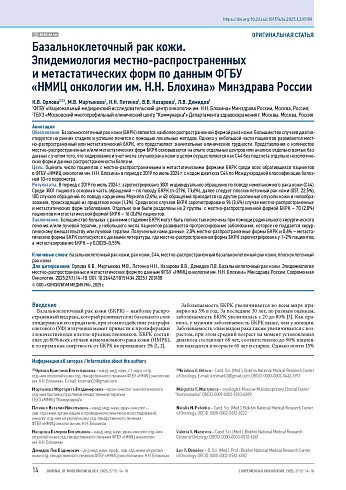
Базальноклеточный рак кожи. Эпидемиология местно-распространенных и метастатических форм по данным ФГБУ «НМИЦ онкологии им. Н.Н. Блохина» Минздрава России
Орлова К.В., Мартынова М.В., Петенко Н.Н., Назарова В.В., Демидов Л.В. Базальноклеточный рак кожи. Эпидемиология местно-распространенных и метастатических форм по данным ФГБУ «НМИЦ онкологии им. Н.Н. Блохина» Минздрава России. Современная Онкология. 2025;27(1):14–18. DOI: 10.26442/18151434.2025.1.203188
© ООО «КОНСИЛИУМ МЕДИКУМ», 2025 г.
© ООО «КОНСИЛИУМ МЕДИКУМ», 2025 г.
________________________________________________
Материалы доступны только для специалистов сферы здравоохранения.
Чтобы посмотреть материал полностью
Авторизуйтесь
или зарегистрируйтесь.
Аннотация
Обоснование. Базальноклеточный рак кожи (БКРК) является наиболее распространенной формой рака кожи. Большинство случаев диагностируется на ранних стадиях и успешно лечится с помощью локальных методов. Однако у небольшой части пациентов развивается местно-распространенный или метастатический БКРК, что представляет значительные клинические трудности. Представления о количестве местно-распространенных и/или метастатических форм БКРК основывается на опыте отдельных центров или анализе отдельно взятых баз данных с учетом того, что кодирование и учет числа случаев рака кожи в целом осуществляется как С44 без подсчета отдельно нозологических форм и данных распространенности болезни.
Цель. Оценить число пациентов с местно-распространенными и метастатическими формами БКРК среди всех обратившихся пациентов в ФГБУ «НМИЦ онкологии им. Н.Н. Блохина» в период с 2019 по июль 2024 г. с кодом диагноза С44 по Международной классификации болезней 10-го пересмотра.
Результаты. В период с 2019 по июль 2024 г. зарегистрировано 3801 индивидуальное обращение по поводу немеланомного рака кожи (С44). Среди 3801 пациента основная часть обращений – по поводу БКРК (n=2796, 73,6%), далее следует плоскоклеточный рак кожи (857, 22,5%), 100 случаев обращений по поводу карциномы Меркеля (2,6%), и 48 обращений приходится на другие различные опухоли кожи и новообразования, происходящие из придатков кожи (1,3%). Среди всех случаев БКРК зарегистрировано 94 (3,4%) случая местно-распространенных и метастатических форм заболевания. Отдельно они были разделены на 2 группы: с местно-распространенной формой БКРК – 78 (2,8%) пациентов и метастатической формой БКРК – 16 (0,6%) пациентов.
Заключение. Большинство больных с ранними стадиями БКРК могут быть полностью излечены при помощи радикального хирургического лечения и/или лучевой терапии, у небольшого числа пациентов развивается прогрессирование заболевания, которое не поддается хирургическому вмешательству или лучевой терапии. Полученные нами данные: 2,8% местно-распространенные формы БКРК и 0,6% – метастатические формы БКРК согласуются с данными литературы, где местно-распространенная форма БКРК зарегистрирована у 1–2% пациентов, а метастазирование БКРК – у 0,0028–0,55%.
Ключевые слова: базальноклеточный рак кожи, рак кожи, С44, местно-распространенный базальноклеточный рак кожи, плоскоклеточный рак кожи
Aim. To estimate the number of patients with locally advanced and metastatic BCRCs among all patients treated in the N.N. Blokhin National Medical Research Center of Oncology fr om 2019 to July 2024 with the diagnosis code C44 according to the International Classification of Diseases, 10th Edition.
Results. Between 2019 and July 2024, 3,801 individual cases of non-melanoma skin cancer (C44) were reported. Most of the 3,801 patients had BCSCs (n=2,796, 73.6%), followed by squamous cell carcinoma (n=857, 22.5%), Merkel cell carcinoma (n=100, 2.6%), and other skin tumors and neoplasms originating from the skin appendages (n=48, 1.3%). Among all cases of BCSCs, 94 (3.4%) cases of locally advanced and metastatic forms of the disease were reported. These patients were divided into two groups: with locally advanced BCSC (78 patients, 2.8%) and metastatic BCSC (16 patients, 0.6%).
Conclusion. Most patients with early stages of BCSCs can be completely cured with radical surgery and/or radiation therapy, and a small number of patients develop disease progression that is not amenable to surgery or radiation therapy. We obtained the following results: 2.8% of locally advanced BCSCs and 0.6% of metastatic BCSCs, which is consistent with the literature data, wh ere locally advanced BCSCs are reported in 1-2% of patients, and BCSC metastasis is reported in 0.0028-0.55%.
Keywords: basal cell skin carcinoma, skin cancer, C44, locally advanced basal cell skin carcinoma, squamous cell skin carcinoma
Цель. Оценить число пациентов с местно-распространенными и метастатическими формами БКРК среди всех обратившихся пациентов в ФГБУ «НМИЦ онкологии им. Н.Н. Блохина» в период с 2019 по июль 2024 г. с кодом диагноза С44 по Международной классификации болезней 10-го пересмотра.
Результаты. В период с 2019 по июль 2024 г. зарегистрировано 3801 индивидуальное обращение по поводу немеланомного рака кожи (С44). Среди 3801 пациента основная часть обращений – по поводу БКРК (n=2796, 73,6%), далее следует плоскоклеточный рак кожи (857, 22,5%), 100 случаев обращений по поводу карциномы Меркеля (2,6%), и 48 обращений приходится на другие различные опухоли кожи и новообразования, происходящие из придатков кожи (1,3%). Среди всех случаев БКРК зарегистрировано 94 (3,4%) случая местно-распространенных и метастатических форм заболевания. Отдельно они были разделены на 2 группы: с местно-распространенной формой БКРК – 78 (2,8%) пациентов и метастатической формой БКРК – 16 (0,6%) пациентов.
Заключение. Большинство больных с ранними стадиями БКРК могут быть полностью излечены при помощи радикального хирургического лечения и/или лучевой терапии, у небольшого числа пациентов развивается прогрессирование заболевания, которое не поддается хирургическому вмешательству или лучевой терапии. Полученные нами данные: 2,8% местно-распространенные формы БКРК и 0,6% – метастатические формы БКРК согласуются с данными литературы, где местно-распространенная форма БКРК зарегистрирована у 1–2% пациентов, а метастазирование БКРК – у 0,0028–0,55%.
Ключевые слова: базальноклеточный рак кожи, рак кожи, С44, местно-распространенный базальноклеточный рак кожи, плоскоклеточный рак кожи
________________________________________________
Aim. To estimate the number of patients with locally advanced and metastatic BCRCs among all patients treated in the N.N. Blokhin National Medical Research Center of Oncology fr om 2019 to July 2024 with the diagnosis code C44 according to the International Classification of Diseases, 10th Edition.
Results. Between 2019 and July 2024, 3,801 individual cases of non-melanoma skin cancer (C44) were reported. Most of the 3,801 patients had BCSCs (n=2,796, 73.6%), followed by squamous cell carcinoma (n=857, 22.5%), Merkel cell carcinoma (n=100, 2.6%), and other skin tumors and neoplasms originating from the skin appendages (n=48, 1.3%). Among all cases of BCSCs, 94 (3.4%) cases of locally advanced and metastatic forms of the disease were reported. These patients were divided into two groups: with locally advanced BCSC (78 patients, 2.8%) and metastatic BCSC (16 patients, 0.6%).
Conclusion. Most patients with early stages of BCSCs can be completely cured with radical surgery and/or radiation therapy, and a small number of patients develop disease progression that is not amenable to surgery or radiation therapy. We obtained the following results: 2.8% of locally advanced BCSCs and 0.6% of metastatic BCSCs, which is consistent with the literature data, wh ere locally advanced BCSCs are reported in 1-2% of patients, and BCSC metastasis is reported in 0.0028-0.55%.
Keywords: basal cell skin carcinoma, skin cancer, C44, locally advanced basal cell skin carcinoma, squamous cell skin carcinoma
Полный текст
Список литературы
1. Lear JT, Smith AG. Basal cell carcinoma. Postgrad Med J. 1997;73(863):538-42. DOI:10.1136/pgmj.73.863.538
2. Miller DL, Weinstock MA. Nonmelanoma skin cancer in the United States: Incidence. J Am Acad Dermatol. 1994;30(5 Pt. 1):774-8. DOI:10.1016/s0190-9622(08)81509-5
3. Wadhera A, Fazio M, Bricca G, et al. Metastatic basal cell carcinoma: A case report and literature review. How accurate is our incidence data? Dermatol Online J. 2006;12(5):7. PMID:16962022
4. Bath-Hextall F, Bong J, Perkins W, Williams H. Interventions for basal cell carcinoma of the skin: Systematic review. BMJ. 2004;329(7468):705. DOI:10.1136/bmj.38219.515266.AE
5. Christenson LJ, Borrowman TA, Vachon CM, et al. Incidence of basal cell and squamous cell carcinomas in a population younger than 40 years. AMA. 2005;294(6):681-90. DOI:10.1001/jama.294.6.681
6. Cameron MC, Lee E, Hibler BP, et al. Basal cell carcinoma: Epidemiology; pathophysiology; clinical and histological subtypes; and disease associations. J Am Acad Dermatol. 2019;80(2):303-17. DOI:10.1016/j.jaad.2018.03.060
7. Aggarwal P, Knabel P, Fleischer AB Jr. United States burden of melanoma and non-melanoma skin cancer from 1990 to 2019. J Am Acad Dermatol. 2021;85(2):388-95. DOI:10.1016/j.jaad.2021.03.109
8. Zhang W, Zeng W, Jiang A, et al. Global, regional and national incidence, mortality and disability-adjusted life-years of skin cancers and trend analysis from 1990 to 2019: An analysis of the Global Burden of Disease Study 2019. Cancer Med. 2021;10(14):4905-22. DOI:10.1002/cam4.4046
9. Asgari MM, Moffet HH, Ray GT, Quesenberry CP. Trends in basal cell carcinoma incidence and identification of high-risk subgroups, 1998–2012. JAMA Dermatol. 2015;151(9):976-81. DOI:10.1001/jamadermatol.2015.1188
10. Chren MM, Linos E, Torres JS, et al. Tumor recurrence 5 years after treatment of cutaneous basal cell carcinoma and squamous cell carcinoma. J Invest Dermatol. 2013;133(5):1188-96. DOI:10.1038/jid.2012.403
11. Lo JS, Snow SN, Reizner GT, et al. Metastatic basal cell carcinoma: report of twelve cases with a review of the literature. J Am Acad Dermatol. 1991;24(5 Pt. 1):715-9. PMID:1869642
12. von Domarus H, Stevens PJ. Metastatic basal cell carcinoma. Report of five cases and review of 170 cases in the literature. J Am Acad Dermatol. 1984;10(6):1043-60. PMID:6736323
13. Wysong A, Aasi SZ, Tang JY. Update on metastatic basal cell carcinoma: A summary of published cases from 1981 through 2011. JAMA Dermatol. 2013;149(5):615-6. DOI:10.1001/jamadermatol.2013.3064
14. Moser S, Borm J, Mihic-Probst D, et al. Metastatic basal cell carcinoma: Report of a case and review of the literature. Oral Surg Oral Med Oral Pathol Oral Radiol. 2014;117(2):e79-82. DOI:10.1016/j.oooo.2012.04.030
15. Ting PT, Kasper R, Arlette JP. Metastatic basal cell carcinoma: Report of two cases and literature review. J Cutan Med Surg. 2005;9(1):10-5. DOI:10.1007/s10227-005-0027-1
16. Hay RJ, Johns NE, Williams HC, et al. The global burden of skin disease in 2010: An analysis of the prevalence and impact of skin conditions. J Invest Dermatol. 2014;134(6):1527-34. DOI:10.1038/jid.2013.446
17. Каприн А.Д., Старинский В.В., Шахзадова А.О. Злокачественные новообразования в России в 2023 году (заболеваемость и смертность). М.: МНИОИ им. П.А. Герцена – филиал ФГБУ «НМИЦ радиологии» Минздрава России, 2024 [Kaprin AD, Starinskii VV, Shakhzadova AO. Zlokachestvennye novoobrazovaniia v Rossii v 2023 godu (zabolevaemost' i smertnost'). Moscow: MNIOI im. P.A. Gertsena – filial FGBU «NMITs radiologii» Minzdrava Rossii, 2024 (in Russian)].
18. Базальноклеточный рак кожи: МКБ: С44. Клинические рекомендации. М., 2024. Режим доступа: https://cr.minzdrav.gov.ru/preview-cr/467_3. Ссылка активна на 23.01.2025 [Bazal'nokletochnyi rak kozhi: MKB: S44. Klinicheskie rekomendatsii. Moscow. 2024. Available at: https://cr.minzdrav.gov.ru/preview-cr/467_3. Accessed: 23.01.2025 (in Russian)].
19. Государственный реестр лекарственных средств. Режим доступа: https://grls.minzdrav.gov.ru/ Ссылка активна на 23.01.2025 [Gosudarstvennyi reestr lekarstvennykh sredstv. Available at: https://grls.minzdrav.gov.ru/ Accessed: 23.01.2025 (in Russian)].
20. Dummer R, Guminksi A, Gutzmer R, et al. Long-term efficacy and safety of sonidegib in patients with advanced basal cell carcinoma: 42-month analysis of the phase II randomized, double-blind BOLT study. Br J Dermatol. 2020;182(6):1369-78. DOI:10.1111/bjd.18552
2. Miller DL, Weinstock MA. Nonmelanoma skin cancer in the United States: Incidence. J Am Acad Dermatol. 1994;30(5 Pt. 1):774-8. DOI:10.1016/s0190-9622(08)81509-5
3. Wadhera A, Fazio M, Bricca G, et al. Metastatic basal cell carcinoma: A case report and literature review. How accurate is our incidence data? Dermatol Online J. 2006;12(5):7. PMID:16962022
4. Bath-Hextall F, Bong J, Perkins W, Williams H. Interventions for basal cell carcinoma of the skin: Systematic review. BMJ. 2004;329(7468):705. DOI:10.1136/bmj.38219.515266.AE
5. Christenson LJ, Borrowman TA, Vachon CM, et al. Incidence of basal cell and squamous cell carcinomas in a population younger than 40 years. AMA. 2005;294(6):681-90. DOI:10.1001/jama.294.6.681
6. Cameron MC, Lee E, Hibler BP, et al. Basal cell carcinoma: Epidemiology; pathophysiology; clinical and histological subtypes; and disease associations. J Am Acad Dermatol. 2019;80(2):303-17. DOI:10.1016/j.jaad.2018.03.060
7. Aggarwal P, Knabel P, Fleischer AB Jr. United States burden of melanoma and non-melanoma skin cancer from 1990 to 2019. J Am Acad Dermatol. 2021;85(2):388-95. DOI:10.1016/j.jaad.2021.03.109
8. Zhang W, Zeng W, Jiang A, et al. Global, regional and national incidence, mortality and disability-adjusted life-years of skin cancers and trend analysis from 1990 to 2019: An analysis of the Global Burden of Disease Study 2019. Cancer Med. 2021;10(14):4905-22. DOI:10.1002/cam4.4046
9. Asgari MM, Moffet HH, Ray GT, Quesenberry CP. Trends in basal cell carcinoma incidence and identification of high-risk subgroups, 1998–2012. JAMA Dermatol. 2015;151(9):976-81. DOI:10.1001/jamadermatol.2015.1188
10. Chren MM, Linos E, Torres JS, et al. Tumor recurrence 5 years after treatment of cutaneous basal cell carcinoma and squamous cell carcinoma. J Invest Dermatol. 2013;133(5):1188-96. DOI:10.1038/jid.2012.403
11. Lo JS, Snow SN, Reizner GT, et al. Metastatic basal cell carcinoma: report of twelve cases with a review of the literature. J Am Acad Dermatol. 1991;24(5 Pt. 1):715-9. PMID:1869642
12. von Domarus H, Stevens PJ. Metastatic basal cell carcinoma. Report of five cases and review of 170 cases in the literature. J Am Acad Dermatol. 1984;10(6):1043-60. PMID:6736323
13. Wysong A, Aasi SZ, Tang JY. Update on metastatic basal cell carcinoma: A summary of published cases from 1981 through 2011. JAMA Dermatol. 2013;149(5):615-6. DOI:10.1001/jamadermatol.2013.3064
14. Moser S, Borm J, Mihic-Probst D, et al. Metastatic basal cell carcinoma: Report of a case and review of the literature. Oral Surg Oral Med Oral Pathol Oral Radiol. 2014;117(2):e79-82. DOI:10.1016/j.oooo.2012.04.030
15. Ting PT, Kasper R, Arlette JP. Metastatic basal cell carcinoma: Report of two cases and literature review. J Cutan Med Surg. 2005;9(1):10-5. DOI:10.1007/s10227-005-0027-1
16. Hay RJ, Johns NE, Williams HC, et al. The global burden of skin disease in 2010: An analysis of the prevalence and impact of skin conditions. J Invest Dermatol. 2014;134(6):1527-34. DOI:10.1038/jid.2013.446
17. Kaprin AD, Starinskii VV, Shakhzadova AO. Zlokachestvennye novoobrazovaniia v Rossii v 2023 godu (zabolevaemost' i smertnost'). Moscow: MNIOI im. P.A. Gertsena – filial FGBU «NMITs radiologii» Minzdrava Rossii, 2024 (in Russian).
18. Bazal'nokletochnyi rak kozhi: MKB: S44. Klinicheskie rekomendatsii. Moscow. 2024. Available at: https://cr.minzdrav.gov.ru/preview-cr/467_3. Accessed: 23.01.2025 (in Russian).
19. Gosudarstvennyi reestr lekarstvennykh sredstv. Available at: https://grls.minzdrav.gov.ru/ Accessed: 23.01.2025 (in Russian).
20. Dummer R, Guminksi A, Gutzmer R, et al. Long-term efficacy and safety of sonidegib in patients with advanced basal cell carcinoma: 42-month analysis of the phase II randomized, double-blind BOLT study. Br J Dermatol. 2020;182(6):1369-78. DOI:10.1111/bjd.18552
2. Miller DL, Weinstock MA. Nonmelanoma skin cancer in the United States: Incidence. J Am Acad Dermatol. 1994;30(5 Pt. 1):774-8. DOI:10.1016/s0190-9622(08)81509-5
3. Wadhera A, Fazio M, Bricca G, et al. Metastatic basal cell carcinoma: A case report and literature review. How accurate is our incidence data? Dermatol Online J. 2006;12(5):7. PMID:16962022
4. Bath-Hextall F, Bong J, Perkins W, Williams H. Interventions for basal cell carcinoma of the skin: Systematic review. BMJ. 2004;329(7468):705. DOI:10.1136/bmj.38219.515266.AE
5. Christenson LJ, Borrowman TA, Vachon CM, et al. Incidence of basal cell and squamous cell carcinomas in a population younger than 40 years. AMA. 2005;294(6):681-90. DOI:10.1001/jama.294.6.681
6. Cameron MC, Lee E, Hibler BP, et al. Basal cell carcinoma: Epidemiology; pathophysiology; clinical and histological subtypes; and disease associations. J Am Acad Dermatol. 2019;80(2):303-17. DOI:10.1016/j.jaad.2018.03.060
7. Aggarwal P, Knabel P, Fleischer AB Jr. United States burden of melanoma and non-melanoma skin cancer from 1990 to 2019. J Am Acad Dermatol. 2021;85(2):388-95. DOI:10.1016/j.jaad.2021.03.109
8. Zhang W, Zeng W, Jiang A, et al. Global, regional and national incidence, mortality and disability-adjusted life-years of skin cancers and trend analysis from 1990 to 2019: An analysis of the Global Burden of Disease Study 2019. Cancer Med. 2021;10(14):4905-22. DOI:10.1002/cam4.4046
9. Asgari MM, Moffet HH, Ray GT, Quesenberry CP. Trends in basal cell carcinoma incidence and identification of high-risk subgroups, 1998–2012. JAMA Dermatol. 2015;151(9):976-81. DOI:10.1001/jamadermatol.2015.1188
10. Chren MM, Linos E, Torres JS, et al. Tumor recurrence 5 years after treatment of cutaneous basal cell carcinoma and squamous cell carcinoma. J Invest Dermatol. 2013;133(5):1188-96. DOI:10.1038/jid.2012.403
11. Lo JS, Snow SN, Reizner GT, et al. Metastatic basal cell carcinoma: report of twelve cases with a review of the literature. J Am Acad Dermatol. 1991;24(5 Pt. 1):715-9. PMID:1869642
12. von Domarus H, Stevens PJ. Metastatic basal cell carcinoma. Report of five cases and review of 170 cases in the literature. J Am Acad Dermatol. 1984;10(6):1043-60. PMID:6736323
13. Wysong A, Aasi SZ, Tang JY. Update on metastatic basal cell carcinoma: A summary of published cases from 1981 through 2011. JAMA Dermatol. 2013;149(5):615-6. DOI:10.1001/jamadermatol.2013.3064
14. Moser S, Borm J, Mihic-Probst D, et al. Metastatic basal cell carcinoma: Report of a case and review of the literature. Oral Surg Oral Med Oral Pathol Oral Radiol. 2014;117(2):e79-82. DOI:10.1016/j.oooo.2012.04.030
15. Ting PT, Kasper R, Arlette JP. Metastatic basal cell carcinoma: Report of two cases and literature review. J Cutan Med Surg. 2005;9(1):10-5. DOI:10.1007/s10227-005-0027-1
16. Hay RJ, Johns NE, Williams HC, et al. The global burden of skin disease in 2010: An analysis of the prevalence and impact of skin conditions. J Invest Dermatol. 2014;134(6):1527-34. DOI:10.1038/jid.2013.446
17. Каприн А.Д., Старинский В.В., Шахзадова А.О. Злокачественные новообразования в России в 2023 году (заболеваемость и смертность). М.: МНИОИ им. П.А. Герцена – филиал ФГБУ «НМИЦ радиологии» Минздрава России, 2024 [Kaprin AD, Starinskii VV, Shakhzadova AO. Zlokachestvennye novoobrazovaniia v Rossii v 2023 godu (zabolevaemost' i smertnost'). Moscow: MNIOI im. P.A. Gertsena – filial FGBU «NMITs radiologii» Minzdrava Rossii, 2024 (in Russian)].
18. Базальноклеточный рак кожи: МКБ: С44. Клинические рекомендации. М., 2024. Режим доступа: https://cr.minzdrav.gov.ru/preview-cr/467_3. Ссылка активна на 23.01.2025 [Bazal'nokletochnyi rak kozhi: MKB: S44. Klinicheskie rekomendatsii. Moscow. 2024. Available at: https://cr.minzdrav.gov.ru/preview-cr/467_3. Accessed: 23.01.2025 (in Russian)].
19. Государственный реестр лекарственных средств. Режим доступа: https://grls.minzdrav.gov.ru/ Ссылка активна на 23.01.2025 [Gosudarstvennyi reestr lekarstvennykh sredstv. Available at: https://grls.minzdrav.gov.ru/ Accessed: 23.01.2025 (in Russian)].
20. Dummer R, Guminksi A, Gutzmer R, et al. Long-term efficacy and safety of sonidegib in patients with advanced basal cell carcinoma: 42-month analysis of the phase II randomized, double-blind BOLT study. Br J Dermatol. 2020;182(6):1369-78. DOI:10.1111/bjd.18552
________________________________________________
2. Miller DL, Weinstock MA. Nonmelanoma skin cancer in the United States: Incidence. J Am Acad Dermatol. 1994;30(5 Pt. 1):774-8. DOI:10.1016/s0190-9622(08)81509-5
3. Wadhera A, Fazio M, Bricca G, et al. Metastatic basal cell carcinoma: A case report and literature review. How accurate is our incidence data? Dermatol Online J. 2006;12(5):7. PMID:16962022
4. Bath-Hextall F, Bong J, Perkins W, Williams H. Interventions for basal cell carcinoma of the skin: Systematic review. BMJ. 2004;329(7468):705. DOI:10.1136/bmj.38219.515266.AE
5. Christenson LJ, Borrowman TA, Vachon CM, et al. Incidence of basal cell and squamous cell carcinomas in a population younger than 40 years. AMA. 2005;294(6):681-90. DOI:10.1001/jama.294.6.681
6. Cameron MC, Lee E, Hibler BP, et al. Basal cell carcinoma: Epidemiology; pathophysiology; clinical and histological subtypes; and disease associations. J Am Acad Dermatol. 2019;80(2):303-17. DOI:10.1016/j.jaad.2018.03.060
7. Aggarwal P, Knabel P, Fleischer AB Jr. United States burden of melanoma and non-melanoma skin cancer from 1990 to 2019. J Am Acad Dermatol. 2021;85(2):388-95. DOI:10.1016/j.jaad.2021.03.109
8. Zhang W, Zeng W, Jiang A, et al. Global, regional and national incidence, mortality and disability-adjusted life-years of skin cancers and trend analysis from 1990 to 2019: An analysis of the Global Burden of Disease Study 2019. Cancer Med. 2021;10(14):4905-22. DOI:10.1002/cam4.4046
9. Asgari MM, Moffet HH, Ray GT, Quesenberry CP. Trends in basal cell carcinoma incidence and identification of high-risk subgroups, 1998–2012. JAMA Dermatol. 2015;151(9):976-81. DOI:10.1001/jamadermatol.2015.1188
10. Chren MM, Linos E, Torres JS, et al. Tumor recurrence 5 years after treatment of cutaneous basal cell carcinoma and squamous cell carcinoma. J Invest Dermatol. 2013;133(5):1188-96. DOI:10.1038/jid.2012.403
11. Lo JS, Snow SN, Reizner GT, et al. Metastatic basal cell carcinoma: report of twelve cases with a review of the literature. J Am Acad Dermatol. 1991;24(5 Pt. 1):715-9. PMID:1869642
12. von Domarus H, Stevens PJ. Metastatic basal cell carcinoma. Report of five cases and review of 170 cases in the literature. J Am Acad Dermatol. 1984;10(6):1043-60. PMID:6736323
13. Wysong A, Aasi SZ, Tang JY. Update on metastatic basal cell carcinoma: A summary of published cases from 1981 through 2011. JAMA Dermatol. 2013;149(5):615-6. DOI:10.1001/jamadermatol.2013.3064
14. Moser S, Borm J, Mihic-Probst D, et al. Metastatic basal cell carcinoma: Report of a case and review of the literature. Oral Surg Oral Med Oral Pathol Oral Radiol. 2014;117(2):e79-82. DOI:10.1016/j.oooo.2012.04.030
15. Ting PT, Kasper R, Arlette JP. Metastatic basal cell carcinoma: Report of two cases and literature review. J Cutan Med Surg. 2005;9(1):10-5. DOI:10.1007/s10227-005-0027-1
16. Hay RJ, Johns NE, Williams HC, et al. The global burden of skin disease in 2010: An analysis of the prevalence and impact of skin conditions. J Invest Dermatol. 2014;134(6):1527-34. DOI:10.1038/jid.2013.446
17. Kaprin AD, Starinskii VV, Shakhzadova AO. Zlokachestvennye novoobrazovaniia v Rossii v 2023 godu (zabolevaemost' i smertnost'). Moscow: MNIOI im. P.A. Gertsena – filial FGBU «NMITs radiologii» Minzdrava Rossii, 2024 (in Russian).
18. Bazal'nokletochnyi rak kozhi: MKB: S44. Klinicheskie rekomendatsii. Moscow. 2024. Available at: https://cr.minzdrav.gov.ru/preview-cr/467_3. Accessed: 23.01.2025 (in Russian).
19. Gosudarstvennyi reestr lekarstvennykh sredstv. Available at: https://grls.minzdrav.gov.ru/ Accessed: 23.01.2025 (in Russian).
20. Dummer R, Guminksi A, Gutzmer R, et al. Long-term efficacy and safety of sonidegib in patients with advanced basal cell carcinoma: 42-month analysis of the phase II randomized, double-blind BOLT study. Br J Dermatol. 2020;182(6):1369-78. DOI:10.1111/bjd.18552
Авторы
К.В. Орлова*1, М.В. Мартынова2, Н.Н. Петенко1, В.В. Назарова1, Л.В. Демидов1
1ФГБУ «Национальный медицинский исследовательский центр онкологии им. Н.Н. Блохина» Минздрава России, Москва, Россия;
2ГБУЗ «Московский многопрофильный клинический центр "Коммунарка"» Департамента здравоохранения г. Москвы, Москва, Россия
*krisman03@gmail.com
1Blokhin National Medical Research Center of Oncology, Moscow, Russia;
2Moscow Multidisciplinary Clinical Center “Kommunarka”, Moscow, Russia
*krisman03@gmail.com
1ФГБУ «Национальный медицинский исследовательский центр онкологии им. Н.Н. Блохина» Минздрава России, Москва, Россия;
2ГБУЗ «Московский многопрофильный клинический центр "Коммунарка"» Департамента здравоохранения г. Москвы, Москва, Россия
*krisman03@gmail.com
________________________________________________
1Blokhin National Medical Research Center of Oncology, Moscow, Russia;
2Moscow Multidisciplinary Clinical Center “Kommunarka”, Moscow, Russia
*krisman03@gmail.com
Цель портала OmniDoctor – предоставление профессиональной информации врачам, провизорам и фармацевтам.