

Материалы доступны только для специалистов сферы здравоохранения.
Чтобы посмотреть материал полностью
Авторизуйтесь
или зарегистрируйтесь.
Безопасность и токсичность комбинированной терапии 1-й линии у больных распространенным почечно-клеточным раком: исследование реальной клинической практики
Безопасность и токсичность комбинированной терапии 1-й линии у больных распространенным почечно-клеточным раком: исследование реальной клинической практики
Нерсесова Т.А., Волкова М.И., Кузьмина Е.С., Антонова Т.Г., Царева Е.В., Стативко О.А., Гриднева Я.В., Черняев В.А., Покатаев И.А. Безопасность и токсичность комбинированной терапии 1-й линии у больных распространенным почечно-клеточным раком: исследование реальной клинической практики. Современная Онкология. 2025;27(3):173–180. DOI: 10.26442/18151434.2025.3.203377
© ООО «КОНСИЛИУМ МЕДИКУМ», 2025 г.
© ООО «КОНСИЛИУМ МЕДИКУМ», 2025 г.
________________________________________________
Материалы доступны только для специалистов сферы здравоохранения.
Чтобы посмотреть материал полностью
Авторизуйтесь
или зарегистрируйтесь.
Аннотация
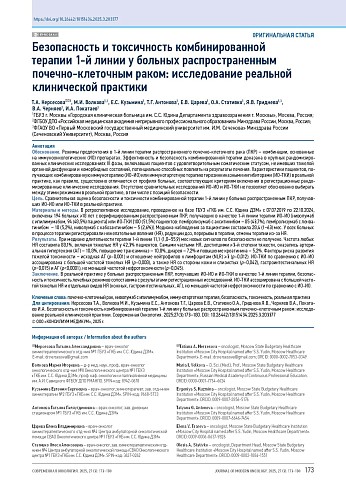
Обоснование. Режимы предпочтения в 1-й линии терапии распространенного почечно-клеточного рака (ПКР) – комбинации, основанные на иммуноонкологических (ИО) препаратах. Эффективность и безопасность комбинированной терапии доказана в крупных рандомизированных клинических исследованиях III фазы, включавших пациентов с удовлетворительным соматическим статусом, не имевших тяжелой органной дисфункции и коморбидных состояний, потенциально способных повлиять на результаты лечения. Характеристики пациентов, получающих комбинированную иммунотерапию (ИО-ИО) или иммунотаргетную терапию тирозинкиназными ингибиторами (ИО-ТКИ) в реальной практике, как правило, существенно отличаются от профиля больных, соответствующих критериям включения в регистрационные рандомизированные клинические исследования. Отсутствие сравнительных исследований ИО-ИО и ИО-ТКИ не позволяет обоснованно выбирать между этими режимами в реальной практике, в том числе с позиций безопасности.
Цель. Сравнительная оценка безопасности и токсичности комбинированной терапии 1-й линии у больных распространенным ПКР, получавших ИО-ИО или ИО-ТКИ в реальной практике.
Материалы и методы. В ретроспективное исследование, проведенное на базе ГБУЗ «ГКБ им. С.С. Юдина ДЗМ» с 07.07.2019 по 22.10.2024, включены 194 больных ≥18 лет с верифицированным распространенным ПКР, получавших в качестве 1-й линии терапии ИО-ИО [ниволумаб с ипилимумабом, 94 (48,5%) пациента] или ИО-ТКИ [100 (51,5%) пациентов: пембролизумаб с акситинибом – 85 (43,7%), пембролизумаб с ленватинибом – 10 (5,2%), ниволумаб с кабозантинибом – 5 (2,6%)]. Медиана наблюдения за пациентами составила 28,4 (1–63) мес. У всех больных в процессе терапии регистрировали нежелательные явления (НЯ), редукции доз, перерывы в терапии, отмены терапии из-за НЯ.
Результаты. При медиане длительности терапии 1-й линии 11,1 (1,0–55,9) мес новых сигналов по безопасности не получено. Частота любых НЯ составила 88,1%, включая тяжелые НЯ у 42,3% пациентов. Самыми частыми НЯ, достигшими ≥3-й степени тяжести, оказались артериальная гипертензия (АГ) – 10,8%, повышение трансаминаз – 10,8%, диарея – 7,2% и повышение креатинина – 5,2%. Факторы риска развития тяжелой токсичности – исходная АГ (р=0,001) и отношение нейтрофилов к лимфоцитам (NLR) ≥3 (р=0,012). ИО-ТКИ по сравнению с ИО-ИО ассоциирована с большей частотой тяжелых НЯ (р=0,008), а также НЯ со стороны кожи и слизистых (р=0,042), гастроинтестинальных НЯ (р=0,015) и АГ (р<0,0001), но меньшей частотой нефротоксичности (р=0,045).
Заключение. В реальной практике у больных распространенным ПКР, получавших ИО-ИО и ИО-ТКИ в качестве 1-й линии терапии, безопасность и токсичность лечебных режимов сопоставима с результатами регистрационных исследований. ИО-ТКИ ассоциирована с большей частотой тяжелых НЯ и отдельных видов НЯ (кожных, гастроинтестинальных, АГ), но меньшей частотой нефротоксичности по сравнению с ИО-ИО.
Ключевые слова: почечно-клеточный рак, ниволумаб с ипилимумабом, иммунотаргетная терапия, безопасность, токсичность, реальная практика
Aim. Comparative assessment of safety and toxicity of first-line combination therapy in patients with advanced RCC treated with IO-IO or IO-TKIs in real-world practice.
Materials and methods. A retrospective study conducted at the Moscow City Clinical Hospital named after S.S. Yudin from 07.07.2019 to 22.10.2024 included 194 patients ≥18 years old with verified advanced RCC who received first-line therapy with IO-IO [nivolumab with ipilimumab, 94 (48.5%) patients] or IO-TKIs [100 (51.5%) patients: pembrolizumab plus axitinib – 85 (43.7%), pembrolizumab plus lenvatinib – 10 (5.2%), nivolumab plus cabozantinib – 5 (2.6%)]. The median follow-up duration was 28.4 (1-63) months. In all patients during therapy, adverse events (AEs), dose reductions, interruptions in therapy, and discontinuations of therapy due to AEs were recorded.
Results. No new safety signals emerged at a median duration of line 1 therapy of 11.1 (1.0-55.9) months. The incidence of any AE was 88.1%, including severe AEs in 42.3% of patients. The most common grade ≥3 AEs were hypertension (HTN) at 10.8%, transaminase increased at 10.8%, diarrhea at 7.2%, and creatinine increased at 5.2%. Risk factors for severe toxicity are baseline hypertension (p=0.001) and the neutrophil-to-lymphocyte ratio (NLR) ≥3 (p=0.012). IO-TKIs compared to IO-IO were associated with a higher incidence of severe AEs (p=0.008), as well as skin and mucosal AEs (p=0.042), gastrointestinal AEs (p=0.015), and hypertension (p<0.0001), but a lower incidence of nephrotoxicity (p=0.045).
Conclusion. In real-world practice, in patients with advanced RCC treated with IO-IO and IO-TKIs as first-line therapy, the safety and toxicity of treatment regimens were comparable to the results of registration studies. IO-TKIs were associated with a higher incidence of severe AEs and certain types of AEs (skin, gastrointestinal, hypertension), but a lower incidence of nephrotoxicity compared to IO-IO.
Keywords: renal cell carcinoma, nivolumab plus ipilimumab, immune targeting therapy, safety, toxicity, real-world practice
Цель. Сравнительная оценка безопасности и токсичности комбинированной терапии 1-й линии у больных распространенным ПКР, получавших ИО-ИО или ИО-ТКИ в реальной практике.
Материалы и методы. В ретроспективное исследование, проведенное на базе ГБУЗ «ГКБ им. С.С. Юдина ДЗМ» с 07.07.2019 по 22.10.2024, включены 194 больных ≥18 лет с верифицированным распространенным ПКР, получавших в качестве 1-й линии терапии ИО-ИО [ниволумаб с ипилимумабом, 94 (48,5%) пациента] или ИО-ТКИ [100 (51,5%) пациентов: пембролизумаб с акситинибом – 85 (43,7%), пембролизумаб с ленватинибом – 10 (5,2%), ниволумаб с кабозантинибом – 5 (2,6%)]. Медиана наблюдения за пациентами составила 28,4 (1–63) мес. У всех больных в процессе терапии регистрировали нежелательные явления (НЯ), редукции доз, перерывы в терапии, отмены терапии из-за НЯ.
Результаты. При медиане длительности терапии 1-й линии 11,1 (1,0–55,9) мес новых сигналов по безопасности не получено. Частота любых НЯ составила 88,1%, включая тяжелые НЯ у 42,3% пациентов. Самыми частыми НЯ, достигшими ≥3-й степени тяжести, оказались артериальная гипертензия (АГ) – 10,8%, повышение трансаминаз – 10,8%, диарея – 7,2% и повышение креатинина – 5,2%. Факторы риска развития тяжелой токсичности – исходная АГ (р=0,001) и отношение нейтрофилов к лимфоцитам (NLR) ≥3 (р=0,012). ИО-ТКИ по сравнению с ИО-ИО ассоциирована с большей частотой тяжелых НЯ (р=0,008), а также НЯ со стороны кожи и слизистых (р=0,042), гастроинтестинальных НЯ (р=0,015) и АГ (р<0,0001), но меньшей частотой нефротоксичности (р=0,045).
Заключение. В реальной практике у больных распространенным ПКР, получавших ИО-ИО и ИО-ТКИ в качестве 1-й линии терапии, безопасность и токсичность лечебных режимов сопоставима с результатами регистрационных исследований. ИО-ТКИ ассоциирована с большей частотой тяжелых НЯ и отдельных видов НЯ (кожных, гастроинтестинальных, АГ), но меньшей частотой нефротоксичности по сравнению с ИО-ИО.
Ключевые слова: почечно-клеточный рак, ниволумаб с ипилимумабом, иммунотаргетная терапия, безопасность, токсичность, реальная практика
________________________________________________
Aim. Comparative assessment of safety and toxicity of first-line combination therapy in patients with advanced RCC treated with IO-IO or IO-TKIs in real-world practice.
Materials and methods. A retrospective study conducted at the Moscow City Clinical Hospital named after S.S. Yudin from 07.07.2019 to 22.10.2024 included 194 patients ≥18 years old with verified advanced RCC who received first-line therapy with IO-IO [nivolumab with ipilimumab, 94 (48.5%) patients] or IO-TKIs [100 (51.5%) patients: pembrolizumab plus axitinib – 85 (43.7%), pembrolizumab plus lenvatinib – 10 (5.2%), nivolumab plus cabozantinib – 5 (2.6%)]. The median follow-up duration was 28.4 (1-63) months. In all patients during therapy, adverse events (AEs), dose reductions, interruptions in therapy, and discontinuations of therapy due to AEs were recorded.
Results. No new safety signals emerged at a median duration of line 1 therapy of 11.1 (1.0-55.9) months. The incidence of any AE was 88.1%, including severe AEs in 42.3% of patients. The most common grade ≥3 AEs were hypertension (HTN) at 10.8%, transaminase increased at 10.8%, diarrhea at 7.2%, and creatinine increased at 5.2%. Risk factors for severe toxicity are baseline hypertension (p=0.001) and the neutrophil-to-lymphocyte ratio (NLR) ≥3 (p=0.012). IO-TKIs compared to IO-IO were associated with a higher incidence of severe AEs (p=0.008), as well as skin and mucosal AEs (p=0.042), gastrointestinal AEs (p=0.015), and hypertension (p<0.0001), but a lower incidence of nephrotoxicity (p=0.045).
Conclusion. In real-world practice, in patients with advanced RCC treated with IO-IO and IO-TKIs as first-line therapy, the safety and toxicity of treatment regimens were comparable to the results of registration studies. IO-TKIs were associated with a higher incidence of severe AEs and certain types of AEs (skin, gastrointestinal, hypertension), but a lower incidence of nephrotoxicity compared to IO-IO.
Keywords: renal cell carcinoma, nivolumab plus ipilimumab, immune targeting therapy, safety, toxicity, real-world practice
Полный текст
Список литературы
1. Волкова М.И., Носов Д.А., Алексеев Б.Я., и др. Почечноклеточный рак. Практические рекомендации RUSSCO, часть 1.2. Злокачественные опухоли. 2024;14(3s2):207-20 [Volkova MI, Nosov DA, Alekseev BIa, et al. Pochechnokletochnyi rak. Prakticheskie rekomendatsii RUSSCO, chast 1.2. Zlokachestvennye opukholi. 2024;14(3s2):207-20 (in Russian)]. DOI:10.18027/2224-5057-2024-14-3s2-1.2-08
2. NCCN Clinical Practice Guidelines in Oncology. Kidney Cancer, Version 3.2025. Available at: https://www.nccn.org/guidelines/nccn-guidelines. Accessed: 06.04.2025.
3. Choueiri TK, Eto M, Motzer R, et al. Lenvatinib plus pembrolizumab versus sunitinib as first-line treatment of patients with advanced renal cell carcinoma (CLEAR): extended follow-up from the phase 3, randomised, open-label study. Lancet Oncology. 2023;24(3):228-38. DOI:10.1016/S1470-2045(23)00049-9
4. Choueiri TK, Powles T, Burotto M, et al. Nivolumab plus Cabozantinib versus Sunitinib for Advanced Renal-Cell Carcinoma. N Engl J Med. 2021;4;384(9):829-41. DOI:10.1056/NEJMoa2026982.
5. Plimack ER, Powles T, Stus V, et al. Pembrolizumab Plus Axitinib Versus Sunitinib as First-line Treatment of Advanced Renal Cell Carcinoma: 43-month Follow-up of the Phase 3 KEYNOTE-426 Study. Eur Urol. 2023;84(5):449-54. DOI:10.1016/j.eururo.2023.06.006
6. Choueiri TK, Penkov K, Uemura H, et al. Avelumab + axitinib versus sunitinib as first-line treatment for patients with advanced renal cell carcinoma: final analysis of the phase III JAVELIN Renal 101 trial. Ann Oncol. 2025;36(4):387-92. DOI:10.1016/j.annonc.2024.12.008
7. Tannir NM, Albiges L, McDermott DF, et al. Nivolumab plus ipilimumab versus sunitinib for first-line treatment of advanced renal cell carcinoma: extended 8-year follow-up results of efficacy and safety from the phase III CheckMate 214 trial. Annals of Oncol. 2024;35(11):1026-38. DOI:10.1016/j.annonc.2024.07.727
8. Common terminology criteria for adverse events (CTCAE) Version 5.0. National Cancer Institute. Available: https://ctep.cancer.gov/protocoldevelopment/electronic_applications/docs/ctcae_v5_quick_reference_5x.... Accessed: 06.04.2025.
9. Chennamadhavuni A, Abushahin L, Jin N, et al. Risk Factors and Biomarkers for Immune-Related Adverse Events: A Practical Guide to Identifying High-Risk Patients and Rechallenging Immune Checkpoint Inhibitors. Front Immunol. 2022;13:779691. DOI:10.3389/fimmu.2022.779691
10. Rizzo A, Mollica V, Santoni M, et al. Risk of toxicity with immunotherapy-tyrosine kinase inhibitors for metastatic renal cell carcinoma: a meta-analysis of randomized controlled trials. Future Oncol. 2022;18(5):625-34. DOI:10.2217/fon-2021-0888
11. Rini BI, Plimack ER, Stus V, et al. KEYNOTE-426 Investigators. Pembrolizumab plus Axitinib versus Sunitinib for Advanced Renal-Cell Carcinoma. N Engl J Med. 2019;380(12):1116-27. DOI:10.1056/NEJMoa1816714
12. Nocera L, Karakiewicz PI, Wenzel M, et al. Clinical Outcomes and Adverse Events after First-Line Treatment in Metastatic Renal Cell Carcinoma: A Systematic Review and Network Meta-Analysis. J Urol. 2022;207(1):16-24. DOI:10.1097/JU.0000000000002252
13. Dukkipati A, Li X, Pal SK, Zugman M. Nephrotoxicity Associated with Contemporary Renal Cell Carcinoma Regimens: A Systematic Review and Meta-Analysis. Kidney Cancer. 2023;7(1):147-59.
14. Pirozzi F, Poto R, Aran L, et al. Cardiovascular Toxicity of Immune Checkpoint Inhibitors: Clinical Risk Factors. Curr Oncol Rep. 2021;23(2):13. DOI:10.1007/s11912-020-01002-w
15. Davies M, Duffield EA. Safety of checkpoint inhibitors for cancer treatment: strategies for patient monitoring and management of immune-mediated adverse events. ImmunoTargets and Therapy. 2017;6:51-71. doi:10.2147/ITT.S141577
16. Cortazar FB, Kibbelaar ZA, Glezerman IG, et al. Clinical Features and Outcomes of Immune Checkpoint Inhibitor-Associated AKI: A Multicenter Study. J Am Soc Nephrol. 2020;31(2):435-46. DOI:10.1681/ASN.2019070676
17. Razane El, Hajj Chehade, Karl Semaan, et al. Risk Factors of Immune Related Adverse Events in Patients with Metastatic Renal Cell Carcinoma Treated with Immune Checkpoint Inhibitors. Oncologist. 2024;29(Suppl. 1):S1. DOI:10.1093/oncolo/oyae181.051
18. Zhang W, Tan Y, Li Y, Liu J. Neutrophil to Lymphocyte ratio as a predictor for immune-related adverse events in cancer patients treated with immune checkpoint inhibitors: a systematic review and meta-analysis. Front Immunol. 2023;14:1234142. DOI:10.3389/fimmu.2023.1234142
19. Takada S, Murooka H, Tahatsu K, et al. Identifying Early Predictive Markers for Immune-Related Adverse Events in Nivolumab-Treated Patients with Renal Cell Carcinoma and Gastric Cancer. Asian Pac J Cancer Prev. 2022;23(2):695-701. DOI:10.31557/APJCP.2022.23.2.695
20. Triggianese P, Novelli L, Galdiero MR, et al. Immune checkpoint inhibitors-induced autoimmunity: The impact of gender. Autoimmun Rev. 2020;19(8):102590. DOI:10.1016/j.autrev.2020
21. Valpione S, Pasquali S, Campana LG, et al. Sex and interleukin-6 are prognostic factors for autoimmune toxicity following treatment with anti-CTLA4 blockade. J Transl Med. 2018;16(1):94. DOI:10.1186/s12967-018-1467-x
2. NCCN Clinical Practice Guidelines in Oncology. Kidney Cancer, Version 3.2025. Available at: https://www.nccn.org/guidelines/nccn-guidelines. Accessed: 06.04.2025.
3. Choueiri TK, Eto M, Motzer R, et al. Lenvatinib plus pembrolizumab versus sunitinib as first-line treatment of patients with advanced renal cell carcinoma (CLEAR): extended follow-up from the phase 3, randomised, open-label study. Lancet Oncology. 2023;24(3):228-38. DOI:10.1016/S1470-2045(23)00049-9
4. Choueiri TK, Powles T, Burotto M, et al. Nivolumab plus Cabozantinib versus Sunitinib for Advanced Renal-Cell Carcinoma. N Engl J Med. 2021;4;384(9):829-41. DOI:10.1056/NEJMoa2026982.
5. Plimack ER, Powles T, Stus V, et al. Pembrolizumab Plus Axitinib Versus Sunitinib as First-line Treatment of Advanced Renal Cell Carcinoma: 43-month Follow-up of the Phase 3 KEYNOTE-426 Study. Eur Urol. 2023;84(5):449-54. DOI:10.1016/j.eururo.2023.06.006
6. Choueiri TK, Penkov K, Uemura H, et al. Avelumab + axitinib versus sunitinib as first-line treatment for patients with advanced renal cell carcinoma: final analysis of the phase III JAVELIN Renal 101 trial. Ann Oncol. 2025;36(4):387-92. DOI:10.1016/j.annonc.2024.12.008
7. Tannir NM, Albiges L, McDermott DF, et al. Nivolumab plus ipilimumab versus sunitinib for first-line treatment of advanced renal cell carcinoma: extended 8-year follow-up results of efficacy and safety from the phase III CheckMate 214 trial. Annals of Oncol. 2024;35(11):1026-38. DOI:10.1016/j.annonc.2024.07.727
8. Common terminology criteria for adverse events (CTCAE) Version 5.0. National Cancer Institute. Available: https://ctep.cancer.gov/protocoldevelopment/electronic_applications/docs/ctcae_v5_quick_reference_5x.... Accessed: 06.04.2025.
9. Chennamadhavuni A, Abushahin L, Jin N, et al. Risk Factors and Biomarkers for Immune-Related Adverse Events: A Practical Guide to Identifying High-Risk Patients and Rechallenging Immune Checkpoint Inhibitors. Front Immunol. 2022;13:779691. DOI:10.3389/fimmu.2022.779691
10. Rizzo A, Mollica V, Santoni M, et al. Risk of toxicity with immunotherapy-tyrosine kinase inhibitors for metastatic renal cell carcinoma: a meta-analysis of randomized controlled trials. Future Oncol. 2022;18(5):625-34. DOI:10.2217/fon-2021-0888
11. Rini BI, Plimack ER, Stus V, et al. KEYNOTE-426 Investigators. Pembrolizumab plus Axitinib versus Sunitinib for Advanced Renal-Cell Carcinoma. N Engl J Med. 2019;380(12):1116-27. DOI:10.1056/NEJMoa1816714
12. Nocera L, Karakiewicz PI, Wenzel M, et al. Clinical Outcomes and Adverse Events after First-Line Treatment in Metastatic Renal Cell Carcinoma: A Systematic Review and Network Meta-Analysis. J Urol. 2022;207(1):16-24. DOI:10.1097/JU.0000000000002252
13. Dukkipati A, Li X, Pal SK, Zugman M. Nephrotoxicity Associated with Contemporary Renal Cell Carcinoma Regimens: A Systematic Review and Meta-Analysis. Kidney Cancer. 2023;7(1):147-59.
14. Pirozzi F, Poto R, Aran L, et al. Cardiovascular Toxicity of Immune Checkpoint Inhibitors: Clinical Risk Factors. Curr Oncol Rep. 2021;23(2):13. DOI:10.1007/s11912-020-01002-w
15. Davies M, Duffield EA. Safety of checkpoint inhibitors for cancer treatment: strategies for patient monitoring and management of immune-mediated adverse events. ImmunoTargets and Therapy. 2017;6:51-71. doi:10.2147/ITT.S141577
16. Cortazar FB, Kibbelaar ZA, Glezerman IG, et al. Clinical Features and Outcomes of Immune Checkpoint Inhibitor-Associated AKI: A Multicenter Study. J Am Soc Nephrol. 2020;31(2):435-46. DOI:10.1681/ASN.2019070676
17. Razane El, Hajj Chehade, Karl Semaan, et al. Risk Factors of Immune Related Adverse Events in Patients with Metastatic Renal Cell Carcinoma Treated with Immune Checkpoint Inhibitors. Oncologist. 2024;29(Suppl. 1):S1. DOI:10.1093/oncolo/oyae181.051
18. Zhang W, Tan Y, Li Y, Liu J. Neutrophil to Lymphocyte ratio as a predictor for immune-related adverse events in cancer patients treated with immune checkpoint inhibitors: a systematic review and meta-analysis. Front Immunol. 2023;14:1234142. DOI:10.3389/fimmu.2023.1234142
19. Takada S, Murooka H, Tahatsu K, et al. Identifying Early Predictive Markers for Immune-Related Adverse Events in Nivolumab-Treated Patients with Renal Cell Carcinoma and Gastric Cancer. Asian Pac J Cancer Prev. 2022;23(2):695-701. DOI:10.31557/APJCP.2022.23.2.695
20. Triggianese P, Novelli L, Galdiero MR, et al. Immune checkpoint inhibitors-induced autoimmunity: The impact of gender. Autoimmun Rev. 2020;19(8):102590. DOI:10.1016/j.autrev.2020
21. Valpione S, Pasquali S, Campana LG, et al. Sex and interleukin-6 are prognostic factors for autoimmune toxicity following treatment with anti-CTLA4 blockade. J Transl Med. 2018;16(1):94. DOI:10.1186/s12967-018-1467-x
2. NCCN Clinical Practice Guidelines in Oncology. Kidney Cancer, Version 3.2025. Available at: https://www.nccn.org/guidelines/nccn-guidelines. Accessed: 06.04.2025.
3. Choueiri TK, Eto M, Motzer R, et al. Lenvatinib plus pembrolizumab versus sunitinib as first-line treatment of patients with advanced renal cell carcinoma (CLEAR): extended follow-up from the phase 3, randomised, open-label study. Lancet Oncology. 2023;24(3):228-38. DOI:10.1016/S1470-2045(23)00049-9
4. Choueiri TK, Powles T, Burotto M, et al. Nivolumab plus Cabozantinib versus Sunitinib for Advanced Renal-Cell Carcinoma. N Engl J Med. 2021;4;384(9):829-41. DOI:10.1056/NEJMoa2026982.
5. Plimack ER, Powles T, Stus V, et al. Pembrolizumab Plus Axitinib Versus Sunitinib as First-line Treatment of Advanced Renal Cell Carcinoma: 43-month Follow-up of the Phase 3 KEYNOTE-426 Study. Eur Urol. 2023;84(5):449-54. DOI:10.1016/j.eururo.2023.06.006
6. Choueiri TK, Penkov K, Uemura H, et al. Avelumab + axitinib versus sunitinib as first-line treatment for patients with advanced renal cell carcinoma: final analysis of the phase III JAVELIN Renal 101 trial. Ann Oncol. 2025;36(4):387-92. DOI:10.1016/j.annonc.2024.12.008
7. Tannir NM, Albiges L, McDermott DF, et al. Nivolumab plus ipilimumab versus sunitinib for first-line treatment of advanced renal cell carcinoma: extended 8-year follow-up results of efficacy and safety from the phase III CheckMate 214 trial. Annals of Oncol. 2024;35(11):1026-38. DOI:10.1016/j.annonc.2024.07.727
8. Common terminology criteria for adverse events (CTCAE) Version 5.0. National Cancer Institute. Available: https://ctep.cancer.gov/protocoldevelopment/electronic_applications/docs/ctcae_v5_quick_reference_5x.... Accessed: 06.04.2025.
9. Chennamadhavuni A, Abushahin L, Jin N, et al. Risk Factors and Biomarkers for Immune-Related Adverse Events: A Practical Guide to Identifying High-Risk Patients and Rechallenging Immune Checkpoint Inhibitors. Front Immunol. 2022;13:779691. DOI:10.3389/fimmu.2022.779691
10. Rizzo A, Mollica V, Santoni M, et al. Risk of toxicity with immunotherapy-tyrosine kinase inhibitors for metastatic renal cell carcinoma: a meta-analysis of randomized controlled trials. Future Oncol. 2022;18(5):625-34. DOI:10.2217/fon-2021-0888
11. Rini BI, Plimack ER, Stus V, et al. KEYNOTE-426 Investigators. Pembrolizumab plus Axitinib versus Sunitinib for Advanced Renal-Cell Carcinoma. N Engl J Med. 2019;380(12):1116-27. DOI:10.1056/NEJMoa1816714
12. Nocera L, Karakiewicz PI, Wenzel M, et al. Clinical Outcomes and Adverse Events after First-Line Treatment in Metastatic Renal Cell Carcinoma: A Systematic Review and Network Meta-Analysis. J Urol. 2022;207(1):16-24. DOI:10.1097/JU.0000000000002252
13. Dukkipati A, Li X, Pal SK, Zugman M. Nephrotoxicity Associated with Contemporary Renal Cell Carcinoma Regimens: A Systematic Review and Meta-Analysis. Kidney Cancer. 2023;7(1):147-59.
14. Pirozzi F, Poto R, Aran L, et al. Cardiovascular Toxicity of Immune Checkpoint Inhibitors: Clinical Risk Factors. Curr Oncol Rep. 2021;23(2):13. DOI:10.1007/s11912-020-01002-w
15. Davies M, Duffield EA. Safety of checkpoint inhibitors for cancer treatment: strategies for patient monitoring and management of immune-mediated adverse events. ImmunoTargets and Therapy. 2017;6:51-71. doi:10.2147/ITT.S141577
16. Cortazar FB, Kibbelaar ZA, Glezerman IG, et al. Clinical Features and Outcomes of Immune Checkpoint Inhibitor-Associated AKI: A Multicenter Study. J Am Soc Nephrol. 2020;31(2):435-46. DOI:10.1681/ASN.2019070676
17. Razane El, Hajj Chehade, Karl Semaan, et al. Risk Factors of Immune Related Adverse Events in Patients with Metastatic Renal Cell Carcinoma Treated with Immune Checkpoint Inhibitors. Oncologist. 2024;29(Suppl. 1):S1. DOI:10.1093/oncolo/oyae181.051
18. Zhang W, Tan Y, Li Y, Liu J. Neutrophil to Lymphocyte ratio as a predictor for immune-related adverse events in cancer patients treated with immune checkpoint inhibitors: a systematic review and meta-analysis. Front Immunol. 2023;14:1234142. DOI:10.3389/fimmu.2023.1234142
19. Takada S, Murooka H, Tahatsu K, et al. Identifying Early Predictive Markers for Immune-Related Adverse Events in Nivolumab-Treated Patients with Renal Cell Carcinoma and Gastric Cancer. Asian Pac J Cancer Prev. 2022;23(2):695-701. DOI:10.31557/APJCP.2022.23.2.695
20. Triggianese P, Novelli L, Galdiero MR, et al. Immune checkpoint inhibitors-induced autoimmunity: The impact of gender. Autoimmun Rev. 2020;19(8):102590. DOI:10.1016/j.autrev.2020
21. Valpione S, Pasquali S, Campana LG, et al. Sex and interleukin-6 are prognostic factors for autoimmune toxicity following treatment with anti-CTLA4 blockade. J Transl Med. 2018;16(1):94. DOI:10.1186/s12967-018-1467-x
________________________________________________
2. NCCN Clinical Practice Guidelines in Oncology. Kidney Cancer, Version 3.2025. Available at: https://www.nccn.org/guidelines/nccn-guidelines. Accessed: 06.04.2025.
3. Choueiri TK, Eto M, Motzer R, et al. Lenvatinib plus pembrolizumab versus sunitinib as first-line treatment of patients with advanced renal cell carcinoma (CLEAR): extended follow-up from the phase 3, randomised, open-label study. Lancet Oncology. 2023;24(3):228-38. DOI:10.1016/S1470-2045(23)00049-9
4. Choueiri TK, Powles T, Burotto M, et al. Nivolumab plus Cabozantinib versus Sunitinib for Advanced Renal-Cell Carcinoma. N Engl J Med. 2021;4;384(9):829-41. DOI:10.1056/NEJMoa2026982.
5. Plimack ER, Powles T, Stus V, et al. Pembrolizumab Plus Axitinib Versus Sunitinib as First-line Treatment of Advanced Renal Cell Carcinoma: 43-month Follow-up of the Phase 3 KEYNOTE-426 Study. Eur Urol. 2023;84(5):449-54. DOI:10.1016/j.eururo.2023.06.006
6. Choueiri TK, Penkov K, Uemura H, et al. Avelumab + axitinib versus sunitinib as first-line treatment for patients with advanced renal cell carcinoma: final analysis of the phase III JAVELIN Renal 101 trial. Ann Oncol. 2025;36(4):387-92. DOI:10.1016/j.annonc.2024.12.008
7. Tannir NM, Albiges L, McDermott DF, et al. Nivolumab plus ipilimumab versus sunitinib for first-line treatment of advanced renal cell carcinoma: extended 8-year follow-up results of efficacy and safety from the phase III CheckMate 214 trial. Annals of Oncol. 2024;35(11):1026-38. DOI:10.1016/j.annonc.2024.07.727
8. Common terminology criteria for adverse events (CTCAE) Version 5.0. National Cancer Institute. Available: https://ctep.cancer.gov/protocoldevelopment/electronic_applications/docs/ctcae_v5_quick_reference_5x.... Accessed: 06.04.2025.
9. Chennamadhavuni A, Abushahin L, Jin N, et al. Risk Factors and Biomarkers for Immune-Related Adverse Events: A Practical Guide to Identifying High-Risk Patients and Rechallenging Immune Checkpoint Inhibitors. Front Immunol. 2022;13:779691. DOI:10.3389/fimmu.2022.779691
10. Rizzo A, Mollica V, Santoni M, et al. Risk of toxicity with immunotherapy-tyrosine kinase inhibitors for metastatic renal cell carcinoma: a meta-analysis of randomized controlled trials. Future Oncol. 2022;18(5):625-34. DOI:10.2217/fon-2021-0888
11. Rini BI, Plimack ER, Stus V, et al. KEYNOTE-426 Investigators. Pembrolizumab plus Axitinib versus Sunitinib for Advanced Renal-Cell Carcinoma. N Engl J Med. 2019;380(12):1116-27. DOI:10.1056/NEJMoa1816714
12. Nocera L, Karakiewicz PI, Wenzel M, et al. Clinical Outcomes and Adverse Events after First-Line Treatment in Metastatic Renal Cell Carcinoma: A Systematic Review and Network Meta-Analysis. J Urol. 2022;207(1):16-24. DOI:10.1097/JU.0000000000002252
13. Dukkipati A, Li X, Pal SK, Zugman M. Nephrotoxicity Associated with Contemporary Renal Cell Carcinoma Regimens: A Systematic Review and Meta-Analysis. Kidney Cancer. 2023;7(1):147-59.
14. Pirozzi F, Poto R, Aran L, et al. Cardiovascular Toxicity of Immune Checkpoint Inhibitors: Clinical Risk Factors. Curr Oncol Rep. 2021;23(2):13. DOI:10.1007/s11912-020-01002-w
15. Davies M, Duffield EA. Safety of checkpoint inhibitors for cancer treatment: strategies for patient monitoring and management of immune-mediated adverse events. ImmunoTargets and Therapy. 2017;6:51-71. doi:10.2147/ITT.S141577
16. Cortazar FB, Kibbelaar ZA, Glezerman IG, et al. Clinical Features and Outcomes of Immune Checkpoint Inhibitor-Associated AKI: A Multicenter Study. J Am Soc Nephrol. 2020;31(2):435-46. DOI:10.1681/ASN.2019070676
17. Razane El, Hajj Chehade, Karl Semaan, et al. Risk Factors of Immune Related Adverse Events in Patients with Metastatic Renal Cell Carcinoma Treated with Immune Checkpoint Inhibitors. Oncologist. 2024;29(Suppl. 1):S1. DOI:10.1093/oncolo/oyae181.051
18. Zhang W, Tan Y, Li Y, Liu J. Neutrophil to Lymphocyte ratio as a predictor for immune-related adverse events in cancer patients treated with immune checkpoint inhibitors: a systematic review and meta-analysis. Front Immunol. 2023;14:1234142. DOI:10.3389/fimmu.2023.1234142
19. Takada S, Murooka H, Tahatsu K, et al. Identifying Early Predictive Markers for Immune-Related Adverse Events in Nivolumab-Treated Patients with Renal Cell Carcinoma and Gastric Cancer. Asian Pac J Cancer Prev. 2022;23(2):695-701. DOI:10.31557/APJCP.2022.23.2.695
20. Triggianese P, Novelli L, Galdiero MR, et al. Immune checkpoint inhibitors-induced autoimmunity: The impact of gender. Autoimmun Rev. 2020;19(8):102590. DOI:10.1016/j.autrev.2020
21. Valpione S, Pasquali S, Campana LG, et al. Sex and interleukin-6 are prognostic factors for autoimmune toxicity following treatment with anti-CTLA4 blockade. J Transl Med. 2018;16(1):94. DOI:10.1186/s12967-018-1467-x
Авторы
Т.А. Нерсесова*1, М.И. Волкова1,2, Е.С. Кузьмина1, Т.Г. Антонова1, Е.В. Царева1, О.А. Стативко1, Я.В. Гриднева1,3, В.А. Черняев1, И.А. Покатаев1
1ГБУЗ г. Москвы «Городская клиническая больница им. С.С. Юдина Департамента здравоохранения г. Москвы», Москва, Россия;
2ФГБОУ ДПО «Российская медицинская академия непрерывного профессионального образования» Минздрава России, Москва, Россия;
3ФГАОУ ВО «Первый Московский государственный медицинский университет им. И.М. Сеченова» Минздрава России (Сеченовский Университет), Москва, Россия
*dr.nersesova@gmail.com
1Moscow State Budgetary Healthcare Institution «Moscow City Hospital named after S.S. Yudin, Moscow Healthcare Department», Moscow, Russia;
2Russian Medical Academy of Continuous Professional Education, Moscow, Russia;
3Sechenov First Moscow State Medical University (Sechenovskiy University), Moscow, Russia
*dr.nersesova@gmail.com
1ГБУЗ г. Москвы «Городская клиническая больница им. С.С. Юдина Департамента здравоохранения г. Москвы», Москва, Россия;
2ФГБОУ ДПО «Российская медицинская академия непрерывного профессионального образования» Минздрава России, Москва, Россия;
3ФГАОУ ВО «Первый Московский государственный медицинский университет им. И.М. Сеченова» Минздрава России (Сеченовский Университет), Москва, Россия
*dr.nersesova@gmail.com
________________________________________________
1Moscow State Budgetary Healthcare Institution «Moscow City Hospital named after S.S. Yudin, Moscow Healthcare Department», Moscow, Russia;
2Russian Medical Academy of Continuous Professional Education, Moscow, Russia;
3Sechenov First Moscow State Medical University (Sechenovskiy University), Moscow, Russia
*dr.nersesova@gmail.com
Цель портала OmniDoctor – предоставление профессиональной информации врачам, провизорам и фармацевтам.