

Материалы доступны только для специалистов сферы здравоохранения.
Чтобы посмотреть материал полностью
Авторизуйтесь
или зарегистрируйтесь.
Оценка межлекарственных взаимодействий у пациентов, получающих химиотерапию по схеме FOLFOX
Оценка межлекарственных взаимодействий у пациентов, получающих химиотерапию по схеме FOLFOX
Федоринов Д.С., Лядова М.А., Лядов В.К., Сычев Д.А. Оценка межлекарственных взаимодействий у пациентов, получающих химиотерапию по схеме FOLFOX. Современная Онкология. 2025;27(3):162–167. DOI: 10.26442/18151434.2025.3.203314
© ООО «КОНСИЛИУМ МЕДИКУМ», 2025 г.
© ООО «КОНСИЛИУМ МЕДИКУМ», 2025 г.
________________________________________________
Материалы доступны только для специалистов сферы здравоохранения.
Чтобы посмотреть материал полностью
Авторизуйтесь
или зарегистрируйтесь.
Аннотация
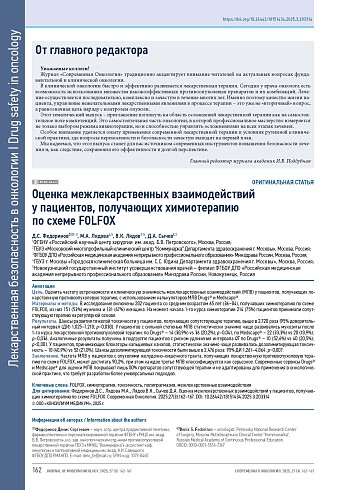
Цель. Оценить частоту встречаемости и клиническую значимость межлекарственных взаимодействий (МЛВ) у пациентов, получающих лекарственную противоопухолевую терапию, с использованием калькуляторов МЛВ Drugs® и Medscape®.
Материалы и методы. В исследование включены 282 пациента со средним возрастом 65 лет (36–84), получавших химиотерапию по схеме FOLFOX, из них 151 (53%) мужчина и 131 (47%) женщина. На момент начала 1-го курса химиотерапии 214 (75%) пациентов принимали сопутствующую терапию на регулярной основе.
Результаты. Шансы развития тяжелой токсичности у пациентов, получающих сопутствующую терапию, выше в 2,720 раза [95% доверительный интервал (ДИ) 1,025–7,218; p=0,038]. У пациентов с сильной степенью МЛВ статистически значимо чаще развивались мукозиты после 1-го курса лекарственной противоопухолевой терапии: по Drugs® – 14 (38,9%) vs 36 (20,2%); р=0,041, по Medscape® – 22 (33,3%) vs 28 (18,9%); р=0,036. Аналогичные результаты получены в подгруппе пациентов с риском удлинения интервала QT по Drugs® – 10 (52,6%) vs 40 (20,5%); р<0,001. У пациентов, принимающих блокаторы кальциевых каналов, статистически значимо чаще развивалась дозолимитирующая токсичность – 18 (40,9%) vs 52 (21,8%). Шансы дозолимитирующей токсичности были выше в 2,476 раза: 95% ДИ 1,261–4,864; p=0,007.
Заключение. Частота МЛВ у пациентов с опухолями желудочно-кишечного тракта, получающих лекарственную противоопухолевую терапию по схеме FOLFOX, может достигать 90,2%, при этом каждое третье МЛВ классифицируется как серьезное. Современные сервисы Drugs® и Medscape® для оценки МЛВ покрывают лишь 80% препаратов сопутствующей терапии и не адаптированы для применения в онкологической практике, что требует разработки более универсальных подходов.
Ключевые слова: FOLFOX, химиотерапия, токсичность, полипрагмазия, межлекарственные взаимодействия
Materials and methods. The study included 282 patients with a mean age of 65 years (36–84) who received FOLFOX chemotherapy, of whom 151 (53%) were males and 131 (47%) were females. At the start of the first course of chemotherapy, 214 (75%) patients were receiving concomitant therapy on a regular basis.
Results. The odds of severe toxicity in patients receiving concomitant therapy were 2.720 times higher [95% confidence interval (CI) 1.025–7.218; p=0.038]. Patients with strong DDI were statistically significantly more likely to develop mucositis after the first course of drug antitumor therapy: 14 (38.9%) vs 36 (20.2%) according to Drugs®, p=0.041; 22 (33.3%) vs 28 (18.9%) according to Medscape®; p=0.036. Similar results were obtained in a subgroup of patients at risk of QT prolongation according to Drugs® – 10 (52.6%) vs 40 (20.5%); p<0.001. Patients taking calcium channel blockers were statistically significantly more likely to develop dose-limiting toxicity: 18 (40.9%) vs 52 (21.8%). The odds of dose-limiting toxicity were 2.476 times higher: 95% CI 1.261–4.864; p=0.007.
Conclusion. The incidence of DDI in patients with gastrointestinal tumors receiving FOLFOX best supportive therapy can be as high as 90.2%, with one in three DDI classified as serious. Drugs® and Medscape® DDI services cover only 80% of concomitant medications and are not adapted to oncology, necessitating the development of more versatile approaches.
Keywords: FOLFOX, chemotherapy, toxicity, polypharmacy, drug interactions
Материалы и методы. В исследование включены 282 пациента со средним возрастом 65 лет (36–84), получавших химиотерапию по схеме FOLFOX, из них 151 (53%) мужчина и 131 (47%) женщина. На момент начала 1-го курса химиотерапии 214 (75%) пациентов принимали сопутствующую терапию на регулярной основе.
Результаты. Шансы развития тяжелой токсичности у пациентов, получающих сопутствующую терапию, выше в 2,720 раза [95% доверительный интервал (ДИ) 1,025–7,218; p=0,038]. У пациентов с сильной степенью МЛВ статистически значимо чаще развивались мукозиты после 1-го курса лекарственной противоопухолевой терапии: по Drugs® – 14 (38,9%) vs 36 (20,2%); р=0,041, по Medscape® – 22 (33,3%) vs 28 (18,9%); р=0,036. Аналогичные результаты получены в подгруппе пациентов с риском удлинения интервала QT по Drugs® – 10 (52,6%) vs 40 (20,5%); р<0,001. У пациентов, принимающих блокаторы кальциевых каналов, статистически значимо чаще развивалась дозолимитирующая токсичность – 18 (40,9%) vs 52 (21,8%). Шансы дозолимитирующей токсичности были выше в 2,476 раза: 95% ДИ 1,261–4,864; p=0,007.
Заключение. Частота МЛВ у пациентов с опухолями желудочно-кишечного тракта, получающих лекарственную противоопухолевую терапию по схеме FOLFOX, может достигать 90,2%, при этом каждое третье МЛВ классифицируется как серьезное. Современные сервисы Drugs® и Medscape® для оценки МЛВ покрывают лишь 80% препаратов сопутствующей терапии и не адаптированы для применения в онкологической практике, что требует разработки более универсальных подходов.
Ключевые слова: FOLFOX, химиотерапия, токсичность, полипрагмазия, межлекарственные взаимодействия
________________________________________________
Materials and methods. The study included 282 patients with a mean age of 65 years (36–84) who received FOLFOX chemotherapy, of whom 151 (53%) were males and 131 (47%) were females. At the start of the first course of chemotherapy, 214 (75%) patients were receiving concomitant therapy on a regular basis.
Results. The odds of severe toxicity in patients receiving concomitant therapy were 2.720 times higher [95% confidence interval (CI) 1.025–7.218; p=0.038]. Patients with strong DDI were statistically significantly more likely to develop mucositis after the first course of drug antitumor therapy: 14 (38.9%) vs 36 (20.2%) according to Drugs®, p=0.041; 22 (33.3%) vs 28 (18.9%) according to Medscape®; p=0.036. Similar results were obtained in a subgroup of patients at risk of QT prolongation according to Drugs® – 10 (52.6%) vs 40 (20.5%); p<0.001. Patients taking calcium channel blockers were statistically significantly more likely to develop dose-limiting toxicity: 18 (40.9%) vs 52 (21.8%). The odds of dose-limiting toxicity were 2.476 times higher: 95% CI 1.261–4.864; p=0.007.
Conclusion. The incidence of DDI in patients with gastrointestinal tumors receiving FOLFOX best supportive therapy can be as high as 90.2%, with one in three DDI classified as serious. Drugs® and Medscape® DDI services cover only 80% of concomitant medications and are not adapted to oncology, necessitating the development of more versatile approaches.
Keywords: FOLFOX, chemotherapy, toxicity, polypharmacy, drug interactions
Полный текст
Список литературы
1. Surveillance, Epidemiology, and End Results Program (SEER). Available at: https://seer.cancer.gov/ Assecced: 20.02.2025.
2. Yang L, Liu S, Xiong Z, et al. Changes in colorectal cancer incidence by site and age from 1973 to 2015: a SEER database analysis. Aging Clin Exp Res. 2021;33(7):1937-46. DOI:10.1007/s40520-020-01721-x
3. Balducci L, Goetz-Parten D, Steinman MA. Polypharmacy and the management of the older cancer patient. Ann Oncol. 2013;24:vii36-40. DOI:10.1093/annonc/mdt266
4. Extermann M. Interaction between Comorbidity and Cancer. Cancer Control. 2007;14(1):13-22. DOI:10.1177/107327480701400103
5. Ramsdale E, Lemelman T, Loh KP, et al. Geriatric assessment-driven polypharmacy discussions between oncologists, older patients, and their caregivers. J Geriatr Oncol. 2018;9(5):534-9. DOI:10.1016/j.jgo.2018.02.007
6. Scott IA, Hilmer SN, Reeve E, et al. Reducing Inappropriate Polypharmacy: The Process of Deprescribing. JAMA Intern Med. 2015;175(5):827. DOI:10.1001/jamainternmed.2015.0324
7. Riechelmann R, Girardi D. Drug interactions in cancer patients: A hidden risk? J Res Pharm Pract. 2016;5(2):77-8. DOI:10.4103/2279-042X.179560
8. Clark LT, Watkins L, Piña IL, et al. Increasing Diversity in Clinical Trials: Overcoming Critical Barriers. Curr Probl Cardiol. 2019;44(5):148-72. DOI:10.1016/j.cpcardiol.2018.11.002
9. Mohamed MR, Mohile SG, Juba KM, et al. Association of polypharmacy and potential drug-drug interactions with adverse treatment outcomes in older adults with advanced cancer. Cancer. 2023;129(7):1096-104. DOI:10.1002/cncr.34642
10. Приказ Минздравсоцразвития России от 22.11.2010 №1022н «Об утверждении Порядка оказания медицинской помощи населению по профилю „Клиническая фармакология“». Режим доступа: http://www.rg.ru/2010/12/31/farmakologia-dok.html. Ссылка доступна на 20.02.2025 [Prikaz Minzdravsotsrazvitiia Rossii ot 22.11.2010 No 1022n «Ob utverzhdenii Poriadka okazaniia meditsinskoi pomoshchi naseleniiu po profiliu „Klinicheskaia farmakologiia“». Available at: http://www.rg.ru/2010/12/31/farmakologia-dok.html. Accessed: 20.02.2025.
11. Сычев Д.А., Отделенов В.А. Межлекарственные взаимодействия в практике интерниста: взгляд клинического фармаколога. Справочник поликлинического врача. 2014;12:18-21. Режим доступа: https://omnidoctor.ru/library/izdaniya-dlya-vrachey/spravochnik-poliklinicheskogo-vracha/spv2014/spv... Ссылка доступна на 20.02.2025 [Sychev DA, Otdelenov VA. Mezhlekarstvennye vzaimodeistviia v praktike internista: vzgliad klinicheskogo farmakologa. Spravochnik poliklinicheskogo vracha. 2014;12:18-21. Available at: https://omnidoctor.ru/library/izdaniya-dlya-vrachey/spravochnik-poliklinicheskogo-vracha/spv2014/spv... Accessed: 20.02.2025 (in Russian)].
12. Drug Interaction Checker. Available at: https://www.drugs.com/drug_interactions.html. Accessed: 20.02.2025.
13. Medscape Drug Interaction Checker. Available at: https://reference.medscape.com/drug-interactionchecker. Accessed: 20.02.2025.
14. Ungureanu D, Popa A, Nemeș A, Crișan CA. Concomitant Administration of Psychotropic and Prostate Cancer Drugs: A Pharmacoepidemiologic Study Using Drug–Drug Interaction Databases. Biomedicines. 2024;12(9):1971. DOI:10.3390/biomedicines12091971
15. Common Terminology Criteria for Adverse Events (CTCAE) Version 5. Published: November 27. US Department of Health and Human Services, National Institutes of Health, National Cancer Institute. Available at: https://ctep.cancer.gov/protocoldevelopment/electronic_applications/docs/ctcae_v5_quick_reference_5x.... Accessed: 20.02.2025.
2. Yang L, Liu S, Xiong Z, et al. Changes in colorectal cancer incidence by site and age from 1973 to 2015: a SEER database analysis. Aging Clin Exp Res. 2021;33(7):1937-46. DOI:10.1007/s40520-020-01721-x
3. Balducci L, Goetz-Parten D, Steinman MA. Polypharmacy and the management of the older cancer patient. Ann Oncol. 2013;24:vii36-40. DOI:10.1093/annonc/mdt266
4. Extermann M. Interaction between Comorbidity and Cancer. Cancer Control. 2007;14(1):13-22. DOI:10.1177/107327480701400103
5. Ramsdale E, Lemelman T, Loh KP, et al. Geriatric assessment-driven polypharmacy discussions between oncologists, older patients, and their caregivers. J Geriatr Oncol. 2018;9(5):534-9. DOI:10.1016/j.jgo.2018.02.007
6. Scott IA, Hilmer SN, Reeve E, et al. Reducing Inappropriate Polypharmacy: The Process of Deprescribing. JAMA Intern Med. 2015;175(5):827. DOI:10.1001/jamainternmed.2015.0324
7. Riechelmann R, Girardi D. Drug interactions in cancer patients: A hidden risk? J Res Pharm Pract. 2016;5(2):77-8. DOI:10.4103/2279-042X.179560
8. Clark LT, Watkins L, Piña IL, et al. Increasing Diversity in Clinical Trials: Overcoming Critical Barriers. Curr Probl Cardiol. 2019;44(5):148-72. DOI:10.1016/j.cpcardiol.2018.11.002
9. Mohamed MR, Mohile SG, Juba KM, et al. Association of polypharmacy and potential drug-drug interactions with adverse treatment outcomes in older adults with advanced cancer. Cancer. 2023;129(7):1096-104. DOI:10.1002/cncr.34642
10. Prikaz Minzdravsotsrazvitiia Rossii ot 22.11.2010 No 1022n «Ob utverzhdenii Poriadka okazaniia meditsinskoi pomoshchi naseleniiu po profiliu „Klinicheskaia farmakologiia“». Available at: http://www.rg.ru/2010/12/31/farmakologia-dok.html. Accessed: 20.02.2025.
11. Sychev DA, Otdelenov VA. Mezhlekarstvennye vzaimodeistviia v praktike internista: vzgliad klinicheskogo farmakologa. Spravochnik poliklinicheskogo vracha. 2014;12:18-21. Available at: https://omnidoctor.ru/library/izdaniya-dlya-vrachey/spravochnik-poliklinicheskogo-vracha/spv2014/spv... Accessed: 20.02.2025 (in Russian).
12. Drug Interaction Checker. Available at: https://www.drugs.com/drug_interactions.html. Accessed: 20.02.2025.
13. Medscape Drug Interaction Checker. Available at: https://reference.medscape.com/drug-interactionchecker. Accessed: 20.02.2025.
14. Ungureanu D, Popa A, Nemeș A, Crișan CA. Concomitant Administration of Psychotropic and Prostate Cancer Drugs: A Pharmacoepidemiologic Study Using Drug–Drug Interaction Databases. Biomedicines. 2024;12(9):1971. DOI:10.3390/biomedicines12091971
15. Common Terminology Criteria for Adverse Events (CTCAE) Version 5. Published: November 27. US Department of Health and Human Services, National Institutes of Health, National Cancer Institute. Available at: https://ctep.cancer.gov/protocoldevelopment/electronic_applications/docs/ctcae_v5_quick_reference_5x.... Accessed: 20.02.2025.
2. Yang L, Liu S, Xiong Z, et al. Changes in colorectal cancer incidence by site and age from 1973 to 2015: a SEER database analysis. Aging Clin Exp Res. 2021;33(7):1937-46. DOI:10.1007/s40520-020-01721-x
3. Balducci L, Goetz-Parten D, Steinman MA. Polypharmacy and the management of the older cancer patient. Ann Oncol. 2013;24:vii36-40. DOI:10.1093/annonc/mdt266
4. Extermann M. Interaction between Comorbidity and Cancer. Cancer Control. 2007;14(1):13-22. DOI:10.1177/107327480701400103
5. Ramsdale E, Lemelman T, Loh KP, et al. Geriatric assessment-driven polypharmacy discussions between oncologists, older patients, and their caregivers. J Geriatr Oncol. 2018;9(5):534-9. DOI:10.1016/j.jgo.2018.02.007
6. Scott IA, Hilmer SN, Reeve E, et al. Reducing Inappropriate Polypharmacy: The Process of Deprescribing. JAMA Intern Med. 2015;175(5):827. DOI:10.1001/jamainternmed.2015.0324
7. Riechelmann R, Girardi D. Drug interactions in cancer patients: A hidden risk? J Res Pharm Pract. 2016;5(2):77-8. DOI:10.4103/2279-042X.179560
8. Clark LT, Watkins L, Piña IL, et al. Increasing Diversity in Clinical Trials: Overcoming Critical Barriers. Curr Probl Cardiol. 2019;44(5):148-72. DOI:10.1016/j.cpcardiol.2018.11.002
9. Mohamed MR, Mohile SG, Juba KM, et al. Association of polypharmacy and potential drug-drug interactions with adverse treatment outcomes in older adults with advanced cancer. Cancer. 2023;129(7):1096-104. DOI:10.1002/cncr.34642
10. Приказ Минздравсоцразвития России от 22.11.2010 №1022н «Об утверждении Порядка оказания медицинской помощи населению по профилю „Клиническая фармакология“». Режим доступа: http://www.rg.ru/2010/12/31/farmakologia-dok.html. Ссылка доступна на 20.02.2025 [Prikaz Minzdravsotsrazvitiia Rossii ot 22.11.2010 No 1022n «Ob utverzhdenii Poriadka okazaniia meditsinskoi pomoshchi naseleniiu po profiliu „Klinicheskaia farmakologiia“». Available at: http://www.rg.ru/2010/12/31/farmakologia-dok.html. Accessed: 20.02.2025.
11. Сычев Д.А., Отделенов В.А. Межлекарственные взаимодействия в практике интерниста: взгляд клинического фармаколога. Справочник поликлинического врача. 2014;12:18-21. Режим доступа: https://omnidoctor.ru/library/izdaniya-dlya-vrachey/spravochnik-poliklinicheskogo-vracha/spv2014/spv... Ссылка доступна на 20.02.2025 [Sychev DA, Otdelenov VA. Mezhlekarstvennye vzaimodeistviia v praktike internista: vzgliad klinicheskogo farmakologa. Spravochnik poliklinicheskogo vracha. 2014;12:18-21. Available at: https://omnidoctor.ru/library/izdaniya-dlya-vrachey/spravochnik-poliklinicheskogo-vracha/spv2014/spv... Accessed: 20.02.2025 (in Russian)].
12. Drug Interaction Checker. Available at: https://www.drugs.com/drug_interactions.html. Accessed: 20.02.2025.
13. Medscape Drug Interaction Checker. Available at: https://reference.medscape.com/drug-interactionchecker. Accessed: 20.02.2025.
14. Ungureanu D, Popa A, Nemeș A, Crișan CA. Concomitant Administration of Psychotropic and Prostate Cancer Drugs: A Pharmacoepidemiologic Study Using Drug–Drug Interaction Databases. Biomedicines. 2024;12(9):1971. DOI:10.3390/biomedicines12091971
15. Common Terminology Criteria for Adverse Events (CTCAE) Version 5. Published: November 27. US Department of Health and Human Services, National Institutes of Health, National Cancer Institute. Available at: https://ctep.cancer.gov/protocoldevelopment/electronic_applications/docs/ctcae_v5_quick_reference_5x.... Accessed: 20.02.2025.
________________________________________________
2. Yang L, Liu S, Xiong Z, et al. Changes in colorectal cancer incidence by site and age from 1973 to 2015: a SEER database analysis. Aging Clin Exp Res. 2021;33(7):1937-46. DOI:10.1007/s40520-020-01721-x
3. Balducci L, Goetz-Parten D, Steinman MA. Polypharmacy and the management of the older cancer patient. Ann Oncol. 2013;24:vii36-40. DOI:10.1093/annonc/mdt266
4. Extermann M. Interaction between Comorbidity and Cancer. Cancer Control. 2007;14(1):13-22. DOI:10.1177/107327480701400103
5. Ramsdale E, Lemelman T, Loh KP, et al. Geriatric assessment-driven polypharmacy discussions between oncologists, older patients, and their caregivers. J Geriatr Oncol. 2018;9(5):534-9. DOI:10.1016/j.jgo.2018.02.007
6. Scott IA, Hilmer SN, Reeve E, et al. Reducing Inappropriate Polypharmacy: The Process of Deprescribing. JAMA Intern Med. 2015;175(5):827. DOI:10.1001/jamainternmed.2015.0324
7. Riechelmann R, Girardi D. Drug interactions in cancer patients: A hidden risk? J Res Pharm Pract. 2016;5(2):77-8. DOI:10.4103/2279-042X.179560
8. Clark LT, Watkins L, Piña IL, et al. Increasing Diversity in Clinical Trials: Overcoming Critical Barriers. Curr Probl Cardiol. 2019;44(5):148-72. DOI:10.1016/j.cpcardiol.2018.11.002
9. Mohamed MR, Mohile SG, Juba KM, et al. Association of polypharmacy and potential drug-drug interactions with adverse treatment outcomes in older adults with advanced cancer. Cancer. 2023;129(7):1096-104. DOI:10.1002/cncr.34642
10. Prikaz Minzdravsotsrazvitiia Rossii ot 22.11.2010 No 1022n «Ob utverzhdenii Poriadka okazaniia meditsinskoi pomoshchi naseleniiu po profiliu „Klinicheskaia farmakologiia“». Available at: http://www.rg.ru/2010/12/31/farmakologia-dok.html. Accessed: 20.02.2025.
11. Sychev DA, Otdelenov VA. Mezhlekarstvennye vzaimodeistviia v praktike internista: vzgliad klinicheskogo farmakologa. Spravochnik poliklinicheskogo vracha. 2014;12:18-21. Available at: https://omnidoctor.ru/library/izdaniya-dlya-vrachey/spravochnik-poliklinicheskogo-vracha/spv2014/spv... Accessed: 20.02.2025 (in Russian).
12. Drug Interaction Checker. Available at: https://www.drugs.com/drug_interactions.html. Accessed: 20.02.2025.
13. Medscape Drug Interaction Checker. Available at: https://reference.medscape.com/drug-interactionchecker. Accessed: 20.02.2025.
14. Ungureanu D, Popa A, Nemeș A, Crișan CA. Concomitant Administration of Psychotropic and Prostate Cancer Drugs: A Pharmacoepidemiologic Study Using Drug–Drug Interaction Databases. Biomedicines. 2024;12(9):1971. DOI:10.3390/biomedicines12091971
15. Common Terminology Criteria for Adverse Events (CTCAE) Version 5. Published: November 27. US Department of Health and Human Services, National Institutes of Health, National Cancer Institute. Available at: https://ctep.cancer.gov/protocoldevelopment/electronic_applications/docs/ctcae_v5_quick_reference_5x.... Accessed: 20.02.2025.
Авторы
Д.С. Федоринов*1-3, М.А. Лядова4,5, В.К. Лядов3-5, Д.А. Сычев1,3
1ФГБНУ «Российский научный центр хирургии им. акад. Б.В. Петровского», Москва, Россия;
2ГБУЗ «Московский многопрофильный клинический центр "Коммунарка" Департамента здравоохранения г. Москвы», Москва, Россия;
3ФГБОУ ДПО «Российская медицинская академия непрерывного профессионального образования» Минздрава России, Москва, Россия;
4ГБУЗ г. Москвы «Городская клиническая больница им. С.С. Юдина Департамента здравоохранения г. Москвы», Москва, Россия;
5Новокузнецкий государственный институт усовершенствования врачей – филиал ФГБОУ ДПО «Российская медицинская академия непрерывного профессионального образования» Минздрава России, Новокузнецк, Россия
*deni_fe@mail.ru
1Petrovsky National Research Center of Surgery, Moscow, Russia;
2Moscow Multidisciplinary Clinical Center "Kommunarka", Moscow, Russia;
3Russian Medical Academy of Continuous Professional Education, Moscow, Russia;
4Moscow State Budgetary Healthcare Institution «Moscow City Hospital named after S.S. Yudin, Moscow Healthcare Department», Moscow, Russia;
5Novokuznetsk State Institute for Further Training of Physicians – Branch Campus of the Russian Medical Academy of Continuous Professional Education, Novokuznetsk, Russia
*deni_fe@mail.ru
1ФГБНУ «Российский научный центр хирургии им. акад. Б.В. Петровского», Москва, Россия;
2ГБУЗ «Московский многопрофильный клинический центр "Коммунарка" Департамента здравоохранения г. Москвы», Москва, Россия;
3ФГБОУ ДПО «Российская медицинская академия непрерывного профессионального образования» Минздрава России, Москва, Россия;
4ГБУЗ г. Москвы «Городская клиническая больница им. С.С. Юдина Департамента здравоохранения г. Москвы», Москва, Россия;
5Новокузнецкий государственный институт усовершенствования врачей – филиал ФГБОУ ДПО «Российская медицинская академия непрерывного профессионального образования» Минздрава России, Новокузнецк, Россия
*deni_fe@mail.ru
________________________________________________
1Petrovsky National Research Center of Surgery, Moscow, Russia;
2Moscow Multidisciplinary Clinical Center "Kommunarka", Moscow, Russia;
3Russian Medical Academy of Continuous Professional Education, Moscow, Russia;
4Moscow State Budgetary Healthcare Institution «Moscow City Hospital named after S.S. Yudin, Moscow Healthcare Department», Moscow, Russia;
5Novokuznetsk State Institute for Further Training of Physicians – Branch Campus of the Russian Medical Academy of Continuous Professional Education, Novokuznetsk, Russia
*deni_fe@mail.ru
Цель портала OmniDoctor – предоставление профессиональной информации врачам, провизорам и фармацевтам.