

Материалы доступны только для специалистов сферы здравоохранения.
Чтобы посмотреть материал полностью
Авторизуйтесь
или зарегистрируйтесь.
Сравнительный анализ мутационного статуса немышечно-инвазивной и мышечно-инвазивной уротелиальной карциномы
Сравнительный анализ мутационного статуса немышечно-инвазивной и мышечно-инвазивной уротелиальной карциномы
Волкова М.И., Хмелькова Д.Н., Гриднева Я.В., Благодатских К.А., Желудкевич А.А., Миронова И.В., Семенова А.Б., Вещевайлов А.А., Бабкина А.В., Бондарев С.А., Галкин В.Н. Сравнительный анализ мутационного статуса немышечно-инвазивной и мышечно-инвазивной уротелиальной карциномы. Современная Онкология. 2025;27(4):353–360. DOI: 10.26442/18151434.2025.4.203475
________________________________________________
Материалы доступны только для специалистов сферы здравоохранения.
Чтобы посмотреть материал полностью
Авторизуйтесь
или зарегистрируйтесь.
Аннотация
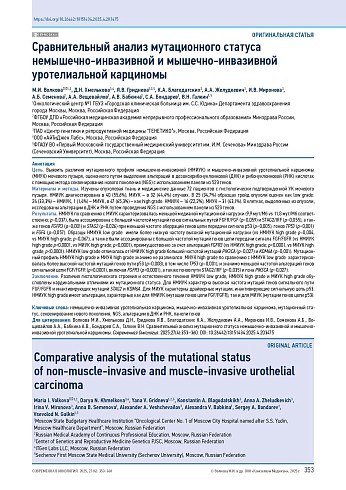
Цель. Выявить различия мутационного профиля немышечно-инвазивной (НМИУК) и мышечно-инвазивной уротелиальной карциномы (МИУК) мочевого пузыря, оцененного путем выделения альтераций в дезоксирибонуклеиновой (ДНК) и рибонуклеиновой (РНК) кислотах с помощью метода секвенирования нового поколения (NGS) с использованием панели из 523 генов.
Материалы и методы. Изучены опухолевая ткань и медицинские данные 72 пациентов с гистологически подтвержденной УК мочевого пузыря. НМИУК диагностирована в 40 (55,6%), МИУК – в 32 (44,4%) случаях. В 25 (34,7%) образцах грейд опухоли оценен как low grade: 24 (33,3%) – НМИУК, 1 (1,4%) – МИУК, в 47 (65,3%) – как high grade: НМИУК – 16 (22,2%), МИУК – 31 (43,1%). В клетках, выделенных из опухоли, исследованы альтерации в ДНК и РНК путем проведения NGS с использованием панели из 523 генов.
Результаты. НМИУК по сравнению с МИУК характеризовалась меньшей медианой мутационной нагрузки (9,9 мут/Мб vs 11,8 мут/Мб соответственно; p=0,037), была ассоциирована с большей частотой мутаций генов сигнальных путей FGFR/FGF (p=0,059) и STAG2/IRF (p=0,055), а также генов FGFR3 (р=0,001) и STAG2 (р=0,026) при меньшей частоте аберраций генов цепи передачи сигнала р53 (р=0,005), генов TP53 (р=0,001) и FGF4 (р=0,057). Образцы НМИУК low grade имели более низкую частоту высокой мутационной нагрузки (vs НМИУК high grade р=0,004, vs МИУК high grade; p=0,067), а также были ассоциированы с большей частотой мутаций генов цепи передачи сигнала FGF/FGFR (vs НМИУК high grade р<0,0001, vs МИУК high grade; р<0,0001), преимущественно за счет альтераций FGFR3 (vs НМИУК high grade; р<0,0001, vs МИУК high grade; р<0,0001). НМИУК low grade отличалась от НМИУК high grade большей частотой мутаций PIK3CA (p=0,027) и KDM6A (р=0,001). Мутационный профиль НМИУК high grade и МИУК high grade значимо не различался. МИУК high grade по сравнению с НМИУК low grade характеризовалась более высокой частотой мутаций генов пути р53 (p=0,008), в том числе TP53 (р=0,001), и значимо меньшей частотой альтераций генов сигнальной цепи FGF/FGFR (р<0,0001), включая FGFR3 (р<0,0001), а также генов пути STAG2/IRF (p=0,035) и гена PIK3CA (р=0,027).
Заключение. Различия гистологического строения и естественного течения НМИУК low grade, НМИУК high grade и МИУК high grade обусловлены кардинальными отличиями их мутационного статуса. Для НМИУК характерна высокая частота мутаций генов сигнального пути FGF/FGFR и инактивирующих мутаций STAG2 и KDM6A. Для МИУК характерны драйверные мутации, инактивирующие сигнальную цепь р53. НМИУК high grade имеет альтерации, характерные как для НМИУК (мутации генов цепи FGF/FGFR), так и для МИУК (мутации генов цепи р53).
Ключевые слова: немышечно-инвазивная уротелиальная карцинома, мышечно-инвазивная уротелиальная карцинома, мутационный статус, секвенирование нового поколения, NGS, альтерации в ДНК и РНК, панели генов
Materials and methods. Tumor tissue and medical data of 72 patients with histologically confirmed bladder UC were studied. NMIUC was diagnosed in 40 (55.6%) patients, and MIUC in 32 (44.4%) patients. In 25 (34.7%) samples the tumor grade was assessed as low: 24 (33.3%) with NMIUC and 1 (1.4%) with MIUC, and in 47 (65.3%) as high: 16 (22.2%) with NMIUC, 31 (43.1%) with MIUC. In isolated tumor cells DNA and RNA alterations were detected by NGS using a panel of 523 genes.
Results. NMIUC, compared to MIUC, was characterized by a lower median mutational burden (9.9 mut/Mb vs. 11.8 mut/Mb, respectively; p=0.037) and was associated with a higher rate of mutations of the FGFR/FGF (p=0.059) and STAG2/IRF (p=0.055) signaling pathways genes, as well as the FGFR3 (p=0.001) and STAG2 (p=0.026) genes with a lower rate of aberrations of the p53 signaling pathway genes (p=0.005), TP53 (p=0.001) and FGF4 (p=0.057). The low grade NMIUC samples had a lower rate of high mutational burden (vs. high grade NMIUC, p=0.004; vs high grade MIUC, p=0.067) and were also associated with a higher rate of FGF/FGFR signaling pathway gene mutations (vs. high grade MIUC, p<0.0001; vs. high grade NMIUC, p<0.0001), mainly due to FGFR3 alterations (vs. high grade NMIUC; p<0.0001; vs. high grade MIUC; p<0.0001). Low grade NMIUC, compared to high grade MIUC, had a higher rate of PIK3CA (p=0.027) and KDM6A (p=0.001) mutations. The mutational profile of high grade NMIUC and high grade MIUC did not differ significantly. High grade MIUC, compared to low grade NMIUC had a higher rate of mutations of the p53 pathway genes (p=0.008), including TP53 (p=0.001), and a significantly lower rate of alterations of the FGF/FGFR signal pathway genes (p<0.0001), including FGFR3 (p<0.0001), as well as the STAG2/IRF pathway genes (p=0.035) and the PIK3CA gene (p=0.027).
Conclusion. Differences of the histological structure and natural history of low grade NMIUC, high grade NMIUC, and high grade MIUC are due to significant differences in their mutational status. NMIUC has a high rate of mutations in genes of the FGF/FGFR signaling pathway and inactivating mutations in STAG2 and KDM6A genes. MIUC typically has driver mutations that inactivate the p53 signal pathway. High grade NMIUC has alterations typical for both NMIUC (FGF/FGFR pathway gene mutations) and MIUC (p53 pathway gene mutations).
Keywords: non-muscle-invasive urothelial carcinoma, muscle-invasive urothelial carcinoma, mutational status, next-generation sequencing, NGS, alterations in DNA and RNA, gene panels
Материалы и методы. Изучены опухолевая ткань и медицинские данные 72 пациентов с гистологически подтвержденной УК мочевого пузыря. НМИУК диагностирована в 40 (55,6%), МИУК – в 32 (44,4%) случаях. В 25 (34,7%) образцах грейд опухоли оценен как low grade: 24 (33,3%) – НМИУК, 1 (1,4%) – МИУК, в 47 (65,3%) – как high grade: НМИУК – 16 (22,2%), МИУК – 31 (43,1%). В клетках, выделенных из опухоли, исследованы альтерации в ДНК и РНК путем проведения NGS с использованием панели из 523 генов.
Результаты. НМИУК по сравнению с МИУК характеризовалась меньшей медианой мутационной нагрузки (9,9 мут/Мб vs 11,8 мут/Мб соответственно; p=0,037), была ассоциирована с большей частотой мутаций генов сигнальных путей FGFR/FGF (p=0,059) и STAG2/IRF (p=0,055), а также генов FGFR3 (р=0,001) и STAG2 (р=0,026) при меньшей частоте аберраций генов цепи передачи сигнала р53 (р=0,005), генов TP53 (р=0,001) и FGF4 (р=0,057). Образцы НМИУК low grade имели более низкую частоту высокой мутационной нагрузки (vs НМИУК high grade р=0,004, vs МИУК high grade; p=0,067), а также были ассоциированы с большей частотой мутаций генов цепи передачи сигнала FGF/FGFR (vs НМИУК high grade р<0,0001, vs МИУК high grade; р<0,0001), преимущественно за счет альтераций FGFR3 (vs НМИУК high grade; р<0,0001, vs МИУК high grade; р<0,0001). НМИУК low grade отличалась от НМИУК high grade большей частотой мутаций PIK3CA (p=0,027) и KDM6A (р=0,001). Мутационный профиль НМИУК high grade и МИУК high grade значимо не различался. МИУК high grade по сравнению с НМИУК low grade характеризовалась более высокой частотой мутаций генов пути р53 (p=0,008), в том числе TP53 (р=0,001), и значимо меньшей частотой альтераций генов сигнальной цепи FGF/FGFR (р<0,0001), включая FGFR3 (р<0,0001), а также генов пути STAG2/IRF (p=0,035) и гена PIK3CA (р=0,027).
Заключение. Различия гистологического строения и естественного течения НМИУК low grade, НМИУК high grade и МИУК high grade обусловлены кардинальными отличиями их мутационного статуса. Для НМИУК характерна высокая частота мутаций генов сигнального пути FGF/FGFR и инактивирующих мутаций STAG2 и KDM6A. Для МИУК характерны драйверные мутации, инактивирующие сигнальную цепь р53. НМИУК high grade имеет альтерации, характерные как для НМИУК (мутации генов цепи FGF/FGFR), так и для МИУК (мутации генов цепи р53).
Ключевые слова: немышечно-инвазивная уротелиальная карцинома, мышечно-инвазивная уротелиальная карцинома, мутационный статус, секвенирование нового поколения, NGS, альтерации в ДНК и РНК, панели генов
________________________________________________
Materials and methods. Tumor tissue and medical data of 72 patients with histologically confirmed bladder UC were studied. NMIUC was diagnosed in 40 (55.6%) patients, and MIUC in 32 (44.4%) patients. In 25 (34.7%) samples the tumor grade was assessed as low: 24 (33.3%) with NMIUC and 1 (1.4%) with MIUC, and in 47 (65.3%) as high: 16 (22.2%) with NMIUC, 31 (43.1%) with MIUC. In isolated tumor cells DNA and RNA alterations were detected by NGS using a panel of 523 genes.
Results. NMIUC, compared to MIUC, was characterized by a lower median mutational burden (9.9 mut/Mb vs. 11.8 mut/Mb, respectively; p=0.037) and was associated with a higher rate of mutations of the FGFR/FGF (p=0.059) and STAG2/IRF (p=0.055) signaling pathways genes, as well as the FGFR3 (p=0.001) and STAG2 (p=0.026) genes with a lower rate of aberrations of the p53 signaling pathway genes (p=0.005), TP53 (p=0.001) and FGF4 (p=0.057). The low grade NMIUC samples had a lower rate of high mutational burden (vs. high grade NMIUC, p=0.004; vs high grade MIUC, p=0.067) and were also associated with a higher rate of FGF/FGFR signaling pathway gene mutations (vs. high grade MIUC, p<0.0001; vs. high grade NMIUC, p<0.0001), mainly due to FGFR3 alterations (vs. high grade NMIUC; p<0.0001; vs. high grade MIUC; p<0.0001). Low grade NMIUC, compared to high grade MIUC, had a higher rate of PIK3CA (p=0.027) and KDM6A (p=0.001) mutations. The mutational profile of high grade NMIUC and high grade MIUC did not differ significantly. High grade MIUC, compared to low grade NMIUC had a higher rate of mutations of the p53 pathway genes (p=0.008), including TP53 (p=0.001), and a significantly lower rate of alterations of the FGF/FGFR signal pathway genes (p<0.0001), including FGFR3 (p<0.0001), as well as the STAG2/IRF pathway genes (p=0.035) and the PIK3CA gene (p=0.027).
Conclusion. Differences of the histological structure and natural history of low grade NMIUC, high grade NMIUC, and high grade MIUC are due to significant differences in their mutational status. NMIUC has a high rate of mutations in genes of the FGF/FGFR signaling pathway and inactivating mutations in STAG2 and KDM6A genes. MIUC typically has driver mutations that inactivate the p53 signal pathway. High grade NMIUC has alterations typical for both NMIUC (FGF/FGFR pathway gene mutations) and MIUC (p53 pathway gene mutations).
Keywords: non-muscle-invasive urothelial carcinoma, muscle-invasive urothelial carcinoma, mutational status, next-generation sequencing, NGS, alterations in DNA and RNA, gene panels
Полный текст
Список литературы
1. Румянцев А.А., Булычкин П.В., Волкова М.И. и др. Рак мочевого пузыря. Практические рекомендации RUSSCO, часть 1.2. Злокачественные опухоли. 2024;14(3s2):221-41 [Rumiantsev AA, Bulychkin PV, Volkova MI, et al. Bladder Cancer. Practical Recommendations of RUSSCO, part 1.2. Malignant Tumors. 2024;14(3s2):221-41 (in Russian)].
2. Audenet F, Attalla K, Sfakianos JP. The evolution of bladder cancer genomics: What have we learned and how can we use it? Urol Oncol. 2018;36(7):313-20. DOI:10.1016/j.urolonc.2018.02.017
3. Van Batavia J, Yamany T, Molotkov A, et al. Bladder cancers arise from distinct urothelial sub-populations. Nat Cell Biol. 2014;16(10):982-91, 1-5. DOI:10.1038/ncb3038
4. Illumina, Inc. Available at: https://support.illumina.com/content/dam/illuminasupport/documents/documentation/software_documentat.... Accessed: 05.06.2025.
5. ClinVar. Available at: https://www.ncbi.nlm.nih.gov/clinvar. Accessed: 05.06.2025.
6. Li MM, Datto M, Duncavage EJ, et al. Standards and Guidelines for the Interpretation and Reporting of Sequence Variants in Cancer: A Joint Consensus Recommendation of the Association for Molecular Pathology, American Society of Clinical Oncology, and College of American Pathologists. J Mol Diagn. 2017;19(1):4-23. DOI:10.1016/j.jmoldx.2016.10.002
7. Chakravarty D, Gao J, Phillips SM, et al. OncoKB: A precision oncology knowledge base. JCO Precis Oncol. 2017;2017:PO.17.00011. DOI:10.1200/PO.17.00011
8. The Cancer Genome Atlas Research Network. Comprehensive Molecular Characterization of Urothelial Bladder Carcinoma. Nature. 2014;507(7492):315-22. DOI:10.1038/nature12965
9. Prip F, Lamy P, Lindskrog SV, et al. Comprehensive genomic characterization of early-stage bladder cancer. Nat Genet. 2025;57(1):115-25. DOI:10.1038/s41588-024-02030-z
10. Гриднева Я.В., Хмелькова Д.Н., Волкова М.И., и др. Опыт исследования образцов уротелиальной карциномы с помощью панели секвенирования нового поколения на 523 гена. Современная онкология. 2024;26(4):489-94 [Gridneva YaV, Khmelkova DN, Volkova MI, et al. Experience of Next-Generation Sequencing in urothelial carcinoma specimens with panel for 523 genes. Journal of Modern Oncology. 2024;26(4):489-94 (in Russian)]. DOI:10.26442/18151434.2024.4.203018
11. Alexandrov LB, Nik-Zainal S, Wedge DC, et al. Signatures of mutational processes in human cancer. Nature. 2013;500(7463):415-21. DOI:10.1038/nature12477
12. Chalmers ZR, Connelly CF, Fabrizio D, et al. Analysis of 100,000 human cancer genomes reveals the landscape of tumor mutational burden. Genome Med. 2017;9(1):34. DOI:10.1186/s13073-017-0424-2
13. Klempner SJ, Fabrizio D, Bane S, et al. Tumor mutational burden as a predictive biomarker for response to immune checkpoint inhibitors: A review of current evidence. Oncologist. 2020;25:e147-59. DOI:10.1634/theoncologist.2019-0244
14. Chandran EBA, Iannantuono GM, Atiq SO, et al. Mismatch repair deficiency and microsatellite instability in urothelial carcinoma: A systematic review and meta-analysis. BMJ Oncol. 2024;3(1):e000335. DOI:10.1136/bmjonc-2024-000335
15. Al-Ahmadie H, Netto GJ. Updates on the genomics of bladder cancer and novel molecular taxonomy. Adv Anatomic Pathol. 2020;27(1):36-43. DOI:10.1097/PAP.0000000000000252
16. Loriot Y, Kamal M, Syx L, et al. The genomic and transcriptomic landscape of metastastic urothelial cancer. Nat Commun. 2024;15(1):8603. DOI:10.1038/s41467-024-52915-0
17. Li Y, Sun L, Guo X, et al. Frontiers in bladder cancer genomic research. Front Oncol. 2021;11:670729. DOI:10.3389/fonc.2021.670729
18. Nassar AH, Umeton R, Kim J, et al. mutational analysis of 472 urothelial carcinoma across grades and anatomic sites. Clin Cancer Res. 2019;25(8):2458-70. DOI:10.1158/1078-0432.CCR-18-3147
19. Wang F, Dong X, Yang F, Xing N. Comparative analysis of differentially mutated genes in non-muscle and muscle-invasive bladder cancer in the chinese population by whole exome sequencing. Front Genet. 2022;13:831146. DOI:10.3389/fgene.2022.831146
20. Solomon DA, Kim JS, Bondaruk J, et al. Frequent truncating mutations of STAG2 in bladder cancer. Nat Genet. 2013;45(12):1428-30. DOI:10.1038/ng.2800
21. Sjödahl G, Eriksson P, Patschan O, et al. Molecular changes during progression from nonmuscle invasive to advanced urothelial carcinoma. Int J Cancer. 2020;146(9):2636-47. DOI:10.1002/ijc.32737
22. Neuzillet Y, Paoletti X, Ouerhani S, et al. A meta-analysis of the relationship between FGFR3 and TP53 mutations in bladder cancer. PLoS One. 2012;7(12):e48993. DOI:10.1371/journal.pone.0048993
23. Loriot Y, Necchi A, Park SH, et al. Erdafitinib in locally advanced or metastatic urothelial carcinoma. N Engl J Med. 2019;381(4):338-48. DOI:10.1056/NEJMoa1817323
24. Catto JWF, Tran B, Rouprêt M, et al.; THOR-2 Cohort 1 Investigators. Erdafitinib in BCG-treated high-risk non-muscle-invasive bladder cancer. Ann Oncol. 2024;35(1):98-106. DOI:10.1016/j.annonc.2023.09.3116
25. Athans SR, Withers H, Stablewski A, et al. STAG2 expression imparts distinct therapeutic vulnerabilities in muscle-invasive bladder cancer cells. Oncogenesis. 2025;14(1):4. DOI:10.1038/s41389-025-00548-3
26. Gui Y, Guo G, Huang Y. Frequent mutations of chromatin remodeling genes in transitional cell carcinoma of the bladder. Nat Genet. 2011;43(9):875-8. DOI:10.1038/ng.907
27. Andricovich J, Perkail S, Kai Y, et al. Loss of KDM6A activates super-enhancers to induce gender-specific squamous-like pancreatic cancer and confers sensitivity to BET inhibitors. Cancer Cell. 2018;33(3):512-26.e8. DOI:10.1016/j.ccell.2018.02.003
28. Chen X, Lin X, Pang G, et al. Significance of KDM6A mutation in bladder cancer immune escape. BMC Cancer. 2021;21(1):635. DOI:10.1186/s12885-021-08372-9
29. Jindal T, Zhu X, Bose R, et al. Somatic alterations of TP53 and MDM2 associated with response to enfortumab vedotin in patients with advanced urothelial cancer. Front Oncol. 2023;13:1161089. DOI:10.3389/fonc.2023.1161089
30. Faltas BM, Osman M, Evans MG, et al. CLONEVO: Preoperative abemaciclib for cisplatin-ineligible muscle-invasive bladder cancer (MIBC) with molecular response assessment. J Clin Oncol. 2024;43(Suppl. 16). Abstract 4520. DOI:10.1200/JCO.2025.43.16_suppl.4520
2. Audenet F, Attalla K, Sfakianos JP. The evolution of bladder cancer genomics: What have we learned and how can we use it? Urol Oncol. 2018;36(7):313-20. DOI:10.1016/j.urolonc.2018.02.017
3. Van Batavia J, Yamany T, Molotkov A, et al. Bladder cancers arise from distinct urothelial sub-populations. Nat Cell Biol. 2014;16(10):982-91, 1-5. DOI:10.1038/ncb3038
4. Illumina, Inc. Available at: https://support.illumina.com/content/dam/illuminasupport/documents/documentation/software_documentat.... Accessed: 05.06.2025.
5. ClinVar. Available at: https://www.ncbi.nlm.nih.gov/clinvar. Accessed: 05.06.2025.
6. Li MM, Datto M, Duncavage EJ, et al. Standards and Guidelines for the Interpretation and Reporting of Sequence Variants in Cancer: A Joint Consensus Recommendation of the Association for Molecular Pathology, American Society of Clinical Oncology, and College of American Pathologists. J Mol Diagn. 2017;19(1):4-23. DOI:10.1016/j.jmoldx.2016.10.002
7. Chakravarty D, Gao J, Phillips SM, et al. OncoKB: A precision oncology knowledge base. JCO Precis Oncol. 2017;2017:PO.17.00011. DOI:10.1200/PO.17.00011
8. The Cancer Genome Atlas Research Network. Comprehensive Molecular Characterization of Urothelial Bladder Carcinoma. Nature. 2014;507(7492):315-22. DOI:10.1038/nature12965
9. Prip F, Lamy P, Lindskrog SV, et al. Comprehensive genomic characterization of early-stage bladder cancer. Nat Genet. 2025;57(1):115-25. DOI:10.1038/s41588-024-02030-z
10. Gridneva YaV, Khmelkova DN, Volkova MI, et al. Experience of Next-Generation Sequencing in urothelial carcinoma specimens with panel for 523 genes. Journal of Modern Oncology. 2024;26(4):489-94 (in Russian). DOI:10.26442/18151434.2024.4.203018
11. Alexandrov LB, Nik-Zainal S, Wedge DC, et al. Signatures of mutational processes in human cancer. Nature. 2013;500(7463):415-21. DOI:10.1038/nature12477
12. Chalmers ZR, Connelly CF, Fabrizio D, et al. Analysis of 100,000 human cancer genomes reveals the landscape of tumor mutational burden. Genome Med. 2017;9(1):34. DOI:10.1186/s13073-017-0424-2
13. Klempner SJ, Fabrizio D, Bane S, et al. Tumor mutational burden as a predictive biomarker for response to immune checkpoint inhibitors: A review of current evidence. Oncologist. 2020;25:e147-59. DOI:10.1634/theoncologist.2019-0244
14. Chandran EBA, Iannantuono GM, Atiq SO, et al. Mismatch repair deficiency and microsatellite instability in urothelial carcinoma: A systematic review and meta-analysis. BMJ Oncol. 2024;3(1):e000335. DOI:10.1136/bmjonc-2024-000335
15. Al-Ahmadie H, Netto GJ. Updates on the genomics of bladder cancer and novel molecular taxonomy. Adv Anatomic Pathol. 2020;27(1):36-43. DOI:10.1097/PAP.0000000000000252
16. Loriot Y, Kamal M, Syx L, et al. The genomic and transcriptomic landscape of metastastic urothelial cancer. Nat Commun. 2024;15(1):8603. DOI:10.1038/s41467-024-52915-0
17. Li Y, Sun L, Guo X, et al. Frontiers in bladder cancer genomic research. Front Oncol. 2021;11:670729. DOI:10.3389/fonc.2021.670729
18. Nassar AH, Umeton R, Kim J, et al. mutational analysis of 472 urothelial carcinoma across grades and anatomic sites. Clin Cancer Res. 2019;25(8):2458-70. DOI:10.1158/1078-0432.CCR-18-3147
19. Wang F, Dong X, Yang F, Xing N. Comparative analysis of differentially mutated genes in non-muscle and muscle-invasive bladder cancer in the chinese population by whole exome sequencing. Front Genet. 2022;13:831146. DOI:10.3389/fgene.2022.831146
20. Solomon DA, Kim JS, Bondaruk J, et al. Frequent truncating mutations of STAG2 in bladder cancer. Nat Genet. 2013;45(12):1428-30. DOI:10.1038/ng.2800
21. Sjödahl G, Eriksson P, Patschan O, et al. Molecular changes during progression from nonmuscle invasive to advanced urothelial carcinoma. Int J Cancer. 2020;146(9):2636-47. DOI:10.1002/ijc.32737
22. Neuzillet Y, Paoletti X, Ouerhani S, et al. A meta-analysis of the relationship between FGFR3 and TP53 mutations in bladder cancer. PLoS One. 2012;7(12):e48993. DOI:10.1371/journal.pone.0048993
23. Loriot Y, Necchi A, Park SH, et al. Erdafitinib in locally advanced or metastatic urothelial carcinoma. N Engl J Med. 2019;381(4):338-48. DOI:10.1056/NEJMoa1817323
24. Catto JWF, Tran B, Rouprêt M, et al.; THOR-2 Cohort 1 Investigators. Erdafitinib in BCG-treated high-risk non-muscle-invasive bladder cancer. Ann Oncol. 2024;35(1):98-106. DOI:10.1016/j.annonc.2023.09.3116
25. Athans SR, Withers H, Stablewski A, et al. STAG2 expression imparts distinct therapeutic vulnerabilities in muscle-invasive bladder cancer cells. Oncogenesis. 2025;14(1):4. DOI:10.1038/s41389-025-00548-3
26. Gui Y, Guo G, Huang Y. Frequent mutations of chromatin remodeling genes in transitional cell carcinoma of the bladder. Nat Genet. 2011;43(9):875-8. DOI:10.1038/ng.907
27. Andricovich J, Perkail S, Kai Y, et al. Loss of KDM6A activates super-enhancers to induce gender-specific squamous-like pancreatic cancer and confers sensitivity to BET inhibitors. Cancer Cell. 2018;33(3):512-26.e8. DOI:10.1016/j.ccell.2018.02.003
28. Chen X, Lin X, Pang G, et al. Significance of KDM6A mutation in bladder cancer immune escape. BMC Cancer. 2021;21(1):635. DOI:10.1186/s12885-021-08372-9
29. Jindal T, Zhu X, Bose R, et al. Somatic alterations of TP53 and MDM2 associated with response to enfortumab vedotin in patients with advanced urothelial cancer. Front Oncol. 2023;13:1161089. DOI:10.3389/fonc.2023.1161089
30. Faltas BM, Osman M, Evans MG, et al. CLONEVO: Preoperative abemaciclib for cisplatin-ineligible muscle-invasive bladder cancer (MIBC) with molecular response assessment. J Clin Oncol. 2024;43(Suppl. 16). Abstract 4520. DOI:10.1200/JCO.2025.43.16_suppl.4520
2. Audenet F, Attalla K, Sfakianos JP. The evolution of bladder cancer genomics: What have we learned and how can we use it? Urol Oncol. 2018;36(7):313-20. DOI:10.1016/j.urolonc.2018.02.017
3. Van Batavia J, Yamany T, Molotkov A, et al. Bladder cancers arise from distinct urothelial sub-populations. Nat Cell Biol. 2014;16(10):982-91, 1-5. DOI:10.1038/ncb3038
4. Illumina, Inc. Available at: https://support.illumina.com/content/dam/illuminasupport/documents/documentation/software_documentat.... Accessed: 05.06.2025.
5. ClinVar. Available at: https://www.ncbi.nlm.nih.gov/clinvar. Accessed: 05.06.2025.
6. Li MM, Datto M, Duncavage EJ, et al. Standards and Guidelines for the Interpretation and Reporting of Sequence Variants in Cancer: A Joint Consensus Recommendation of the Association for Molecular Pathology, American Society of Clinical Oncology, and College of American Pathologists. J Mol Diagn. 2017;19(1):4-23. DOI:10.1016/j.jmoldx.2016.10.002
7. Chakravarty D, Gao J, Phillips SM, et al. OncoKB: A precision oncology knowledge base. JCO Precis Oncol. 2017;2017:PO.17.00011. DOI:10.1200/PO.17.00011
8. The Cancer Genome Atlas Research Network. Comprehensive Molecular Characterization of Urothelial Bladder Carcinoma. Nature. 2014;507(7492):315-22. DOI:10.1038/nature12965
9. Prip F, Lamy P, Lindskrog SV, et al. Comprehensive genomic characterization of early-stage bladder cancer. Nat Genet. 2025;57(1):115-25. DOI:10.1038/s41588-024-02030-z
10. Гриднева Я.В., Хмелькова Д.Н., Волкова М.И., и др. Опыт исследования образцов уротелиальной карциномы с помощью панели секвенирования нового поколения на 523 гена. Современная онкология. 2024;26(4):489-94 [Gridneva YaV, Khmelkova DN, Volkova MI, et al. Experience of Next-Generation Sequencing in urothelial carcinoma specimens with panel for 523 genes. Journal of Modern Oncology. 2024;26(4):489-94 (in Russian)]. DOI:10.26442/18151434.2024.4.203018
11. Alexandrov LB, Nik-Zainal S, Wedge DC, et al. Signatures of mutational processes in human cancer. Nature. 2013;500(7463):415-21. DOI:10.1038/nature12477
12. Chalmers ZR, Connelly CF, Fabrizio D, et al. Analysis of 100,000 human cancer genomes reveals the landscape of tumor mutational burden. Genome Med. 2017;9(1):34. DOI:10.1186/s13073-017-0424-2
13. Klempner SJ, Fabrizio D, Bane S, et al. Tumor mutational burden as a predictive biomarker for response to immune checkpoint inhibitors: A review of current evidence. Oncologist. 2020;25:e147-59. DOI:10.1634/theoncologist.2019-0244
14. Chandran EBA, Iannantuono GM, Atiq SO, et al. Mismatch repair deficiency and microsatellite instability in urothelial carcinoma: A systematic review and meta-analysis. BMJ Oncol. 2024;3(1):e000335. DOI:10.1136/bmjonc-2024-000335
15. Al-Ahmadie H, Netto GJ. Updates on the genomics of bladder cancer and novel molecular taxonomy. Adv Anatomic Pathol. 2020;27(1):36-43. DOI:10.1097/PAP.0000000000000252
16. Loriot Y, Kamal M, Syx L, et al. The genomic and transcriptomic landscape of metastastic urothelial cancer. Nat Commun. 2024;15(1):8603. DOI:10.1038/s41467-024-52915-0
17. Li Y, Sun L, Guo X, et al. Frontiers in bladder cancer genomic research. Front Oncol. 2021;11:670729. DOI:10.3389/fonc.2021.670729
18. Nassar AH, Umeton R, Kim J, et al. mutational analysis of 472 urothelial carcinoma across grades and anatomic sites. Clin Cancer Res. 2019;25(8):2458-70. DOI:10.1158/1078-0432.CCR-18-3147
19. Wang F, Dong X, Yang F, Xing N. Comparative analysis of differentially mutated genes in non-muscle and muscle-invasive bladder cancer in the chinese population by whole exome sequencing. Front Genet. 2022;13:831146. DOI:10.3389/fgene.2022.831146
20. Solomon DA, Kim JS, Bondaruk J, et al. Frequent truncating mutations of STAG2 in bladder cancer. Nat Genet. 2013;45(12):1428-30. DOI:10.1038/ng.2800
21. Sjödahl G, Eriksson P, Patschan O, et al. Molecular changes during progression from nonmuscle invasive to advanced urothelial carcinoma. Int J Cancer. 2020;146(9):2636-47. DOI:10.1002/ijc.32737
22. Neuzillet Y, Paoletti X, Ouerhani S, et al. A meta-analysis of the relationship between FGFR3 and TP53 mutations in bladder cancer. PLoS One. 2012;7(12):e48993. DOI:10.1371/journal.pone.0048993
23. Loriot Y, Necchi A, Park SH, et al. Erdafitinib in locally advanced or metastatic urothelial carcinoma. N Engl J Med. 2019;381(4):338-48. DOI:10.1056/NEJMoa1817323
24. Catto JWF, Tran B, Rouprêt M, et al.; THOR-2 Cohort 1 Investigators. Erdafitinib in BCG-treated high-risk non-muscle-invasive bladder cancer. Ann Oncol. 2024;35(1):98-106. DOI:10.1016/j.annonc.2023.09.3116
25. Athans SR, Withers H, Stablewski A, et al. STAG2 expression imparts distinct therapeutic vulnerabilities in muscle-invasive bladder cancer cells. Oncogenesis. 2025;14(1):4. DOI:10.1038/s41389-025-00548-3
26. Gui Y, Guo G, Huang Y. Frequent mutations of chromatin remodeling genes in transitional cell carcinoma of the bladder. Nat Genet. 2011;43(9):875-8. DOI:10.1038/ng.907
27. Andricovich J, Perkail S, Kai Y, et al. Loss of KDM6A activates super-enhancers to induce gender-specific squamous-like pancreatic cancer and confers sensitivity to BET inhibitors. Cancer Cell. 2018;33(3):512-26.e8. DOI:10.1016/j.ccell.2018.02.003
28. Chen X, Lin X, Pang G, et al. Significance of KDM6A mutation in bladder cancer immune escape. BMC Cancer. 2021;21(1):635. DOI:10.1186/s12885-021-08372-9
29. Jindal T, Zhu X, Bose R, et al. Somatic alterations of TP53 and MDM2 associated with response to enfortumab vedotin in patients with advanced urothelial cancer. Front Oncol. 2023;13:1161089. DOI:10.3389/fonc.2023.1161089
30. Faltas BM, Osman M, Evans MG, et al. CLONEVO: Preoperative abemaciclib for cisplatin-ineligible muscle-invasive bladder cancer (MIBC) with molecular response assessment. J Clin Oncol. 2024;43(Suppl. 16). Abstract 4520. DOI:10.1200/JCO.2025.43.16_suppl.4520
________________________________________________
2. Audenet F, Attalla K, Sfakianos JP. The evolution of bladder cancer genomics: What have we learned and how can we use it? Urol Oncol. 2018;36(7):313-20. DOI:10.1016/j.urolonc.2018.02.017
3. Van Batavia J, Yamany T, Molotkov A, et al. Bladder cancers arise from distinct urothelial sub-populations. Nat Cell Biol. 2014;16(10):982-91, 1-5. DOI:10.1038/ncb3038
4. Illumina, Inc. Available at: https://support.illumina.com/content/dam/illuminasupport/documents/documentation/software_documentat.... Accessed: 05.06.2025.
5. ClinVar. Available at: https://www.ncbi.nlm.nih.gov/clinvar. Accessed: 05.06.2025.
6. Li MM, Datto M, Duncavage EJ, et al. Standards and Guidelines for the Interpretation and Reporting of Sequence Variants in Cancer: A Joint Consensus Recommendation of the Association for Molecular Pathology, American Society of Clinical Oncology, and College of American Pathologists. J Mol Diagn. 2017;19(1):4-23. DOI:10.1016/j.jmoldx.2016.10.002
7. Chakravarty D, Gao J, Phillips SM, et al. OncoKB: A precision oncology knowledge base. JCO Precis Oncol. 2017;2017:PO.17.00011. DOI:10.1200/PO.17.00011
8. The Cancer Genome Atlas Research Network. Comprehensive Molecular Characterization of Urothelial Bladder Carcinoma. Nature. 2014;507(7492):315-22. DOI:10.1038/nature12965
9. Prip F, Lamy P, Lindskrog SV, et al. Comprehensive genomic characterization of early-stage bladder cancer. Nat Genet. 2025;57(1):115-25. DOI:10.1038/s41588-024-02030-z
10. Gridneva YaV, Khmelkova DN, Volkova MI, et al. Experience of Next-Generation Sequencing in urothelial carcinoma specimens with panel for 523 genes. Journal of Modern Oncology. 2024;26(4):489-94 (in Russian). DOI:10.26442/18151434.2024.4.203018
11. Alexandrov LB, Nik-Zainal S, Wedge DC, et al. Signatures of mutational processes in human cancer. Nature. 2013;500(7463):415-21. DOI:10.1038/nature12477
12. Chalmers ZR, Connelly CF, Fabrizio D, et al. Analysis of 100,000 human cancer genomes reveals the landscape of tumor mutational burden. Genome Med. 2017;9(1):34. DOI:10.1186/s13073-017-0424-2
13. Klempner SJ, Fabrizio D, Bane S, et al. Tumor mutational burden as a predictive biomarker for response to immune checkpoint inhibitors: A review of current evidence. Oncologist. 2020;25:e147-59. DOI:10.1634/theoncologist.2019-0244
14. Chandran EBA, Iannantuono GM, Atiq SO, et al. Mismatch repair deficiency and microsatellite instability in urothelial carcinoma: A systematic review and meta-analysis. BMJ Oncol. 2024;3(1):e000335. DOI:10.1136/bmjonc-2024-000335
15. Al-Ahmadie H, Netto GJ. Updates on the genomics of bladder cancer and novel molecular taxonomy. Adv Anatomic Pathol. 2020;27(1):36-43. DOI:10.1097/PAP.0000000000000252
16. Loriot Y, Kamal M, Syx L, et al. The genomic and transcriptomic landscape of metastastic urothelial cancer. Nat Commun. 2024;15(1):8603. DOI:10.1038/s41467-024-52915-0
17. Li Y, Sun L, Guo X, et al. Frontiers in bladder cancer genomic research. Front Oncol. 2021;11:670729. DOI:10.3389/fonc.2021.670729
18. Nassar AH, Umeton R, Kim J, et al. mutational analysis of 472 urothelial carcinoma across grades and anatomic sites. Clin Cancer Res. 2019;25(8):2458-70. DOI:10.1158/1078-0432.CCR-18-3147
19. Wang F, Dong X, Yang F, Xing N. Comparative analysis of differentially mutated genes in non-muscle and muscle-invasive bladder cancer in the chinese population by whole exome sequencing. Front Genet. 2022;13:831146. DOI:10.3389/fgene.2022.831146
20. Solomon DA, Kim JS, Bondaruk J, et al. Frequent truncating mutations of STAG2 in bladder cancer. Nat Genet. 2013;45(12):1428-30. DOI:10.1038/ng.2800
21. Sjödahl G, Eriksson P, Patschan O, et al. Molecular changes during progression from nonmuscle invasive to advanced urothelial carcinoma. Int J Cancer. 2020;146(9):2636-47. DOI:10.1002/ijc.32737
22. Neuzillet Y, Paoletti X, Ouerhani S, et al. A meta-analysis of the relationship between FGFR3 and TP53 mutations in bladder cancer. PLoS One. 2012;7(12):e48993. DOI:10.1371/journal.pone.0048993
23. Loriot Y, Necchi A, Park SH, et al. Erdafitinib in locally advanced or metastatic urothelial carcinoma. N Engl J Med. 2019;381(4):338-48. DOI:10.1056/NEJMoa1817323
24. Catto JWF, Tran B, Rouprêt M, et al.; THOR-2 Cohort 1 Investigators. Erdafitinib in BCG-treated high-risk non-muscle-invasive bladder cancer. Ann Oncol. 2024;35(1):98-106. DOI:10.1016/j.annonc.2023.09.3116
25. Athans SR, Withers H, Stablewski A, et al. STAG2 expression imparts distinct therapeutic vulnerabilities in muscle-invasive bladder cancer cells. Oncogenesis. 2025;14(1):4. DOI:10.1038/s41389-025-00548-3
26. Gui Y, Guo G, Huang Y. Frequent mutations of chromatin remodeling genes in transitional cell carcinoma of the bladder. Nat Genet. 2011;43(9):875-8. DOI:10.1038/ng.907
27. Andricovich J, Perkail S, Kai Y, et al. Loss of KDM6A activates super-enhancers to induce gender-specific squamous-like pancreatic cancer and confers sensitivity to BET inhibitors. Cancer Cell. 2018;33(3):512-26.e8. DOI:10.1016/j.ccell.2018.02.003
28. Chen X, Lin X, Pang G, et al. Significance of KDM6A mutation in bladder cancer immune escape. BMC Cancer. 2021;21(1):635. DOI:10.1186/s12885-021-08372-9
29. Jindal T, Zhu X, Bose R, et al. Somatic alterations of TP53 and MDM2 associated with response to enfortumab vedotin in patients with advanced urothelial cancer. Front Oncol. 2023;13:1161089. DOI:10.3389/fonc.2023.1161089
30. Faltas BM, Osman M, Evans MG, et al. CLONEVO: Preoperative abemaciclib for cisplatin-ineligible muscle-invasive bladder cancer (MIBC) with molecular response assessment. J Clin Oncol. 2024;43(Suppl. 16). Abstract 4520. DOI:10.1200/JCO.2025.43.16_suppl.4520
Авторы
М.И. Волкова*1,2, Д.Н. Хмелькова3,4, Я.В. Гриднева1,2,5, К.А. Благодатских3, А.А. Желудкевич3, И.В. Миронова3, А.Б. Семенова1, А.А. Вещевайлов1, А.В. Бабкина1, С.А. Бондарев1, В.Н. Галкин1,5
1Онкологический центр №1 ГБУЗ «Городская клиническая больница им. С.С. Юдина» Департамента здравоохранения города Москвы, Москва, Российская Федерация
2ФГБОУ ДПО «Российская медицинская академия непрерывного профессионального образования» Минздрава России, Москва, Российская Федерация
3ПАО «Центр генетики и репродуктивной медицины “ГЕНЕТИКО”», Москва, Российская Федерация
4ООО «АйТиДжен Лабс», Москва, Российская Федерация
5ФГАОУ ВО «Первый Московский государственный медицинский университет им. И.М. Сеченова» Минздрава России (Сеченовский Университет), Москва, Российская Федерация
*mivolkova6@gmail.com
1Moscow State Budgetary Healthcare Institution “Oncological Center No. 1 of Moscow City Hospital named after S.S. Yudin, Moscow Healthcare Department”, Moscow, Russian Federation
2Russian Medical Academy of Continuous Professional Education, Moscow, Russian Federation
3Center of Genetics and Reproductive Medicine Genetico PJSC, Moscow, Russian Federation
4ITGen Labs LLC, Moscow, Russian Federation
5Sechenov First Moscow State Medical University (Sechenov University), Moscow, Russian Federation
*mivolkova6@gmail.com
1Онкологический центр №1 ГБУЗ «Городская клиническая больница им. С.С. Юдина» Департамента здравоохранения города Москвы, Москва, Российская Федерация
2ФГБОУ ДПО «Российская медицинская академия непрерывного профессионального образования» Минздрава России, Москва, Российская Федерация
3ПАО «Центр генетики и репродуктивной медицины “ГЕНЕТИКО”», Москва, Российская Федерация
4ООО «АйТиДжен Лабс», Москва, Российская Федерация
5ФГАОУ ВО «Первый Московский государственный медицинский университет им. И.М. Сеченова» Минздрава России (Сеченовский Университет), Москва, Российская Федерация
*mivolkova6@gmail.com
________________________________________________
1Moscow State Budgetary Healthcare Institution “Oncological Center No. 1 of Moscow City Hospital named after S.S. Yudin, Moscow Healthcare Department”, Moscow, Russian Federation
2Russian Medical Academy of Continuous Professional Education, Moscow, Russian Federation
3Center of Genetics and Reproductive Medicine Genetico PJSC, Moscow, Russian Federation
4ITGen Labs LLC, Moscow, Russian Federation
5Sechenov First Moscow State Medical University (Sechenov University), Moscow, Russian Federation
*mivolkova6@gmail.com
Цель портала OmniDoctor – предоставление профессиональной информации врачам, провизорам и фармацевтам.