

Материалы доступны только для специалистов сферы здравоохранения.
Чтобы посмотреть материал полностью
Авторизуйтесь
или зарегистрируйтесь.
Первый опыт роботических малоинвазивных резекций при раке пищевода. Ретроспективное исследование
Первый опыт роботических малоинвазивных резекций при раке пищевода. Ретроспективное исследование
Сехниаидзе Д.Д., Ерыгин Д.В., Каннер Д.Ю., Блинов Д.А., Агасиев М.В. Первый опыт роботических малоинвазивных резекций при раке пищевода. Ретроспективное исследование. Современная Онкология. 2026;28(1):6–9. DOI: 10.26442/18151434.2026.1.203646
________________________________________________
Материалы доступны только для специалистов сферы здравоохранения.
Чтобы посмотреть материал полностью
Авторизуйтесь
или зарегистрируйтесь.
Аннотация
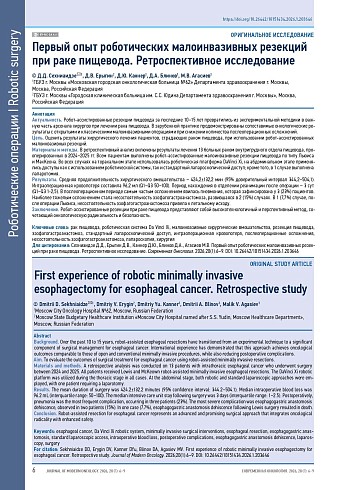
Актуальность. Робот-ассистированные резекции пищевода за последние 10–15 лет превратились из экспериментальной методики в важную часть арсенала хирургов при лечении рака пищевода. В зарубежной практике продемонстрированы сопоставимые онкологические результаты с открытыми и классическими малоинвазивными операциями при снижении количества послеоперационных осложнений.
Цель. Оценить результаты хирургического лечения пациентов, страдающих раком пищевода, при использовании робот-ассистированных малоинвазивных резекций.
Материалы и методы. В ретроспективный анализ включены результаты лечения 13 больных раком внутригрудного отдела пищевода, прооперированных в 2024–2025 гг. Всем пациентам выполнены робот-ассистированные малоинвазивные резекции пищевода по типу Льюиса и МакКеона. Во всех случаях на торакальном этапе использовалась роботическая платформа DaVinci Xi, на абдоминальном этапе применялись доступы как с использованием роботической системы, так и стандартный лапароскопический доступ; кроме того, в 1 случае выполнена лапаротомия.
Результаты. Средняя продолжительность хирургического вмешательства – 424,2±132,2 мин (95% доверительный интервал 344,2–504,1). Интраоперационная кровопотеря составила 96,2 мл (Q1–Q3 50–100). Период нахождения в отделении реанимации после операции – 3 сут (Q1–Q3 1-2,5). В послеоперационном периоде самым частым осложнением явилась пневмония, которая зафиксирована у 3 (23%) пациентов. Наиболее тяжелым осложнением стала несостоятельность эзофагогастроанастомоза, развившаяся в 2 (15%) случаях. В 1 (7,7%) случае, после операции Льюиса, несостоятельность эзофагогастроанастомоза привела к летальному исходу.
Заключение. Робот-ассистированные резекции при раке пищевода представляют собой высокотехнологичный и перспективный метод, сочетающий онкологическую радикальность и безопасность.
Ключевые слова: рак пищевода, роботическая система Da Vinci Xi, малоинвазивные хирургические вмешательства, резекция пищевода, эзофагогастроанастомоз, стандартный лапароскопический доступ, интраоперационная кровопотеря, послеоперационные осложнения, несостоятельность эзофагогастроанастомоза, лапароскопия, хирургия
Aim. To evaluate the outcomes of surgical treatment for esophageal cancer using robot-assisted minimally invasive resections.
Materials and methods. A retrospective analysis was conducted on 13 patients with intrathoracic esophageal cancer who underwent surgery between 2024 and 2025. All patients received Lewis and McKeown robot-assisted minimally invasive esophageal resections. The DaVinci Xi robotic platform was utilized during the thoracic stage in all cases. At the abdominal stage, both robotic and standard laparoscopic approaches were employed, with one patient requiring a laparotomy.
Results. The mean duration of surgery was 424.2±132.2 minutes (95% confidence interval: 344.2–504.1). Median intraoperative blood loss was 96.2 mL (interquartile range: 50–100). The median intensive care unit stay following surgery was 3 days (interquartile range: 1–2.5). Postoperatively, pneumonia was the most frequent complication, occurring in three patients (23%). The most severe complication was esophagogastric anastomosis dehiscence, observed in two patients (15%). In one case (7.7%), esophagogastric anastomosis dehiscence following Lewis surgery resulted in death.
Conclusion. Robot-assisted resection for esophageal cancer represents an advanced and promising surgical approach that integrates oncological radicality with enhanced safety.
Keywords: esophageal cancer, Da Vinci Xi robotic system, minimally invasive surgical interventions, esophageal resection, esophagogastric anastomosis, standard laparoscopic access, intraoperative blood loss, postoperative complications, esophagogastric anastomosis dehiscence, laparoscopy, surgery
Цель. Оценить результаты хирургического лечения пациентов, страдающих раком пищевода, при использовании робот-ассистированных малоинвазивных резекций.
Материалы и методы. В ретроспективный анализ включены результаты лечения 13 больных раком внутригрудного отдела пищевода, прооперированных в 2024–2025 гг. Всем пациентам выполнены робот-ассистированные малоинвазивные резекции пищевода по типу Льюиса и МакКеона. Во всех случаях на торакальном этапе использовалась роботическая платформа DaVinci Xi, на абдоминальном этапе применялись доступы как с использованием роботической системы, так и стандартный лапароскопический доступ; кроме того, в 1 случае выполнена лапаротомия.
Результаты. Средняя продолжительность хирургического вмешательства – 424,2±132,2 мин (95% доверительный интервал 344,2–504,1). Интраоперационная кровопотеря составила 96,2 мл (Q1–Q3 50–100). Период нахождения в отделении реанимации после операции – 3 сут (Q1–Q3 1-2,5). В послеоперационном периоде самым частым осложнением явилась пневмония, которая зафиксирована у 3 (23%) пациентов. Наиболее тяжелым осложнением стала несостоятельность эзофагогастроанастомоза, развившаяся в 2 (15%) случаях. В 1 (7,7%) случае, после операции Льюиса, несостоятельность эзофагогастроанастомоза привела к летальному исходу.
Заключение. Робот-ассистированные резекции при раке пищевода представляют собой высокотехнологичный и перспективный метод, сочетающий онкологическую радикальность и безопасность.
Ключевые слова: рак пищевода, роботическая система Da Vinci Xi, малоинвазивные хирургические вмешательства, резекция пищевода, эзофагогастроанастомоз, стандартный лапароскопический доступ, интраоперационная кровопотеря, послеоперационные осложнения, несостоятельность эзофагогастроанастомоза, лапароскопия, хирургия
________________________________________________
Aim. To evaluate the outcomes of surgical treatment for esophageal cancer using robot-assisted minimally invasive resections.
Materials and methods. A retrospective analysis was conducted on 13 patients with intrathoracic esophageal cancer who underwent surgery between 2024 and 2025. All patients received Lewis and McKeown robot-assisted minimally invasive esophageal resections. The DaVinci Xi robotic platform was utilized during the thoracic stage in all cases. At the abdominal stage, both robotic and standard laparoscopic approaches were employed, with one patient requiring a laparotomy.
Results. The mean duration of surgery was 424.2±132.2 minutes (95% confidence interval: 344.2–504.1). Median intraoperative blood loss was 96.2 mL (interquartile range: 50–100). The median intensive care unit stay following surgery was 3 days (interquartile range: 1–2.5). Postoperatively, pneumonia was the most frequent complication, occurring in three patients (23%). The most severe complication was esophagogastric anastomosis dehiscence, observed in two patients (15%). In one case (7.7%), esophagogastric anastomosis dehiscence following Lewis surgery resulted in death.
Conclusion. Robot-assisted resection for esophageal cancer represents an advanced and promising surgical approach that integrates oncological radicality with enhanced safety.
Keywords: esophageal cancer, Da Vinci Xi robotic system, minimally invasive surgical interventions, esophageal resection, esophagogastric anastomosis, standard laparoscopic access, intraoperative blood loss, postoperative complications, esophagogastric anastomosis dehiscence, laparoscopy, surgery
Полный текст
Список литературы
1. Kooij C, Goense L, Feike Kingma B, et al. Robot-Assisted Minimally Invasive Esophagectomy: Current Best Practice. Dig Surg. 2025;42(4):204-12. DOI:10.1159/000546749
2. Gritsiuta A, Petrov R. The rise of robotic-assisted esophagectomy: a game-changer or just an added cost – a narrative review. Ann Esophagus. 2025;8. DOI:10.21037/aoe-25-10
3. Zhou J, Xu J, Chen L, et al. McKeown esophagectomy: robot-assisted versus conventional minimally invasive technique-systematic review and meta-analysis. Dis Esophagus. 2022;35(10):doac011. DOI:10.1093/dote/doac011
4. Watanabe M, Otake R, Kozuki R, et al. Recent progress in multidisciplinary treatment for patients with esophageal cancer. Surg Today. 2020;50(1):12-20. DOI:10.1007/s00595-019-01878-7
5. Watanabe M, Kuriyama K, Terayama M et al. Robotic-assisted esophagectomy: current situation and future perspectives. Ann Thorac Cardiovasc Surg. 2023;29(4):168-76. DOI:10.5761/atcs.ra.23-00064
6. Biere SSAY, Van Berge Henegouwen MI, Maas KW, et al. Minimally invasive versus open oesophagectomy for patients with oesophageal cancer: A multicentre, open-label, randomised controlled trial. Lancet. 2012;379:1887-92. DOI:10.1016/S0140-6736(12)60516-9
7. Sihag S, Kosinski AS, Gaissert HA, et al. Minimally invasive versus open esophagectomy for esophageal cancer: a comparison of early surgical outcomes from the society of thoracic surgeons national database. Ann Thorac Surg. 2015;101:1281-9. DOI:10.1016/j.athoracsur.2015.09.095
8. Zhang Y, Han Y, Gan Q, et al. Early outcomes of robot-assisted versus thoracoscopic-assisted ivor lewis esophagectomy for esophageal cancer: a propensity score-matched study. Ann Surg Oncol. 2019;26:1284-91. DOI:10.1245/s10434-019-07273-3
9. Sarkaria IS, Rizk NP, Goldman DA, et al. Early quality of life outcomes after robotic-assisted minimally invasive and open esophagectomy. Ann Thorac Surg. 2019;108:920-8. DOI:10.1016/j.athoracsur.2018.11.075
10. Tagkalos E, Goense L, Hoppe-Lotichius M, et al. Robot-assisted minimally invasive esophagectomy (RAMIE) compared to conventional minimally invasive esophagectomy (MIE) for esophageal cancer: A propensity-matched analysis. Dis Esophagus. 2019;33:doz060. DOI:10.1093/dote/doz060
11. van der Sluis PC, Tagkalos E, Hadzijusufovic E, et al. Robot-assisted minimally invasive esophagectomy with intrathoracic anastomosis (ivor lewis): promising results in 100 consecutive patients (the European experience). Gastrointest Surg. 2020;25:1-8. DOI:10.1007/s11605-019-04510-8
12. van der Sluis PC, van der Horst S, May AM, et al. Robot-assisted minimally invasive thoracolaparoscopic esophagectomy versus open transthoracic esophagectomy for resectable esophageal cancer: a randomized controlled trial. Ann Surg. 2019;269:621-30. DOI:10.1097/SLA.0000000000003031
13. Merboth F, Hasanovic J, Stange D, et al. Strategiewechsel zur minimal-invasiven Ösophagektomie–Ergebnisse an einem zertifizierten Zentrum. Die Chir. 2021;93:694-701. DOI:10.1007/s00104-021-01550-2
14. Angeramo CA, Harriott CB, Casas MA, et al. Minimally invasive Ivor Lewis esophagectomy: robot-assisted versus laparoscopic–thoracoscopic technique. Systematic review and meta-analysis. Surgery. 2021;170:1692-701. DOI:10.1016/j.surg.2021.07.013
15. Yang Y, Li B, Yi J, et al. Robot-assisted versus conventional minimally invasive esophagectomy for resectable esophageal squamous cell carcinoma. Ann Surg. 2021;275:646-53. DOI:10.1097/SLA.0000000000005023
2. Gritsiuta A, Petrov R. The rise of robotic-assisted esophagectomy: a game-changer or just an added cost – a narrative review. Ann Esophagus. 2025;8. DOI:10.21037/aoe-25-10
3. Zhou J, Xu J, Chen L, et al. McKeown esophagectomy: robot-assisted versus conventional minimally invasive technique-systematic review and meta-analysis. Dis Esophagus. 2022;35(10):doac011. DOI:10.1093/dote/doac011
4. Watanabe M, Otake R, Kozuki R, et al. Recent progress in multidisciplinary treatment for patients with esophageal cancer. Surg Today. 2020;50(1):12-20. DOI:10.1007/s00595-019-01878-7
5. Watanabe M, Kuriyama K, Terayama M et al. Robotic-assisted esophagectomy: current situation and future perspectives. Ann Thorac Cardiovasc Surg. 2023;29(4):168-76. DOI:10.5761/atcs.ra.23-00064
6. Biere SSAY, Van Berge Henegouwen MI, Maas KW, et al. Minimally invasive versus open oesophagectomy for patients with oesophageal cancer: A multicentre, open-label, randomised controlled trial. Lancet. 2012;379:1887-92. DOI:10.1016/S0140-6736(12)60516-9
7. Sihag S, Kosinski AS, Gaissert HA, et al. Minimally invasive versus open esophagectomy for esophageal cancer: a comparison of early surgical outcomes from the society of thoracic surgeons national database. Ann Thorac Surg. 2015;101:1281-9. DOI:10.1016/j.athoracsur.2015.09.095
8. Zhang Y, Han Y, Gan Q, et al. Early outcomes of robot-assisted versus thoracoscopic-assisted ivor lewis esophagectomy for esophageal cancer: a propensity score-matched study. Ann Surg Oncol. 2019;26:1284-91. DOI:10.1245/s10434-019-07273-3
9. Sarkaria IS, Rizk NP, Goldman DA, et al. Early quality of life outcomes after robotic-assisted minimally invasive and open esophagectomy. Ann Thorac Surg. 2019;108:920-8. DOI:10.1016/j.athoracsur.2018.11.075
10. Tagkalos E, Goense L, Hoppe-Lotichius M, et al. Robot-assisted minimally invasive esophagectomy (RAMIE) compared to conventional minimally invasive esophagectomy (MIE) for esophageal cancer: A propensity-matched analysis. Dis Esophagus. 2019;33:doz060. DOI:10.1093/dote/doz060
11. van der Sluis PC, Tagkalos E, Hadzijusufovic E, et al. Robot-assisted minimally invasive esophagectomy with intrathoracic anastomosis (ivor lewis): promising results in 100 consecutive patients (the European experience). Gastrointest Surg. 2020;25:1-8. DOI:10.1007/s11605-019-04510-8
12. van der Sluis PC, van der Horst S, May AM, et al. Robot-assisted minimally invasive thoracolaparoscopic esophagectomy versus open transthoracic esophagectomy for resectable esophageal cancer: a randomized controlled trial. Ann Surg. 2019;269:621-30. DOI:10.1097/SLA.0000000000003031
13. Merboth F, Hasanovic J, Stange D, et al. Strategiewechsel zur minimal-invasiven Ösophagektomie–Ergebnisse an einem zertifizierten Zentrum. Die Chir. 2021;93:694-701. DOI:10.1007/s00104-021-01550-2
14. Angeramo CA, Harriott CB, Casas MA, et al. Minimally invasive Ivor Lewis esophagectomy: robot-assisted versus laparoscopic–thoracoscopic technique. Systematic review and meta-analysis. Surgery. 2021;170:1692-701. DOI:10.1016/j.surg.2021.07.013
15. Yang Y, Li B, Yi J, et al. Robot-assisted versus conventional minimally invasive esophagectomy for resectable esophageal squamous cell carcinoma. Ann Surg. 2021;275:646-53. DOI:10.1097/SLA.0000000000005023
2. Gritsiuta A, Petrov R. The rise of robotic-assisted esophagectomy: a game-changer or just an added cost – a narrative review. Ann Esophagus. 2025;8. DOI:10.21037/aoe-25-10
3. Zhou J, Xu J, Chen L, et al. McKeown esophagectomy: robot-assisted versus conventional minimally invasive technique-systematic review and meta-analysis. Dis Esophagus. 2022;35(10):doac011. DOI:10.1093/dote/doac011
4. Watanabe M, Otake R, Kozuki R, et al. Recent progress in multidisciplinary treatment for patients with esophageal cancer. Surg Today. 2020;50(1):12-20. DOI:10.1007/s00595-019-01878-7
5. Watanabe M, Kuriyama K, Terayama M et al. Robotic-assisted esophagectomy: current situation and future perspectives. Ann Thorac Cardiovasc Surg. 2023;29(4):168-76. DOI:10.5761/atcs.ra.23-00064
6. Biere SSAY, Van Berge Henegouwen MI, Maas KW, et al. Minimally invasive versus open oesophagectomy for patients with oesophageal cancer: A multicentre, open-label, randomised controlled trial. Lancet. 2012;379:1887-92. DOI:10.1016/S0140-6736(12)60516-9
7. Sihag S, Kosinski AS, Gaissert HA, et al. Minimally invasive versus open esophagectomy for esophageal cancer: a comparison of early surgical outcomes from the society of thoracic surgeons national database. Ann Thorac Surg. 2015;101:1281-9. DOI:10.1016/j.athoracsur.2015.09.095
8. Zhang Y, Han Y, Gan Q, et al. Early outcomes of robot-assisted versus thoracoscopic-assisted ivor lewis esophagectomy for esophageal cancer: a propensity score-matched study. Ann Surg Oncol. 2019;26:1284-91. DOI:10.1245/s10434-019-07273-3
9. Sarkaria IS, Rizk NP, Goldman DA, et al. Early quality of life outcomes after robotic-assisted minimally invasive and open esophagectomy. Ann Thorac Surg. 2019;108:920-8. DOI:10.1016/j.athoracsur.2018.11.075
10. Tagkalos E, Goense L, Hoppe-Lotichius M, et al. Robot-assisted minimally invasive esophagectomy (RAMIE) compared to conventional minimally invasive esophagectomy (MIE) for esophageal cancer: A propensity-matched analysis. Dis Esophagus. 2019;33:doz060. DOI:10.1093/dote/doz060
11. van der Sluis PC, Tagkalos E, Hadzijusufovic E, et al. Robot-assisted minimally invasive esophagectomy with intrathoracic anastomosis (ivor lewis): promising results in 100 consecutive patients (the European experience). Gastrointest Surg. 2020;25:1-8. DOI:10.1007/s11605-019-04510-8
12. van der Sluis PC, van der Horst S, May AM, et al. Robot-assisted minimally invasive thoracolaparoscopic esophagectomy versus open transthoracic esophagectomy for resectable esophageal cancer: a randomized controlled trial. Ann Surg. 2019;269:621-30. DOI:10.1097/SLA.0000000000003031
13. Merboth F, Hasanovic J, Stange D, et al. Strategiewechsel zur minimal-invasiven Ösophagektomie–Ergebnisse an einem zertifizierten Zentrum. Die Chir. 2021;93:694-701. DOI:10.1007/s00104-021-01550-2
14. Angeramo CA, Harriott CB, Casas MA, et al. Minimally invasive Ivor Lewis esophagectomy: robot-assisted versus laparoscopic–thoracoscopic technique. Systematic review and meta-analysis. Surgery. 2021;170:1692-701. DOI:10.1016/j.surg.2021.07.013
15. Yang Y, Li B, Yi J, et al. Robot-assisted versus conventional minimally invasive esophagectomy for resectable esophageal squamous cell carcinoma. Ann Surg. 2021;275:646-53. DOI:10.1097/SLA.0000000000005023
________________________________________________
2. Gritsiuta A, Petrov R. The rise of robotic-assisted esophagectomy: a game-changer or just an added cost – a narrative review. Ann Esophagus. 2025;8. DOI:10.21037/aoe-25-10
3. Zhou J, Xu J, Chen L, et al. McKeown esophagectomy: robot-assisted versus conventional minimally invasive technique-systematic review and meta-analysis. Dis Esophagus. 2022;35(10):doac011. DOI:10.1093/dote/doac011
4. Watanabe M, Otake R, Kozuki R, et al. Recent progress in multidisciplinary treatment for patients with esophageal cancer. Surg Today. 2020;50(1):12-20. DOI:10.1007/s00595-019-01878-7
5. Watanabe M, Kuriyama K, Terayama M et al. Robotic-assisted esophagectomy: current situation and future perspectives. Ann Thorac Cardiovasc Surg. 2023;29(4):168-76. DOI:10.5761/atcs.ra.23-00064
6. Biere SSAY, Van Berge Henegouwen MI, Maas KW, et al. Minimally invasive versus open oesophagectomy for patients with oesophageal cancer: A multicentre, open-label, randomised controlled trial. Lancet. 2012;379:1887-92. DOI:10.1016/S0140-6736(12)60516-9
7. Sihag S, Kosinski AS, Gaissert HA, et al. Minimally invasive versus open esophagectomy for esophageal cancer: a comparison of early surgical outcomes from the society of thoracic surgeons national database. Ann Thorac Surg. 2015;101:1281-9. DOI:10.1016/j.athoracsur.2015.09.095
8. Zhang Y, Han Y, Gan Q, et al. Early outcomes of robot-assisted versus thoracoscopic-assisted ivor lewis esophagectomy for esophageal cancer: a propensity score-matched study. Ann Surg Oncol. 2019;26:1284-91. DOI:10.1245/s10434-019-07273-3
9. Sarkaria IS, Rizk NP, Goldman DA, et al. Early quality of life outcomes after robotic-assisted minimally invasive and open esophagectomy. Ann Thorac Surg. 2019;108:920-8. DOI:10.1016/j.athoracsur.2018.11.075
10. Tagkalos E, Goense L, Hoppe-Lotichius M, et al. Robot-assisted minimally invasive esophagectomy (RAMIE) compared to conventional minimally invasive esophagectomy (MIE) for esophageal cancer: A propensity-matched analysis. Dis Esophagus. 2019;33:doz060. DOI:10.1093/dote/doz060
11. van der Sluis PC, Tagkalos E, Hadzijusufovic E, et al. Robot-assisted minimally invasive esophagectomy with intrathoracic anastomosis (ivor lewis): promising results in 100 consecutive patients (the European experience). Gastrointest Surg. 2020;25:1-8. DOI:10.1007/s11605-019-04510-8
12. van der Sluis PC, van der Horst S, May AM, et al. Robot-assisted minimally invasive thoracolaparoscopic esophagectomy versus open transthoracic esophagectomy for resectable esophageal cancer: a randomized controlled trial. Ann Surg. 2019;269:621-30. DOI:10.1097/SLA.0000000000003031
13. Merboth F, Hasanovic J, Stange D, et al. Strategiewechsel zur minimal-invasiven Ösophagektomie–Ergebnisse an einem zertifizierten Zentrum. Die Chir. 2021;93:694-701. DOI:10.1007/s00104-021-01550-2
14. Angeramo CA, Harriott CB, Casas MA, et al. Minimally invasive Ivor Lewis esophagectomy: robot-assisted versus laparoscopic–thoracoscopic technique. Systematic review and meta-analysis. Surgery. 2021;170:1692-701. DOI:10.1016/j.surg.2021.07.013
15. Yang Y, Li B, Yi J, et al. Robot-assisted versus conventional minimally invasive esophagectomy for resectable esophageal squamous cell carcinoma. Ann Surg. 2021;275:646-53. DOI:10.1097/SLA.0000000000005023
Авторы
Д.Д. Сехниаидзе*1, Д.В. Ерыгин2, Д.Ю. Каннер1, Д.А. Блинов1, М.В. Агасиев1
1ГБУЗ г. Москвы «Московская городская онкологическая больница №62» Департамента здравоохранения г. Москвы, Москва, Российская Федерация
2ГБУЗ г. Москвы «Городская клиническая больница им. С.С. Юдина Департамента здравоохранения г. Москвы», Москва, Российская Федерация
*skirrr@mail.ru
1Moscow City Oncology Hospital №62, Moscow, Russian Federation
2Moscow State Budgetary Healthcare Institution «Moscow City Hospital named after S.S. Yudin, Moscow Healthcare Department», Moscow, Russian Federation
*skirrr@mail.ru
1ГБУЗ г. Москвы «Московская городская онкологическая больница №62» Департамента здравоохранения г. Москвы, Москва, Российская Федерация
2ГБУЗ г. Москвы «Городская клиническая больница им. С.С. Юдина Департамента здравоохранения г. Москвы», Москва, Российская Федерация
*skirrr@mail.ru
________________________________________________
1Moscow City Oncology Hospital №62, Moscow, Russian Federation
2Moscow State Budgetary Healthcare Institution «Moscow City Hospital named after S.S. Yudin, Moscow Healthcare Department», Moscow, Russian Federation
*skirrr@mail.ru
Цель портала OmniDoctor – предоставление профессиональной информации врачам, провизорам и фармацевтам.