

Материалы доступны только для специалистов сферы здравоохранения.
Чтобы посмотреть материал полностью
Авторизуйтесь
или зарегистрируйтесь.
Технические аспекты робот-ассистированной гастрэктомии: результаты 96 операций. Ретроспективное исследование
Технические аспекты робот-ассистированной гастрэктомии: результаты 96 операций. Ретроспективное исследование
Андрейцев И.Л., Кузьменко А.А., Греков Д.Н., Лебедев С.С., Якомаскин В.Н., Петросян Т.В., Бако Р.О., Чекини А.К. Технические аспекты робот-ассистированной гастрэктомии: результаты 96 операций. Ретроспективное исследование. Современная Онкология. 2026;28(1):10–15. DOI: 10.26442/18151434.2026.1.203642
________________________________________________
Материалы доступны только для специалистов сферы здравоохранения.
Чтобы посмотреть материал полностью
Авторизуйтесь
или зарегистрируйтесь.
Аннотация
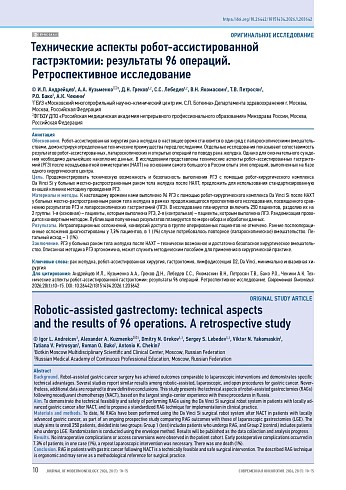
Обоснование. Робот-ассистированная хирургия рака желудка в настоящее время становится в один ряд с лапароскопическими вмешательствами, демонстрируя определенные технические преимущества перед последними. Отдельные исследования показывают сопоставимость результатов робот-ассистированных, лапароскопических и открытых операций по поводу рака желудка. Однако для окончательного суждения необходимо дальнейшее накопление данных. В исследовании представлены технические аспекты робот-ассистированных гастрэктомий (РГЭ) после неоадъювантной химиотерапии (НАХТ) на основании самого большого в России опыта этих операций, выполненных на базе одного хирургического центра.
Цель. Продемонстрировать техническую возможность и безопасность выполнения РГЭ с помощью робот-хирургического комплекса Da Vinci Si у больных местно-распространенным раком тела желудка после НАХТ, предложить для использования стандартизированную в нашей клинике методику проведения РГЭ.
Материалы и методы. К настоящему времени нами выполнено 96 РГЭ с помощью робот-хирургического комплекса Da Vinci Si после НАХТ у больных местно-распространенным раком тела желудка в рамках продолжающегося проспективного исследования, посвященного сравнению результатов РГЭ и лапаросокопических гастрэктомий (ЛГЭ). В исследование планируется включить 250 пациентов, разделив их на 2 группы: 1-я (основная) – пациенты, которым выполнена РГЭ, 2-я (контрольная) – пациенты, котроым выполнена ЛГЭ. Рандомизация проводится конвертным методом. Публикация полученных результатов планируется по мере набора и обработки данных.
Результаты. Интраоперационных осложнений, конверсий доступа в группе оперированных пациентов не отмечено. Ранние послеоперационные осложения диагностированы у 7,3% пациентов, в 1 (1%) случае потребовалось повторное (лапароскопическое) вмешательство. Летальный исход – 1 (1%).
Заключение. РГЭ у больных раком тела желудка после НАХТ – технически возможное и достаточно безопасное хирургическое вмешательство. Описанная методика РГЭ эргономична, может служить методическим пособием для применения в хирургической практике.
Ключевые слова: рак желудка, робот-ассистированная хирургия, гастрэктомия, лимфодиссекция D2, Da Vinci, минимально инвазивная хирургия
Aim. To demonstrate the technical feasibility and safety of performing RAGs using the Da Vinci Si surgical robot system in patients with locally advanced gastric cancer after NACT, and to propose a standardized RAG technique for implementation in clinical practice.
Materials and methods. To date, 96 RAGs have been performed using the Da Vinci Si surgical robot system after NACT in patients with locally advanced gastric cancer, as part of an ongoing prospective study comparing RAG outcomes with those of laparoscopic gastrectomies (LGE). The study aims to enroll 250 patients, divided into two groups: Group 1 (test) includes patients who undergo RAG, and Group 2 (control) includes patients who undergo LGE. Randomization is conducted using the envelope method. Results will be published as the data collection and analysis progress.
Results. No intraoperative complications or access conversions were observed in the patient cohort. Early postoperative complications occurred in 7.3% of patients; in one case (1%), a repeat laparoscopic intervention was necessary. There was one death (1%).
Conclusion. RAG in patients with gastric cancer following NACT is a technically feasible and safe surgical intervention. The described RAG technique is ergonomic and may serve as a methodological reference for surgical practice.
Keywords: gastric cancer, robot-assisted surgery, gastrectomy, D2 lymph node dissection, Da Vinci, minimally invasive surgery
Цель. Продемонстрировать техническую возможность и безопасность выполнения РГЭ с помощью робот-хирургического комплекса Da Vinci Si у больных местно-распространенным раком тела желудка после НАХТ, предложить для использования стандартизированную в нашей клинике методику проведения РГЭ.
Материалы и методы. К настоящему времени нами выполнено 96 РГЭ с помощью робот-хирургического комплекса Da Vinci Si после НАХТ у больных местно-распространенным раком тела желудка в рамках продолжающегося проспективного исследования, посвященного сравнению результатов РГЭ и лапаросокопических гастрэктомий (ЛГЭ). В исследование планируется включить 250 пациентов, разделив их на 2 группы: 1-я (основная) – пациенты, которым выполнена РГЭ, 2-я (контрольная) – пациенты, котроым выполнена ЛГЭ. Рандомизация проводится конвертным методом. Публикация полученных результатов планируется по мере набора и обработки данных.
Результаты. Интраоперационных осложнений, конверсий доступа в группе оперированных пациентов не отмечено. Ранние послеоперационные осложения диагностированы у 7,3% пациентов, в 1 (1%) случае потребовалось повторное (лапароскопическое) вмешательство. Летальный исход – 1 (1%).
Заключение. РГЭ у больных раком тела желудка после НАХТ – технически возможное и достаточно безопасное хирургическое вмешательство. Описанная методика РГЭ эргономична, может служить методическим пособием для применения в хирургической практике.
Ключевые слова: рак желудка, робот-ассистированная хирургия, гастрэктомия, лимфодиссекция D2, Da Vinci, минимально инвазивная хирургия
________________________________________________
Aim. To demonstrate the technical feasibility and safety of performing RAGs using the Da Vinci Si surgical robot system in patients with locally advanced gastric cancer after NACT, and to propose a standardized RAG technique for implementation in clinical practice.
Materials and methods. To date, 96 RAGs have been performed using the Da Vinci Si surgical robot system after NACT in patients with locally advanced gastric cancer, as part of an ongoing prospective study comparing RAG outcomes with those of laparoscopic gastrectomies (LGE). The study aims to enroll 250 patients, divided into two groups: Group 1 (test) includes patients who undergo RAG, and Group 2 (control) includes patients who undergo LGE. Randomization is conducted using the envelope method. Results will be published as the data collection and analysis progress.
Results. No intraoperative complications or access conversions were observed in the patient cohort. Early postoperative complications occurred in 7.3% of patients; in one case (1%), a repeat laparoscopic intervention was necessary. There was one death (1%).
Conclusion. RAG in patients with gastric cancer following NACT is a technically feasible and safe surgical intervention. The described RAG technique is ergonomic and may serve as a methodological reference for surgical practice.
Keywords: gastric cancer, robot-assisted surgery, gastrectomy, D2 lymph node dissection, Da Vinci, minimally invasive surgery
Полный текст
Список литературы
1. Mocan L. Surgical Management of Gastric Cancer: A systematic review. J Clin Med. 2021;10(12):2557. DOI:10.3390/jcm10122557
2. Paul HA, Bargar WL, Mittlestadt B, et al. Development of a surgical robot for cementless total hip arthroplasty. Clin Orthop Relat Res. 1992;(285):57-66. PMID: 1446455.
3. Falcone T, Goldberg J, Garcia-Ruiz A, et al. Full robotic assistance for Laparoscopic Tubal Anastomosis: A case report. J Laparoendosc Adv Sur Tech A. 1999;9(1):107-13. DOI:10.1089/lap.1999.9.107
4. Потапов П.А., Тимошенко Д.С., Армашов В.П., и др. Роботическая хирургия: вчера, сегодня, завтра. Хирургия. Журнал им. Н.И. Пирогова. 2022;(11):29-35 [Potapov PA, Timoshenko DS, Armashov VP, et al. Robotic-Assisted surgery: yesterday, today, tomorrow. Khirurgiia (Mosk). 2022;(11):29-35 (in Russian)]. DOI:10.17116/hirurgia202211129
5. Ohgami M, Otani Y, Kumai K, et al. Curative laparoscopic surgery for early gastric cancer: Five Years’ experience. World J Surg. 1999;23(2):187-93. DOI:10.1007/pl00013167
6. Obama K, Hyung W. Robotic gastrectomy for Gastric cancer. Robotic Surgery. 2013;(1):49-62. DOI:10.1007/978-4-431-54853-9_5
7. Du R, Wan Yu, Shang Yu, Lu G. Robotic Versus Laparoscopic Gastrectomy for Gastric Cancer: The Largest Systematic Reviews of 68,755 Patients and Meta-analysis. Ann Surg Oncol. 2025;32(1):351-73. DOI:10.1245/s10434-024-16371-w
8. Ma J, Li X, Zhao Sh, et al. Robotic versus laparoscopic gastrectomy for gastric cancer: A systematic review and meta-analysis. World J Surg Oncol. 2020;18(1):306. DOI:10.1186/s12957-020-02080-7
9. Liu H, Kinoshita T, Tonouchi A, et al. What are the reasons for a longer operation time in robotic gastrectomy than in laparoscopic gastrectomy for stomach cancer? Surg Endosc. 2019;33(1):192-8. DOI:10.1007/s00464-018-6294-x
10. Huang KH, Lan YT, Fang WL, et al. Comparison of the operative outcomes and learning curves between laparoscopic and robotic gastrectomy for gastric cancer. PLoS One. 2014;9(10):e111499. DOI:10.1371/journal.pone.0111499
11. Hikage M, Tokunaga M, Makuuchi R, et al. Comparison of Surgical Outcomes Between Robotic and Laparoscopic Distal Gastrectomy for Ct1 Gastric Cancer. World J Surg. 2018;42(6):1803-10. DOI:10.1007/s00268-017-4345-4
12. Hikage M, Fujiya K, Kamiya S, et al. Robotic Gastrectomy Compared with Laparoscopic Gastrectomy for Clinical Stage I/II Gastric Cancer Patients: A Propensity Score-Matched Analysis. World J Surg. 2021;45(5):1483-94. DOI:10.1007/s00268-020-05939-8
13. Wang WJ, Li HT, Yu JP, et al. Severity and incidence of complications assessed by the Clavien-Dindo classification following robotic and laparoscopic gastrectomy for advanced gastric cancer: a retrospective and propensity score-matched study. Surg Endosc. 2019;33(10):3341-54. DOI:10.1007/s00464-018-06624-7
14. Li Zh, Li J, Li B, et al. Robotic versus laparoscopic gastrectomy with D2 lymph node dissection for advanced gastric cancer: a propensity score-matched analysis. Cancer Manag Res. 2018;10:705-14. DOI:10.2147/CMAR.S161007
15. Matsunaga T, Miyauchi W, Kono Yu, et al. The Advantages of Robotic Gastrectomy over Laparoscopic Surgery for Gastric Cancer. Yonago Acta Med. 2020;63(2):99-106. DOI:10.33160/yam.2020.05.005
16. de Jongh C, Cianchi F, Kinoshita T, et al. Surgical Techniques and Related Perioperative Outcomes After Robot-assisted Minimally Invasive Gastrectomy (RAMIG): Results From the Prospective Multicenter International Ugira Gastric Registry. Ann Surg. 2024;280(1):98-107. DOI:10.1097/SLA.0000000000006147
17. Triemstra L, de Jongh C, Brenkman H, et al. Implementing robot-assisted minimally invasive gastrectomy (RAMIG) for gastric cancer in a European tertiary referral center. Eur J Surg Oncol. 2025;51(10):110342. DOI:10.1016/j.ejso.2025.110342
2. Paul HA, Bargar WL, Mittlestadt B, et al. Development of a surgical robot for cementless total hip arthroplasty. Clin Orthop Relat Res. 1992;(285):57-66. PMID: 1446455.
3. Falcone T, Goldberg J, Garcia-Ruiz A, et al. Full robotic assistance for Laparoscopic Tubal Anastomosis: A case report. J Laparoendosc Adv Sur Tech A. 1999;9(1):107-13. DOI:10.1089/lap.1999.9.107
4. Potapov PA, Timoshenko DS, Armashov VP, et al. Robotic-Assisted surgery: yesterday, today, tomorrow. Khirurgiia (Mosk). 2022;(11):29-35 (in Russian). DOI:10.17116/hirurgia202211129
5. Ohgami M, Otani Y, Kumai K, et al. Curative laparoscopic surgery for early gastric cancer: Five Years’ experience. World J Surg. 1999;23(2):187-93. DOI:10.1007/pl00013167
6. Obama K, Hyung W. Robotic gastrectomy for Gastric cancer. Robotic Surgery. 2013;(1):49-62. DOI:10.1007/978-4-431-54853-9_5
7. Du R, Wan Yu, Shang Yu, Lu G. Robotic Versus Laparoscopic Gastrectomy for Gastric Cancer: The Largest Systematic Reviews of 68,755 Patients and Meta-analysis. Ann Surg Oncol. 2025;32(1):351-73. DOI:10.1245/s10434-024-16371-w
8. Ma J, Li X, Zhao Sh, et al. Robotic versus laparoscopic gastrectomy for gastric cancer: A systematic review and meta-analysis. World J Surg Oncol. 2020;18(1):306. DOI:10.1186/s12957-020-02080-7
9. Liu H, Kinoshita T, Tonouchi A, et al. What are the reasons for a longer operation time in robotic gastrectomy than in laparoscopic gastrectomy for stomach cancer? Surg Endosc. 2019;33(1):192-8. DOI:10.1007/s00464-018-6294-x
10. Huang KH, Lan YT, Fang WL, et al. Comparison of the operative outcomes and learning curves between laparoscopic and robotic gastrectomy for gastric cancer. PLoS One. 2014;9(10):e111499. DOI:10.1371/journal.pone.0111499
11. Hikage M, Tokunaga M, Makuuchi R, et al. Comparison of Surgical Outcomes Between Robotic and Laparoscopic Distal Gastrectomy for Ct1 Gastric Cancer. World J Surg. 2018;42(6):1803-10. DOI:10.1007/s00268-017-4345-4
12. Hikage M, Fujiya K, Kamiya S, et al. Robotic Gastrectomy Compared with Laparoscopic Gastrectomy for Clinical Stage I/II Gastric Cancer Patients: A Propensity Score-Matched Analysis. World J Surg. 2021;45(5):1483-94. DOI:10.1007/s00268-020-05939-8
13. Wang WJ, Li HT, Yu JP, et al. Severity and incidence of complications assessed by the Clavien-Dindo classification following robotic and laparoscopic gastrectomy for advanced gastric cancer: a retrospective and propensity score-matched study. Surg Endosc. 2019;33(10):3341-54. DOI:10.1007/s00464-018-06624-7
14. Li Zh, Li J, Li B, et al. Robotic versus laparoscopic gastrectomy with D2 lymph node dissection for advanced gastric cancer: a propensity score-matched analysis. Cancer Manag Res. 2018;10:705-14. DOI:10.2147/CMAR.S161007
15. Matsunaga T, Miyauchi W, Kono Yu, et al. The Advantages of Robotic Gastrectomy over Laparoscopic Surgery for Gastric Cancer. Yonago Acta Med. 2020;63(2):99-106. DOI:10.33160/yam.2020.05.005
16. de Jongh C, Cianchi F, Kinoshita T, et al. Surgical Techniques and Related Perioperative Outcomes After Robot-assisted Minimally Invasive Gastrectomy (RAMIG): Results From the Prospective Multicenter International Ugira Gastric Registry. Ann Surg. 2024;280(1):98-107. DOI:10.1097/SLA.0000000000006147
17. Triemstra L, de Jongh C, Brenkman H, et al. Implementing robot-assisted minimally invasive gastrectomy (RAMIG) for gastric cancer in a European tertiary referral center. Eur J Surg Oncol. 2025;51(10):110342. DOI:10.1016/j.ejso.2025.110342
2. Paul HA, Bargar WL, Mittlestadt B, et al. Development of a surgical robot for cementless total hip arthroplasty. Clin Orthop Relat Res. 1992;(285):57-66. PMID: 1446455.
3. Falcone T, Goldberg J, Garcia-Ruiz A, et al. Full robotic assistance for Laparoscopic Tubal Anastomosis: A case report. J Laparoendosc Adv Sur Tech A. 1999;9(1):107-13. DOI:10.1089/lap.1999.9.107
4. Потапов П.А., Тимошенко Д.С., Армашов В.П., и др. Роботическая хирургия: вчера, сегодня, завтра. Хирургия. Журнал им. Н.И. Пирогова. 2022;(11):29-35 [Potapov PA, Timoshenko DS, Armashov VP, et al. Robotic-Assisted surgery: yesterday, today, tomorrow. Khirurgiia (Mosk). 2022;(11):29-35 (in Russian)]. DOI:10.17116/hirurgia202211129
5. Ohgami M, Otani Y, Kumai K, et al. Curative laparoscopic surgery for early gastric cancer: Five Years’ experience. World J Surg. 1999;23(2):187-93. DOI:10.1007/pl00013167
6. Obama K, Hyung W. Robotic gastrectomy for Gastric cancer. Robotic Surgery. 2013;(1):49-62. DOI:10.1007/978-4-431-54853-9_5
7. Du R, Wan Yu, Shang Yu, Lu G. Robotic Versus Laparoscopic Gastrectomy for Gastric Cancer: The Largest Systematic Reviews of 68,755 Patients and Meta-analysis. Ann Surg Oncol. 2025;32(1):351-73. DOI:10.1245/s10434-024-16371-w
8. Ma J, Li X, Zhao Sh, et al. Robotic versus laparoscopic gastrectomy for gastric cancer: A systematic review and meta-analysis. World J Surg Oncol. 2020;18(1):306. DOI:10.1186/s12957-020-02080-7
9. Liu H, Kinoshita T, Tonouchi A, et al. What are the reasons for a longer operation time in robotic gastrectomy than in laparoscopic gastrectomy for stomach cancer? Surg Endosc. 2019;33(1):192-8. DOI:10.1007/s00464-018-6294-x
10. Huang KH, Lan YT, Fang WL, et al. Comparison of the operative outcomes and learning curves between laparoscopic and robotic gastrectomy for gastric cancer. PLoS One. 2014;9(10):e111499. DOI:10.1371/journal.pone.0111499
11. Hikage M, Tokunaga M, Makuuchi R, et al. Comparison of Surgical Outcomes Between Robotic and Laparoscopic Distal Gastrectomy for Ct1 Gastric Cancer. World J Surg. 2018;42(6):1803-10. DOI:10.1007/s00268-017-4345-4
12. Hikage M, Fujiya K, Kamiya S, et al. Robotic Gastrectomy Compared with Laparoscopic Gastrectomy for Clinical Stage I/II Gastric Cancer Patients: A Propensity Score-Matched Analysis. World J Surg. 2021;45(5):1483-94. DOI:10.1007/s00268-020-05939-8
13. Wang WJ, Li HT, Yu JP, et al. Severity and incidence of complications assessed by the Clavien-Dindo classification following robotic and laparoscopic gastrectomy for advanced gastric cancer: a retrospective and propensity score-matched study. Surg Endosc. 2019;33(10):3341-54. DOI:10.1007/s00464-018-06624-7
14. Li Zh, Li J, Li B, et al. Robotic versus laparoscopic gastrectomy with D2 lymph node dissection for advanced gastric cancer: a propensity score-matched analysis. Cancer Manag Res. 2018;10:705-14. DOI:10.2147/CMAR.S161007
15. Matsunaga T, Miyauchi W, Kono Yu, et al. The Advantages of Robotic Gastrectomy over Laparoscopic Surgery for Gastric Cancer. Yonago Acta Med. 2020;63(2):99-106. DOI:10.33160/yam.2020.05.005
16. de Jongh C, Cianchi F, Kinoshita T, et al. Surgical Techniques and Related Perioperative Outcomes After Robot-assisted Minimally Invasive Gastrectomy (RAMIG): Results From the Prospective Multicenter International Ugira Gastric Registry. Ann Surg. 2024;280(1):98-107. DOI:10.1097/SLA.0000000000006147
17. Triemstra L, de Jongh C, Brenkman H, et al. Implementing robot-assisted minimally invasive gastrectomy (RAMIG) for gastric cancer in a European tertiary referral center. Eur J Surg Oncol. 2025;51(10):110342. DOI:10.1016/j.ejso.2025.110342
________________________________________________
2. Paul HA, Bargar WL, Mittlestadt B, et al. Development of a surgical robot for cementless total hip arthroplasty. Clin Orthop Relat Res. 1992;(285):57-66. PMID: 1446455.
3. Falcone T, Goldberg J, Garcia-Ruiz A, et al. Full robotic assistance for Laparoscopic Tubal Anastomosis: A case report. J Laparoendosc Adv Sur Tech A. 1999;9(1):107-13. DOI:10.1089/lap.1999.9.107
4. Potapov PA, Timoshenko DS, Armashov VP, et al. Robotic-Assisted surgery: yesterday, today, tomorrow. Khirurgiia (Mosk). 2022;(11):29-35 (in Russian). DOI:10.17116/hirurgia202211129
5. Ohgami M, Otani Y, Kumai K, et al. Curative laparoscopic surgery for early gastric cancer: Five Years’ experience. World J Surg. 1999;23(2):187-93. DOI:10.1007/pl00013167
6. Obama K, Hyung W. Robotic gastrectomy for Gastric cancer. Robotic Surgery. 2013;(1):49-62. DOI:10.1007/978-4-431-54853-9_5
7. Du R, Wan Yu, Shang Yu, Lu G. Robotic Versus Laparoscopic Gastrectomy for Gastric Cancer: The Largest Systematic Reviews of 68,755 Patients and Meta-analysis. Ann Surg Oncol. 2025;32(1):351-73. DOI:10.1245/s10434-024-16371-w
8. Ma J, Li X, Zhao Sh, et al. Robotic versus laparoscopic gastrectomy for gastric cancer: A systematic review and meta-analysis. World J Surg Oncol. 2020;18(1):306. DOI:10.1186/s12957-020-02080-7
9. Liu H, Kinoshita T, Tonouchi A, et al. What are the reasons for a longer operation time in robotic gastrectomy than in laparoscopic gastrectomy for stomach cancer? Surg Endosc. 2019;33(1):192-8. DOI:10.1007/s00464-018-6294-x
10. Huang KH, Lan YT, Fang WL, et al. Comparison of the operative outcomes and learning curves between laparoscopic and robotic gastrectomy for gastric cancer. PLoS One. 2014;9(10):e111499. DOI:10.1371/journal.pone.0111499
11. Hikage M, Tokunaga M, Makuuchi R, et al. Comparison of Surgical Outcomes Between Robotic and Laparoscopic Distal Gastrectomy for Ct1 Gastric Cancer. World J Surg. 2018;42(6):1803-10. DOI:10.1007/s00268-017-4345-4
12. Hikage M, Fujiya K, Kamiya S, et al. Robotic Gastrectomy Compared with Laparoscopic Gastrectomy for Clinical Stage I/II Gastric Cancer Patients: A Propensity Score-Matched Analysis. World J Surg. 2021;45(5):1483-94. DOI:10.1007/s00268-020-05939-8
13. Wang WJ, Li HT, Yu JP, et al. Severity and incidence of complications assessed by the Clavien-Dindo classification following robotic and laparoscopic gastrectomy for advanced gastric cancer: a retrospective and propensity score-matched study. Surg Endosc. 2019;33(10):3341-54. DOI:10.1007/s00464-018-06624-7
14. Li Zh, Li J, Li B, et al. Robotic versus laparoscopic gastrectomy with D2 lymph node dissection for advanced gastric cancer: a propensity score-matched analysis. Cancer Manag Res. 2018;10:705-14. DOI:10.2147/CMAR.S161007
15. Matsunaga T, Miyauchi W, Kono Yu, et al. The Advantages of Robotic Gastrectomy over Laparoscopic Surgery for Gastric Cancer. Yonago Acta Med. 2020;63(2):99-106. DOI:10.33160/yam.2020.05.005
16. de Jongh C, Cianchi F, Kinoshita T, et al. Surgical Techniques and Related Perioperative Outcomes After Robot-assisted Minimally Invasive Gastrectomy (RAMIG): Results From the Prospective Multicenter International Ugira Gastric Registry. Ann Surg. 2024;280(1):98-107. DOI:10.1097/SLA.0000000000006147
17. Triemstra L, de Jongh C, Brenkman H, et al. Implementing robot-assisted minimally invasive gastrectomy (RAMIG) for gastric cancer in a European tertiary referral center. Eur J Surg Oncol. 2025;51(10):110342. DOI:10.1016/j.ejso.2025.110342
Авторы
И.Л. Андрейцев1, А.А. Кузьменко*1, Д.Н. Греков1,2, С.С. Лебедев1,2, В.Н. Якомаскин1, Т.В. Петросян1, Р.О. Бако1, А.К. Чекини1
1ГБУЗ «Московский многопрофильный научно-клинический центр им. С.П. Боткина» Департамента здравоохранения г. Москвы, Москва, Российская Федерация
2ФГБОУ ДПО «Российская медицинская академия непрерывного профессионального образования» Минздрава России, Москва, Российская Федерация
*dr.kuzmenko@mail.ru
1Botkin Moscow Multidisciplinary Scientific and Clinical Center, Moscow, Russian Federation
2Russian Medical Academy of Continuous Professional Education, Moscow, Russian Federation
*dr.kuzmenko@mail.ru
1ГБУЗ «Московский многопрофильный научно-клинический центр им. С.П. Боткина» Департамента здравоохранения г. Москвы, Москва, Российская Федерация
2ФГБОУ ДПО «Российская медицинская академия непрерывного профессионального образования» Минздрава России, Москва, Российская Федерация
*dr.kuzmenko@mail.ru
________________________________________________
1Botkin Moscow Multidisciplinary Scientific and Clinical Center, Moscow, Russian Federation
2Russian Medical Academy of Continuous Professional Education, Moscow, Russian Federation
*dr.kuzmenko@mail.ru
Цель портала OmniDoctor – предоставление профессиональной информации врачам, провизорам и фармацевтам.