

Материалы доступны только для специалистов сферы здравоохранения.
Чтобы посмотреть материал полностью
Авторизуйтесь
или зарегистрируйтесь.
Маркеры Т2-воспаления дыхательных путей у пациентов с хронической обструктивной болезнью легких - Журнал Терапевтический архив №3 Вопросы пульмонологии 2025
Маркеры Т2-воспаления дыхательных путей у пациентов с хронической обструктивной болезнью легких
Сергеева Г.Р., Емельянов А.В., Лешенкова Е.В., Знахуренко А.А. Маркеры Т2-воспаления дыхательных путей у пациентов с хронической обструктивной болезнью легких. Терапевтический архив. 2025;97(3):250–256. DOI: 10.26442/00403660.2025.03.203147
© ООО «КОНСИЛИУМ МЕДИКУМ», 2025 г.
© ООО «КОНСИЛИУМ МЕДИКУМ», 2025 г.
________________________________________________
Материалы доступны только для специалистов сферы здравоохранения.
Чтобы посмотреть материал полностью
Авторизуйтесь
или зарегистрируйтесь.
Аннотация
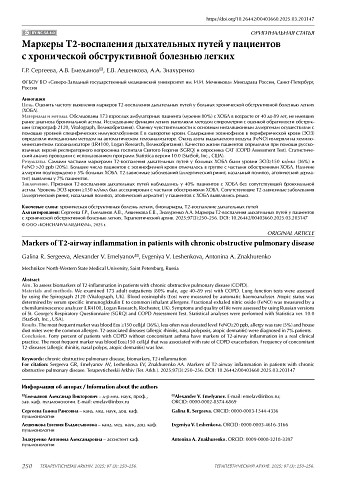
Цель. Оценить частоту выявления маркеров Т2-воспаления дыхательных путей у больных хронической обструктивной болезнью легких (ХОБЛ).
Материалы и методы. Обследованы 173 взрослых амбулаторных пациента (мужчин 80%) с ХОБЛ в возрасте от 40 до 89 лет, не имевших ранее диагноза бронхиальной астмы. Исследование функции легких выполняли методом спирометрии с оценкой обратимости обструкции (спирограф 2120, Vitalograph, Великобритания). Оценку чувствительности к основным ингаляционным аллергенам осуществляли с помощью уровней специфических иммуноглобулинов E в сыворотке крови. Содержание эозинофилов в периферической крови (ЭОЗ) определяли импедансным методом на автоматическом гемоанализаторе. Оксид азота выдыхаемого воздуха (FeNO) измеряли на хемилюминесцентном газоанализаторе (LR4100, Logan Research, Великобритания). Качество жизни пациентов определяли при помощи русскоязычных версий респираторного вопросника госпиталя Святого Георгия (SGRQ) и опросника CAT (COPD Assessment Test). Статистический анализ проводили с использованием программ Statistica версии 10.0 (StatSoft, Inc., США).
Результаты. Самыми частыми маркерами Т2-воспаления дыхательных путей у больных ХОБЛ были уровни ЭОЗ≥150 кл/мкл (36%) и FeNO >20 ppb (20%). Большее число пациентов с эозинофилией крови отмечалось в группе с частыми обострениями ХОБЛ. Наличие аллергии подтверждено у 5% больных ХОБЛ. Т2-зависимые заболеваний (аллергический ринит, назальный полипоз, атопический дерматит) выявлены у 7% пациентов.
Заключение. Признаки Т2-воспаления дыхательных путей наблюдались у 40% пациентов с ХОБЛ без сопутствующей бронхиальной астмы. Уровень ЭОЗ крови ≥150 кл/мкл был ассоциирован с частыми обострениями ХОБЛ. Cопутствующие Т2-зависимые заболевания (аллергический ринит, назальный полипоз, атопический дерматит) у пациентов с ХОБЛ выявлялись редко.
Ключевые слова: хроническая обструктивная болезнь легких, биомаркеры, Т2-воспаление дыхательных путей
Materials and methods. We examined 173 adult outpatients (80% male, age 40–89 yrs) with COPD. Lung function tests were assessed by using the Spirograph 2120 (Vitalograph, UK). Blood eosinophils (Eos) were measured by automatic haemoanalyser. Atopic status was determined by serum specific immunoglobulin E to common inhalant allergens. Fractional exhaled nitric oxide (FeNO) was measured by a chemiluminescence analyzer (LR4100, Logan Research, Rochester, UK). Symptoms and quality of life were assessed by using Russian versions of St. George's Respiratory Questionnaire (SGRQ) and COPD Assessment Test. Statistical analyses were performed with Statistica ver. 10.0 (StatSoft, Inc., USA).
Results. The most frequent marker was blood Eos ≥150 cell/μl (36%), less often was elevated level FeNO≥20 ppb, allergy was rare (5%) and house dust mites were the common allergen. T2-associated diseases (allergic rhinitis, nasal polyposis, atopic dermatitis) were diagnosed in 7% patients.
Conclusion. Forty percent of patients with COPD without concomitant asthma have markers of T2-airway inflammation in a real clinical practice. The most frequent marker was blood Eos≥150 cell/μl that was associated with rate of COPD exacerbation. Frequency of concomitant T2-diseases (allergic rhinitis, nasal polyps, atopic dermatitis) was low.
Keywords: chronic obstructive pulmonary disease, biomarkers, T2-inflammation
Материалы и методы. Обследованы 173 взрослых амбулаторных пациента (мужчин 80%) с ХОБЛ в возрасте от 40 до 89 лет, не имевших ранее диагноза бронхиальной астмы. Исследование функции легких выполняли методом спирометрии с оценкой обратимости обструкции (спирограф 2120, Vitalograph, Великобритания). Оценку чувствительности к основным ингаляционным аллергенам осуществляли с помощью уровней специфических иммуноглобулинов E в сыворотке крови. Содержание эозинофилов в периферической крови (ЭОЗ) определяли импедансным методом на автоматическом гемоанализаторе. Оксид азота выдыхаемого воздуха (FeNO) измеряли на хемилюминесцентном газоанализаторе (LR4100, Logan Research, Великобритания). Качество жизни пациентов определяли при помощи русскоязычных версий респираторного вопросника госпиталя Святого Георгия (SGRQ) и опросника CAT (COPD Assessment Test). Статистический анализ проводили с использованием программ Statistica версии 10.0 (StatSoft, Inc., США).
Результаты. Самыми частыми маркерами Т2-воспаления дыхательных путей у больных ХОБЛ были уровни ЭОЗ≥150 кл/мкл (36%) и FeNO >20 ppb (20%). Большее число пациентов с эозинофилией крови отмечалось в группе с частыми обострениями ХОБЛ. Наличие аллергии подтверждено у 5% больных ХОБЛ. Т2-зависимые заболеваний (аллергический ринит, назальный полипоз, атопический дерматит) выявлены у 7% пациентов.
Заключение. Признаки Т2-воспаления дыхательных путей наблюдались у 40% пациентов с ХОБЛ без сопутствующей бронхиальной астмы. Уровень ЭОЗ крови ≥150 кл/мкл был ассоциирован с частыми обострениями ХОБЛ. Cопутствующие Т2-зависимые заболевания (аллергический ринит, назальный полипоз, атопический дерматит) у пациентов с ХОБЛ выявлялись редко.
Ключевые слова: хроническая обструктивная болезнь легких, биомаркеры, Т2-воспаление дыхательных путей
________________________________________________
Materials and methods. We examined 173 adult outpatients (80% male, age 40–89 yrs) with COPD. Lung function tests were assessed by using the Spirograph 2120 (Vitalograph, UK). Blood eosinophils (Eos) were measured by automatic haemoanalyser. Atopic status was determined by serum specific immunoglobulin E to common inhalant allergens. Fractional exhaled nitric oxide (FeNO) was measured by a chemiluminescence analyzer (LR4100, Logan Research, Rochester, UK). Symptoms and quality of life were assessed by using Russian versions of St. George's Respiratory Questionnaire (SGRQ) and COPD Assessment Test. Statistical analyses were performed with Statistica ver. 10.0 (StatSoft, Inc., USA).
Results. The most frequent marker was blood Eos ≥150 cell/μl (36%), less often was elevated level FeNO≥20 ppb, allergy was rare (5%) and house dust mites were the common allergen. T2-associated diseases (allergic rhinitis, nasal polyposis, atopic dermatitis) were diagnosed in 7% patients.
Conclusion. Forty percent of patients with COPD without concomitant asthma have markers of T2-airway inflammation in a real clinical practice. The most frequent marker was blood Eos≥150 cell/μl that was associated with rate of COPD exacerbation. Frequency of concomitant T2-diseases (allergic rhinitis, nasal polyps, atopic dermatitis) was low.
Keywords: chronic obstructive pulmonary disease, biomarkers, T2-inflammation
Полный текст
Список литературы
1. Barnes PJ. Inflammatory mechanisms in patients with chronic obstructive pulmonary disease. J Allergy Clin Immunol. 2016;138(1):16-27. DOI:10.1016/j.jaci.2016.05.011
2. Global Initiative for Chronic Obstructive Lung Disease. Global Strategy for the Diagnosis, Management, and Prevention of Chronic Obstructive Pulmonary Disease. 2025 Report. Available at: https://goldcopd.org/2025-gold-report. Accessed: 01.12.2024.
3. Global Initiative for Asthma. Global Strategy for Asthma Management and Prevention. Updated 2024. Available at: https://ginasthma.org/2024-report/ Accessed: 01.12.2024.
4. Maspero J, Adir Y, Al-Ahmad M, et al. Type 2 inflammation in asthma and other airway diseases. ERJ Open Res. 2022;8(3):00576-2021. DOI:10.1183/23120541.00576-2021
5. Сергеева Г.Р., Емельянов А.В. Фенотипы и эндотипы тяжелой бронхиальной астмы. Медицинский совет. 2024;(20):52-9 [Sergeeva GR, Emelyanov AV. Severe asthma phenotypes and endotypes. Meditsinskiy sovet = Medical Council. 2024;(20):52-9 (in Russian)]. DOI:10.21518/ms2024-461
6. Fernandes L, Rane S, Mandrekar S, Mesquita AM. Eosinophilic airway inflammation in patients with stable biomass smoke- versus tobacco smoke-associated chronic obstructive pulmonary disease. J Health Pollut. 2019;9(24):191209. DOI:10.5696/2156-9614-9.24.191209
7. Singh D, Kolsum U, Brightling CE, et al. Eosinophilic inflammation in COPD: Prevalence and clinical characteristics. Eur Respir J. 2014;44(6):1697-700. DOI:10.1183/09031936.00162414
8. Barnes PJ, Chowdhury B, Kharitonov SA, et al. Pulmonary biomarkers in chronic obstructive pulmonary disease. Am J Respir Crit Care Med. 2006;174(1):6-14. DOI:10.1164/rccm.200510-1659PP
9. Bafadhel M, McKenna S, Agbetile J, et al. Aspergillus fumigatus during stable state and exacerbations of COPD. Eur Respir J. 2014;43(1):64-71. DOI:10.1183/09031936.00162912
10. Putcha N, Fawzy A, Matsui EC, et al. Clinical phenotypes of atopy and asthma in COPD: A meta-analysis of SPIROMICS and COPDGene. Chest. 2020;158(6):2333-45. DOI:10.1016/j.chest.2020.04.069
11. Хроническая обструктивная болезнь легких. Федеральные клинические рекомендации. Российское респираторное общество. Режим доступа: https://spulmo.ru/upload/KR-HOBL.pdf. Ссылка активна на 28.11.2024 [Khronicheskaia obstruktivnaia bolezn' legkikh. Federal'nye klinicheskie rekomendatsii. Rossiiskoe respiratornoe obshchestvo. Available at: https://spulmo.ru/upload/KR-HOBL.pdf. Accessed: 28.11.2024 (in Russian)].
12. Busby J, Holweg CTJ, Chai A, et al. Change in type-2 biomarkers and related cytokines with prednisolone in uncontrolled severe oral corticosteroid dependent asthmatics: An interventional open-label study. Thorax. 2019;74(8):806-9. DOI:10.1136/thoraxjnl-2018-212709
13. George L, Brightling CE. Eosinophilic airway inflammation: Role in asthma and chronic obstructive pulmonary disease. Ther Adv Chronic Dis. 2016;7(1):34-51. DOI:10.1177/2040622315609251
14. Beech A, Higham A, Booth S, et al. Type 2 inflammation in COPD: Is it just asthma? Breathe (Sheff). 2024;20(3):230229. DOI:10.1183/20734735.0229-2023
15. Авдеев С.Н., Трушенко Н.В., Мержоева З.М., и др. Эозинофильное воспаление при хронической обструктивной болезни легких. Терапевтический архив. 2019;91(10):144-52 [Avdeev SN, Trushenko NV, Merzhoeva ZM, et al. Eosinophilic inflammation in chronic obstructive pulmonary disease. Terapevticheskii Arkhiv (Ter. Arkh.). 2019;91(10):144-52 (in Russian)]. DOI:10.26442/00403660.2019.10.000426
16. Oshagbemi OA, Burden AM, Braeken DCW, et al. Stability of blood eosinophils in patients with chronic obstructive pulmonary disease and in control subjects, and the impact of sex, age, smoking, and baseline counts. Am J Respir Crit Care Med. 2017;195(10):1402-4. DOI:10.1164/rccm.201701-0009LE
17. Landis S, Suruki R, Maskell J, et al. Demographic and clinical characteristics of COPD patients at different blood eosinophil levels in the UK clinical practice research datalink. COPD. 2018;15(2):177-84. DOI:10.1080/15412555.2018.1441275
18. Kolsum U, Damera G, Pham TH, et al. Pulmonary inflammation in patients with chronic obstructive pulmonary disease with higher blood eosinophil counts. J Allergy Clin Immunol. 2017;140(4):1181-4.e7. DOI:10.1016/j.jaci.2017.04.027
19. Escamilla-Gil JM, Fernandez-Nieto M, Acevedo N. Understanding the cellular sources of the fractional exhaled nitric oxide (FeNO) and its role as a biomarker of type 2 inflammation in asthma. Biomed Res Int. 2022;2022:5753524. DOI:10.1155/2022/5753524
20. Medrek SK, Parulekar AD, Hanania NA. Predictive biomarkers for asthma therapy. Curr Allergy Asthma Rep. 2017;17(10):69. DOI:10.1007/s11882-017-0739-5
21. Maniscalco M, Fuschillo S, Mormile I, et al. Exhaled nitric oxide as biomarker of type 2 diseases. Cells. 2023;12(21):2518. DOI:10.3390/cells12212518
22. Yatera K, Mukae H. Possible pathogenic roles of nitric oxide in asthma. Respir Investig. 2019;57(4):295-7. DOI:10.1016/j.resinv.2019.03.007
23. Wenzel S, Castro M, Corren J, et al. Dupilumab efficacy and safety in adults with uncontrolled persistent asthma despite use of medium-to-high-dose inhaled corticosteroids plus a long-acting β2 agonist: A randomised double-blind placebo-controlled pivotal phase 2b dose-ranging trial. Lancet. 2016;388(10039):31-44. DOI:10.1016/S0140-6736(16)30307-5
24. Pavord ID, Korn S, Howarth P, et al. Mepolizumab for severe eosinophilic asthma (DREAM): A multicentre, double-blind, placebo-controlled trial. Lancet. 2012;380(9842):651-9. DOI:10.1016/S0140-6736(12)60988-X
25. Corren J, Lemanske RF, Hanania NA, et al. Lebrikizumab treatment in adults with asthma. N Engl J Med. 2011;365(12):1088-98. DOI:10.1056/NEJMoa1106469
26. Ansarin K, Chatkin JM, Ferreira IM, et al. Exhaled nitric oxide in chronic obstructive pulmonary disease: Relationship to pulmonary function. Eur Respir J. 2001;17(5):934-8. DOI:10.1183/09031936.01.17509340
27. Alcázar-Navarrete B, Ruiz Rodríguez O, Conde Baena P, et al. Persistently elevated exhaled nitric oxide fraction is associated with increased risk of exacerbation in COPD. Eur Respir J. 2018;51(1):1701457. DOI:10.1183/13993003.01457-2017
28. Tiew PY, Ko FWS, Pang SL, et al. Environmental fungal sensitisation associates with poorer clinical outcomes in COPD. Eur Respir J. 2020;56(2):2000418. DOI:10.1183/13993003.00418-2020
2. Global Initiative for Chronic Obstructive Lung Disease. Global Strategy for the Diagnosis, Management, and Prevention of Chronic Obstructive Pulmonary Disease. 2025 Report. Available at: https://goldcopd.org/2025-gold-report. Accessed: 01.12.2024.
3. Global Initiative for Asthma. Global Strategy for Asthma Management and Prevention. Updated 2024. Available at: https://ginasthma.org/2024-report/ Accessed: 01.12.2024.
4. Maspero J, Adir Y, Al-Ahmad M, et al. Type 2 inflammation in asthma and other airway diseases. ERJ Open Res. 2022;8(3):00576-2021. DOI:10.1183/23120541.00576-2021
5. Sergeeva GR, Emelyanov AV. Severe asthma phenotypes and endotypes. Meditsinskiy sovet = Medical Council. 2024;(20):52-9 (in Russian). DOI:10.21518/ms2024-461
6. Fernandes L, Rane S, Mandrekar S, Mesquita AM. Eosinophilic airway inflammation in patients with stable biomass smoke- versus tobacco smoke-associated chronic obstructive pulmonary disease. J Health Pollut. 2019;9(24):191209. DOI:10.5696/2156-9614-9.24.191209
7. Singh D, Kolsum U, Brightling CE, et al. Eosinophilic inflammation in COPD: Prevalence and clinical characteristics. Eur Respir J. 2014;44(6):1697-700. DOI:10.1183/09031936.00162414
8. Barnes PJ, Chowdhury B, Kharitonov SA, et al. Pulmonary biomarkers in chronic obstructive pulmonary disease. Am J Respir Crit Care Med. 2006;174(1):6-14. DOI:10.1164/rccm.200510-1659PP
9. Bafadhel M, McKenna S, Agbetile J, et al. Aspergillus fumigatus during stable state and exacerbations of COPD. Eur Respir J. 2014;43(1):64-71. DOI:10.1183/09031936.00162912
10. Putcha N, Fawzy A, Matsui EC, et al. Clinical phenotypes of atopy and asthma in COPD: A meta-analysis of SPIROMICS and COPDGene. Chest. 2020;158(6):2333-45. DOI:10.1016/j.chest.2020.04.069
11. Khronicheskaia obstruktivnaia bolezn' legkikh. Federal'nye klinicheskie rekomendatsii. Rossiiskoe respiratornoe obshchestvo. Available at: https://spulmo.ru/upload/KR-HOBL.pdf. Accessed: 28.11.2024 (in Russian).
12. Busby J, Holweg CTJ, Chai A, et al. Change in type-2 biomarkers and related cytokines with prednisolone in uncontrolled severe oral corticosteroid dependent asthmatics: An interventional open-label study. Thorax. 2019;74(8):806-9. DOI:10.1136/thoraxjnl-2018-212709
13. George L, Brightling CE. Eosinophilic airway inflammation: Role in asthma and chronic obstructive pulmonary disease. Ther Adv Chronic Dis. 2016;7(1):34-51. DOI:10.1177/2040622315609251
14. Beech A, Higham A, Booth S, et al. Type 2 inflammation in COPD: Is it just asthma? Breathe (Sheff). 2024;20(3):230229. DOI:10.1183/20734735.0229-2023
15. Avdeev SN, Trushenko NV, Merzhoeva ZM, et al. Eosinophilic inflammation in chronic obstructive pulmonary disease. Terapevticheskii Arkhiv (Ter. Arkh.). 2019;91(10):144-52 (in Russian). DOI:10.26442/00403660.2019.10.000426
16. Oshagbemi OA, Burden AM, Braeken DCW, et al. Stability of blood eosinophils in patients with chronic obstructive pulmonary disease and in control subjects, and the impact of sex, age, smoking, and baseline counts. Am J Respir Crit Care Med. 2017;195(10):1402-4. DOI:10.1164/rccm.201701-0009LE
17. Landis S, Suruki R, Maskell J, et al. Demographic and clinical characteristics of COPD patients at different blood eosinophil levels in the UK clinical practice research datalink. COPD. 2018;15(2):177-84. DOI:10.1080/15412555.2018.1441275
18. Kolsum U, Damera G, Pham TH, et al. Pulmonary inflammation in patients with chronic obstructive pulmonary disease with higher blood eosinophil counts. J Allergy Clin Immunol. 2017;140(4):1181-4.e7. DOI:10.1016/j.jaci.2017.04.027
19. Escamilla-Gil JM, Fernandez-Nieto M, Acevedo N. Understanding the cellular sources of the fractional exhaled nitric oxide (FeNO) and its role as a biomarker of type 2 inflammation in asthma. Biomed Res Int. 2022;2022:5753524. DOI:10.1155/2022/5753524
20. Medrek SK, Parulekar AD, Hanania NA. Predictive biomarkers for asthma therapy. Curr Allergy Asthma Rep. 2017;17(10):69. DOI:10.1007/s11882-017-0739-5
21. Maniscalco M, Fuschillo S, Mormile I, et al. Exhaled nitric oxide as biomarker of type 2 diseases. Cells. 2023;12(21):2518. DOI:10.3390/cells12212518
22. Yatera K, Mukae H. Possible pathogenic roles of nitric oxide in asthma. Respir Investig. 2019;57(4):295-7. DOI:10.1016/j.resinv.2019.03.007
23. Wenzel S, Castro M, Corren J, et al. Dupilumab efficacy and safety in adults with uncontrolled persistent asthma despite use of medium-to-high-dose inhaled corticosteroids plus a long-acting β2 agonist: A randomised double-blind placebo-controlled pivotal phase 2b dose-ranging trial. Lancet. 2016;388(10039):31-44. DOI:10.1016/S0140-6736(16)30307-5
24. Pavord ID, Korn S, Howarth P, et al. Mepolizumab for severe eosinophilic asthma (DREAM): A multicentre, double-blind, placebo-controlled trial. Lancet. 2012;380(9842):651-9. DOI:10.1016/S0140-6736(12)60988-X
25. Corren J, Lemanske RF, Hanania NA, et al. Lebrikizumab treatment in adults with asthma. N Engl J Med. 2011;365(12):1088-98. DOI:10.1056/NEJMoa1106469
26. Ansarin K, Chatkin JM, Ferreira IM, et al. Exhaled nitric oxide in chronic obstructive pulmonary disease: Relationship to pulmonary function. Eur Respir J. 2001;17(5):934-8. DOI:10.1183/09031936.01.17509340
27. Alcázar-Navarrete B, Ruiz Rodríguez O, Conde Baena P, et al. Persistently elevated exhaled nitric oxide fraction is associated with increased risk of exacerbation in COPD. Eur Respir J. 2018;51(1):1701457. DOI:10.1183/13993003.01457-2017
28. Tiew PY, Ko FWS, Pang SL, et al. Environmental fungal sensitisation associates with poorer clinical outcomes in COPD. Eur Respir J. 2020;56(2):2000418. DOI:10.1183/13993003.00418-2020
2. Global Initiative for Chronic Obstructive Lung Disease. Global Strategy for the Diagnosis, Management, and Prevention of Chronic Obstructive Pulmonary Disease. 2025 Report. Available at: https://goldcopd.org/2025-gold-report. Accessed: 01.12.2024.
3. Global Initiative for Asthma. Global Strategy for Asthma Management and Prevention. Updated 2024. Available at: https://ginasthma.org/2024-report/ Accessed: 01.12.2024.
4. Maspero J, Adir Y, Al-Ahmad M, et al. Type 2 inflammation in asthma and other airway diseases. ERJ Open Res. 2022;8(3):00576-2021. DOI:10.1183/23120541.00576-2021
5. Сергеева Г.Р., Емельянов А.В. Фенотипы и эндотипы тяжелой бронхиальной астмы. Медицинский совет. 2024;(20):52-9 [Sergeeva GR, Emelyanov AV. Severe asthma phenotypes and endotypes. Meditsinskiy sovet = Medical Council. 2024;(20):52-9 (in Russian)]. DOI:10.21518/ms2024-461
6. Fernandes L, Rane S, Mandrekar S, Mesquita AM. Eosinophilic airway inflammation in patients with stable biomass smoke- versus tobacco smoke-associated chronic obstructive pulmonary disease. J Health Pollut. 2019;9(24):191209. DOI:10.5696/2156-9614-9.24.191209
7. Singh D, Kolsum U, Brightling CE, et al. Eosinophilic inflammation in COPD: Prevalence and clinical characteristics. Eur Respir J. 2014;44(6):1697-700. DOI:10.1183/09031936.00162414
8. Barnes PJ, Chowdhury B, Kharitonov SA, et al. Pulmonary biomarkers in chronic obstructive pulmonary disease. Am J Respir Crit Care Med. 2006;174(1):6-14. DOI:10.1164/rccm.200510-1659PP
9. Bafadhel M, McKenna S, Agbetile J, et al. Aspergillus fumigatus during stable state and exacerbations of COPD. Eur Respir J. 2014;43(1):64-71. DOI:10.1183/09031936.00162912
10. Putcha N, Fawzy A, Matsui EC, et al. Clinical phenotypes of atopy and asthma in COPD: A meta-analysis of SPIROMICS and COPDGene. Chest. 2020;158(6):2333-45. DOI:10.1016/j.chest.2020.04.069
11. Хроническая обструктивная болезнь легких. Федеральные клинические рекомендации. Российское респираторное общество. Режим доступа: https://spulmo.ru/upload/KR-HOBL.pdf. Ссылка активна на 28.11.2024 [Khronicheskaia obstruktivnaia bolezn' legkikh. Federal'nye klinicheskie rekomendatsii. Rossiiskoe respiratornoe obshchestvo. Available at: https://spulmo.ru/upload/KR-HOBL.pdf. Accessed: 28.11.2024 (in Russian)].
12. Busby J, Holweg CTJ, Chai A, et al. Change in type-2 biomarkers and related cytokines with prednisolone in uncontrolled severe oral corticosteroid dependent asthmatics: An interventional open-label study. Thorax. 2019;74(8):806-9. DOI:10.1136/thoraxjnl-2018-212709
13. George L, Brightling CE. Eosinophilic airway inflammation: Role in asthma and chronic obstructive pulmonary disease. Ther Adv Chronic Dis. 2016;7(1):34-51. DOI:10.1177/2040622315609251
14. Beech A, Higham A, Booth S, et al. Type 2 inflammation in COPD: Is it just asthma? Breathe (Sheff). 2024;20(3):230229. DOI:10.1183/20734735.0229-2023
15. Авдеев С.Н., Трушенко Н.В., Мержоева З.М., и др. Эозинофильное воспаление при хронической обструктивной болезни легких. Терапевтический архив. 2019;91(10):144-52 [Avdeev SN, Trushenko NV, Merzhoeva ZM, et al. Eosinophilic inflammation in chronic obstructive pulmonary disease. Terapevticheskii Arkhiv (Ter. Arkh.). 2019;91(10):144-52 (in Russian)]. DOI:10.26442/00403660.2019.10.000426
16. Oshagbemi OA, Burden AM, Braeken DCW, et al. Stability of blood eosinophils in patients with chronic obstructive pulmonary disease and in control subjects, and the impact of sex, age, smoking, and baseline counts. Am J Respir Crit Care Med. 2017;195(10):1402-4. DOI:10.1164/rccm.201701-0009LE
17. Landis S, Suruki R, Maskell J, et al. Demographic and clinical characteristics of COPD patients at different blood eosinophil levels in the UK clinical practice research datalink. COPD. 2018;15(2):177-84. DOI:10.1080/15412555.2018.1441275
18. Kolsum U, Damera G, Pham TH, et al. Pulmonary inflammation in patients with chronic obstructive pulmonary disease with higher blood eosinophil counts. J Allergy Clin Immunol. 2017;140(4):1181-4.e7. DOI:10.1016/j.jaci.2017.04.027
19. Escamilla-Gil JM, Fernandez-Nieto M, Acevedo N. Understanding the cellular sources of the fractional exhaled nitric oxide (FeNO) and its role as a biomarker of type 2 inflammation in asthma. Biomed Res Int. 2022;2022:5753524. DOI:10.1155/2022/5753524
20. Medrek SK, Parulekar AD, Hanania NA. Predictive biomarkers for asthma therapy. Curr Allergy Asthma Rep. 2017;17(10):69. DOI:10.1007/s11882-017-0739-5
21. Maniscalco M, Fuschillo S, Mormile I, et al. Exhaled nitric oxide as biomarker of type 2 diseases. Cells. 2023;12(21):2518. DOI:10.3390/cells12212518
22. Yatera K, Mukae H. Possible pathogenic roles of nitric oxide in asthma. Respir Investig. 2019;57(4):295-7. DOI:10.1016/j.resinv.2019.03.007
23. Wenzel S, Castro M, Corren J, et al. Dupilumab efficacy and safety in adults with uncontrolled persistent asthma despite use of medium-to-high-dose inhaled corticosteroids plus a long-acting β2 agonist: A randomised double-blind placebo-controlled pivotal phase 2b dose-ranging trial. Lancet. 2016;388(10039):31-44. DOI:10.1016/S0140-6736(16)30307-5
24. Pavord ID, Korn S, Howarth P, et al. Mepolizumab for severe eosinophilic asthma (DREAM): A multicentre, double-blind, placebo-controlled trial. Lancet. 2012;380(9842):651-9. DOI:10.1016/S0140-6736(12)60988-X
25. Corren J, Lemanske RF, Hanania NA, et al. Lebrikizumab treatment in adults with asthma. N Engl J Med. 2011;365(12):1088-98. DOI:10.1056/NEJMoa1106469
26. Ansarin K, Chatkin JM, Ferreira IM, et al. Exhaled nitric oxide in chronic obstructive pulmonary disease: Relationship to pulmonary function. Eur Respir J. 2001;17(5):934-8. DOI:10.1183/09031936.01.17509340
27. Alcázar-Navarrete B, Ruiz Rodríguez O, Conde Baena P, et al. Persistently elevated exhaled nitric oxide fraction is associated with increased risk of exacerbation in COPD. Eur Respir J. 2018;51(1):1701457. DOI:10.1183/13993003.01457-2017
28. Tiew PY, Ko FWS, Pang SL, et al. Environmental fungal sensitisation associates with poorer clinical outcomes in COPD. Eur Respir J. 2020;56(2):2000418. DOI:10.1183/13993003.00418-2020
________________________________________________
2. Global Initiative for Chronic Obstructive Lung Disease. Global Strategy for the Diagnosis, Management, and Prevention of Chronic Obstructive Pulmonary Disease. 2025 Report. Available at: https://goldcopd.org/2025-gold-report. Accessed: 01.12.2024.
3. Global Initiative for Asthma. Global Strategy for Asthma Management and Prevention. Updated 2024. Available at: https://ginasthma.org/2024-report/ Accessed: 01.12.2024.
4. Maspero J, Adir Y, Al-Ahmad M, et al. Type 2 inflammation in asthma and other airway diseases. ERJ Open Res. 2022;8(3):00576-2021. DOI:10.1183/23120541.00576-2021
5. Sergeeva GR, Emelyanov AV. Severe asthma phenotypes and endotypes. Meditsinskiy sovet = Medical Council. 2024;(20):52-9 (in Russian). DOI:10.21518/ms2024-461
6. Fernandes L, Rane S, Mandrekar S, Mesquita AM. Eosinophilic airway inflammation in patients with stable biomass smoke- versus tobacco smoke-associated chronic obstructive pulmonary disease. J Health Pollut. 2019;9(24):191209. DOI:10.5696/2156-9614-9.24.191209
7. Singh D, Kolsum U, Brightling CE, et al. Eosinophilic inflammation in COPD: Prevalence and clinical characteristics. Eur Respir J. 2014;44(6):1697-700. DOI:10.1183/09031936.00162414
8. Barnes PJ, Chowdhury B, Kharitonov SA, et al. Pulmonary biomarkers in chronic obstructive pulmonary disease. Am J Respir Crit Care Med. 2006;174(1):6-14. DOI:10.1164/rccm.200510-1659PP
9. Bafadhel M, McKenna S, Agbetile J, et al. Aspergillus fumigatus during stable state and exacerbations of COPD. Eur Respir J. 2014;43(1):64-71. DOI:10.1183/09031936.00162912
10. Putcha N, Fawzy A, Matsui EC, et al. Clinical phenotypes of atopy and asthma in COPD: A meta-analysis of SPIROMICS and COPDGene. Chest. 2020;158(6):2333-45. DOI:10.1016/j.chest.2020.04.069
11. Khronicheskaia obstruktivnaia bolezn' legkikh. Federal'nye klinicheskie rekomendatsii. Rossiiskoe respiratornoe obshchestvo. Available at: https://spulmo.ru/upload/KR-HOBL.pdf. Accessed: 28.11.2024 (in Russian).
12. Busby J, Holweg CTJ, Chai A, et al. Change in type-2 biomarkers and related cytokines with prednisolone in uncontrolled severe oral corticosteroid dependent asthmatics: An interventional open-label study. Thorax. 2019;74(8):806-9. DOI:10.1136/thoraxjnl-2018-212709
13. George L, Brightling CE. Eosinophilic airway inflammation: Role in asthma and chronic obstructive pulmonary disease. Ther Adv Chronic Dis. 2016;7(1):34-51. DOI:10.1177/2040622315609251
14. Beech A, Higham A, Booth S, et al. Type 2 inflammation in COPD: Is it just asthma? Breathe (Sheff). 2024;20(3):230229. DOI:10.1183/20734735.0229-2023
15. Avdeev SN, Trushenko NV, Merzhoeva ZM, et al. Eosinophilic inflammation in chronic obstructive pulmonary disease. Terapevticheskii Arkhiv (Ter. Arkh.). 2019;91(10):144-52 (in Russian). DOI:10.26442/00403660.2019.10.000426
16. Oshagbemi OA, Burden AM, Braeken DCW, et al. Stability of blood eosinophils in patients with chronic obstructive pulmonary disease and in control subjects, and the impact of sex, age, smoking, and baseline counts. Am J Respir Crit Care Med. 2017;195(10):1402-4. DOI:10.1164/rccm.201701-0009LE
17. Landis S, Suruki R, Maskell J, et al. Demographic and clinical characteristics of COPD patients at different blood eosinophil levels in the UK clinical practice research datalink. COPD. 2018;15(2):177-84. DOI:10.1080/15412555.2018.1441275
18. Kolsum U, Damera G, Pham TH, et al. Pulmonary inflammation in patients with chronic obstructive pulmonary disease with higher blood eosinophil counts. J Allergy Clin Immunol. 2017;140(4):1181-4.e7. DOI:10.1016/j.jaci.2017.04.027
19. Escamilla-Gil JM, Fernandez-Nieto M, Acevedo N. Understanding the cellular sources of the fractional exhaled nitric oxide (FeNO) and its role as a biomarker of type 2 inflammation in asthma. Biomed Res Int. 2022;2022:5753524. DOI:10.1155/2022/5753524
20. Medrek SK, Parulekar AD, Hanania NA. Predictive biomarkers for asthma therapy. Curr Allergy Asthma Rep. 2017;17(10):69. DOI:10.1007/s11882-017-0739-5
21. Maniscalco M, Fuschillo S, Mormile I, et al. Exhaled nitric oxide as biomarker of type 2 diseases. Cells. 2023;12(21):2518. DOI:10.3390/cells12212518
22. Yatera K, Mukae H. Possible pathogenic roles of nitric oxide in asthma. Respir Investig. 2019;57(4):295-7. DOI:10.1016/j.resinv.2019.03.007
23. Wenzel S, Castro M, Corren J, et al. Dupilumab efficacy and safety in adults with uncontrolled persistent asthma despite use of medium-to-high-dose inhaled corticosteroids plus a long-acting β2 agonist: A randomised double-blind placebo-controlled pivotal phase 2b dose-ranging trial. Lancet. 2016;388(10039):31-44. DOI:10.1016/S0140-6736(16)30307-5
24. Pavord ID, Korn S, Howarth P, et al. Mepolizumab for severe eosinophilic asthma (DREAM): A multicentre, double-blind, placebo-controlled trial. Lancet. 2012;380(9842):651-9. DOI:10.1016/S0140-6736(12)60988-X
25. Corren J, Lemanske RF, Hanania NA, et al. Lebrikizumab treatment in adults with asthma. N Engl J Med. 2011;365(12):1088-98. DOI:10.1056/NEJMoa1106469
26. Ansarin K, Chatkin JM, Ferreira IM, et al. Exhaled nitric oxide in chronic obstructive pulmonary disease: Relationship to pulmonary function. Eur Respir J. 2001;17(5):934-8. DOI:10.1183/09031936.01.17509340
27. Alcázar-Navarrete B, Ruiz Rodríguez O, Conde Baena P, et al. Persistently elevated exhaled nitric oxide fraction is associated with increased risk of exacerbation in COPD. Eur Respir J. 2018;51(1):1701457. DOI:10.1183/13993003.01457-2017
28. Tiew PY, Ko FWS, Pang SL, et al. Environmental fungal sensitisation associates with poorer clinical outcomes in COPD. Eur Respir J. 2020;56(2):2000418. DOI:10.1183/13993003.00418-2020
Авторы
Г.Р. Сергеева, А.В. Емельянов*, Е.В. Лешенкова, А.А. Знахуренко
ФГБОУ ВО «Северо-Западный государственный медицинский университет им. И.И. Мечникова» Минздрава России, Санкт-Петербург, Россия
*emelav@inbox.ru
Mechnikov North-Western State Medical University, Saint Petersburg, Russia
*emelav@inbox.ru
ФГБОУ ВО «Северо-Западный государственный медицинский университет им. И.И. Мечникова» Минздрава России, Санкт-Петербург, Россия
*emelav@inbox.ru
________________________________________________
Mechnikov North-Western State Medical University, Saint Petersburg, Russia
*emelav@inbox.ru
Цель портала OmniDoctor – предоставление профессиональной информации врачам, провизорам и фармацевтам.