

Материалы доступны только для специалистов сферы здравоохранения.
Чтобы посмотреть материал полностью
Авторизуйтесь
или зарегистрируйтесь.
Мочевая кислота и состояние скелетных мышц у женщин с ревматоидным артритом - Журнал Терапевтический архив №5 Вопросы ревматологии 2025
Мочевая кислота и состояние скелетных мышц у женщин с ревматоидным артритом
Добровольская О.В., Козырева М.В., Демин Н.В., Торопцова Н.В. Мочевая кислота и состояние скелетных мышц у женщин с ревматоидным артритом. Терапевтический архив. 2025;97(5):427–433. DOI: 10.26442/00403660.2025.05.203215
© ООО «КОНСИЛИУМ МЕДИКУМ», 2025 г.
© ООО «КОНСИЛИУМ МЕДИКУМ», 2025 г.
________________________________________________
Материалы доступны только для специалистов сферы здравоохранения.
Чтобы посмотреть материал полностью
Авторизуйтесь
или зарегистрируйтесь.
Аннотация
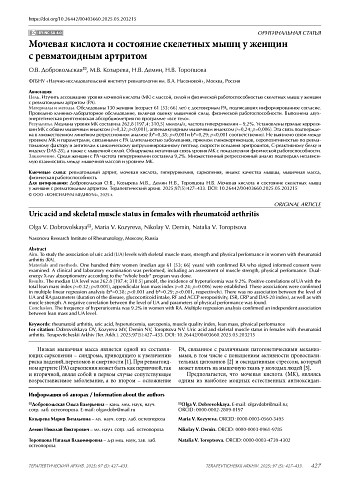
Цель. Изучить ассоциацию уровня мочевой кислоты (МК) с массой, силой и физической работоспособностью скелетных мышц у женщин с ревматоидным артритом (РА).
Материалы и методы. Обследованы 130 женщин (возраст 61 [53; 66] лет) с достоверным РА, подписавших информированное согласие. Проведено клинико-лабораторное обследование, включая оценку мышечной силы, физической работоспособности. Выполнена двухэнергетическая рентгеновская абсорбциометрия по программе «все тело».
Результаты. Медиана уровня МК составила 262,8 [197,4; 310,5] мкмоль/л, частота гиперурикемии – 9,2%. Установлены прямые корреляции МК с общим мышечным индексом (r=0,32; р<0,001), аппендикулярным мышечным индексом (r=0,24; p=0,006). Эта связь подтверждена в множественном линейном регрессионном анализе (b*=0,38; p<0,001и b*=0,29; p<0,001 соответственно). Не выявлено связи между уровнем МК и параметрами, связанными с РА (длительностью заболевания, приемом глюкокортикоидов, серопозитивностью по ревматоидному фактору и антителам к циклическому цитруллинированному пептиду, скорости оседания эритроцитов, С-реактивному белку и индексу DAS-28), а также с мышечной силой. Обнаружена негативная связь уровня МК с показателями физической работоспособности.
Заключение. Среди женщин с РА частота гиперурикемии составила 9,2%. Множественный регрессионный анализ подтвердил независимую взаимосвязь между мышечной массой и уровнем МК.
Ключевые слова: ревматоидный артрит, мочевая кислота, гиперурикемия, саркопения, индекс качества мышцы, мышечная масса, физическая работоспособность
Materials and methods. One hundred thirty women (median age 61 [53; 66] years) with confirmed RA who signed informed consent were examined. A clinical and laboratory examination was performed, including an assessment of muscle strength, physical performance. Dual-energy X-ray absorptiometry according to the “whole body” program was done.
Results. The median UA level was 262.8 [197.4; 310.5] μmol/l, the incidence of hyperuricemia was 9.2%. Positive correlations of UA with the total lean mass index (r=0.32; p<0.001), appendicular lean mass index (r=0.24; p=0.006) were established. These associations were confirmed in multiple linear regression analysis (b*=0.38; p<0.001 and b*=0.29; p<0.001, respectively). There was no association between the level of UA and RA parameters (duration of the disease, glucocorticoid intake, RF and ACCP seropositivity, ESR, CRP and DAS-28 index), as well as with muscle strength. A negative correlation between the level of UA and parameters of physical performance was found.
Conclusion. The frequency of hyperuricemia was 9.2% in women with RA. Multiple regression analysis confirmed an independent association between lean mass and UA level.
Keywords: rheumatoid arthritis, uric acid, hyperuricemia, sarcopenia, muscle quality index, lean mass, physical performance
Материалы и методы. Обследованы 130 женщин (возраст 61 [53; 66] лет) с достоверным РА, подписавших информированное согласие. Проведено клинико-лабораторное обследование, включая оценку мышечной силы, физической работоспособности. Выполнена двухэнергетическая рентгеновская абсорбциометрия по программе «все тело».
Результаты. Медиана уровня МК составила 262,8 [197,4; 310,5] мкмоль/л, частота гиперурикемии – 9,2%. Установлены прямые корреляции МК с общим мышечным индексом (r=0,32; р<0,001), аппендикулярным мышечным индексом (r=0,24; p=0,006). Эта связь подтверждена в множественном линейном регрессионном анализе (b*=0,38; p<0,001и b*=0,29; p<0,001 соответственно). Не выявлено связи между уровнем МК и параметрами, связанными с РА (длительностью заболевания, приемом глюкокортикоидов, серопозитивностью по ревматоидному фактору и антителам к циклическому цитруллинированному пептиду, скорости оседания эритроцитов, С-реактивному белку и индексу DAS-28), а также с мышечной силой. Обнаружена негативная связь уровня МК с показателями физической работоспособности.
Заключение. Среди женщин с РА частота гиперурикемии составила 9,2%. Множественный регрессионный анализ подтвердил независимую взаимосвязь между мышечной массой и уровнем МК.
Ключевые слова: ревматоидный артрит, мочевая кислота, гиперурикемия, саркопения, индекс качества мышцы, мышечная масса, физическая работоспособность
________________________________________________
Materials and methods. One hundred thirty women (median age 61 [53; 66] years) with confirmed RA who signed informed consent were examined. A clinical and laboratory examination was performed, including an assessment of muscle strength, physical performance. Dual-energy X-ray absorptiometry according to the “whole body” program was done.
Results. The median UA level was 262.8 [197.4; 310.5] μmol/l, the incidence of hyperuricemia was 9.2%. Positive correlations of UA with the total lean mass index (r=0.32; p<0.001), appendicular lean mass index (r=0.24; p=0.006) were established. These associations were confirmed in multiple linear regression analysis (b*=0.38; p<0.001 and b*=0.29; p<0.001, respectively). There was no association between the level of UA and RA parameters (duration of the disease, glucocorticoid intake, RF and ACCP seropositivity, ESR, CRP and DAS-28 index), as well as with muscle strength. A negative correlation between the level of UA and parameters of physical performance was found.
Conclusion. The frequency of hyperuricemia was 9.2% in women with RA. Multiple regression analysis confirmed an independent association between lean mass and UA level.
Keywords: rheumatoid arthritis, uric acid, hyperuricemia, sarcopenia, muscle quality index, lean mass, physical performance
Полный текст
Список литературы
1. Cruz-Jentoft AJ, Bahat G, Bauer J, et al. Sarcopenia: revised European consensus on definition and diagnosis. Age Ageing. 2019;48(1):16-31. DOI:10.1093/ageing/afy169
2. Díaz BB, González DA, Gannar F, et al. Myokines, physical activity, insulin resistance and autoimmune diseases. Immunol Lett. 2018. DOI:10.1016/j.imlet.2018.09.002
3. Hao JQ, Zhuang ZX, Hu SY, et al. Exploring the impact of protein intake on the association between oxidative balance score and lean mass in adults aged 20-59: NHANES 2011–2018. J Health Popul Nutr. 2024;43(1):137. DOI:10.1186/s41043-024-00629-w
4. Hediger MA, Johnson RJ, Miyazaki H, Endou H. Molecular physiology of urate transport. Physiology (Bethesda). 2005;20:125-33. DOI:10.1152/physiol.00039.2004
5. García-EsQuinas E, Guallar-Castillón P, Carnicero JA, et al. Serum uric acid concentrations and risk of frailty in older adults. Exp Gerontol. 2016;82:160-5. DOI:10.1016/j.exger.2016.07.002
6. Yun J, Kwon RJ, Kim T. Prevalence and clinical characteristics of low skeletal muscle index among adults visiting a health promotion center: Cross-sectional. Medicine (Baltimore). 2023;102(29):e34404. DOI:10.1097/MD.0000000000034404
7. Chen L, Wu L, Li Q, et al. Hyperuricemia Associated with Low Skeletal Muscle in the Middle-Aged and Elderly Population in China. Exp Clin Endocrinol Diabetes. 2022;130(8):546-53. DOI:10.1055/a-1785-3729
8. Gherghina ME, Peride I, Tiglis M, et al. Uric Acid and Oxidative Stress-Relationship with Cardiovascular, Metabolic, and Renal Impairment. Int J Mol Sci. 2022;23(6):3188. DOI:10.3390/ijms23063188
9. Alkhudir D, Al-Herz A, Saleh K, et al. Serum Uric Acid Level Associated with Disease Activity in Rheumatoid Arthritis Patients. Open Access Rheumatol. 2023;15:223-30. DOI:10.2147/OARRR.S418814
10. Nada D, Gaber R, Mahmoud AS, et al. Hyperuricemia Among Egyptian Rheumatoid Arthritis Patients. Is It an Association or an Inflammatory Marker? A Cross-Sectional Observational Study. Open Access Rheumatol. 2021;13:305-14. DOI:10.2147/OARRR.S331488
11. Lopes LCC, Vaz-Gonçalves L, Schincaglia RM, et al. Sex and population-specific cutoff values of muscle Quality index: results from NHANES 2011–2014. Clin Nutr. 2022;41(6):1328-34. DOI:10.1016/j.clnu.2022.04.026.
12. Nahas PC, Rossato LT, de Branco FMS, et al. Serum uric acid is positively associated with muscle strength in older men and women: findings from NHANES 1999–2002. Clin Nutr. 2021;40(6):4386-93. DOI:10.1016/j.clnu.2020.12.043.
13. García-EsQuinas E, Rodríguez-Artalejo F. Association between serum uric acid concentrations and grip strength: is there effect modification by age? Clin Nutr. 2018;37(2):566-72. DOI:10.1016/j.clnu.2017.01.008.
14. Beavers KM, Beavers DP, Serra MC, et al. Low relative skeletal muscle mass indicative of Sarcopenia is associated with elevations in serum uric acid levels: findings from NHANES III. J Nutr Health Aging. 2009;13(3):177-82. DOI:10.1007/s12603-009-0054-5.
15. Weng L, Xu Z, Chen Y, Chen C. Associations between the muscle Quality index and adult lung functions from NHANES 2011–2012. Front Public Health. 2023;11:1146456. DOI:10.3389/fpubh.2023.1146456
16. Wen H, Li X, Tan N. Inverse association between uric acid levels and muscle Quality index in adults: a cross-sectional analysis of NHANES 2011–2014. BMC Public Health. 2024;24(1):3109. DOI:10.1186/s12889-024-20559-w
17. Сорокина А.О., Демин Н.В., Добровольская О.В., и др. Патологические фенотипы состава тела у больных ревматическими заболеваниями. Научно-практическая ревматология. 2022;60(4):487-94 [Sorokina AO, Demin NV, Dobrovolskaya OV, et al. Pathological phenotypes of body composition in patients with rheumatic diseases. Rheumatology Science and Practice. 2022;60(4):487-94 (in Russian)]. DOI:10.47360/1995-4484-2022-487-494
2. Díaz BB, González DA, Gannar F, et al. Myokines, physical activity, insulin resistance and autoimmune diseases. Immunol Lett. 2018. DOI:10.1016/j.imlet.2018.09.002
3. Hao JQ, Zhuang ZX, Hu SY, et al. Exploring the impact of protein intake on the association between oxidative balance score and lean mass in adults aged 20-59: NHANES 2011–2018. J Health Popul Nutr. 2024;43(1):137. DOI:10.1186/s41043-024-00629-w
4. Hediger MA, Johnson RJ, Miyazaki H, Endou H. Molecular physiology of urate transport. Physiology (Bethesda). 2005;20:125-33. DOI:10.1152/physiol.00039.2004
5. García-EsQuinas E, Guallar-Castillón P, Carnicero JA, et al. Serum uric acid concentrations and risk of frailty in older adults. Exp Gerontol. 2016;82:160-5. DOI:10.1016/j.exger.2016.07.002
6. Yun J, Kwon RJ, Kim T. Prevalence and clinical characteristics of low skeletal muscle index among adults visiting a health promotion center: Cross-sectional. Medicine (Baltimore). 2023;102(29):e34404. DOI:10.1097/MD.0000000000034404
7. Chen L, Wu L, Li Q, et al. Hyperuricemia Associated with Low Skeletal Muscle in the Middle-Aged and Elderly Population in China. Exp Clin Endocrinol Diabetes. 2022;130(8):546-53. DOI:10.1055/a-1785-3729
8. Gherghina ME, Peride I, Tiglis M, et al. Uric Acid and Oxidative Stress-Relationship with Cardiovascular, Metabolic, and Renal Impairment. Int J Mol Sci. 2022;23(6):3188. DOI:10.3390/ijms23063188
9. Alkhudir D, Al-Herz A, Saleh K, et al. Serum Uric Acid Level Associated with Disease Activity in Rheumatoid Arthritis Patients. Open Access Rheumatol. 2023;15:223-30. DOI:10.2147/OARRR.S418814
10. Nada D, Gaber R, Mahmoud AS, et al. Hyperuricemia Among Egyptian Rheumatoid Arthritis Patients. Is It an Association or an Inflammatory Marker? A Cross-Sectional Observational Study. Open Access Rheumatol. 2021;13:305-14. DOI:10.2147/OARRR.S331488
11. Lopes LCC, Vaz-Gonçalves L, Schincaglia RM, et al. Sex and population-specific cutoff values of muscle Quality index: results from NHANES 2011–2014. Clin Nutr. 2022;41(6):1328-34. DOI:10.1016/j.clnu.2022.04.026.
12. Nahas PC, Rossato LT, de Branco FMS, et al. Serum uric acid is positively associated with muscle strength in older men and women: findings from NHANES 1999–2002. Clin Nutr. 2021;40(6):4386-93. DOI:10.1016/j.clnu.2020.12.043.
13. García-EsQuinas E, Rodríguez-Artalejo F. Association between serum uric acid concentrations and grip strength: is there effect modification by age? Clin Nutr. 2018;37(2):566-72. DOI:10.1016/j.clnu.2017.01.008.
14. Beavers KM, Beavers DP, Serra MC, et al. Low relative skeletal muscle mass indicative of Sarcopenia is associated with elevations in serum uric acid levels: findings from NHANES III. J Nutr Health Aging. 2009;13(3):177-82. DOI:10.1007/s12603-009-0054-5.
15. Weng L, Xu Z, Chen Y, Chen C. Associations between the muscle Quality index and adult lung functions from NHANES 2011–2012. Front Public Health. 2023;11:1146456. DOI:10.3389/fpubh.2023.1146456
16. Wen H, Li X, Tan N. Inverse association between uric acid levels and muscle Quality index in adults: a cross-sectional analysis of NHANES 2011–2014. BMC Public Health. 2024;24(1):3109. DOI:10.1186/s12889-024-20559-w
17. Sorokina AO, Demin NV, Dobrovolskaya OV, et al. Pathological phenotypes of body composition in patients with rheumatic diseases. Rheumatology Science and Practice. 2022;60(4):487-94 (in Russian). DOI:10.47360/1995-4484-2022-487-494
2. Díaz BB, González DA, Gannar F, et al. Myokines, physical activity, insulin resistance and autoimmune diseases. Immunol Lett. 2018. DOI:10.1016/j.imlet.2018.09.002
3. Hao JQ, Zhuang ZX, Hu SY, et al. Exploring the impact of protein intake on the association between oxidative balance score and lean mass in adults aged 20-59: NHANES 2011–2018. J Health Popul Nutr. 2024;43(1):137. DOI:10.1186/s41043-024-00629-w
4. Hediger MA, Johnson RJ, Miyazaki H, Endou H. Molecular physiology of urate transport. Physiology (Bethesda). 2005;20:125-33. DOI:10.1152/physiol.00039.2004
5. García-EsQuinas E, Guallar-Castillón P, Carnicero JA, et al. Serum uric acid concentrations and risk of frailty in older adults. Exp Gerontol. 2016;82:160-5. DOI:10.1016/j.exger.2016.07.002
6. Yun J, Kwon RJ, Kim T. Prevalence and clinical characteristics of low skeletal muscle index among adults visiting a health promotion center: Cross-sectional. Medicine (Baltimore). 2023;102(29):e34404. DOI:10.1097/MD.0000000000034404
7. Chen L, Wu L, Li Q, et al. Hyperuricemia Associated with Low Skeletal Muscle in the Middle-Aged and Elderly Population in China. Exp Clin Endocrinol Diabetes. 2022;130(8):546-53. DOI:10.1055/a-1785-3729
8. Gherghina ME, Peride I, Tiglis M, et al. Uric Acid and Oxidative Stress-Relationship with Cardiovascular, Metabolic, and Renal Impairment. Int J Mol Sci. 2022;23(6):3188. DOI:10.3390/ijms23063188
9. Alkhudir D, Al-Herz A, Saleh K, et al. Serum Uric Acid Level Associated with Disease Activity in Rheumatoid Arthritis Patients. Open Access Rheumatol. 2023;15:223-30. DOI:10.2147/OARRR.S418814
10. Nada D, Gaber R, Mahmoud AS, et al. Hyperuricemia Among Egyptian Rheumatoid Arthritis Patients. Is It an Association or an Inflammatory Marker? A Cross-Sectional Observational Study. Open Access Rheumatol. 2021;13:305-14. DOI:10.2147/OARRR.S331488
11. Lopes LCC, Vaz-Gonçalves L, Schincaglia RM, et al. Sex and population-specific cutoff values of muscle Quality index: results from NHANES 2011–2014. Clin Nutr. 2022;41(6):1328-34. DOI:10.1016/j.clnu.2022.04.026.
12. Nahas PC, Rossato LT, de Branco FMS, et al. Serum uric acid is positively associated with muscle strength in older men and women: findings from NHANES 1999–2002. Clin Nutr. 2021;40(6):4386-93. DOI:10.1016/j.clnu.2020.12.043.
13. García-EsQuinas E, Rodríguez-Artalejo F. Association between serum uric acid concentrations and grip strength: is there effect modification by age? Clin Nutr. 2018;37(2):566-72. DOI:10.1016/j.clnu.2017.01.008.
14. Beavers KM, Beavers DP, Serra MC, et al. Low relative skeletal muscle mass indicative of Sarcopenia is associated with elevations in serum uric acid levels: findings from NHANES III. J Nutr Health Aging. 2009;13(3):177-82. DOI:10.1007/s12603-009-0054-5.
15. Weng L, Xu Z, Chen Y, Chen C. Associations between the muscle Quality index and adult lung functions from NHANES 2011–2012. Front Public Health. 2023;11:1146456. DOI:10.3389/fpubh.2023.1146456
16. Wen H, Li X, Tan N. Inverse association between uric acid levels and muscle Quality index in adults: a cross-sectional analysis of NHANES 2011–2014. BMC Public Health. 2024;24(1):3109. DOI:10.1186/s12889-024-20559-w
17. Сорокина А.О., Демин Н.В., Добровольская О.В., и др. Патологические фенотипы состава тела у больных ревматическими заболеваниями. Научно-практическая ревматология. 2022;60(4):487-94 [Sorokina AO, Demin NV, Dobrovolskaya OV, et al. Pathological phenotypes of body composition in patients with rheumatic diseases. Rheumatology Science and Practice. 2022;60(4):487-94 (in Russian)]. DOI:10.47360/1995-4484-2022-487-494
________________________________________________
2. Díaz BB, González DA, Gannar F, et al. Myokines, physical activity, insulin resistance and autoimmune diseases. Immunol Lett. 2018. DOI:10.1016/j.imlet.2018.09.002
3. Hao JQ, Zhuang ZX, Hu SY, et al. Exploring the impact of protein intake on the association between oxidative balance score and lean mass in adults aged 20-59: NHANES 2011–2018. J Health Popul Nutr. 2024;43(1):137. DOI:10.1186/s41043-024-00629-w
4. Hediger MA, Johnson RJ, Miyazaki H, Endou H. Molecular physiology of urate transport. Physiology (Bethesda). 2005;20:125-33. DOI:10.1152/physiol.00039.2004
5. García-EsQuinas E, Guallar-Castillón P, Carnicero JA, et al. Serum uric acid concentrations and risk of frailty in older adults. Exp Gerontol. 2016;82:160-5. DOI:10.1016/j.exger.2016.07.002
6. Yun J, Kwon RJ, Kim T. Prevalence and clinical characteristics of low skeletal muscle index among adults visiting a health promotion center: Cross-sectional. Medicine (Baltimore). 2023;102(29):e34404. DOI:10.1097/MD.0000000000034404
7. Chen L, Wu L, Li Q, et al. Hyperuricemia Associated with Low Skeletal Muscle in the Middle-Aged and Elderly Population in China. Exp Clin Endocrinol Diabetes. 2022;130(8):546-53. DOI:10.1055/a-1785-3729
8. Gherghina ME, Peride I, Tiglis M, et al. Uric Acid and Oxidative Stress-Relationship with Cardiovascular, Metabolic, and Renal Impairment. Int J Mol Sci. 2022;23(6):3188. DOI:10.3390/ijms23063188
9. Alkhudir D, Al-Herz A, Saleh K, et al. Serum Uric Acid Level Associated with Disease Activity in Rheumatoid Arthritis Patients. Open Access Rheumatol. 2023;15:223-30. DOI:10.2147/OARRR.S418814
10. Nada D, Gaber R, Mahmoud AS, et al. Hyperuricemia Among Egyptian Rheumatoid Arthritis Patients. Is It an Association or an Inflammatory Marker? A Cross-Sectional Observational Study. Open Access Rheumatol. 2021;13:305-14. DOI:10.2147/OARRR.S331488
11. Lopes LCC, Vaz-Gonçalves L, Schincaglia RM, et al. Sex and population-specific cutoff values of muscle Quality index: results from NHANES 2011–2014. Clin Nutr. 2022;41(6):1328-34. DOI:10.1016/j.clnu.2022.04.026.
12. Nahas PC, Rossato LT, de Branco FMS, et al. Serum uric acid is positively associated with muscle strength in older men and women: findings from NHANES 1999–2002. Clin Nutr. 2021;40(6):4386-93. DOI:10.1016/j.clnu.2020.12.043.
13. García-EsQuinas E, Rodríguez-Artalejo F. Association between serum uric acid concentrations and grip strength: is there effect modification by age? Clin Nutr. 2018;37(2):566-72. DOI:10.1016/j.clnu.2017.01.008.
14. Beavers KM, Beavers DP, Serra MC, et al. Low relative skeletal muscle mass indicative of Sarcopenia is associated with elevations in serum uric acid levels: findings from NHANES III. J Nutr Health Aging. 2009;13(3):177-82. DOI:10.1007/s12603-009-0054-5.
15. Weng L, Xu Z, Chen Y, Chen C. Associations between the muscle Quality index and adult lung functions from NHANES 2011–2012. Front Public Health. 2023;11:1146456. DOI:10.3389/fpubh.2023.1146456
16. Wen H, Li X, Tan N. Inverse association between uric acid levels and muscle Quality index in adults: a cross-sectional analysis of NHANES 2011–2014. BMC Public Health. 2024;24(1):3109. DOI:10.1186/s12889-024-20559-w
17. Sorokina AO, Demin NV, Dobrovolskaya OV, et al. Pathological phenotypes of body composition in patients with rheumatic diseases. Rheumatology Science and Practice. 2022;60(4):487-94 (in Russian). DOI:10.47360/1995-4484-2022-487-494
Авторы
О.В. Добровольская*, М.В. Козырева, Н.В. Демин, Н.В. Торопцова
ФГБНУ «Научно-исследовательский институт ревматологии им. В.А. Насоновой», Москва, Россия
*olgavdobr@mail.ru
Nasonova Research Institute of Rheumatology, Moscow, Russia
*olgavdobr@mail.ru
ФГБНУ «Научно-исследовательский институт ревматологии им. В.А. Насоновой», Москва, Россия
*olgavdobr@mail.ru
________________________________________________
Nasonova Research Institute of Rheumatology, Moscow, Russia
*olgavdobr@mail.ru
Цель портала OmniDoctor – предоставление профессиональной информации врачам, провизорам и фармацевтам.