

Материалы доступны только для специалистов сферы здравоохранения.
Чтобы посмотреть материал полностью
Авторизуйтесь
или зарегистрируйтесь.
Когнитивные нарушения у пациентов с хронической сердечной недостаточностью и их влияние на приверженность лечению - Журнал Терапевтический архив №7 Vario 2025
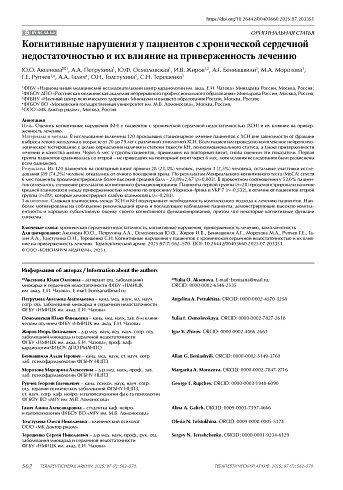
Когнитивные нарушения у пациентов с хронической сердечной недостаточностью и их влияние на приверженность лечению
Аксенова Ю.О., Петрухина А.А., Осмоловская Ю.Ф., Жиров И.В., Бениашвили А.Г., Морозова М.А., Рупчев Г.Е., Галич А.А., Толстухина О.Н., Терещенко С.Н. Когнитивные нарушения у пациентов с хронической сердечной недостаточностью и их влияние на приверженность лечению. Терапевтический архив. 2025;97(7):562–570. DOI: 10.26442/00403660.2025.07.203351
© ООО «КОНСИЛИУМ МЕДИКУМ», 2025 г.
© ООО «КОНСИЛИУМ МЕДИКУМ», 2025 г.
________________________________________________
Материалы доступны только для специалистов сферы здравоохранения.
Чтобы посмотреть материал полностью
Авторизуйтесь
или зарегистрируйтесь.
Аннотация
Цель. Оценить когнитивные нарушения (КН) у пациентов с хронической сердечной недостаточностью (ХСН) и их влияние на приверженность лечению.
Материалы и методы. В исследование включены 120 проходящих стационарное лечение пациентов с ХСН вне зависимости от фракции выброса левого желудочка в возрасте от 20 до 79 лет с различной этиологией ХСН. Всем пациентам проведено комплексное нейропсихологическое тестирование с целью определения наличия и степени тяжести КН, психоэмоционального статуса, а также приверженности лечению и качества жизни. Через 6 мес у группы пациентов, пришедших на повторный визит, снова оценили эти показатели. Первая группа пациентов сравнивалась со второй – не пришедших на повторный визит через 6 мес, хотя условия исследования были разъяснены всем одинаково.
Результаты. Из 120 пациентов на повторный визит пришли 28 (23,3%) человек, умерли 3 (2,5%) человека, остальные участники исследования [89 (74,2%) человек] отказались от очного посещения врача. По результатам Монреальского когнитивного теста (MoCA) спустя 6 мес пациенты продемонстрировали более высокий средний балл – 23,89±2,67 (p=0,003). В процентном соотношении у 53,6% пациентов отмечалось улучшение результатов когнитивного функционирования. Пациенты первой группы (n=28) продемонстрировали наличие средней взаимосвязи между приверженностью лечению по опроснику Мориски–Грина и УКР-7 (r=-0,532), в отличие от пациентов второй группы (n=89), которые демонстрируют слабую взаимосвязь (r=-0,283).
Заключение. Сложная взаимосвязь между ХСН и КН подчеркивает необходимость комплексного подхода к лечению пациентов. Наиболее мотивированы на соблюдение рекомендаций врача и последующее наблюдение пациенты, демонстрирующие высокую комплаентность и хорошую субъективную оценку своего когнитивного функционирования, притом что некоторые когнитивные функции снижены.
Ключевые слова: хроническая сердечная недостаточность, когнитивные нарушения, приверженность лечению, комплаентность
Materials and methods. The study included 120 hospitalized patients with CHF regardless of left ventricular ejection fraction aged from 20 to 79 years with different etiology of CHF. All patients underwent complex neuropsychological testing to determine the presence and severity of CH, psychoemotional status, as well as adherence to treatment and quality of life. After 6 months, the group of patients who came for a follow-up visit was re-evaluated for these indicators. The first group of patients was compared with the second group of patients who did not come for a follow-up visit after 6 months, although the conditions of the study were explained to all single patients.
Results. Out of 120 patients, 28 (23.3%) patients came for a follow-up visit, 3 (2.5%) patients died, the rest of the study participants [89 (74.2%) patients] – refused a face-to-face visit to the physician. On MoCA after 6 months, patients showed a higher mean score of 23.89±2.67 (p=0.003). Percentage-wise, 53.6% of patients showed improvement in cognitive functioning scores. Group 1 patients (n=28) demonstrated a medium relationship between treatment adherence on the Morisky–Green questionnaire and RBM-7 (r=-0.532) in contrast to group 2 patients (n=89) who demonstrated a weak relationship (r=-0.283).
Conclusion. The complex relationship between CHF and cognitive impairment emphasizes the need for a comprehensive approach to patient care. Patients who demonstrate high compliance and good subjective assessment of their cognitive functioning, although some cognitive functions are reduced, are the most motivated to comply with the doctor's recommendations and follow-up.
Keywords: chronic heart failure, cognitive impairment, adherence to treatment, compliance
Материалы и методы. В исследование включены 120 проходящих стационарное лечение пациентов с ХСН вне зависимости от фракции выброса левого желудочка в возрасте от 20 до 79 лет с различной этиологией ХСН. Всем пациентам проведено комплексное нейропсихологическое тестирование с целью определения наличия и степени тяжести КН, психоэмоционального статуса, а также приверженности лечению и качества жизни. Через 6 мес у группы пациентов, пришедших на повторный визит, снова оценили эти показатели. Первая группа пациентов сравнивалась со второй – не пришедших на повторный визит через 6 мес, хотя условия исследования были разъяснены всем одинаково.
Результаты. Из 120 пациентов на повторный визит пришли 28 (23,3%) человек, умерли 3 (2,5%) человека, остальные участники исследования [89 (74,2%) человек] отказались от очного посещения врача. По результатам Монреальского когнитивного теста (MoCA) спустя 6 мес пациенты продемонстрировали более высокий средний балл – 23,89±2,67 (p=0,003). В процентном соотношении у 53,6% пациентов отмечалось улучшение результатов когнитивного функционирования. Пациенты первой группы (n=28) продемонстрировали наличие средней взаимосвязи между приверженностью лечению по опроснику Мориски–Грина и УКР-7 (r=-0,532), в отличие от пациентов второй группы (n=89), которые демонстрируют слабую взаимосвязь (r=-0,283).
Заключение. Сложная взаимосвязь между ХСН и КН подчеркивает необходимость комплексного подхода к лечению пациентов. Наиболее мотивированы на соблюдение рекомендаций врача и последующее наблюдение пациенты, демонстрирующие высокую комплаентность и хорошую субъективную оценку своего когнитивного функционирования, притом что некоторые когнитивные функции снижены.
Ключевые слова: хроническая сердечная недостаточность, когнитивные нарушения, приверженность лечению, комплаентность
________________________________________________
Materials and methods. The study included 120 hospitalized patients with CHF regardless of left ventricular ejection fraction aged from 20 to 79 years with different etiology of CHF. All patients underwent complex neuropsychological testing to determine the presence and severity of CH, psychoemotional status, as well as adherence to treatment and quality of life. After 6 months, the group of patients who came for a follow-up visit was re-evaluated for these indicators. The first group of patients was compared with the second group of patients who did not come for a follow-up visit after 6 months, although the conditions of the study were explained to all single patients.
Results. Out of 120 patients, 28 (23.3%) patients came for a follow-up visit, 3 (2.5%) patients died, the rest of the study participants [89 (74.2%) patients] – refused a face-to-face visit to the physician. On MoCA after 6 months, patients showed a higher mean score of 23.89±2.67 (p=0.003). Percentage-wise, 53.6% of patients showed improvement in cognitive functioning scores. Group 1 patients (n=28) demonstrated a medium relationship between treatment adherence on the Morisky–Green questionnaire and RBM-7 (r=-0.532) in contrast to group 2 patients (n=89) who demonstrated a weak relationship (r=-0.283).
Conclusion. The complex relationship between CHF and cognitive impairment emphasizes the need for a comprehensive approach to patient care. Patients who demonstrate high compliance and good subjective assessment of their cognitive functioning, although some cognitive functions are reduced, are the most motivated to comply with the doctor's recommendations and follow-up.
Keywords: chronic heart failure, cognitive impairment, adherence to treatment, compliance
Полный текст
Список литературы
1. Goyal P, Didomenico RJ, Pressler SJ, et al; HFSA Scientific Statement Committee Members. Cognitive Impairment in Heart Failure: A Heart Failure Society of America Scientific Statement. J Card Fail. 2024;30(3):488-504. DOI:10.1016/j.cardfail.2024.01.003
2. Yang M, Sun D, Wang Y, et al. Cognitive impairment in heart failure: Landscape, challenges, and future directions. Front Cardiovasc Med. 2022;8:831734. DOI:10.3389/fcvm.2021.831734
3. Аксенова Ю.О., Осмоловская Ю.Ф., Петрухина А.А., и др. Когнитивные нарушения при хронической сердечной недостаточности. Как влияют новые терапевтические возможности лечения хронической сердечной недостаточности на когнитивные функции? Евразийский кардиологический журнал. 2024;(1):100-6 [Aksenova YuO, Osmolovskaya YuF, Petrukhina AА, et al. Cognitive impairment in chronic heart failure. How new therapeutic options for the treatment of chronic heart failure affect cognitive function? Eurasian Heart Journal. 2024;(1):100-6 (in Russian)]. DOI:10.38109/2225-1685-2024-1-100-106
4. Ni RSS, Mohamed Raffi HQ, Dong Y. The pathophysiology of cognitive impairment in individuals with heart failure: a systematic review. Front Cardiovasc Med. 2023;10:1181979. DOI:10.3389/fcvm.2023.1181979
5. Ovsenik A, Podbregar M, Fabjan A. Сerebral blood flow impairment and cognitive decline in heart failure. Brain Behav. 2021;11(6):e02176. DOI:10.1002/brb3.2176
6. Caldas JR, Panerai RB, Haunton VJ. Cerebral blood flow in ischemic heart failure. Am J Physiol Regul Integr Comp Physiol. 2017;312(1):R108-13. DOI:10.1152/ajpregu.00361.2016
7. Toledo C, Andrade DC, Díaz HS, et al. Neurocognitive disorders in heart failure: novel pathophysiological mechanisms underpinning memory loss and learning impairment. Mol Neurobiol. 2019;56(12):8035-51. DOI:10.1007/s12035-019-01655-0
8. Meguro T, Meguro Y, Kunieda T. Atrophy of the parahippocampal gyrus is prominent in heart failure patients without dementia. ESC Heart Fail. 2017;4(4):632-40. DOI:10.1002/ehf2.12192
9. Chen LY, Norby FL, Gottesman RF, et al. Association of atrial fibrillationwith cognitive decline and dementia over 20 years: the ARIC-NCS (Athero-sclerosis Risk in Communities Neurocognitive Study). J Am HeartAssoc. 2018;7:7. DOI:10.1161/JAHA.117.00730135
10. Gardarsdottir M, Sigurdsson S, Aspelund T, et al. Atrial fibrillation isassociated with decreased totalcerebral blood flow and brain perfu-sion. Europace. 2018;20:1252-8. DOI:10.1093/europace/eux22036
11. Шария М.А., Устюжанин Д.В., Жиров И.В., и др. Оценка результатов магнитно-резонансной томографии головного мозга при когнитивных нарушениях у пациентов с сердечной недостаточностью. Терапевтический архив. 2024;96(9):909-13 [Shariya MA, Ustyuzhanin DV, Zhirov IV, et al. Evaluation of the results of magnetic resonance imaging of the brain for cognitive impairment in patients with heart failure: A review. Terapevticheskii Arkhiv (Ter. Arkh.). 2024;96(9):909-13 (in Russian)]. DOI:10.26442/00403660.2024.09.202853
12. Athilingam P, Moynihan J, Chen L, et al. Elevated levels of interleukin 6 and C-reactive protein associated with cognitive impairment in heart failure. Congest Heart Fail. 2013;19(2):92-8. DOI:10.1111/chf.12007
13. Gonzalez P, Machado I, Vilcaes A, et al. Molecular mechanisms involved in interleukin 1-beta (IL-1β)-induced memory impairment Modulation by alpha-melanocyte-stimulating hormone (α-MSH). Brain Behav Immun. 2013;34:141-50. DOI:10.1016/j.bbi.2013.08.007
14. Massussi M, Bellicini MG, Adamo M, et al. Connecting the dots: A narrative review of the relationship between heart failure and cognitive impairment. ESC Heart Failure. 2025;12(2):1119-31. DOI:10.1002/ehf2.15144
15. Танашян М.М., Суркова Е.В., Антонова К.В., и др. Сахарный диабет 2-го типа и когнитивные функции у пациентов с хроническими цереброваскулярными заболеваниями. Терапевтический архив. 2021;93(10):1179-85 [Tanashyan MM, Surkova EV, Antonova KV, et al. Type 2 diabetes and cognitive functions in patients with chronic cerebrovascular diseases. Terapevticheskii Arkhiv (Ter. Arkh.). 2021;93(10):1179-85 (in Russian)]. DOI:10.26442/00403660.2021.10.201108
16. Saito H, Yamashita M, Endo Y, et al. Cognitive impairment measured by Mini-Cog provides additive prognostic information in elderly patients with heart failure. J Cardiol. 2020;76(4):350-6. DOI:10.1016/j.jjcc.2020.06.016
17. Van Nieuwkerk AC, Delewi R, Wolters FJ, et al; Heart-Brain Connection Consortium. Cognitive Impairment in Patients With Cardiac Disease: Implications for Clinical Practice. Stroke. 2023;54(8):2181-91. DOI:10.1161/STROKEAHA.123.040499
18. Bunch TJ, Crandall BG, Weiss JP, et al. Patients treated with catheter ablation for atrial fibrillation have long-term rates of death, stroke, and dementia similar to patients without atrial fibrillation. J Cardiovasc Electrophysiol. 2011;22:839-45. DOI:10.1111/j.1540-8167.2011.02035.x
19. Guo J, Liu Y, Jia J, et al. Effects of rhythm-control and rate-control strategies on cognitive function and dementia in atrial fibrillation: a systematic review and meta-analysis. Age Ageing. 2024;53: DOI:10.1093/ageing/afae009
20. Alosco ML, Spitznagel MB, Sweet LH, et al. Atrial fibrillation exacerbates cognitive dysfunction and cerebral perfusion in heart failure. PACE - Pacing Clin Electrophysiol. 2015;38:178-86. DOI:10.1111/pace.12543
21. Mahindru A, Patil P, Agrawal V. Role of physical activity on mental health and well-being: a review. Cureus. 2023;15:e33475. DOI:10.7759/cureus.33475
22. Arnold SE, Arvanitakis Z, Macauley-Rambach SL, et al. Brain insulin resistance in type 2 diabetes and Alzheimer disease: concepts and conundrums. Nat Rev Neurol. 2018;14:168-81. DOI:10.1038/nrneurol.2017.185
2. Yang M, Sun D, Wang Y, et al. Cognitive impairment in heart failure: Landscape, challenges, and future directions. Front Cardiovasc Med. 2022;8:831734. DOI:10.3389/fcvm.2021.831734
3. Aksenova YuO, Osmolovskaya YuF, Petrukhina AА, et al. Cognitive impairment in chronic heart failure. How new therapeutic options for the treatment of chronic heart failure affect cognitive function? Eurasian Heart Journal. 2024;(1):100-6 (in Russian). DOI:10.38109/2225-1685-2024-1-100-106
4. Ni RSS, Mohamed Raffi HQ, Dong Y. The pathophysiology of cognitive impairment in individuals with heart failure: a systematic review. Front Cardiovasc Med. 2023;10:1181979. DOI:10.3389/fcvm.2023.1181979
5. Ovsenik A, Podbregar M, Fabjan A. Сerebral blood flow impairment and cognitive decline in heart failure. Brain Behav. 2021;11(6):e02176. DOI:10.1002/brb3.2176
6. Caldas JR, Panerai RB, Haunton VJ. Cerebral blood flow in ischemic heart failure. Am J Physiol Regul Integr Comp Physiol. 2017;312(1):R108-13. DOI:10.1152/ajpregu.00361.2016
7. Toledo C, Andrade DC, Díaz HS, et al. Neurocognitive disorders in heart failure: novel pathophysiological mechanisms underpinning memory loss and learning impairment. Mol Neurobiol. 2019;56(12):8035-51. DOI:10.1007/s12035-019-01655-0
8. Meguro T, Meguro Y, Kunieda T. Atrophy of the parahippocampal gyrus is prominent in heart failure patients without dementia. ESC Heart Fail. 2017;4(4):632-40. DOI:10.1002/ehf2.12192
9. Chen LY, Norby FL, Gottesman RF, et al. Association of atrial fibrillationwith cognitive decline and dementia over 20 years: the ARIC-NCS (Athero-sclerosis Risk in Communities Neurocognitive Study). J Am HeartAssoc. 2018;7:7. DOI:10.1161/JAHA.117.00730135
10. Gardarsdottir M, Sigurdsson S, Aspelund T, et al. Atrial fibrillation isassociated with decreased totalcerebral blood flow and brain perfu-sion. Europace. 2018;20:1252-8. DOI:10.1093/europace/eux22036
11. Shariya MA, Ustyuzhanin DV, Zhirov IV, et al. Evaluation of the results of magnetic resonance imaging of the brain for cognitive impairment in patients with heart failure: A review. Terapevticheskii Arkhiv (Ter. Arkh.). 2024;96(9):909-13 (in Russian). DOI:10.26442/00403660.2024.09.202853
12. Athilingam P, Moynihan J, Chen L, et al. Elevated levels of interleukin 6 and C-reactive protein associated with cognitive impairment in heart failure. Congest Heart Fail. 2013;19(2):92-8. DOI:10.1111/chf.12007
13. Gonzalez P, Machado I, Vilcaes A, et al. Molecular mechanisms involved in interleukin 1-beta (IL-1β)-induced memory impairment Modulation by alpha-melanocyte-stimulating hormone (α-MSH). Brain Behav Immun. 2013;34:141-50. DOI:10.1016/j.bbi.2013.08.007
14. Massussi M, Bellicini MG, Adamo M, et al. Connecting the dots: A narrative review of the relationship between heart failure and cognitive impairment. ESC Heart Failure. 2025;12(2):1119-31. DOI:10.1002/ehf2.15144
15. Tanashyan MM, Surkova EV, Antonova KV, et al. Type 2 diabetes and cognitive functions in patients with chronic cerebrovascular diseases. Terapevticheskii Arkhiv (Ter. Arkh.). 2021;93(10):1179-85 (in Russian). DOI:10.26442/00403660.2021.10.201108
16. Saito H, Yamashita M, Endo Y, et al. Cognitive impairment measured by Mini-Cog provides additive prognostic information in elderly patients with heart failure. J Cardiol. 2020;76(4):350-6. DOI:10.1016/j.jjcc.2020.06.016
17. Van Nieuwkerk AC, Delewi R, Wolters FJ, et al; Heart-Brain Connection Consortium. Cognitive Impairment in Patients With Cardiac Disease: Implications for Clinical Practice. Stroke. 2023;54(8):2181-91. DOI:10.1161/STROKEAHA.123.040499
18. Bunch TJ, Crandall BG, Weiss JP, et al. Patients treated with catheter ablation for atrial fibrillation have long-term rates of death, stroke, and dementia similar to patients without atrial fibrillation. J Cardiovasc Electrophysiol. 2011;22:839-45. DOI:10.1111/j.1540-8167.2011.02035.x
19. Guo J, Liu Y, Jia J, et al. Effects of rhythm-control and rate-control strategies on cognitive function and dementia in atrial fibrillation: a systematic review and meta-analysis. Age Ageing. 2024;53: DOI:10.1093/ageing/afae009
20. Alosco ML, Spitznagel MB, Sweet LH, et al. Atrial fibrillation exacerbates cognitive dysfunction and cerebral perfusion in heart failure. PACE - Pacing Clin Electrophysiol. 2015;38:178-86. DOI:10.1111/pace.12543
21. Mahindru A, Patil P, Agrawal V. Role of physical activity on mental health and well-being: a review. Cureus. 2023;15:e33475. DOI:10.7759/cureus.33475
22. Arnold SE, Arvanitakis Z, Macauley-Rambach SL, et al. Brain insulin resistance in type 2 diabetes and Alzheimer disease: concepts and conundrums. Nat Rev Neurol. 2018;14:168-81. DOI:10.1038/nrneurol.2017.185
2. Yang M, Sun D, Wang Y, et al. Cognitive impairment in heart failure: Landscape, challenges, and future directions. Front Cardiovasc Med. 2022;8:831734. DOI:10.3389/fcvm.2021.831734
3. Аксенова Ю.О., Осмоловская Ю.Ф., Петрухина А.А., и др. Когнитивные нарушения при хронической сердечной недостаточности. Как влияют новые терапевтические возможности лечения хронической сердечной недостаточности на когнитивные функции? Евразийский кардиологический журнал. 2024;(1):100-6 [Aksenova YuO, Osmolovskaya YuF, Petrukhina AА, et al. Cognitive impairment in chronic heart failure. How new therapeutic options for the treatment of chronic heart failure affect cognitive function? Eurasian Heart Journal. 2024;(1):100-6 (in Russian)]. DOI:10.38109/2225-1685-2024-1-100-106
4. Ni RSS, Mohamed Raffi HQ, Dong Y. The pathophysiology of cognitive impairment in individuals with heart failure: a systematic review. Front Cardiovasc Med. 2023;10:1181979. DOI:10.3389/fcvm.2023.1181979
5. Ovsenik A, Podbregar M, Fabjan A. Сerebral blood flow impairment and cognitive decline in heart failure. Brain Behav. 2021;11(6):e02176. DOI:10.1002/brb3.2176
6. Caldas JR, Panerai RB, Haunton VJ. Cerebral blood flow in ischemic heart failure. Am J Physiol Regul Integr Comp Physiol. 2017;312(1):R108-13. DOI:10.1152/ajpregu.00361.2016
7. Toledo C, Andrade DC, Díaz HS, et al. Neurocognitive disorders in heart failure: novel pathophysiological mechanisms underpinning memory loss and learning impairment. Mol Neurobiol. 2019;56(12):8035-51. DOI:10.1007/s12035-019-01655-0
8. Meguro T, Meguro Y, Kunieda T. Atrophy of the parahippocampal gyrus is prominent in heart failure patients without dementia. ESC Heart Fail. 2017;4(4):632-40. DOI:10.1002/ehf2.12192
9. Chen LY, Norby FL, Gottesman RF, et al. Association of atrial fibrillationwith cognitive decline and dementia over 20 years: the ARIC-NCS (Athero-sclerosis Risk in Communities Neurocognitive Study). J Am HeartAssoc. 2018;7:7. DOI:10.1161/JAHA.117.00730135
10. Gardarsdottir M, Sigurdsson S, Aspelund T, et al. Atrial fibrillation isassociated with decreased totalcerebral blood flow and brain perfu-sion. Europace. 2018;20:1252-8. DOI:10.1093/europace/eux22036
11. Шария М.А., Устюжанин Д.В., Жиров И.В., и др. Оценка результатов магнитно-резонансной томографии головного мозга при когнитивных нарушениях у пациентов с сердечной недостаточностью. Терапевтический архив. 2024;96(9):909-13 [Shariya MA, Ustyuzhanin DV, Zhirov IV, et al. Evaluation of the results of magnetic resonance imaging of the brain for cognitive impairment in patients with heart failure: A review. Terapevticheskii Arkhiv (Ter. Arkh.). 2024;96(9):909-13 (in Russian)]. DOI:10.26442/00403660.2024.09.202853
12. Athilingam P, Moynihan J, Chen L, et al. Elevated levels of interleukin 6 and C-reactive protein associated with cognitive impairment in heart failure. Congest Heart Fail. 2013;19(2):92-8. DOI:10.1111/chf.12007
13. Gonzalez P, Machado I, Vilcaes A, et al. Molecular mechanisms involved in interleukin 1-beta (IL-1β)-induced memory impairment Modulation by alpha-melanocyte-stimulating hormone (α-MSH). Brain Behav Immun. 2013;34:141-50. DOI:10.1016/j.bbi.2013.08.007
14. Massussi M, Bellicini MG, Adamo M, et al. Connecting the dots: A narrative review of the relationship between heart failure and cognitive impairment. ESC Heart Failure. 2025;12(2):1119-31. DOI:10.1002/ehf2.15144
15. Танашян М.М., Суркова Е.В., Антонова К.В., и др. Сахарный диабет 2-го типа и когнитивные функции у пациентов с хроническими цереброваскулярными заболеваниями. Терапевтический архив. 2021;93(10):1179-85 [Tanashyan MM, Surkova EV, Antonova KV, et al. Type 2 diabetes and cognitive functions in patients with chronic cerebrovascular diseases. Terapevticheskii Arkhiv (Ter. Arkh.). 2021;93(10):1179-85 (in Russian)]. DOI:10.26442/00403660.2021.10.201108
16. Saito H, Yamashita M, Endo Y, et al. Cognitive impairment measured by Mini-Cog provides additive prognostic information in elderly patients with heart failure. J Cardiol. 2020;76(4):350-6. DOI:10.1016/j.jjcc.2020.06.016
17. Van Nieuwkerk AC, Delewi R, Wolters FJ, et al; Heart-Brain Connection Consortium. Cognitive Impairment in Patients With Cardiac Disease: Implications for Clinical Practice. Stroke. 2023;54(8):2181-91. DOI:10.1161/STROKEAHA.123.040499
18. Bunch TJ, Crandall BG, Weiss JP, et al. Patients treated with catheter ablation for atrial fibrillation have long-term rates of death, stroke, and dementia similar to patients without atrial fibrillation. J Cardiovasc Electrophysiol. 2011;22:839-45. DOI:10.1111/j.1540-8167.2011.02035.x
19. Guo J, Liu Y, Jia J, et al. Effects of rhythm-control and rate-control strategies on cognitive function and dementia in atrial fibrillation: a systematic review and meta-analysis. Age Ageing. 2024;53: DOI:10.1093/ageing/afae009
20. Alosco ML, Spitznagel MB, Sweet LH, et al. Atrial fibrillation exacerbates cognitive dysfunction and cerebral perfusion in heart failure. PACE - Pacing Clin Electrophysiol. 2015;38:178-86. DOI:10.1111/pace.12543
21. Mahindru A, Patil P, Agrawal V. Role of physical activity on mental health and well-being: a review. Cureus. 2023;15:e33475. DOI:10.7759/cureus.33475
22. Arnold SE, Arvanitakis Z, Macauley-Rambach SL, et al. Brain insulin resistance in type 2 diabetes and Alzheimer disease: concepts and conundrums. Nat Rev Neurol. 2018;14:168-81. DOI:10.1038/nrneurol.2017.185
________________________________________________
2. Yang M, Sun D, Wang Y, et al. Cognitive impairment in heart failure: Landscape, challenges, and future directions. Front Cardiovasc Med. 2022;8:831734. DOI:10.3389/fcvm.2021.831734
3. Aksenova YuO, Osmolovskaya YuF, Petrukhina AА, et al. Cognitive impairment in chronic heart failure. How new therapeutic options for the treatment of chronic heart failure affect cognitive function? Eurasian Heart Journal. 2024;(1):100-6 (in Russian). DOI:10.38109/2225-1685-2024-1-100-106
4. Ni RSS, Mohamed Raffi HQ, Dong Y. The pathophysiology of cognitive impairment in individuals with heart failure: a systematic review. Front Cardiovasc Med. 2023;10:1181979. DOI:10.3389/fcvm.2023.1181979
5. Ovsenik A, Podbregar M, Fabjan A. Сerebral blood flow impairment and cognitive decline in heart failure. Brain Behav. 2021;11(6):e02176. DOI:10.1002/brb3.2176
6. Caldas JR, Panerai RB, Haunton VJ. Cerebral blood flow in ischemic heart failure. Am J Physiol Regul Integr Comp Physiol. 2017;312(1):R108-13. DOI:10.1152/ajpregu.00361.2016
7. Toledo C, Andrade DC, Díaz HS, et al. Neurocognitive disorders in heart failure: novel pathophysiological mechanisms underpinning memory loss and learning impairment. Mol Neurobiol. 2019;56(12):8035-51. DOI:10.1007/s12035-019-01655-0
8. Meguro T, Meguro Y, Kunieda T. Atrophy of the parahippocampal gyrus is prominent in heart failure patients without dementia. ESC Heart Fail. 2017;4(4):632-40. DOI:10.1002/ehf2.12192
9. Chen LY, Norby FL, Gottesman RF, et al. Association of atrial fibrillationwith cognitive decline and dementia over 20 years: the ARIC-NCS (Athero-sclerosis Risk in Communities Neurocognitive Study). J Am HeartAssoc. 2018;7:7. DOI:10.1161/JAHA.117.00730135
10. Gardarsdottir M, Sigurdsson S, Aspelund T, et al. Atrial fibrillation isassociated with decreased totalcerebral blood flow and brain perfu-sion. Europace. 2018;20:1252-8. DOI:10.1093/europace/eux22036
11. Shariya MA, Ustyuzhanin DV, Zhirov IV, et al. Evaluation of the results of magnetic resonance imaging of the brain for cognitive impairment in patients with heart failure: A review. Terapevticheskii Arkhiv (Ter. Arkh.). 2024;96(9):909-13 (in Russian). DOI:10.26442/00403660.2024.09.202853
12. Athilingam P, Moynihan J, Chen L, et al. Elevated levels of interleukin 6 and C-reactive protein associated with cognitive impairment in heart failure. Congest Heart Fail. 2013;19(2):92-8. DOI:10.1111/chf.12007
13. Gonzalez P, Machado I, Vilcaes A, et al. Molecular mechanisms involved in interleukin 1-beta (IL-1β)-induced memory impairment Modulation by alpha-melanocyte-stimulating hormone (α-MSH). Brain Behav Immun. 2013;34:141-50. DOI:10.1016/j.bbi.2013.08.007
14. Massussi M, Bellicini MG, Adamo M, et al. Connecting the dots: A narrative review of the relationship between heart failure and cognitive impairment. ESC Heart Failure. 2025;12(2):1119-31. DOI:10.1002/ehf2.15144
15. Tanashyan MM, Surkova EV, Antonova KV, et al. Type 2 diabetes and cognitive functions in patients with chronic cerebrovascular diseases. Terapevticheskii Arkhiv (Ter. Arkh.). 2021;93(10):1179-85 (in Russian). DOI:10.26442/00403660.2021.10.201108
16. Saito H, Yamashita M, Endo Y, et al. Cognitive impairment measured by Mini-Cog provides additive prognostic information in elderly patients with heart failure. J Cardiol. 2020;76(4):350-6. DOI:10.1016/j.jjcc.2020.06.016
17. Van Nieuwkerk AC, Delewi R, Wolters FJ, et al; Heart-Brain Connection Consortium. Cognitive Impairment in Patients With Cardiac Disease: Implications for Clinical Practice. Stroke. 2023;54(8):2181-91. DOI:10.1161/STROKEAHA.123.040499
18. Bunch TJ, Crandall BG, Weiss JP, et al. Patients treated with catheter ablation for atrial fibrillation have long-term rates of death, stroke, and dementia similar to patients without atrial fibrillation. J Cardiovasc Electrophysiol. 2011;22:839-45. DOI:10.1111/j.1540-8167.2011.02035.x
19. Guo J, Liu Y, Jia J, et al. Effects of rhythm-control and rate-control strategies on cognitive function and dementia in atrial fibrillation: a systematic review and meta-analysis. Age Ageing. 2024;53: DOI:10.1093/ageing/afae009
20. Alosco ML, Spitznagel MB, Sweet LH, et al. Atrial fibrillation exacerbates cognitive dysfunction and cerebral perfusion in heart failure. PACE - Pacing Clin Electrophysiol. 2015;38:178-86. DOI:10.1111/pace.12543
21. Mahindru A, Patil P, Agrawal V. Role of physical activity on mental health and well-being: a review. Cureus. 2023;15:e33475. DOI:10.7759/cureus.33475
22. Arnold SE, Arvanitakis Z, Macauley-Rambach SL, et al. Brain insulin resistance in type 2 diabetes and Alzheimer disease: concepts and conundrums. Nat Rev Neurol. 2018;14:168-81. DOI:10.1038/nrneurol.2017.185
Авторы
Ю.О. Аксенова*1, А.А. Петрухина1, Ю.Ф. Осмоловская1, И.В. Жиров1,2, А.Г. Бениашвили3, М.А. Морозова3, Г.Е. Рупчев3,4, А.А. Галич4, О.Н. Толстухина5, С.Н. Терещенко1
1ФГБУ «Национальный медицинский исследовательский центр кардиологии им. акад. Е.И. Чазова» Минздрава России, Москва, Россия;
2ФГБОУ ДПО «Российская медицинская академия непрерывного профессионального образования» Минздрава России, Москва, Россия;
3ФГБНУ «Научный центр психического здоровья» Миннауки и высшего образования России, Москва, Россия;
4ФГБОУ ВО «Московский государственный университет им. М.В. Ломоносова», Москва, Россия;
5ООО «МК Доктор рядом», Москва, Россия
*bonisana@mail.ru
1Chazov National Medical Research Center of Cardiology, Moscow, Russia;
2Russian Medical Academy of Continuous Professional Education, Moscow, Russia;
3Mental Health Research Center, Moscow, Russia;
4Lomonosov Moscow State University, Moscow, Russia;
5The Doctor is Nearby LLC, Moscow, Russia
*bonisana@mail.ru
1ФГБУ «Национальный медицинский исследовательский центр кардиологии им. акад. Е.И. Чазова» Минздрава России, Москва, Россия;
2ФГБОУ ДПО «Российская медицинская академия непрерывного профессионального образования» Минздрава России, Москва, Россия;
3ФГБНУ «Научный центр психического здоровья» Миннауки и высшего образования России, Москва, Россия;
4ФГБОУ ВО «Московский государственный университет им. М.В. Ломоносова», Москва, Россия;
5ООО «МК Доктор рядом», Москва, Россия
*bonisana@mail.ru
________________________________________________
1Chazov National Medical Research Center of Cardiology, Moscow, Russia;
2Russian Medical Academy of Continuous Professional Education, Moscow, Russia;
3Mental Health Research Center, Moscow, Russia;
4Lomonosov Moscow State University, Moscow, Russia;
5The Doctor is Nearby LLC, Moscow, Russia
*bonisana@mail.ru
Цель портала OmniDoctor – предоставление профессиональной информации врачам, провизорам и фармацевтам.