

Материалы доступны только для специалистов сферы здравоохранения.
Чтобы посмотреть материал полностью
Авторизуйтесь
или зарегистрируйтесь.
Прогностическое значение экспрессии AIF при диффузной В-крупноклеточной лимфоме - Журнал Терапевтический архив №7 Vario 2025
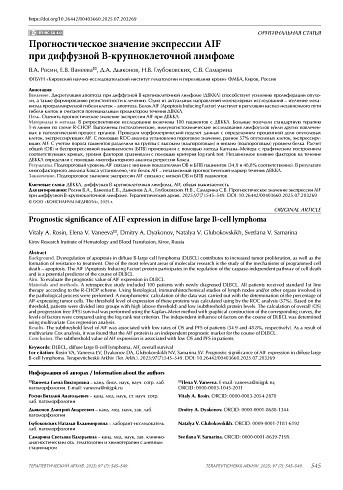
Прогностическое значение экспрессии AIF при диффузной В-крупноклеточной лимфоме
Росин В.А., Ванеева Е.В., Дьяконов Д.А., Глубоковских Н.В., Самарина С.В. Прогностическое значение экспрессии AIF при диффузной В-крупноклеточной лимфоме. Терапевтический архив. 2025;97(7):545–549. DOI: 10.26442/00403660.2025.07.203269
© ООО «КОНСИЛИУМ МЕДИКУМ», 2025 г.
© ООО «КОНСИЛИУМ МЕДИКУМ», 2025 г.
________________________________________________
Материалы доступны только для специалистов сферы здравоохранения.
Чтобы посмотреть материал полностью
Авторизуйтесь
или зарегистрируйтесь.
Аннотация
Введение. Дисрегуляция апоптоза при диффузной В-крупноклеточной лимфоме (ДВККЛ) способствует усилению пролиферации опухоли, а также формированию резистентности к лечению. Одно из актуальных направлений молекулярных исследований – изучение механизма программируемой гибели клеток – апоптоза. Белок AIF (Apoptosis Inducing Factor) участвует в регуляции каспаз-независимого пути гибели клеток и считается потенциальным предиктором течения ДВККЛ.
Цель. Оценить прогностическое значение экспрессии AIF при ДВККЛ.
Материалы и методы. В ретроспективное исследование включены 100 пациентов с ДВККЛ. Больные получали стандартную терапию 1-й линии по схеме R-CHOP. Выполнены гистологические, иммуногистохимические исследования лимфоузлов и/или других вовлеченных в патологический процесс органов. Проведен морфометрический подсчет данных с определением процентной доли опухолевых клеток, экспрессирующих AIF. С помощью ROC-анализа установлено пороговое значение, равное 57% опухолевых клеток, экспрессирующих AIF. С учетом порога пациентов разделили на группы с высоким (надпороговым) и низким (подпороговым) уровнем белка. Расчет общей (ОВ) и беспрогрессивной выживаемости (БПВ) производили с помощью метода Каплана–Мейера с графическим построением соответствующих кривых, уровни факторов сравнивали с помощью критерия log-rank test. Независимое влияние факторов на течение ДВККЛ определяли с помощью многофакторного анализа регрессии Кокса.
Результаты. Подпороговый уровень AIF связан с низкими показателями ОВ и БПВ пациентов (34,9 и 48,8% соответственно). В результате многофакторного анализа Кокса установлено, что белок AIF – независимый прогностический маркер течения ДВККЛ.
Заключение. Подпороговое значение экспрессии AIF связано с низкой ОВ и БПВ пациентов.
Ключевые слова: ДВККЛ, диффузная В-крупноклеточная лимфома, AIF, общая выживаемость
Aim. To evaluate the prognostic value of AIF expression in DLBCL.
Materials and methods. A retrospective study included 100 patients with newly diagnosed DLBCL. All patients received standard 1st line therapy according to the R-CHOP scheme. Using histological, immunohistochemical studies of lymph nodes and/or other organs involved in the pathological process were performed. A morphometric calculation of the data was carried out with the determination of the percentage of AIF-expressing tumor cells. The threshold level of expression of these proteins was calculated using by the ROC analysis (57%). Based on the threshold, patients were divided into groups with high (above threshold) and low (subthreshold) protein levels. The calculation of overall (OS) and progression-free (PFS) survival was performed using the Kaplan–Meier method with graphical construction of the corresponding curves, the levels of factors were compared using the log-rank test criterion. The independent influence of factors on the course of DLBCL was determined using multivariate Cox regression analysis.
Results. The subthreshold level of AIF was associated with low rates of OS and PFS of patients (34.9 and 48.8%, respectively). As a result of multivariate Cox analysis, it was found that the AIF protein is an independent prognostic marker for the course of DLBCL.
Conclusion. The subthreshold value of AIF expression is associated with low OS and PFS in patients.
Keywords: DLBCL, diffuse large B-cell lymphoma, AIF, overall survival
Цель. Оценить прогностическое значение экспрессии AIF при ДВККЛ.
Материалы и методы. В ретроспективное исследование включены 100 пациентов с ДВККЛ. Больные получали стандартную терапию 1-й линии по схеме R-CHOP. Выполнены гистологические, иммуногистохимические исследования лимфоузлов и/или других вовлеченных в патологический процесс органов. Проведен морфометрический подсчет данных с определением процентной доли опухолевых клеток, экспрессирующих AIF. С помощью ROC-анализа установлено пороговое значение, равное 57% опухолевых клеток, экспрессирующих AIF. С учетом порога пациентов разделили на группы с высоким (надпороговым) и низким (подпороговым) уровнем белка. Расчет общей (ОВ) и беспрогрессивной выживаемости (БПВ) производили с помощью метода Каплана–Мейера с графическим построением соответствующих кривых, уровни факторов сравнивали с помощью критерия log-rank test. Независимое влияние факторов на течение ДВККЛ определяли с помощью многофакторного анализа регрессии Кокса.
Результаты. Подпороговый уровень AIF связан с низкими показателями ОВ и БПВ пациентов (34,9 и 48,8% соответственно). В результате многофакторного анализа Кокса установлено, что белок AIF – независимый прогностический маркер течения ДВККЛ.
Заключение. Подпороговое значение экспрессии AIF связано с низкой ОВ и БПВ пациентов.
Ключевые слова: ДВККЛ, диффузная В-крупноклеточная лимфома, AIF, общая выживаемость
________________________________________________
Aim. To evaluate the prognostic value of AIF expression in DLBCL.
Materials and methods. A retrospective study included 100 patients with newly diagnosed DLBCL. All patients received standard 1st line therapy according to the R-CHOP scheme. Using histological, immunohistochemical studies of lymph nodes and/or other organs involved in the pathological process were performed. A morphometric calculation of the data was carried out with the determination of the percentage of AIF-expressing tumor cells. The threshold level of expression of these proteins was calculated using by the ROC analysis (57%). Based on the threshold, patients were divided into groups with high (above threshold) and low (subthreshold) protein levels. The calculation of overall (OS) and progression-free (PFS) survival was performed using the Kaplan–Meier method with graphical construction of the corresponding curves, the levels of factors were compared using the log-rank test criterion. The independent influence of factors on the course of DLBCL was determined using multivariate Cox regression analysis.
Results. The subthreshold level of AIF was associated with low rates of OS and PFS of patients (34.9 and 48.8%, respectively). As a result of multivariate Cox analysis, it was found that the AIF protein is an independent prognostic marker for the course of DLBCL.
Conclusion. The subthreshold value of AIF expression is associated with low OS and PFS in patients.
Keywords: DLBCL, diffuse large B-cell lymphoma, AIF, overall survival
Полный текст
Список литературы
1. Swerdlow S, Campo E, Harris N, et al. WHO classification of tumours of haematopoietic and lymphoid tissues. 4th ed. IARC: Lyon, 2017.
2. Wang L, Li L, Young K, et al. New agents and regimens for difuse large B cell lymphoma. J Hematol Oncol. 2020;13:175. DOI:10.1186/s13045-020-01011-z
3. Капланов К.Д., Волков Н.П., Клиточенко Т.Ю., и др. Результаты анализа регионального регистра пациентов с диффузной В-крупноклеточной лимфомой: факторы риска и проблемы иммунохимиотерапии. Клиническая онкогематология. 2019;12(2):154-64 [Kaplanov KD, Volkov NP, Klitochenko TYu, et al. Analysis Results of the Regional Registry of Patients with Diffuse Large B-cell Lymphoma: Risk Factors and Chemommunotherapy Issues. Klinicheskaya Onkogematologiya. 2019;12(2):154-64 (in Russian)]. DOI:10.21320/2500-2139-2019-12-2-154-164
4. Шардаков В.И., Сухорукова Э.Е. Биологическое и клиническое значение проявлений апоптоза у людей. Киров, 2019. С. 5-78 [Shardakov VI, Sukhorukova EE. Biological and clinical significance of apoptosis manifestations in humans. Kirov, 2019. P. 5-78 (in Russian)].
5. Sevrioukova I. Apoptosis-inducing factor: structure, function, and redox regulation. Antioxid Redox Signal. 2011;14(12):2545-79. DOI:10.1089/ars.2010.3445
6. Фадеева Н.П., Антипова Н.В., Шендер В.О., и др. Определение белков наружной мембраны митохондрий, взаимодействующих с белком AIF. Asta Naturae. 2018;10(4):100-9 [Fadeeva NP, Antipova NV, Shender VO, et al. Identification of mitochondrial outer membrane proteins interacting with AIF protein. Asta Naturae. 2018;10(4):100-9 (in Russian)]. DOI:10.32607/20758251-2018-10-4-100-109
7. Дятлова А.С., Дудков А.В., Линькова Н.С., и др. Молекулярные маркеры каспазо-зависимого и митохондриального апоптоза: роль в развитии патологии и в процессе клеточного старения. Успехи современной биологии. 2018;138(2):126-37 [Dyatlova AS, Dudkov AV, Linkova NS, et al. Molecular markers of caspase-dependent and mitochondrial apoptosis: role in the development of pathology and in the process of cell aging. Advances in Modern Biology. 2018;138(2):126-37 (in Russian)]. DOI:10.7868/S0042132418020023
8. Banoa D, Prehn J. Apoptosis-Inducing Factor (AIF) in Physiology and Disease: The Tale of a Repented Natural Born Killer. EBio Medicine. 2018;30:29-37. DOI:10.1016/j.ebiom.2018.03.016
9. Letkovska K, Babal P, Cierna Z, et al. Prognostic Value of Apoptosis-Inducing Factor (AIF) in Germ Cell Tumors. Cancers. 2021;13(4):776. DOI:10.3390/cancers13040776
10. Xing Y, Li Y, Hu B, et al. PAK5-mediated AIF phosphorylation inhibits its nuclear translocation and promotes breast cancer tumorigenesis. Int J Biol Sci. 2021;17(5):1315-27. DOI:10.7150/ijbs.58102
11. Perraud A, Akil H, Nouaille M, et al. Expression of p53 and DR5 in normal and malignant tissues of colorectal cancer: correlation with advanced stages. Oncol Rep. 2011;26:1091-7. DOI:10.3892/or.2011.1404
12. Cabon L, Bertaux A, Brunelle-Navas M, et al. AIF loss deregulates hematopoiesis and reveals different adaptive metabolic responses in bone marrow cells and thymocytes. Cell Death Differ. 2018;25:983-1001. DOI:10.1038/s41418-017-0035-x
13. Delavallée L, Mathiah N, Cabon L, et al. Mitochondrial AIF loss causes metabolic reprogramming, caspase-independent cell death blockade, embryonic lethality, and perinatal hydrocephalus. Mol Metab. 2020;40:101027. DOI:10.1016/j.molmet.2020.101027
14. Troutaud D, Petit B, Bellanger C, et al. Prognostic significance of BAD and AIF apoptotic pathways in diffuse large B-cell lymphoma. Clin Lymphoma Myeloma Leuk. 2010;10(2):118-24. DOI:10.3816/CLML.2010.n.016
15. Cardama A, Qiu Yi H, Post S, et al. Phase Protein Array Profiling Reveals Distinct Proteomic Signatures Associated With Chronic Myeloid Leukemia Progression and With Chronic Phase in the CD34-Positive Compartment. Cancer. 2012;118(21):5283-92. DOI:10.1002/cncr.27568
16. Ванеева Е.В., Росин В.А., Дьяконов Д.А., и др. Оценка прогностического значения экспрессии pSTAT3 при диффузной В-крупноклеточной лимфоме на российской выборке пациентов. Сибирский научный медицинский журнал. 2019;39(5):125-33 [Vaneeva EV, Rosin VA, Dyakonov DA, et al. Evaluation of the prognostic value of pSTAT3 expression in diffuse B-large cell lymphoma in a Russian sample of patients. Siberian Scientific Medical Journal. 2019;39(5):125-33 (in Russian)]. DOI:10.20538/1682-0363-2021-3-13-20
17. Ванеева Е.В., Росин В.А., Дьяконов Д.А., и др. Значение экспрессии рАКТ1 при диффузной В-крупноклеточной лимфоме. Бюллетень сибирской медицины. 2021;3:6-13 [Vaneeva EV, Rosin VA, Dyakonov DA, et al. Significance of pAKT1 expression in diffuse large B-cell lymphoma. Bulletin of Siberian Medicine. 2021;3:6-13 (in Russian)]. DOI:10.20538/1682-0363-2021-3-13-20
18. Artus C, Boujrad H, Bouharrour A, et al. AIF promotes chromatinolysis and caspase-independent programmed necrosis by interacting with histone H2AX. EMBO J. 2010;29(9):1585-99. DOI:10.1038/emboj.2010.43
2. Wang L, Li L, Young K, et al. New agents and regimens for difuse large B cell lymphoma. J Hematol Oncol. 2020;13:175. DOI:10.1186/s13045-020-01011-z
3. Kaplanov KD, Volkov NP, Klitochenko TYu, et al. Analysis Results of the Regional Registry of Patients with Diffuse Large B-cell Lymphoma: Risk Factors and Chemommunotherapy Issues. Klinicheskaya Onkogematologiya. 2019;12(2):154-64 (in Russian). DOI:10.21320/2500-2139-2019-12-2-154-164
4. Shardakov VI, Sukhorukova EE. Biological and clinical significance of apoptosis manifestations in humans. Kirov, 2019. P. 5-78 (in Russian).
5. Sevrioukova I. Apoptosis-inducing factor: structure, function, and redox regulation. Antioxid Redox Signal. 2011;14(12):2545-79. DOI:10.1089/ars.2010.3445
6. Fadeeva NP, Antipova NV, Shender VO, et al. Identification of mitochondrial outer membrane proteins interacting with AIF protein. Asta Naturae. 2018;10(4):100-9 (in Russian). DOI:10.32607/20758251-2018-10-4-100-109
7. Dyatlova AS, Dudkov AV, Linkova NS, et al. Molecular markers of caspase-dependent and mitochondrial apoptosis: role in the development of pathology and in the process of cell aging. Advances in Modern Biology. 2018;138(2):126-37 (in Russian). DOI:10.7868/S0042132418020023
8. Banoa D, Prehn J. Apoptosis-Inducing Factor (AIF) in Physiology and Disease: The Tale of a Repented Natural Born Killer. EBio Medicine. 2018;30:29-37. DOI:10.1016/j.ebiom.2018.03.016
9. Letkovska K, Babal P, Cierna Z, et al. Prognostic Value of Apoptosis-Inducing Factor (AIF) in Germ Cell Tumors. Cancers. 2021;13(4):776. DOI:10.3390/cancers13040776
10. Xing Y, Li Y, Hu B, et al. PAK5-mediated AIF phosphorylation inhibits its nuclear translocation and promotes breast cancer tumorigenesis. Int J Biol Sci. 2021;17(5):1315-27. DOI:10.7150/ijbs.58102
11. Perraud A, Akil H, Nouaille M, et al. Expression of p53 and DR5 in normal and malignant tissues of colorectal cancer: correlation with advanced stages. Oncol Rep. 2011;26:1091-7. DOI:10.3892/or.2011.1404
12. Cabon L, Bertaux A, Brunelle-Navas M, et al. AIF loss deregulates hematopoiesis and reveals different adaptive metabolic responses in bone marrow cells and thymocytes. Cell Death Differ. 2018;25:983-1001. DOI:10.1038/s41418-017-0035-x
13. Delavallée L, Mathiah N, Cabon L, et al. Mitochondrial AIF loss causes metabolic reprogramming, caspase-independent cell death blockade, embryonic lethality, and perinatal hydrocephalus. Mol Metab. 2020;40:101027. DOI:10.1016/j.molmet.2020.101027
14. Troutaud D, Petit B, Bellanger C, et al. Prognostic significance of BAD and AIF apoptotic pathways in diffuse large B-cell lymphoma. Clin Lymphoma Myeloma Leuk. 2010;10(2):118-24. DOI:10.3816/CLML.2010.n.016
15. Cardama A, Qiu Yi H, Post S, et al. Phase Protein Array Profiling Reveals Distinct Proteomic Signatures Associated With Chronic Myeloid Leukemia Progression and With Chronic Phase in the CD34-Positive Compartment. Cancer. 2012;118(21):5283-92. DOI:10.1002/cncr.27568
16. Vaneeva EV, Rosin VA, Dyakonov DA, et al. Evaluation of the prognostic value of pSTAT3 expression in diffuse B-large cell lymphoma in a Russian sample of patients. Siberian Scientific Medical Journal. 2019;39(5):125-33 (in Russian). DOI:10.20538/1682-0363-2021-3-13-20
17. Vaneeva EV, Rosin VA, Dyakonov DA, et al. Significance of pAKT1 expression in diffuse large B-cell lymphoma. Bulletin of Siberian Medicine. 2021;3:6-13 (in Russian). DOI:10.20538/1682-0363-2021-3-13-20
18. Artus C, Boujrad H, Bouharrour A, et al. AIF promotes chromatinolysis and caspase-independent programmed necrosis by interacting with histone H2AX. EMBO J. 2010;29(9):1585-99. DOI:10.1038/emboj.2010.43
2. Wang L, Li L, Young K, et al. New agents and regimens for difuse large B cell lymphoma. J Hematol Oncol. 2020;13:175. DOI:10.1186/s13045-020-01011-z
3. Капланов К.Д., Волков Н.П., Клиточенко Т.Ю., и др. Результаты анализа регионального регистра пациентов с диффузной В-крупноклеточной лимфомой: факторы риска и проблемы иммунохимиотерапии. Клиническая онкогематология. 2019;12(2):154-64 [Kaplanov KD, Volkov NP, Klitochenko TYu, et al. Analysis Results of the Regional Registry of Patients with Diffuse Large B-cell Lymphoma: Risk Factors and Chemommunotherapy Issues. Klinicheskaya Onkogematologiya. 2019;12(2):154-64 (in Russian)]. DOI:10.21320/2500-2139-2019-12-2-154-164
4. Шардаков В.И., Сухорукова Э.Е. Биологическое и клиническое значение проявлений апоптоза у людей. Киров, 2019. С. 5-78 [Shardakov VI, Sukhorukova EE. Biological and clinical significance of apoptosis manifestations in humans. Kirov, 2019. P. 5-78 (in Russian)].
5. Sevrioukova I. Apoptosis-inducing factor: structure, function, and redox regulation. Antioxid Redox Signal. 2011;14(12):2545-79. DOI:10.1089/ars.2010.3445
6. Фадеева Н.П., Антипова Н.В., Шендер В.О., и др. Определение белков наружной мембраны митохондрий, взаимодействующих с белком AIF. Asta Naturae. 2018;10(4):100-9 [Fadeeva NP, Antipova NV, Shender VO, et al. Identification of mitochondrial outer membrane proteins interacting with AIF protein. Asta Naturae. 2018;10(4):100-9 (in Russian)]. DOI:10.32607/20758251-2018-10-4-100-109
7. Дятлова А.С., Дудков А.В., Линькова Н.С., и др. Молекулярные маркеры каспазо-зависимого и митохондриального апоптоза: роль в развитии патологии и в процессе клеточного старения. Успехи современной биологии. 2018;138(2):126-37 [Dyatlova AS, Dudkov AV, Linkova NS, et al. Molecular markers of caspase-dependent and mitochondrial apoptosis: role in the development of pathology and in the process of cell aging. Advances in Modern Biology. 2018;138(2):126-37 (in Russian)]. DOI:10.7868/S0042132418020023
8. Banoa D, Prehn J. Apoptosis-Inducing Factor (AIF) in Physiology and Disease: The Tale of a Repented Natural Born Killer. EBio Medicine. 2018;30:29-37. DOI:10.1016/j.ebiom.2018.03.016
9. Letkovska K, Babal P, Cierna Z, et al. Prognostic Value of Apoptosis-Inducing Factor (AIF) in Germ Cell Tumors. Cancers. 2021;13(4):776. DOI:10.3390/cancers13040776
10. Xing Y, Li Y, Hu B, et al. PAK5-mediated AIF phosphorylation inhibits its nuclear translocation and promotes breast cancer tumorigenesis. Int J Biol Sci. 2021;17(5):1315-27. DOI:10.7150/ijbs.58102
11. Perraud A, Akil H, Nouaille M, et al. Expression of p53 and DR5 in normal and malignant tissues of colorectal cancer: correlation with advanced stages. Oncol Rep. 2011;26:1091-7. DOI:10.3892/or.2011.1404
12. Cabon L, Bertaux A, Brunelle-Navas M, et al. AIF loss deregulates hematopoiesis and reveals different adaptive metabolic responses in bone marrow cells and thymocytes. Cell Death Differ. 2018;25:983-1001. DOI:10.1038/s41418-017-0035-x
13. Delavallée L, Mathiah N, Cabon L, et al. Mitochondrial AIF loss causes metabolic reprogramming, caspase-independent cell death blockade, embryonic lethality, and perinatal hydrocephalus. Mol Metab. 2020;40:101027. DOI:10.1016/j.molmet.2020.101027
14. Troutaud D, Petit B, Bellanger C, et al. Prognostic significance of BAD and AIF apoptotic pathways in diffuse large B-cell lymphoma. Clin Lymphoma Myeloma Leuk. 2010;10(2):118-24. DOI:10.3816/CLML.2010.n.016
15. Cardama A, Qiu Yi H, Post S, et al. Phase Protein Array Profiling Reveals Distinct Proteomic Signatures Associated With Chronic Myeloid Leukemia Progression and With Chronic Phase in the CD34-Positive Compartment. Cancer. 2012;118(21):5283-92. DOI:10.1002/cncr.27568
16. Ванеева Е.В., Росин В.А., Дьяконов Д.А., и др. Оценка прогностического значения экспрессии pSTAT3 при диффузной В-крупноклеточной лимфоме на российской выборке пациентов. Сибирский научный медицинский журнал. 2019;39(5):125-33 [Vaneeva EV, Rosin VA, Dyakonov DA, et al. Evaluation of the prognostic value of pSTAT3 expression in diffuse B-large cell lymphoma in a Russian sample of patients. Siberian Scientific Medical Journal. 2019;39(5):125-33 (in Russian)]. DOI:10.20538/1682-0363-2021-3-13-20
17. Ванеева Е.В., Росин В.А., Дьяконов Д.А., и др. Значение экспрессии рАКТ1 при диффузной В-крупноклеточной лимфоме. Бюллетень сибирской медицины. 2021;3:6-13 [Vaneeva EV, Rosin VA, Dyakonov DA, et al. Significance of pAKT1 expression in diffuse large B-cell lymphoma. Bulletin of Siberian Medicine. 2021;3:6-13 (in Russian)]. DOI:10.20538/1682-0363-2021-3-13-20
18. Artus C, Boujrad H, Bouharrour A, et al. AIF promotes chromatinolysis and caspase-independent programmed necrosis by interacting with histone H2AX. EMBO J. 2010;29(9):1585-99. DOI:10.1038/emboj.2010.43
________________________________________________
2. Wang L, Li L, Young K, et al. New agents and regimens for difuse large B cell lymphoma. J Hematol Oncol. 2020;13:175. DOI:10.1186/s13045-020-01011-z
3. Kaplanov KD, Volkov NP, Klitochenko TYu, et al. Analysis Results of the Regional Registry of Patients with Diffuse Large B-cell Lymphoma: Risk Factors and Chemommunotherapy Issues. Klinicheskaya Onkogematologiya. 2019;12(2):154-64 (in Russian). DOI:10.21320/2500-2139-2019-12-2-154-164
4. Shardakov VI, Sukhorukova EE. Biological and clinical significance of apoptosis manifestations in humans. Kirov, 2019. P. 5-78 (in Russian).
5. Sevrioukova I. Apoptosis-inducing factor: structure, function, and redox regulation. Antioxid Redox Signal. 2011;14(12):2545-79. DOI:10.1089/ars.2010.3445
6. Fadeeva NP, Antipova NV, Shender VO, et al. Identification of mitochondrial outer membrane proteins interacting with AIF protein. Asta Naturae. 2018;10(4):100-9 (in Russian). DOI:10.32607/20758251-2018-10-4-100-109
7. Dyatlova AS, Dudkov AV, Linkova NS, et al. Molecular markers of caspase-dependent and mitochondrial apoptosis: role in the development of pathology and in the process of cell aging. Advances in Modern Biology. 2018;138(2):126-37 (in Russian). DOI:10.7868/S0042132418020023
8. Banoa D, Prehn J. Apoptosis-Inducing Factor (AIF) in Physiology and Disease: The Tale of a Repented Natural Born Killer. EBio Medicine. 2018;30:29-37. DOI:10.1016/j.ebiom.2018.03.016
9. Letkovska K, Babal P, Cierna Z, et al. Prognostic Value of Apoptosis-Inducing Factor (AIF) in Germ Cell Tumors. Cancers. 2021;13(4):776. DOI:10.3390/cancers13040776
10. Xing Y, Li Y, Hu B, et al. PAK5-mediated AIF phosphorylation inhibits its nuclear translocation and promotes breast cancer tumorigenesis. Int J Biol Sci. 2021;17(5):1315-27. DOI:10.7150/ijbs.58102
11. Perraud A, Akil H, Nouaille M, et al. Expression of p53 and DR5 in normal and malignant tissues of colorectal cancer: correlation with advanced stages. Oncol Rep. 2011;26:1091-7. DOI:10.3892/or.2011.1404
12. Cabon L, Bertaux A, Brunelle-Navas M, et al. AIF loss deregulates hematopoiesis and reveals different adaptive metabolic responses in bone marrow cells and thymocytes. Cell Death Differ. 2018;25:983-1001. DOI:10.1038/s41418-017-0035-x
13. Delavallée L, Mathiah N, Cabon L, et al. Mitochondrial AIF loss causes metabolic reprogramming, caspase-independent cell death blockade, embryonic lethality, and perinatal hydrocephalus. Mol Metab. 2020;40:101027. DOI:10.1016/j.molmet.2020.101027
14. Troutaud D, Petit B, Bellanger C, et al. Prognostic significance of BAD and AIF apoptotic pathways in diffuse large B-cell lymphoma. Clin Lymphoma Myeloma Leuk. 2010;10(2):118-24. DOI:10.3816/CLML.2010.n.016
15. Cardama A, Qiu Yi H, Post S, et al. Phase Protein Array Profiling Reveals Distinct Proteomic Signatures Associated With Chronic Myeloid Leukemia Progression and With Chronic Phase in the CD34-Positive Compartment. Cancer. 2012;118(21):5283-92. DOI:10.1002/cncr.27568
16. Vaneeva EV, Rosin VA, Dyakonov DA, et al. Evaluation of the prognostic value of pSTAT3 expression in diffuse B-large cell lymphoma in a Russian sample of patients. Siberian Scientific Medical Journal. 2019;39(5):125-33 (in Russian). DOI:10.20538/1682-0363-2021-3-13-20
17. Vaneeva EV, Rosin VA, Dyakonov DA, et al. Significance of pAKT1 expression in diffuse large B-cell lymphoma. Bulletin of Siberian Medicine. 2021;3:6-13 (in Russian). DOI:10.20538/1682-0363-2021-3-13-20
18. Artus C, Boujrad H, Bouharrour A, et al. AIF promotes chromatinolysis and caspase-independent programmed necrosis by interacting with histone H2AX. EMBO J. 2010;29(9):1585-99. DOI:10.1038/emboj.2010.43
Авторы
В.А. Росин, Е.В. Ванеева*, Д.А. Дьяконов, Н.В. Глубоковских, С.В. Самарина
ФГБУН «Кировский научно-исследовательский институт гематологии и переливания крови» ФМБА, Киров, Россия
*vaneeva@niigpk.ru
Kirov Research Institute of Hematology and Blood Transfusion, Kirov, Russia
*vaneeva@niigpk.ru
ФГБУН «Кировский научно-исследовательский институт гематологии и переливания крови» ФМБА, Киров, Россия
*vaneeva@niigpk.ru
________________________________________________
Kirov Research Institute of Hematology and Blood Transfusion, Kirov, Russia
*vaneeva@niigpk.ru
Цель портала OmniDoctor – предоставление профессиональной информации врачам, провизорам и фармацевтам.