

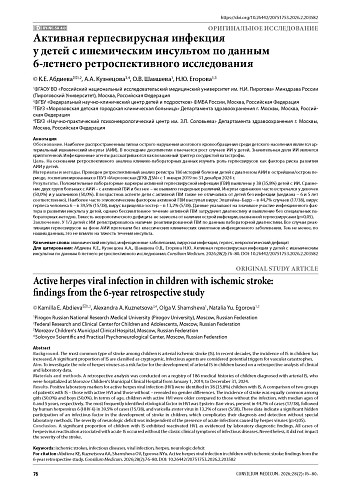
Материалы доступны только для специалистов сферы здравоохранения.
Чтобы посмотреть материал полностью
Авторизуйтесь
или зарегистрируйтесь.
Активная герпесвирусная инфекция у детей с ишемическим инсультом по данным 6-летнего ретроспективного исследования
Активная герпесвирусная инфекция у детей с ишемическим инсультом по данным 6-летнего ретроспективного исследования
Абдиева К.Е., Кузнецова А.А., Шамшева О.В., Егорова Н.Ю. Активная герпесвирусная инфекция у детей с ишемическим инсультом по данным 6-летнего ретроспективного исследования. Consilium Medicum. 2026;28(2):76–80. DOI: 10.26442/20751753.2026.2.203582
________________________________________________
Материалы доступны только для специалистов сферы здравоохранения.
Чтобы посмотреть материал полностью
Авторизуйтесь
или зарегистрируйтесь.
Аннотация
Обоснование. Наиболее распространенным типом острого нарушения мозгового кровообращения среди детского населения является артериальный ишемический инсульт (АИИ). В последние десятилетия отмечается рост случаев ИИ у детей. Значительная доля ИИ является криптогенной. Инфекционные агенты рассматриваются как возможный триггер сосудистой катастрофы.
Цель. На основании ретроспективного анализа клинико-лабораторных данных изучить роль герпесвирусов как фактора риска развития АИИ у детей.
Материалы и методы. Проведен ретроспективный анализ регистра 186 историй болезни детей с диагнозом АИИ в острейшем/остром периоде, госпитализированных в ГБУЗ «Морозовская ДГКБ ДЗМ» с 1 января 2019 по 31 декабря 2024 г.
Результаты. Положительные лабораторные маркеры активной герпесвирусной инфекции (ГВИ) выявлены у 38 (35,8%) детей с ИИ. Сравнение двух групп больных с АИИ – с активной ГВИ и без нее – не выявило гендерных различий. Инсульт одинаково часто встречался у девочек (50,0%) и у мальчиков (50,0%). В возрастном аспекте дети с активной ГВИ также не отличались от детей без инфекции (медиана – 6 и 5 лет соответственно). Наиболее часто этиологическим фактором активной ГВИ выступал вирус Эпштейна–Барр – в 44,7% случаев (17/38), вирус герпеса человека 6 – в 39,5% (15/38), вирус варицелла-зостер – в 13,2% (5/38). Данные указывают на значимое участие инфекционного фактора в развитии инсульта у детей, однако бессимптомное течение активной ГВИ затрудняет диагностику и выявление без специальных лабораторных методов. Тяжесть неврологического дефицита не зависела от наличия острой инфекции, вызванной герпесвирусами (p>0,05).
Заключение. У 1/3 детей с ИИ регистрировалось наличие реактивированной ГВИ по данным лабораторной диагностики. Все случаи реактивации герпесвирусов на фоне АИИ протекали без классических клинических симптомов инфекционного заболевания. Тем не менее, по нашим данным, это не влияло на тяжесть течения инсульта.
Ключевые слова: ишемический инсульт, инфекционные заболевания, вирусная инфекция, герпес, неврологический дефицит
Aim. To investigate the role of herpes viruses as a risk factor for the development of arterial IS in children based on a retrospective analysis of clinical and laboratory data.
Materials and methods. A retrospective analysis was conducted on a registry of 186 medical histories of children diagnosed with arterial IS, who were hospitalized at Morozov Children's Municipal Clinical Hospital from January 1, 2019, to December 31, 2024.
Results. Positive laboratory markers for active herpes viral infection (HVI) were identified in 38 (35.8%) children with IS. A comparison of two groups of patients with IS – those with active HVI and those without – revealed no gender differences. The incidence of stroke was equally common among girls (50.0%) and boys (50.0%). In terms of age, children with active HVI were older compared to those without the infection, with median ages of 6 and 5 years, respectively. The most frequently identified etiological factor in HVI was Epstein–Barr virus, present in 44.7% of cases (17/38), followed by human herpesvirus 6 (HHV-6) in 39.5% of cases (15/38), and varicella-zoster virus in 13.2% of cases (5/38). These data indicate a significant hidden participation of an infectious factor in the development of stroke in children, which complicates their diagnosis and detection without special laboratory methods. The severity of neurologic deficit was independent of the presence of acute infections caused by herpes viruses (p>0,05).
Conclusion. A significant proportion of children with IS exhibited reactivated HVI, as evidenced by laboratory diagnostic findings. All cases of herpesvirus reactivation associated with acute IS occurred without the classic clinical symptoms of infectious diseases. Nevertheless, it did not impact the severity of the stroke.
Keywords: ischemic strokes, infectious diseases, viral infection, herpes, neurologic deficit
Цель. На основании ретроспективного анализа клинико-лабораторных данных изучить роль герпесвирусов как фактора риска развития АИИ у детей.
Материалы и методы. Проведен ретроспективный анализ регистра 186 историй болезни детей с диагнозом АИИ в острейшем/остром периоде, госпитализированных в ГБУЗ «Морозовская ДГКБ ДЗМ» с 1 января 2019 по 31 декабря 2024 г.
Результаты. Положительные лабораторные маркеры активной герпесвирусной инфекции (ГВИ) выявлены у 38 (35,8%) детей с ИИ. Сравнение двух групп больных с АИИ – с активной ГВИ и без нее – не выявило гендерных различий. Инсульт одинаково часто встречался у девочек (50,0%) и у мальчиков (50,0%). В возрастном аспекте дети с активной ГВИ также не отличались от детей без инфекции (медиана – 6 и 5 лет соответственно). Наиболее часто этиологическим фактором активной ГВИ выступал вирус Эпштейна–Барр – в 44,7% случаев (17/38), вирус герпеса человека 6 – в 39,5% (15/38), вирус варицелла-зостер – в 13,2% (5/38). Данные указывают на значимое участие инфекционного фактора в развитии инсульта у детей, однако бессимптомное течение активной ГВИ затрудняет диагностику и выявление без специальных лабораторных методов. Тяжесть неврологического дефицита не зависела от наличия острой инфекции, вызванной герпесвирусами (p>0,05).
Заключение. У 1/3 детей с ИИ регистрировалось наличие реактивированной ГВИ по данным лабораторной диагностики. Все случаи реактивации герпесвирусов на фоне АИИ протекали без классических клинических симптомов инфекционного заболевания. Тем не менее, по нашим данным, это не влияло на тяжесть течения инсульта.
Ключевые слова: ишемический инсульт, инфекционные заболевания, вирусная инфекция, герпес, неврологический дефицит
________________________________________________
Aim. To investigate the role of herpes viruses as a risk factor for the development of arterial IS in children based on a retrospective analysis of clinical and laboratory data.
Materials and methods. A retrospective analysis was conducted on a registry of 186 medical histories of children diagnosed with arterial IS, who were hospitalized at Morozov Children's Municipal Clinical Hospital from January 1, 2019, to December 31, 2024.
Results. Positive laboratory markers for active herpes viral infection (HVI) were identified in 38 (35.8%) children with IS. A comparison of two groups of patients with IS – those with active HVI and those without – revealed no gender differences. The incidence of stroke was equally common among girls (50.0%) and boys (50.0%). In terms of age, children with active HVI were older compared to those without the infection, with median ages of 6 and 5 years, respectively. The most frequently identified etiological factor in HVI was Epstein–Barr virus, present in 44.7% of cases (17/38), followed by human herpesvirus 6 (HHV-6) in 39.5% of cases (15/38), and varicella-zoster virus in 13.2% of cases (5/38). These data indicate a significant hidden participation of an infectious factor in the development of stroke in children, which complicates their diagnosis and detection without special laboratory methods. The severity of neurologic deficit was independent of the presence of acute infections caused by herpes viruses (p>0,05).
Conclusion. A significant proportion of children with IS exhibited reactivated HVI, as evidenced by laboratory diagnostic findings. All cases of herpesvirus reactivation associated with acute IS occurred without the classic clinical symptoms of infectious diseases. Nevertheless, it did not impact the severity of the stroke.
Keywords: ischemic strokes, infectious diseases, viral infection, herpes, neurologic deficit
Полный текст
Список литературы
1. Ишемический инсульт и транзиторная ишемическая атака. Возрастная группа: взрослые/дети. Клинические рекомендации 2024 г. [Ishemicheskii insul't i tranzitornaia ishemicheskaia ataka. Vozrastnaia gruppa: vzroslye/deti. Klinicheskie rekomendatsii 2024 g. (in Russian)].
2. GBD 2021 Stroke Risk Factor Collaborators. Global, regional, and national burden of stroke and its risk factors, 1990-2021: a systematic analysis for the Global Burden of Disease Study 2021. Lancet Neurol. 2024;23(10):973-1003. DOI:10.1016/S1474-4422(24)00369-7
3. deVeber GA, Kirton A, Booth FA, et al. Epidemiology and Outcomes of Arterial Ischemic Stroke in Children: The Canadian Pediatric Ischemic Stroke Registry. Pediatr Neurol. 2017;69:58-70. DOI:10.1016/j.pediatrneurol.2017.01.016
4. Steinlin M, Pfister I, Pavlovic J, et al. The first three years of the Swiss Neuropaediatric Stroke Registry (SNPSR): a population-based study of incidence, symptoms and risk factors. Neuropediatrics. 2005;36(2):90-7. DOI:10.1055/s-2005-837658
5. Щедеркина И.О., Лившиц М.И., Кессель А.Е., и др. Инсульт у детей: опыт работы Центра по лечению цереброваскулярных заболеваний у детей и подростков Москвы. Журнал неврологии и психиатрии им. С.С. Корсакова. Спецвыпуски. 2023;123(8‑2):22‑31 [Shchederkina IO, Livshits MI, Kessel AE, et al. Stroke in children: experience of the Center for the Treatment of Cerebrovascular Diseases in Children and Adolescents in Moscow. S.S. Korsakov Journal of Neurology and Psychiatry. 2023;123(8‑2):22‑31 (in Russian)]. DOI:10.17116/jnevro202312308222
6. Gerstl L, Olivieri M, Heinen F, et al. Stroke alarm-Arterial ischemic stroke as one of the most time-critical emergencies in children and adolescents. Nervenarzt. 2022;93(2):158-66 (in German). DOI:10.1007/s00115-021-01252-4
7. Fullerton HJ, Stence N, Hills NK, et al. Focal Cerebral Arteriopathy of Childhood: Novel Severity Score and Natural History. Stroke. 2018;49(11):2590-96. DOI:10.1161/STROKEAHA.118.021556
8. Cornet MC, Grose C, Vexler Z, et al. The Role of Infection and Inflammation in the Pathogenesis of Pediatric Arterial Ischemic Stroke. Semin Pediatr Neurol. 2022;44:100995. DOI:10.1016/j.spen.2022.100995
9. Grose C, Shaban A, Fullerton HJ. Common Features Between Stroke Following Varicella in Children and Stroke Following Herpes Zoster in Adults: Varicella-Zoster Virus in Trigeminal Ganglion. Curr Top Microbiol Immunol. 2023;438:247-72. DOI:10.1007/82_2021_236
10. Eleftheriou D, Moraitis E, Hong Y, et al. Microparticle-mediated VZV propagation and endothelial activation: Mechanism of VZV vasculopathy. Neurology. 2020;94(5):e474-80. DOI:10.1212/WNL.0000000000008885
11. Saberi A, Akhondzadeh S, Kazemi S, Kazemi S. Infectious Agents and Stroke: A Systematic Review. Basic Clin Neurosci. 2021;12(4):427-40. DOI:10.32598/bcn.2021.1324.2
12. Elkind MS, Hills NK, Glaser CA, et al. Herpesvirus Infections and Childhood Arterial Ischemic Stroke: Results of the VIPS Study. Circulation. 2016;133(8):732-41. DOI:10.1161/CIRCULATIONAHA.115.018595
13. Харламова Ф.С., Шамшева О.В., Симонова Е.В., Дроздова И.М. Поражение ЦНС при моно- и микст-инфекции герпеса человека 6-го типа. Лечащий врач. 2016;11:56-63 [Kharlamova FS, Shamsheva OV, Simonova EV, Drozdova IM. Porazhenie TsNS pri mono- i mikst-infektsii gerpesa cheloveka 6-go tipa. Lechashchii vrach. 2016;11:56-63 (in Russian)].
14. Wada A, Muramatsu K, Sunaga Y, et al. Brainstem infarction associated with HHV-6 infection in an infant. Brain Dev. 2018;40(3):242-6. DOI:10.1016/j.braindev.2017.09.005
15. Hills NK, Johnston SC, Sidney S, et al. Recent trauma and acute infection as risk factors for childhood arterial ischemic stroke. Ann Neurol. 2012;72(6):850-8. DOI:10.1002/ana.23688
16. Hills NK, Sidney S, Fullerton HJ. Timing and number of minor infections as risk factors for childhood arterial ischemic stroke. Neurology. 2014;83(10):890-7. DOI:10.1212/WNL.0000000000000752
17. Егорова Н.Ю., Гусева Л.Н., Гусева Н.А., и др. Значение маркеров герпетических вирусов для оценки состояния здоровья детей. Детские инфекции. 2008;7(2):16-22 [Egorova NYu, Guseva LN, Guseva NA, et al. Importance of herpetic viruses markers in evaluation of children health condition. Children infections = Detskie Infektsii. 2008;7(2):16-22 (in Russian)].
18. Clifford A, Hoffman GS. Evidence for a vascular microbiome and its role in vessel health and disease. Curr Opin Rheumatol. 2015;27(4):397-405. DOI:10.1097/BOR.0000000000000184
19. Sun LR, Lynch JK. Advances in the Diagnosis and Treatment of Pediatric Arterial Ischemic Stroke. Neurotherapeutics. 2023;20(3):633-54. DOI:10.1007/s13311-023-01373-5
20. Fullerton HJ, Hills NK, Wintermark M, et al. Evidence of Varicella Zoster Virus Reactivation in Children With Arterial Ischemic Stroke: Results of the VIPS II Study. J Am Heart Assoc. 2025;14(6):e039184. DOI:10.1161/JAHA.124.039184
2. GBD 2021 Stroke Risk Factor Collaborators. Global, regional, and national burden of stroke and its risk factors, 1990-2021: a systematic analysis for the Global Burden of Disease Study 2021. Lancet Neurol. 2024;23(10):973-1003. DOI:10.1016/S1474-4422(24)00369-7
3. deVeber GA, Kirton A, Booth FA, et al. Epidemiology and Outcomes of Arterial Ischemic Stroke in Children: The Canadian Pediatric Ischemic Stroke Registry. Pediatr Neurol. 2017;69:58-70. DOI:10.1016/j.pediatrneurol.2017.01.016
4. Steinlin M, Pfister I, Pavlovic J, et al. The first three years of the Swiss Neuropaediatric Stroke Registry (SNPSR): a population-based study of incidence, symptoms and risk factors. Neuropediatrics. 2005;36(2):90-7. DOI:10.1055/s-2005-837658
5. Shchederkina IO, Livshits MI, Kessel AE, et al. Stroke in children: experience of the Center for the Treatment of Cerebrovascular Diseases in Children and Adolescents in Moscow. S.S. Korsakov Journal of Neurology and Psychiatry. 2023;123(8‑2):22‑31 (in Russian). DOI:10.17116/jnevro202312308222
6. Gerstl L, Olivieri M, Heinen F, et al. Stroke alarm-Arterial ischemic stroke as one of the most time-critical emergencies in children and adolescents. Nervenarzt. 2022;93(2):158-66 (in German). DOI:10.1007/s00115-021-01252-4
7. Fullerton HJ, Stence N, Hills NK, et al. Focal Cerebral Arteriopathy of Childhood: Novel Severity Score and Natural History. Stroke. 2018;49(11):2590-96. DOI:10.1161/STROKEAHA.118.021556
8. Cornet MC, Grose C, Vexler Z, et al. The Role of Infection and Inflammation in the Pathogenesis of Pediatric Arterial Ischemic Stroke. Semin Pediatr Neurol. 2022;44:100995. DOI:10.1016/j.spen.2022.100995
9. Grose C, Shaban A, Fullerton HJ. Common Features Between Stroke Following Varicella in Children and Stroke Following Herpes Zoster in Adults: Varicella-Zoster Virus in Trigeminal Ganglion. Curr Top Microbiol Immunol. 2023;438:247-72. DOI:10.1007/82_2021_236
10. Eleftheriou D, Moraitis E, Hong Y, et al. Microparticle-mediated VZV propagation and endothelial activation: Mechanism of VZV vasculopathy. Neurology. 2020;94(5):e474-80. DOI:10.1212/WNL.0000000000008885
11. Saberi A, Akhondzadeh S, Kazemi S, Kazemi S. Infectious Agents and Stroke: A Systematic Review. Basic Clin Neurosci. 2021;12(4):427-40. DOI:10.32598/bcn.2021.1324.2
12. Elkind MS, Hills NK, Glaser CA, et al. Herpesvirus Infections and Childhood Arterial Ischemic Stroke: Results of the VIPS Study. Circulation. 2016;133(8):732-41. DOI:10.1161/CIRCULATIONAHA.115.018595
13. Kharlamova FS, Shamsheva OV, Simonova EV, Drozdova IM. Porazhenie TsNS pri mono- i mikst-infektsii gerpesa cheloveka 6-go tipa. Lechashchii vrach. 2016;11:56-63 (in Russian).
14. Wada A, Muramatsu K, Sunaga Y, et al. Brainstem infarction associated with HHV-6 infection in an infant. Brain Dev. 2018;40(3):242-6. DOI:10.1016/j.braindev.2017.09.005
15. Hills NK, Johnston SC, Sidney S, et al. Recent trauma and acute infection as risk factors for childhood arterial ischemic stroke. Ann Neurol. 2012;72(6):850-8. DOI:10.1002/ana.23688
16. Hills NK, Sidney S, Fullerton HJ. Timing and number of minor infections as risk factors for childhood arterial ischemic stroke. Neurology. 2014;83(10):890-7. DOI:10.1212/WNL.0000000000000752
17. Egorova NYu, Guseva LN, Guseva NA, et al. Importance of herpetic viruses markers in evaluation of children health condition. Children infections = Detskie Infektsii. 2008;7(2):16-22 (in Russian).
18. Clifford A, Hoffman GS. Evidence for a vascular microbiome and its role in vessel health and disease. Curr Opin Rheumatol. 2015;27(4):397-405. DOI:10.1097/BOR.0000000000000184
19. Sun LR, Lynch JK. Advances in the Diagnosis and Treatment of Pediatric Arterial Ischemic Stroke. Neurotherapeutics. 2023;20(3):633-54. DOI:10.1007/s13311-023-01373-5
20. Fullerton HJ, Hills NK, Wintermark M, et al. Evidence of Varicella Zoster Virus Reactivation in Children With Arterial Ischemic Stroke: Results of the VIPS II Study. J Am Heart Assoc. 2025;14(6):e039184. DOI:10.1161/JAHA.124.039184
2. GBD 2021 Stroke Risk Factor Collaborators. Global, regional, and national burden of stroke and its risk factors, 1990-2021: a systematic analysis for the Global Burden of Disease Study 2021. Lancet Neurol. 2024;23(10):973-1003. DOI:10.1016/S1474-4422(24)00369-7
3. deVeber GA, Kirton A, Booth FA, et al. Epidemiology and Outcomes of Arterial Ischemic Stroke in Children: The Canadian Pediatric Ischemic Stroke Registry. Pediatr Neurol. 2017;69:58-70. DOI:10.1016/j.pediatrneurol.2017.01.016
4. Steinlin M, Pfister I, Pavlovic J, et al. The first three years of the Swiss Neuropaediatric Stroke Registry (SNPSR): a population-based study of incidence, symptoms and risk factors. Neuropediatrics. 2005;36(2):90-7. DOI:10.1055/s-2005-837658
5. Щедеркина И.О., Лившиц М.И., Кессель А.Е., и др. Инсульт у детей: опыт работы Центра по лечению цереброваскулярных заболеваний у детей и подростков Москвы. Журнал неврологии и психиатрии им. С.С. Корсакова. Спецвыпуски. 2023;123(8‑2):22‑31 [Shchederkina IO, Livshits MI, Kessel AE, et al. Stroke in children: experience of the Center for the Treatment of Cerebrovascular Diseases in Children and Adolescents in Moscow. S.S. Korsakov Journal of Neurology and Psychiatry. 2023;123(8‑2):22‑31 (in Russian)]. DOI:10.17116/jnevro202312308222
6. Gerstl L, Olivieri M, Heinen F, et al. Stroke alarm-Arterial ischemic stroke as one of the most time-critical emergencies in children and adolescents. Nervenarzt. 2022;93(2):158-66 (in German). DOI:10.1007/s00115-021-01252-4
7. Fullerton HJ, Stence N, Hills NK, et al. Focal Cerebral Arteriopathy of Childhood: Novel Severity Score and Natural History. Stroke. 2018;49(11):2590-96. DOI:10.1161/STROKEAHA.118.021556
8. Cornet MC, Grose C, Vexler Z, et al. The Role of Infection and Inflammation in the Pathogenesis of Pediatric Arterial Ischemic Stroke. Semin Pediatr Neurol. 2022;44:100995. DOI:10.1016/j.spen.2022.100995
9. Grose C, Shaban A, Fullerton HJ. Common Features Between Stroke Following Varicella in Children and Stroke Following Herpes Zoster in Adults: Varicella-Zoster Virus in Trigeminal Ganglion. Curr Top Microbiol Immunol. 2023;438:247-72. DOI:10.1007/82_2021_236
10. Eleftheriou D, Moraitis E, Hong Y, et al. Microparticle-mediated VZV propagation and endothelial activation: Mechanism of VZV vasculopathy. Neurology. 2020;94(5):e474-80. DOI:10.1212/WNL.0000000000008885
11. Saberi A, Akhondzadeh S, Kazemi S, Kazemi S. Infectious Agents and Stroke: A Systematic Review. Basic Clin Neurosci. 2021;12(4):427-40. DOI:10.32598/bcn.2021.1324.2
12. Elkind MS, Hills NK, Glaser CA, et al. Herpesvirus Infections and Childhood Arterial Ischemic Stroke: Results of the VIPS Study. Circulation. 2016;133(8):732-41. DOI:10.1161/CIRCULATIONAHA.115.018595
13. Харламова Ф.С., Шамшева О.В., Симонова Е.В., Дроздова И.М. Поражение ЦНС при моно- и микст-инфекции герпеса человека 6-го типа. Лечащий врач. 2016;11:56-63 [Kharlamova FS, Shamsheva OV, Simonova EV, Drozdova IM. Porazhenie TsNS pri mono- i mikst-infektsii gerpesa cheloveka 6-go tipa. Lechashchii vrach. 2016;11:56-63 (in Russian)].
14. Wada A, Muramatsu K, Sunaga Y, et al. Brainstem infarction associated with HHV-6 infection in an infant. Brain Dev. 2018;40(3):242-6. DOI:10.1016/j.braindev.2017.09.005
15. Hills NK, Johnston SC, Sidney S, et al. Recent trauma and acute infection as risk factors for childhood arterial ischemic stroke. Ann Neurol. 2012;72(6):850-8. DOI:10.1002/ana.23688
16. Hills NK, Sidney S, Fullerton HJ. Timing and number of minor infections as risk factors for childhood arterial ischemic stroke. Neurology. 2014;83(10):890-7. DOI:10.1212/WNL.0000000000000752
17. Егорова Н.Ю., Гусева Л.Н., Гусева Н.А., и др. Значение маркеров герпетических вирусов для оценки состояния здоровья детей. Детские инфекции. 2008;7(2):16-22 [Egorova NYu, Guseva LN, Guseva NA, et al. Importance of herpetic viruses markers in evaluation of children health condition. Children infections = Detskie Infektsii. 2008;7(2):16-22 (in Russian)].
18. Clifford A, Hoffman GS. Evidence for a vascular microbiome and its role in vessel health and disease. Curr Opin Rheumatol. 2015;27(4):397-405. DOI:10.1097/BOR.0000000000000184
19. Sun LR, Lynch JK. Advances in the Diagnosis and Treatment of Pediatric Arterial Ischemic Stroke. Neurotherapeutics. 2023;20(3):633-54. DOI:10.1007/s13311-023-01373-5
20. Fullerton HJ, Hills NK, Wintermark M, et al. Evidence of Varicella Zoster Virus Reactivation in Children With Arterial Ischemic Stroke: Results of the VIPS II Study. J Am Heart Assoc. 2025;14(6):e039184. DOI:10.1161/JAHA.124.039184
________________________________________________
2. GBD 2021 Stroke Risk Factor Collaborators. Global, regional, and national burden of stroke and its risk factors, 1990-2021: a systematic analysis for the Global Burden of Disease Study 2021. Lancet Neurol. 2024;23(10):973-1003. DOI:10.1016/S1474-4422(24)00369-7
3. deVeber GA, Kirton A, Booth FA, et al. Epidemiology and Outcomes of Arterial Ischemic Stroke in Children: The Canadian Pediatric Ischemic Stroke Registry. Pediatr Neurol. 2017;69:58-70. DOI:10.1016/j.pediatrneurol.2017.01.016
4. Steinlin M, Pfister I, Pavlovic J, et al. The first three years of the Swiss Neuropaediatric Stroke Registry (SNPSR): a population-based study of incidence, symptoms and risk factors. Neuropediatrics. 2005;36(2):90-7. DOI:10.1055/s-2005-837658
5. Shchederkina IO, Livshits MI, Kessel AE, et al. Stroke in children: experience of the Center for the Treatment of Cerebrovascular Diseases in Children and Adolescents in Moscow. S.S. Korsakov Journal of Neurology and Psychiatry. 2023;123(8‑2):22‑31 (in Russian). DOI:10.17116/jnevro202312308222
6. Gerstl L, Olivieri M, Heinen F, et al. Stroke alarm-Arterial ischemic stroke as one of the most time-critical emergencies in children and adolescents. Nervenarzt. 2022;93(2):158-66 (in German). DOI:10.1007/s00115-021-01252-4
7. Fullerton HJ, Stence N, Hills NK, et al. Focal Cerebral Arteriopathy of Childhood: Novel Severity Score and Natural History. Stroke. 2018;49(11):2590-96. DOI:10.1161/STROKEAHA.118.021556
8. Cornet MC, Grose C, Vexler Z, et al. The Role of Infection and Inflammation in the Pathogenesis of Pediatric Arterial Ischemic Stroke. Semin Pediatr Neurol. 2022;44:100995. DOI:10.1016/j.spen.2022.100995
9. Grose C, Shaban A, Fullerton HJ. Common Features Between Stroke Following Varicella in Children and Stroke Following Herpes Zoster in Adults: Varicella-Zoster Virus in Trigeminal Ganglion. Curr Top Microbiol Immunol. 2023;438:247-72. DOI:10.1007/82_2021_236
10. Eleftheriou D, Moraitis E, Hong Y, et al. Microparticle-mediated VZV propagation and endothelial activation: Mechanism of VZV vasculopathy. Neurology. 2020;94(5):e474-80. DOI:10.1212/WNL.0000000000008885
11. Saberi A, Akhondzadeh S, Kazemi S, Kazemi S. Infectious Agents and Stroke: A Systematic Review. Basic Clin Neurosci. 2021;12(4):427-40. DOI:10.32598/bcn.2021.1324.2
12. Elkind MS, Hills NK, Glaser CA, et al. Herpesvirus Infections and Childhood Arterial Ischemic Stroke: Results of the VIPS Study. Circulation. 2016;133(8):732-41. DOI:10.1161/CIRCULATIONAHA.115.018595
13. Kharlamova FS, Shamsheva OV, Simonova EV, Drozdova IM. Porazhenie TsNS pri mono- i mikst-infektsii gerpesa cheloveka 6-go tipa. Lechashchii vrach. 2016;11:56-63 (in Russian).
14. Wada A, Muramatsu K, Sunaga Y, et al. Brainstem infarction associated with HHV-6 infection in an infant. Brain Dev. 2018;40(3):242-6. DOI:10.1016/j.braindev.2017.09.005
15. Hills NK, Johnston SC, Sidney S, et al. Recent trauma and acute infection as risk factors for childhood arterial ischemic stroke. Ann Neurol. 2012;72(6):850-8. DOI:10.1002/ana.23688
16. Hills NK, Sidney S, Fullerton HJ. Timing and number of minor infections as risk factors for childhood arterial ischemic stroke. Neurology. 2014;83(10):890-7. DOI:10.1212/WNL.0000000000000752
17. Egorova NYu, Guseva LN, Guseva NA, et al. Importance of herpetic viruses markers in evaluation of children health condition. Children infections = Detskie Infektsii. 2008;7(2):16-22 (in Russian).
18. Clifford A, Hoffman GS. Evidence for a vascular microbiome and its role in vessel health and disease. Curr Opin Rheumatol. 2015;27(4):397-405. DOI:10.1097/BOR.0000000000000184
19. Sun LR, Lynch JK. Advances in the Diagnosis and Treatment of Pediatric Arterial Ischemic Stroke. Neurotherapeutics. 2023;20(3):633-54. DOI:10.1007/s13311-023-01373-5
20. Fullerton HJ, Hills NK, Wintermark M, et al. Evidence of Varicella Zoster Virus Reactivation in Children With Arterial Ischemic Stroke: Results of the VIPS II Study. J Am Heart Assoc. 2025;14(6):e039184. DOI:10.1161/JAHA.124.039184
Авторы
К.Е. Абдиева*1,2, А.А. Кузнецова3,4, О.В. Шамшева1, Н.Ю. Егорова1,3
1ФГАОУ ВО «Российский национальный исследовательский медицинский университет им. Н.И. Пирогова» Минздрава России (Пироговский Университет), Москва, Российская Федерация
2ФГБУ «Федеральный научно-клинический центр детей и подростков» ФМБА России, Москва, Российская Федерация
3ГБУЗ «Морозовская детская городская клиническая больница» Департамента здравоохранения г. Москвы, Москва, Российская Федерация
4ГБУЗ «Научно-практический психоневрологический центр им. З.П. Соловьева» Департамента здравоохранения г. Москвы, Москва, Российская Федерация
*abdieva99@mail.ru
1Pirogov Russian National Research Medical University (Pirogov University), Moscow, Russian Federation
2Federal Research and Clinical Center for Children and Adolescents, Moscow, Russian Federation
3Morozov Children's Municipal Clinical Hospital, Moscow, Russian Federation
4Solovyov Scientific and Practical Psychoneurological Center, Moscow, Russian Federation
*abdieva99@mail.ru
1ФГАОУ ВО «Российский национальный исследовательский медицинский университет им. Н.И. Пирогова» Минздрава России (Пироговский Университет), Москва, Российская Федерация
2ФГБУ «Федеральный научно-клинический центр детей и подростков» ФМБА России, Москва, Российская Федерация
3ГБУЗ «Морозовская детская городская клиническая больница» Департамента здравоохранения г. Москвы, Москва, Российская Федерация
4ГБУЗ «Научно-практический психоневрологический центр им. З.П. Соловьева» Департамента здравоохранения г. Москвы, Москва, Российская Федерация
*abdieva99@mail.ru
________________________________________________
1Pirogov Russian National Research Medical University (Pirogov University), Moscow, Russian Federation
2Federal Research and Clinical Center for Children and Adolescents, Moscow, Russian Federation
3Morozov Children's Municipal Clinical Hospital, Moscow, Russian Federation
4Solovyov Scientific and Practical Psychoneurological Center, Moscow, Russian Federation
*abdieva99@mail.ru
Цель портала OmniDoctor – предоставление профессиональной информации врачам, провизорам и фармацевтам.