

Материалы доступны только для специалистов сферы здравоохранения.
Чтобы посмотреть материал полностью
Авторизуйтесь
или зарегистрируйтесь.
Сравнительный анализ результатов кохлеарной имплантации у пациентов с простыми и сложными пороками развития внутреннего уха
Сравнительный анализ результатов кохлеарной имплантации у пациентов с простыми и сложными пороками развития внутреннего уха
Попадюк В.И., Диаб Х.М., Пащинина О.А., Харири М., Михалевич А.Е., Шукурян М.А. Сравнительный анализ результатов кохлеарной имплантации у пациентов с простыми и сложными пороками развития внутреннего уха. Consilium Medicum. 2026;28(3):131–138. DOI: 10.26442/20751753.2026.3.203561
________________________________________________
Материалы доступны только для специалистов сферы здравоохранения.
Чтобы посмотреть материал полностью
Авторизуйтесь
или зарегистрируйтесь.
Аннотация
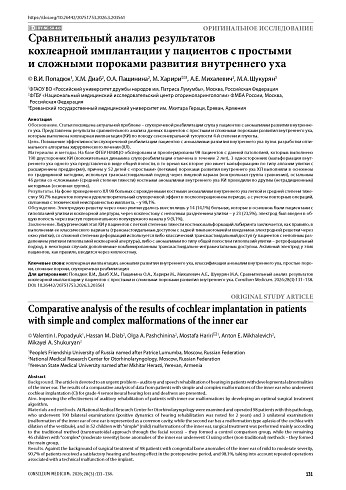
Обоснование. Статья посвящена актуальной проблеме – слухоречевой реабилитации слуха у пациентов с аномалиями развития внутреннего уха. Представлены результаты сравнительного анализа данных пациентов с простыми и сложными пороками развития внутреннего уха, которым выполнена кохлеарная имплантация (КИ) по поводу сенсоневральной тугоухости 4-й степени и глухоты.
Цель. Повышение эффективности слухоречевой реабилитации пациентов с аномалиями развития внутреннего уха путем разработки оптимального алгоритма хирургического лечения (ХЛ).
Материалы и методы. На базе ФГБУ НМИЦО обследованы и прооперированы 98 пациентов с данной патологией, которым выполнено 190 двусторонних КИ (положительная динамика слухореабилитации отмечена в течение 2 лет), 3 односторонних (мальформация внутреннего уха одного уха представлена в виде общей полости, в то время как второе ухо имеет мальформацию по типу аплазии улитки с расширением преддверия), причем у 52 детей с «простыми» (легкими) пороками развития внутреннего уха ХЛ выполняли в основном по традицинной методике, используя трансмастоидальный подход через лицевой карман (контрольная группа сравнения), остальным 46 детям со «сложными» (средней степени тяжести) костными аномалиями внутреннего уха КИ проводили по другим (нетрадиционным) методикам (основная группа).
Результаты. На фоне проведенного ХЛ 98 больных с врожденными костными аномалиями внутреннего уха легкой и средней степени тяжести у 90,7% пациентов получен удовлетворительный слухоречевой эффект в послеоперационном периоде, а с учетом повторных операций, связанных с технической неисправностью импланта, – у 98,1%.
Обсуждение. Электродную решетку через окно улитки удалось ввести лишь у 14 (14,1%) больных, которые в основном были пациентами с гипоплазией улитки и кохлеарной апертуры, через кохлеостому с неполным разделением улитки – у 23 (23,5%), электрод был введен в общую полость через выступ горизонтального полукружного канала у 9 (9,1%).
Заключение. Хирургический этап КИ у пациентов с легкой степенью тяжести костных мальформаций лабиринта заключается, как правило, в выполнении ее классического варианта (трансмастоидальным доступом с задней тимпанотомией и введением электродной решетки через окно улитки), со сложной степенью деформаций используется либо классический трансмастоидальный доступ (у пациентов с неполным разделением улитки и гипоплазией кохлеарной апертуры), либо с аномалиями по типу общей полости и гипоплазий улитки – ретрофациальный подход, в некоторых случаях дополняемые комбинированным трансмастоидально-интрамеатальным доступом. Активный электрод у этих пациентов, как правило, вводится через кохлеостому.
Ключевые слова: кохлеарная имплантация, аномалия развития внутреннего уха, классификация аномалии внутреннего уха, простые пороки, сложные пороки, слухоречевая реабилитация
Aim. Improving the effectiveness of auditory rehabilitation of patients with inner ear malformations by developing an optimal surgical treatment algorithm.
Materials and methods. At National Medical Research Center for Otorhinolaryngology were examined and operated 98 patients with this pathology, who underwent 190 bilateral examinations (positive dynamics of hearing rehabilitation was noted for 2 years) and 3 unilateral examinations (malformation of the inner ear of one ear is represented as a common cavity, while the second ear has a malformation type aplasia of the cochlea with dilation of the vestibule), and in 52 children with "simple" (mild) malformations of the inner ear, surgical treatment was performed mainly according to the traditional method (transmastoidal approach through the facial recess) – they formed a control comparison group, while the remaining 46 children with "complex" (moderate severity) bone anomalies of the inner ear underwent CI using other (non-traditional) methods – they formed the main group.
Results. Against the background of surgical treatment of 98 patients with congenital bone anomalies of the inner ear of mild to moderate severity, 90.7% of patients received a satisfactory hearing and hearing effect in the postoperative period, and 98.1%, taking into account repeated operations associated with a technical malfunction of the implant.
Discussion. The electrode array was inserted through the cochlea window in only 14 (14.1%) of patients, mainly patients with cochlea and cochlear aperture hypoplasia, through a cochleostomy in 23 (23.5%) with incomplete cochlea separation, in 9 (9.1%) of patients the electrode was inserted into the common cavity through the lateral semicircular canal.
Conclusion. The surgical stage of CI in patients with mild bone malformations of the labyrinth usually consists in performing its classical version (transmastoidal access with posterior tympanotomy and insertion of an electrode array through the cochlea window); with a complex degree of deformity, either classical transmastoidal access is used (in patients with incomplete separation of the cochlea and hypoplasia of the cochlear aperture); with anomalies of the type of the ear cavity and hypoplasia of the cochlea – a retrofacial approach, in some cases complemented by combined transmastoidal-intrameatal access. The active electrode in these patients is usually inserted through a cochleostomy.
Keywords: cochlear implantation, inner ear malformation, classification of inner ear anomalies, simple defects, complex defects, auditory-speech rehabilitation
Цель. Повышение эффективности слухоречевой реабилитации пациентов с аномалиями развития внутреннего уха путем разработки оптимального алгоритма хирургического лечения (ХЛ).
Материалы и методы. На базе ФГБУ НМИЦО обследованы и прооперированы 98 пациентов с данной патологией, которым выполнено 190 двусторонних КИ (положительная динамика слухореабилитации отмечена в течение 2 лет), 3 односторонних (мальформация внутреннего уха одного уха представлена в виде общей полости, в то время как второе ухо имеет мальформацию по типу аплазии улитки с расширением преддверия), причем у 52 детей с «простыми» (легкими) пороками развития внутреннего уха ХЛ выполняли в основном по традицинной методике, используя трансмастоидальный подход через лицевой карман (контрольная группа сравнения), остальным 46 детям со «сложными» (средней степени тяжести) костными аномалиями внутреннего уха КИ проводили по другим (нетрадиционным) методикам (основная группа).
Результаты. На фоне проведенного ХЛ 98 больных с врожденными костными аномалиями внутреннего уха легкой и средней степени тяжести у 90,7% пациентов получен удовлетворительный слухоречевой эффект в послеоперационном периоде, а с учетом повторных операций, связанных с технической неисправностью импланта, – у 98,1%.
Обсуждение. Электродную решетку через окно улитки удалось ввести лишь у 14 (14,1%) больных, которые в основном были пациентами с гипоплазией улитки и кохлеарной апертуры, через кохлеостому с неполным разделением улитки – у 23 (23,5%), электрод был введен в общую полость через выступ горизонтального полукружного канала у 9 (9,1%).
Заключение. Хирургический этап КИ у пациентов с легкой степенью тяжести костных мальформаций лабиринта заключается, как правило, в выполнении ее классического варианта (трансмастоидальным доступом с задней тимпанотомией и введением электродной решетки через окно улитки), со сложной степенью деформаций используется либо классический трансмастоидальный доступ (у пациентов с неполным разделением улитки и гипоплазией кохлеарной апертуры), либо с аномалиями по типу общей полости и гипоплазий улитки – ретрофациальный подход, в некоторых случаях дополняемые комбинированным трансмастоидально-интрамеатальным доступом. Активный электрод у этих пациентов, как правило, вводится через кохлеостому.
Ключевые слова: кохлеарная имплантация, аномалия развития внутреннего уха, классификация аномалии внутреннего уха, простые пороки, сложные пороки, слухоречевая реабилитация
________________________________________________
Aim. Improving the effectiveness of auditory rehabilitation of patients with inner ear malformations by developing an optimal surgical treatment algorithm.
Materials and methods. At National Medical Research Center for Otorhinolaryngology were examined and operated 98 patients with this pathology, who underwent 190 bilateral examinations (positive dynamics of hearing rehabilitation was noted for 2 years) and 3 unilateral examinations (malformation of the inner ear of one ear is represented as a common cavity, while the second ear has a malformation type aplasia of the cochlea with dilation of the vestibule), and in 52 children with "simple" (mild) malformations of the inner ear, surgical treatment was performed mainly according to the traditional method (transmastoidal approach through the facial recess) – they formed a control comparison group, while the remaining 46 children with "complex" (moderate severity) bone anomalies of the inner ear underwent CI using other (non-traditional) methods – they formed the main group.
Results. Against the background of surgical treatment of 98 patients with congenital bone anomalies of the inner ear of mild to moderate severity, 90.7% of patients received a satisfactory hearing and hearing effect in the postoperative period, and 98.1%, taking into account repeated operations associated with a technical malfunction of the implant.
Discussion. The electrode array was inserted through the cochlea window in only 14 (14.1%) of patients, mainly patients with cochlea and cochlear aperture hypoplasia, through a cochleostomy in 23 (23.5%) with incomplete cochlea separation, in 9 (9.1%) of patients the electrode was inserted into the common cavity through the lateral semicircular canal.
Conclusion. The surgical stage of CI in patients with mild bone malformations of the labyrinth usually consists in performing its classical version (transmastoidal access with posterior tympanotomy and insertion of an electrode array through the cochlea window); with a complex degree of deformity, either classical transmastoidal access is used (in patients with incomplete separation of the cochlea and hypoplasia of the cochlear aperture); with anomalies of the type of the ear cavity and hypoplasia of the cochlea – a retrofacial approach, in some cases complemented by combined transmastoidal-intrameatal access. The active electrode in these patients is usually inserted through a cochleostomy.
Keywords: cochlear implantation, inner ear malformation, classification of inner ear anomalies, simple defects, complex defects, auditory-speech rehabilitation
Полный текст
Список литературы
1. Диаб Х.М. О классификации пороков развития уха. Российская оториноларингология. 2012;2(57):154-61 [Diab KhM. O klassifikatsii porokov razvitiia ukha. Rossiiskaia otorinolaringologiia. 2012;2(57):154-61 (in Russian)].
2. Кузовков В.Е., Сугарова С.Б., Лиленко А.С., Луппов Д.С. Влияние снижения слуха на когнитивную функцию и ее оценка. Российская оториноларингология. 2020;19(2):80-4 [Kuzovkov VE, Sugarova SB, Lilenko AS, Luppov DS. The impact of hearing loss on cognitive function and its assessment. Russian Otorhinolaryngology. 2020;19(2):80-4 (in Russian)]. DOI:10.18692/1810-4800-2020-2-80-84
3. Кузовков В.Е., Сугарпова С.Б., Кантемирова Р.К., и др. Кохлеарная имплантация как метод слуховой реабилитации в разных возрастных группах. Российская оториноларингология. 2022;21(2):70-9 [Kuzovkov VE, Sugarova SB, Kantemirova RK, et al. Cochlear implantation as a method of auditory rehabilitation in different age groups. Russian Otorhinolaryngology. 2022;21(2):70-9 (in Russian)]. DOI:10.18692/1810-4800-2022-2-70-79
4. Sennaroğlu L, Bajin MD. Classification and Current Management of Inner Ear Malformations. Balkan Med J. 2017;34(5):397-411. DOI:10.4274/balkanmedj.2017.0367
5. Sennaroglu L. Cochlear implantation in inner ear malformations – a review article. Cochlear Implants Int. 2010;11(1):4-41. DOI:10.1002/cii.416
6. Saikawa E, Takano K, Ogasawara N, et al. Cochlear Implantation in Children with Cochlear Malformation. Adv Otorhinolaryngol. 2016;77:7-11. DOI:10.1159/000441859
7. Huang BY, Zdanski C, Castillo M. Pediatric sensorineural hearing loss, part 1: Practical aspects for neuroradiologists. AJNR Am J Neuroradiol. 2012;33(2):211-7. DOI:10.3174/ajnr.A2498
8. Pakdaman MN, Herrmann BS, Curtin HD, et al. Cochlear implantation in children with anomalous cochleovestibular anatomy: a systematic review. Otolaryngol Head Neck Surg. 2012;146(2):180-90. DOI:10.1177/0194599811429244
9. Jackler RK, Luxford WM, House WF. Congenital malformations of the inner ear: a classification based on embryogenesis. Laryngoscope. 1987;97(3 Pt. 2 Suppl. 40):2-14. DOI:10.1002/lary.5540971301
10. Sennaroglu L, Saatci I. A New Classification for Cochleovestibular Malformations. The Laryngoscope. 2003;112(12):2230-21. DOI:10.1097/00005537-200212000-00019
11. Дайхес Н.А., Диаб Х.М., Пащинина О.А., и др. Сложные случаи кохлеарной имплантации. Альманах клинической медицины. 2016;44(7):821-7 [Daikhes NA, Diab KM, Pashchinina OA, et al. Difficult cases of cochlear implantation. Almanac of Clinical Medicine. 2016;44(7):821-7 (in Russian)]. DOI:10.18786/2072-0505-2016-44-7-821-827
12. Sennaroglu L, Ozgen B. Management of Children with Inner Ear Malformations. Pediatric Otolaryngology. 2016; 6:91-106. DOI:10.5005/jp/books/12712_10
13. Papsin BC. Cochlear implantation in children with anomalous cochleovestibular anatomy. Laryngoscope. 2005;115(1 Pt 2 Suppl. 106):1-26. DOI:10.1097/00005537-200501001-00001
14. McConkey Robbins A, Koch DB, Osberger MJ, et al. Effect of age at cochlear implantation on auditory skill development in infants and toddlers. Arch Otolaryngol Head Neck Surg. 2004;130(5):570-4. DOI:10.1001/archotol.130.5.570
15. Isaiah A, Lee D, Lenes-Voit F, et al. Clinical outcomes following cochlear implantation in children with inner ear anomalies. Int J Pediatr Otorhinolaryngol. 2017;93:1-6. DOI:10.1016/j.ijporl.2016.12.001
16. Melo AS, Martins J, Silva J, et al. Cochlear implantation in children with anomalous cochleovestibular anatomy. Auris Nasus Larynx. 2017;44(5):509-16. DOI:10.1016/j.anl.2017.02.003
17. Celik M, Karatas E, Kanlikama M. Outcomes of cochlear implantation in children with and without inner ear malformations. Pak J Med Sci. 2018;34(2):380-4. DOI:10.12669/pjms.342.14066
18. Patel ND, Ascha MS, Manzoor NF, et al. Morphology and cochlear implantation in enlarged vestibular aqueduct. Am J Otolaryngol. 2018;39(6):657-63. DOI:10.1016/j.amjoto.2018.06.006
2. Kuzovkov VE, Sugarova SB, Lilenko AS, Luppov DS. The impact of hearing loss on cognitive function and its assessment. Russian Otorhinolaryngology. 2020;19(2):80-4 (in Russian). DOI:10.18692/1810-4800-2020-2-80-84
3. Kuzovkov VE, Sugarova SB, Kantemirova RK, et al. Cochlear implantation as a method of auditory rehabilitation in different age groups. Russian Otorhinolaryngology. 2022;21(2):70-9 (in Russian). DOI:10.18692/1810-4800-2022-2-70-79
4. Sennaroğlu L, Bajin MD. Classification and Current Management of Inner Ear Malformations. Balkan Med J. 2017;34(5):397-411. DOI:10.4274/balkanmedj.2017.0367
5. Sennaroglu L. Cochlear implantation in inner ear malformations – a review article. Cochlear Implants Int. 2010;11(1):4-41. DOI:10.1002/cii.416
6. Saikawa E, Takano K, Ogasawara N, et al. Cochlear Implantation in Children with Cochlear Malformation. Adv Otorhinolaryngol. 2016;77:7-11. DOI:10.1159/000441859
7. Huang BY, Zdanski C, Castillo M. Pediatric sensorineural hearing loss, part 1: Practical aspects for neuroradiologists. AJNR Am J Neuroradiol. 2012;33(2):211-7. DOI:10.3174/ajnr.A2498
8. Pakdaman MN, Herrmann BS, Curtin HD, et al. Cochlear implantation in children with anomalous cochleovestibular anatomy: a systematic review. Otolaryngol Head Neck Surg. 2012;146(2):180-90. DOI:10.1177/0194599811429244
9. Jackler RK, Luxford WM, House WF. Congenital malformations of the inner ear: a classification based on embryogenesis. Laryngoscope. 1987;97(3 Pt. 2 Suppl. 40):2-14. DOI:10.1002/lary.5540971301
10. Sennaroglu L, Saatci I. A New Classification for Cochleovestibular Malformations. The Laryngoscope. 2003;112(12):2230-21. DOI:10.1097/00005537-200212000-00019
11. Daikhes NA, Diab KM, Pashchinina OA, et al. Difficult cases of cochlear implantation. Almanac of Clinical Medicine. 2016;44(7):821-7 (in Russian). DOI:10.18786/2072-0505-2016-44-7-821-827
12. Sennaroglu L, Ozgen B. Management of Children with Inner Ear Malformations. Pediatric Otolaryngology. 2016; 6:91-106. DOI:10.5005/jp/books/12712_10
13. Papsin BC. Cochlear implantation in children with anomalous cochleovestibular anatomy. Laryngoscope. 2005;115(1 Pt 2 Suppl. 106):1-26. DOI:10.1097/00005537-200501001-00001
14. McConkey Robbins A, Koch DB, Osberger MJ, et al. Effect of age at cochlear implantation on auditory skill development in infants and toddlers. Arch Otolaryngol Head Neck Surg. 2004;130(5):570-4. DOI:10.1001/archotol.130.5.570
15. Isaiah A, Lee D, Lenes-Voit F, et al. Clinical outcomes following cochlear implantation in children with inner ear anomalies. Int J Pediatr Otorhinolaryngol. 2017;93:1-6. DOI:10.1016/j.ijporl.2016.12.001
16. Melo AS, Martins J, Silva J, et al. Cochlear implantation in children with anomalous cochleovestibular anatomy. Auris Nasus Larynx. 2017;44(5):509-16. DOI:10.1016/j.anl.2017.02.003
17. Celik M, Karatas E, Kanlikama M. Outcomes of cochlear implantation in children with and without inner ear malformations. Pak J Med Sci. 2018;34(2):380-4. DOI:10.12669/pjms.342.14066
18. Patel ND, Ascha MS, Manzoor NF, et al. Morphology and cochlear implantation in enlarged vestibular aqueduct. Am J Otolaryngol. 2018;39(6):657-63. DOI:10.1016/j.amjoto.2018.06.006
2. Кузовков В.Е., Сугарова С.Б., Лиленко А.С., Луппов Д.С. Влияние снижения слуха на когнитивную функцию и ее оценка. Российская оториноларингология. 2020;19(2):80-4 [Kuzovkov VE, Sugarova SB, Lilenko AS, Luppov DS. The impact of hearing loss on cognitive function and its assessment. Russian Otorhinolaryngology. 2020;19(2):80-4 (in Russian)]. DOI:10.18692/1810-4800-2020-2-80-84
3. Кузовков В.Е., Сугарпова С.Б., Кантемирова Р.К., и др. Кохлеарная имплантация как метод слуховой реабилитации в разных возрастных группах. Российская оториноларингология. 2022;21(2):70-9 [Kuzovkov VE, Sugarova SB, Kantemirova RK, et al. Cochlear implantation as a method of auditory rehabilitation in different age groups. Russian Otorhinolaryngology. 2022;21(2):70-9 (in Russian)]. DOI:10.18692/1810-4800-2022-2-70-79
4. Sennaroğlu L, Bajin MD. Classification and Current Management of Inner Ear Malformations. Balkan Med J. 2017;34(5):397-411. DOI:10.4274/balkanmedj.2017.0367
5. Sennaroglu L. Cochlear implantation in inner ear malformations – a review article. Cochlear Implants Int. 2010;11(1):4-41. DOI:10.1002/cii.416
6. Saikawa E, Takano K, Ogasawara N, et al. Cochlear Implantation in Children with Cochlear Malformation. Adv Otorhinolaryngol. 2016;77:7-11. DOI:10.1159/000441859
7. Huang BY, Zdanski C, Castillo M. Pediatric sensorineural hearing loss, part 1: Practical aspects for neuroradiologists. AJNR Am J Neuroradiol. 2012;33(2):211-7. DOI:10.3174/ajnr.A2498
8. Pakdaman MN, Herrmann BS, Curtin HD, et al. Cochlear implantation in children with anomalous cochleovestibular anatomy: a systematic review. Otolaryngol Head Neck Surg. 2012;146(2):180-90. DOI:10.1177/0194599811429244
9. Jackler RK, Luxford WM, House WF. Congenital malformations of the inner ear: a classification based on embryogenesis. Laryngoscope. 1987;97(3 Pt. 2 Suppl. 40):2-14. DOI:10.1002/lary.5540971301
10. Sennaroglu L, Saatci I. A New Classification for Cochleovestibular Malformations. The Laryngoscope. 2003;112(12):2230-21. DOI:10.1097/00005537-200212000-00019
11. Дайхес Н.А., Диаб Х.М., Пащинина О.А., и др. Сложные случаи кохлеарной имплантации. Альманах клинической медицины. 2016;44(7):821-7 [Daikhes NA, Diab KM, Pashchinina OA, et al. Difficult cases of cochlear implantation. Almanac of Clinical Medicine. 2016;44(7):821-7 (in Russian)]. DOI:10.18786/2072-0505-2016-44-7-821-827
12. Sennaroglu L, Ozgen B. Management of Children with Inner Ear Malformations. Pediatric Otolaryngology. 2016; 6:91-106. DOI:10.5005/jp/books/12712_10
13. Papsin BC. Cochlear implantation in children with anomalous cochleovestibular anatomy. Laryngoscope. 2005;115(1 Pt 2 Suppl. 106):1-26. DOI:10.1097/00005537-200501001-00001
14. McConkey Robbins A, Koch DB, Osberger MJ, et al. Effect of age at cochlear implantation on auditory skill development in infants and toddlers. Arch Otolaryngol Head Neck Surg. 2004;130(5):570-4. DOI:10.1001/archotol.130.5.570
15. Isaiah A, Lee D, Lenes-Voit F, et al. Clinical outcomes following cochlear implantation in children with inner ear anomalies. Int J Pediatr Otorhinolaryngol. 2017;93:1-6. DOI:10.1016/j.ijporl.2016.12.001
16. Melo AS, Martins J, Silva J, et al. Cochlear implantation in children with anomalous cochleovestibular anatomy. Auris Nasus Larynx. 2017;44(5):509-16. DOI:10.1016/j.anl.2017.02.003
17. Celik M, Karatas E, Kanlikama M. Outcomes of cochlear implantation in children with and without inner ear malformations. Pak J Med Sci. 2018;34(2):380-4. DOI:10.12669/pjms.342.14066
18. Patel ND, Ascha MS, Manzoor NF, et al. Morphology and cochlear implantation in enlarged vestibular aqueduct. Am J Otolaryngol. 2018;39(6):657-63. DOI:10.1016/j.amjoto.2018.06.006
________________________________________________
2. Kuzovkov VE, Sugarova SB, Lilenko AS, Luppov DS. The impact of hearing loss on cognitive function and its assessment. Russian Otorhinolaryngology. 2020;19(2):80-4 (in Russian). DOI:10.18692/1810-4800-2020-2-80-84
3. Kuzovkov VE, Sugarova SB, Kantemirova RK, et al. Cochlear implantation as a method of auditory rehabilitation in different age groups. Russian Otorhinolaryngology. 2022;21(2):70-9 (in Russian). DOI:10.18692/1810-4800-2022-2-70-79
4. Sennaroğlu L, Bajin MD. Classification and Current Management of Inner Ear Malformations. Balkan Med J. 2017;34(5):397-411. DOI:10.4274/balkanmedj.2017.0367
5. Sennaroglu L. Cochlear implantation in inner ear malformations – a review article. Cochlear Implants Int. 2010;11(1):4-41. DOI:10.1002/cii.416
6. Saikawa E, Takano K, Ogasawara N, et al. Cochlear Implantation in Children with Cochlear Malformation. Adv Otorhinolaryngol. 2016;77:7-11. DOI:10.1159/000441859
7. Huang BY, Zdanski C, Castillo M. Pediatric sensorineural hearing loss, part 1: Practical aspects for neuroradiologists. AJNR Am J Neuroradiol. 2012;33(2):211-7. DOI:10.3174/ajnr.A2498
8. Pakdaman MN, Herrmann BS, Curtin HD, et al. Cochlear implantation in children with anomalous cochleovestibular anatomy: a systematic review. Otolaryngol Head Neck Surg. 2012;146(2):180-90. DOI:10.1177/0194599811429244
9. Jackler RK, Luxford WM, House WF. Congenital malformations of the inner ear: a classification based on embryogenesis. Laryngoscope. 1987;97(3 Pt. 2 Suppl. 40):2-14. DOI:10.1002/lary.5540971301
10. Sennaroglu L, Saatci I. A New Classification for Cochleovestibular Malformations. The Laryngoscope. 2003;112(12):2230-21. DOI:10.1097/00005537-200212000-00019
11. Daikhes NA, Diab KM, Pashchinina OA, et al. Difficult cases of cochlear implantation. Almanac of Clinical Medicine. 2016;44(7):821-7 (in Russian). DOI:10.18786/2072-0505-2016-44-7-821-827
12. Sennaroglu L, Ozgen B. Management of Children with Inner Ear Malformations. Pediatric Otolaryngology. 2016; 6:91-106. DOI:10.5005/jp/books/12712_10
13. Papsin BC. Cochlear implantation in children with anomalous cochleovestibular anatomy. Laryngoscope. 2005;115(1 Pt 2 Suppl. 106):1-26. DOI:10.1097/00005537-200501001-00001
14. McConkey Robbins A, Koch DB, Osberger MJ, et al. Effect of age at cochlear implantation on auditory skill development in infants and toddlers. Arch Otolaryngol Head Neck Surg. 2004;130(5):570-4. DOI:10.1001/archotol.130.5.570
15. Isaiah A, Lee D, Lenes-Voit F, et al. Clinical outcomes following cochlear implantation in children with inner ear anomalies. Int J Pediatr Otorhinolaryngol. 2017;93:1-6. DOI:10.1016/j.ijporl.2016.12.001
16. Melo AS, Martins J, Silva J, et al. Cochlear implantation in children with anomalous cochleovestibular anatomy. Auris Nasus Larynx. 2017;44(5):509-16. DOI:10.1016/j.anl.2017.02.003
17. Celik M, Karatas E, Kanlikama M. Outcomes of cochlear implantation in children with and without inner ear malformations. Pak J Med Sci. 2018;34(2):380-4. DOI:10.12669/pjms.342.14066
18. Patel ND, Ascha MS, Manzoor NF, et al. Morphology and cochlear implantation in enlarged vestibular aqueduct. Am J Otolaryngol. 2018;39(6):657-63. DOI:10.1016/j.amjoto.2018.06.006
Авторы
В.И. Попадюк1, Х.М. Диаб2, О.А. Пащинина2, М. Харири*1, А.Е. Михалевич2, М.А. Шукурян3
1ФГАОУ ВО «Российский университет дружбы народов им. Патриса Лумумбы», Москва, Российская Федерация
2ФГБУ «Национальный медицинский исследовательский центр оториноларингологии» ФМБА России, Москва, Российская Федерация
3Ереванский государственный медицинский университет им. Мхитара Гераци, Ереван, Армения
*hariri.mostafa@mail.ru
1People’s Friendship University of Russia named after Patrice Lumumba, Moscow, Russian Federation
2National Medical Research Center for Otorhinolaryngology, Moscow, Russian Federation
3Yerevan State Medical University named after Mkhitar Herasti, Yerevan, Armenia
*hariri.mostafa@mail.ru
1ФГАОУ ВО «Российский университет дружбы народов им. Патриса Лумумбы», Москва, Российская Федерация
2ФГБУ «Национальный медицинский исследовательский центр оториноларингологии» ФМБА России, Москва, Российская Федерация
3Ереванский государственный медицинский университет им. Мхитара Гераци, Ереван, Армения
*hariri.mostafa@mail.ru
________________________________________________
1People’s Friendship University of Russia named after Patrice Lumumba, Moscow, Russian Federation
2National Medical Research Center for Otorhinolaryngology, Moscow, Russian Federation
3Yerevan State Medical University named after Mkhitar Herasti, Yerevan, Armenia
*hariri.mostafa@mail.ru
Цель портала OmniDoctor – предоставление профессиональной информации врачам, провизорам и фармацевтам.