

Материалы доступны только для специалистов сферы здравоохранения.
Чтобы посмотреть материал полностью
Авторизуйтесь
или зарегистрируйтесь.
Аномальные маточные кровотечения: ставим диагноз и выбираем лечение
Аномальные маточные кровотечения: ставим диагноз и выбираем лечение
Чернуха Г.Е., Ильина Л.М., Иванов И.А. Аномальные маточные кровотечения: ставим диагноз и выбираем лечение. Гинекология. 2018; 20 (4): 4–8.
DOI: 10.26442/2079-5696_2018.4.4-8
DOI: 10.26442/2079-5696_2018.4.4-8
DOI: 10.26442/2079-5696_2018.4.4-8
________________________________________________
DOI: 10.26442/2079-5696_2018.4.4-8
Материалы доступны только для специалистов сферы здравоохранения.
Чтобы посмотреть материал полностью
Авторизуйтесь
или зарегистрируйтесь.
Аннотация
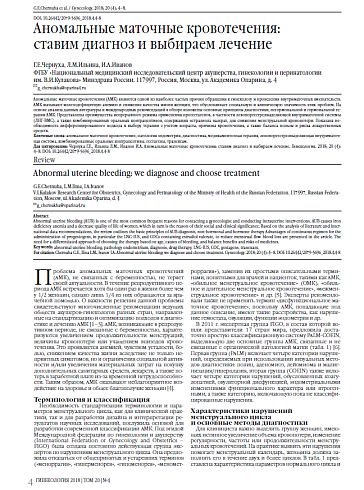
Аномальные маточные кровотечения (АМК) являются одной из наиболее частых причин обращения к гинекологу и проведения внутриматочных вмешательств. АМК вызывают железодефицитную анемию и снижение качества жизни женщин, что обусловливает социальную и клиническую значимость этих проблем. На основе анализа данных литературы и международных рекомендаций в обзоре изложены основные принципы диагностики, негормональной и гормональной терапии АМК. Представлены преимущества непрерывного режима применения прогестагенов, в частности левоноргестрелвыделяющей внутриматочной системы (ЛНГ-ВМС), а также комбинированных оральных контрацептивов, содержащих эстрадиола валерат, для снижения менструальной кровопотери. Показана необходимость дифференцированного подхода к выбору терапии с учетом возраста, причины кровотечения, а также баланса пользы и риска лекарственных средств.
Ключевые слова: аномальное маточное кровотечение, патология эндометрия, диагностика, медикаментозная терапия, левоноргестрелвыделяющая внутриматочная система, комбинированные оральные контрацептивы, гестагены, транексам.
Key words: abnormal uterine bleeding, pathology endometrium, diagnosis, drug therapy, LNG-IUS, COC, gestagens, tranexam.
Ключевые слова: аномальное маточное кровотечение, патология эндометрия, диагностика, медикаментозная терапия, левоноргестрелвыделяющая внутриматочная система, комбинированные оральные контрацептивы, гестагены, транексам.
________________________________________________
Key words: abnormal uterine bleeding, pathology endometrium, diagnosis, drug therapy, LNG-IUS, COC, gestagens, tranexam.
Полный текст
Список литературы
1. American College of Obstetricians and Gynecologists. Management of acute abnormal uterine bleeding in non-pregnant women. Committee Opinion №557. Obstet Gynecol 2013; 121: 891–6.
2. SOGC Practice Bulletin No. 292-Abnormal Uterine Bleeding in Pre-Menopausal Women. Singh S, Best C, Dunn S, Leyland N, Wolfman WL; Clinical practice – Gynaecology Committee. J Obstet Gynaecol Can 2013; 35 (5): 473–5.
3. National Collaborating Centre for Women’s and Children’s Health; National Institute for Health and Clinical Excellence. NICE guideline [NG88]. Heavy menstrual bleeding: assessment and management. March 2018.
4. Jensen JT, Lefebvre P, Laliberté F et al. Cost burden and treatment patterns associated with management of heavy menstrual bleeding. J Womens Health (Larchmt) 2012; 21 (5): 539–47.
5. Woolcock JG, Critchley HO, Munro MG et al. Review of the confusion in current and historical terminology and defnitions for disturbances of menstrual bleeding. Fertil Steril 2008; 90 (6): 2269–80.
6. Munro MG, Critchley HOD, Brode MS, Fraser IS; for the FIGO Working Group on Menstrual Disorders. Intern. Special Communication. FIGO classification system (PALM-COEIN) for causes of abnormal uterine bleeding in nongravid women of reproductive age. J Gynecol Obstet 2011; 113: 3–13.
7. Fraser IS, Critchley HO, Broder M, Munro MG. The FIGO recommendations on terminologies and denitions for normal and abnormal uterine bleeding. Semin Reprod Med 2011; 29 (5): 383–90.
8. Calhoun AH, Gill N. Presenting a New, Non-Hormonally Mediated Cyclic Headache in Women: End-Menstrual Migraine. Headache 2017; 57: 17–20.
9. Sweet MG, Schmidt-Dalton TA, Weiss PM, Madsen KP. Evaluation and management of abnormal uterine bleeding in premenopausal women. Am Fam Physician 2012; 85 (1): 35–4.
10. Goodman NF, Cobin RH, Futterweit W et al. American Association of Clinical Endocrinologists, American College of Endocrinology, Androgen Excess and PCOS Society Disease State Clinical Review: Guide to the Best Practices in the Evaluation and Treatment of Polycystic Ovary Syndrome. PCOS Best Practices, Endocr Pract 2015; 21 (11): 1291–300.
11. Синдром поликистозных яичников в репродуктивном возрасте (современные подходы к диагностике и лечению). Клинические рекомендации (протокол лечения). Письмо Министерства здравоохранения РФ от 10.06.2015 г. №15–4/10/2–2814. / Sindrom polikistoznyh yaichnikov v reproduktivnom vozraste (sovremennye podhody k diagnostike i lecheniyu). Klinicheskie rekomendacii (protokol lecheniya). Pis'mo Ministerstva zdravoohraneniya RF ot 10.06.2015 g. №15–4/10/2–2814. [in Russian]
12. Matteson KA, Rahn DD, Wheeler TL et al. Nonsurgical management of heavy menstrual bleeding: a systematic review. Obstet Gynecol 2013; 121 (3): 632–43.
13. Trelle S, Reichenbach S, Wandel S et al. Cardiovascular safety of non-steroidal anti-inflammatory drugs: network meta-analysis. BMJ 2011; 342: 7086–9.
14. Sundstrom A, Seaman H, Kieler H, Alfredsson L. The risk of venous thromboembolism associated with the use of tranexamic acid and other drugs used to treat menorrhagia; a case-control study using the General Practice Research Database. BJOG 2009; 116: 91–7.
15. Wellington K, Wagstaff AJ. Tranexamic acid: a review of its use in management of menorrhagia. Drugs 2003; 63: 1417–33.
16. Lethaby A, Irvine GA, Cameron IT. Cyclical progestogens for heavy menstrual bleeding. Cochrane Database Syst Rev 2008; 1: CD001016.
17. Hickey M, Higham JM, Fraser I. Progestogens with or without oestrogen for irregular uterine bleeding associated with anovulation. Cochrane Database Syst Rev 2012; 9: CD001895.
18. Lethaby AE, Cooke I, Rees M. Progesterone or progestogen-releasing intrauterine systems for heavy menstrual bleeding. Cochrane Database Syst Rev 2005; 4: CD002126.
19. Farquhar C, Brown J. Oral contraceptive pill for heavy menstrual bleeding. Cochrane Database Syst Rev 2009; 4: CD000154.
20. Cooper K, Lee A, Chien P et al. Outcomes following hysterectomy or endometrial ablation for heavy menstrual bleeding: Retrospective analysis of hospital episode statistics in scotland. BJOG 2011; 118 (10): 1171–9.
21. Farquhar C, Brown J. Oral contraceptive pill for heavy menstrual bleeding. Cochrane Database Syst Rev 2009; 4: CD000154.
22. ACOG practice bulletin no. 110: noncontraceptive uses of hormonal contraceptives. Obstet Gynecol 2010; 115: 206–18.
23. Department of Reproductive Health, World Health Organization. Medical eligibility criteria for contraceptive use. Fifth edition – Executive Summary. Publication date: 2015. WHO reference number: WHO/RHR/15.07.
24. Collaborative Group on Epidemiological Studies on Endometrial Cancer. Endometrial cancer and oral contraceptives: an individual participant meta-analysis of 27 276 women with endometrial cancer from 36 epidemiological studies. Lancet Oncol 2015; 16 (9): 1061–70.
25. Fraser IS, Parke S, Mellinger U et al. Effective treatment of heavy and/or prolonged menstrual bleeding without organic cause: pooled analysis of two multinational, randomised, double-blind, placebo-controlled trials of oestradiol valerate and dienogest. Eur J Contracept Reprod Health Care 2011; 16: 258–26.
26. Di Carlo C, Gargano V, De Rosa N et al. Effects of estradiol valerate and dienogest on quality of life and sexual function according to age. Gynecol Endocrinol 2014; 30 (12): 925–8.
27. Ahrendt HJ, Makalova D, Parke S et al. Bleeding pattern and cycle control with an estradiol-based oral contraceptive: a seven-cycle, randomized comparative trial of estradiol valerate/dienogest and ethinyl estradiol/levonorgestrel. Contraception 2009; 80 (5): 436–44.
28. Briggs P, Serrani M, Vogtländer K, Рarke S. Continuation rates, bleeding profile acceptability, and satisfaction of women using an oral contraceptive pill containing estradiol valerate and dienogest versus a progestogen-only pill after switching from an ethinylestradiol-containing pill in a real-life setting: results of the CONTENT study. Int J Womens Health 2016; 8: 477–87.
29. Nappi RE, Terreno E, Sances G et al. Effect of a contraceptive pill containing estradiol valerate and dienogest (E2V/DNG) in women with menstrually-related migraine (MRM). Contraception 2013; 88 (3): 369–75.
30. Petraglia F, Parke S, Serrani M et al. Estradiol valerate plus dienogest versus ethinylestradiol plus levonorgestrel for the treatment of primary dysmenorrhea. Int J Gynaecol Obstet 2014; 125 (3): 270–4.
31. Macias G, Merki-Feld GS, Parke S et al. Effects of a combined oral contraceptive containing oestradiol valerate/dienogest on hormone withdrawal-associated symptoms: results from the multicentre, randomised, double-blind, active-controlled HARMONY II study. J Obstet Gynaecol 2013; 33: 591–6.
32. Чернуха Г.Е., Ильина Л.М. Воспаление – биологическая основа обильного менструального кровотечения, дисменореи и нарушений ЦНС. Комплексное решение проблемы. Мед. совет. Гинекологическая эндокринология. 2015; с. 20–7. / Chernuha G.E., Ilina L.M. Vospalenie – biologicheskaya osnova obil'nogo menstrual'nogo krovotecheniya, dismenorei i narushenij CNS. Kompleksnoe reshenie problemy. Med. sovet. Ginekologicheskaya endokrinologiya. 2015; s. 20–7. [in Russian]
33. Buhling KJ, Klovekorn L, Daniels B et al. Contraceptive counselling and self-prescription of contraceptives of German gynaecologists: Results of a nationwide survey. Eur J Contracept Reprod Health Care 2014; 19 (6): 448–56.
34. Junge W, Mellinger U, Parke S, Serrani M. Metabolic and haemostatic effects of estradiol valerate/dienogest, a novel oral contraceptive. Clin Drug Investig 2011; 31 (8): 573–84.
35. Dinger J, Minh TD, Heinemann K. Impact of Estrogen Type on Cardiovascular Safety of Combined Oral Contraceptives. Contraception 2016; 94: 328–39.
36. Graziottin A, Zanello PP. Menstruation, inflammation and comorbidities: implications for woman health. Minerva Gynecol 2015; 67: 21–34.
37. Agren UM, Anttila M, Mäenpää-Liukko K et al. Effects of a monophasic combined oral contraceptive containing nomegestrol acetate and 17b-estradiol compared with one containing levonorgestrel and ethinylestradiol on haemostasis, lipids and carbohydrate metabolism. Eur J Contracept Reprod Health Care 2011; 16: 444–57.
2. SOGC Practice Bulletin No. 292-Abnormal Uterine Bleeding in Pre-Menopausal Women. Singh S, Best C, Dunn S, Leyland N, Wolfman WL; Clinical practice – Gynaecology Committee. J Obstet Gynaecol Can 2013; 35 (5): 473–5.
3. National Collaborating Centre for Women’s and Children’s Health; National Institute for Health and Clinical Excellence. NICE guideline [NG88]. Heavy menstrual bleeding: assessment and management. March 2018.
4. Jensen JT, Lefebvre P, Laliberté F et al. Cost burden and treatment patterns associated with management of heavy menstrual bleeding. J Womens Health (Larchmt) 2012; 21 (5): 539–47.
5. Woolcock JG, Critchley HO, Munro MG et al. Review of the confusion in current and historical terminology and defnitions for disturbances of menstrual bleeding. Fertil Steril 2008; 90 (6): 2269–80.
6. Munro MG, Critchley HOD, Brode MS, Fraser IS; for the FIGO Working Group on Menstrual Disorders. Intern. Special Communication. FIGO classification system (PALM-COEIN) for causes of abnormal uterine bleeding in nongravid women of reproductive age. J Gynecol Obstet 2011; 113: 3–13.
7. Fraser IS, Critchley HO, Broder M, Munro MG. The FIGO recommendations on terminologies and denitions for normal and abnormal uterine bleeding. Semin Reprod Med 2011; 29 (5): 383–90.
8. Calhoun AH, Gill N. Presenting a New, Non-Hormonally Mediated Cyclic Headache in Women: End-Menstrual Migraine. Headache 2017; 57: 17–20.
9. Sweet MG, Schmidt-Dalton TA, Weiss PM, Madsen KP. Evaluation and management of abnormal uterine bleeding in premenopausal women. Am Fam Physician 2012; 85 (1): 35–4.
10. Goodman NF, Cobin RH, Futterweit W et al. American Association of Clinical Endocrinologists, American College of Endocrinology, Androgen Excess and PCOS Society Disease State Clinical Review: Guide to the Best Practices in the Evaluation and Treatment of Polycystic Ovary Syndrome. PCOS Best Practices, Endocr Pract 2015; 21 (11): 1291–300.
11. Sindrom polikistoznyh yaichnikov v reproduktivnom vozraste (sovremennye podhody k diagnostike i lecheniyu). Klinicheskie rekomendacii (protokol lecheniya). Pis'mo Ministerstva zdravoohraneniya RF ot 10.06.2015 g. №15–4/10/2–2814. [in Russian]
12. Matteson KA, Rahn DD, Wheeler TL et al. Nonsurgical management of heavy menstrual bleeding: a systematic review. Obstet Gynecol 2013; 121 (3): 632–43.
13. Trelle S, Reichenbach S, Wandel S et al. Cardiovascular safety of non-steroidal anti-inflammatory drugs: network meta-analysis. BMJ 2011; 342: 7086–9.
14. Sundstrom A, Seaman H, Kieler H, Alfredsson L. The risk of venous thromboembolism associated with the use of tranexamic acid and other drugs used to treat menorrhagia; a case-control study using the General Practice Research Database. BJOG 2009; 116: 91–7.
15. Wellington K, Wagstaff AJ. Tranexamic acid: a review of its use in management of menorrhagia. Drugs 2003; 63: 1417–33.
16. Lethaby A, Irvine GA, Cameron IT. Cyclical progestogens for heavy menstrual bleeding. Cochrane Database Syst Rev 2008; 1: CD001016.
17. Hickey M, Higham JM, Fraser I. Progestogens with or without oestrogen for irregular uterine bleeding associated with anovulation. Cochrane Database Syst Rev 2012; 9: CD001895.
18. Lethaby AE, Cooke I, Rees M. Progesterone or progestogen-releasing intrauterine systems for heavy menstrual bleeding. Cochrane Database Syst Rev 2005; 4: CD002126.
19. Farquhar C, Brown J. Oral contraceptive pill for heavy menstrual bleeding. Cochrane Database Syst Rev 2009; 4: CD000154.
20. Cooper K, Lee A, Chien P et al. Outcomes following hysterectomy or endometrial ablation for heavy menstrual bleeding: Retrospective analysis of hospital episode statistics in scotland. BJOG 2011; 118 (10): 1171–9.
21. Farquhar C, Brown J. Oral contraceptive pill for heavy menstrual bleeding. Cochrane Database Syst Rev 2009; 4: CD000154.
22. ACOG practice bulletin no. 110: noncontraceptive uses of hormonal contraceptives. Obstet Gynecol 2010; 115: 206–18.
23. Department of Reproductive Health, World Health Organization. Medical eligibility criteria for contraceptive use. Fifth edition – Executive Summary. Publication date: 2015. WHO reference number: WHO/RHR/15.07.
24. Collaborative Group on Epidemiological Studies on Endometrial Cancer. Endometrial cancer and oral contraceptives: an individual participant meta-analysis of 27 276 women with endometrial cancer from 36 epidemiological studies. Lancet Oncol 2015; 16 (9): 1061–70.
25. Fraser IS, Parke S, Mellinger U et al. Effective treatment of heavy and/or prolonged menstrual bleeding without organic cause: pooled analysis of two multinational, randomised, double-blind, placebo-controlled trials of oestradiol valerate and dienogest. Eur J Contracept Reprod Health Care 2011; 16: 258–26.
26. Di Carlo C, Gargano V, De Rosa N et al. Effects of estradiol valerate and dienogest on quality of life and sexual function according to age. Gynecol Endocrinol 2014; 30 (12): 925–8.
27. Ahrendt HJ, Makalova D, Parke S et al. Bleeding pattern and cycle control with an estradiol-based oral contraceptive: a seven-cycle, randomized comparative trial of estradiol valerate/dienogest and ethinyl estradiol/levonorgestrel. Contraception 2009; 80 (5): 436–44.
28. Briggs P, Serrani M, Vogtländer K, Рarke S. Continuation rates, bleeding profile acceptability, and satisfaction of women using an oral contraceptive pill containing estradiol valerate and dienogest versus a progestogen-only pill after switching from an ethinylestradiol-containing pill in a real-life setting: results of the CONTENT study. Int J Womens Health 2016; 8: 477–87.
29. Nappi RE, Terreno E, Sances G et al. Effect of a contraceptive pill containing estradiol valerate and dienogest (E2V/DNG) in women with menstrually-related migraine (MRM). Contraception 2013; 88 (3): 369–75.
30. Petraglia F, Parke S, Serrani M et al. Estradiol valerate plus dienogest versus ethinylestradiol plus levonorgestrel for the treatment of primary dysmenorrhea. Int J Gynaecol Obstet 2014; 125 (3): 270–4.
31. Macias G, Merki-Feld GS, Parke S et al. Effects of a combined oral contraceptive containing oestradiol valerate/dienogest on hormone withdrawal-associated symptoms: results from the multicentre, randomised, double-blind, active-controlled HARMONY II study. J Obstet Gynaecol 2013; 33: 591–6.
32. Chernuha G.E., Ilina L.M. Vospalenie – biologicheskaya osnova obil'nogo menstrual'nogo krovotecheniya, dismenorei i narushenij CNS. Kompleksnoe reshenie problemy. Med. sovet. Ginekologicheskaya endokrinologiya. 2015; s. 20–7. [in Russian]
33. Buhling KJ, Klovekorn L, Daniels B et al. Contraceptive counselling and self-prescription of contraceptives of German gynaecologists: Results of a nationwide survey. Eur J Contracept Reprod Health Care 2014; 19 (6): 448–56.
34. Junge W, Mellinger U, Parke S, Serrani M. Metabolic and haemostatic effects of estradiol valerate/dienogest, a novel oral contraceptive. Clin Drug Investig 2011; 31 (8): 573–84.
35. Dinger J, Minh TD, Heinemann K. Impact of Estrogen Type on Cardiovascular Safety of Combined Oral Contraceptives. Contraception 2016; 94: 328–39.
36. Graziottin A, Zanello PP. Menstruation, inflammation and comorbidities: implications for woman health. Minerva Gynecol 2015; 67: 21–34.
37. Agren UM, Anttila M, Mäenpää-Liukko K et al. Effects of a monophasic combined oral contraceptive containing nomegestrol acetate and 17b-estradiol compared with one containing levonorgestrel and ethinylestradiol on haemostasis, lipids and carbohydrate metabolism. Eur J Contracept Reprod Health Care 2011; 16: 444–57.
2. SOGC Practice Bulletin No. 292-Abnormal Uterine Bleeding in Pre-Menopausal Women. Singh S, Best C, Dunn S, Leyland N, Wolfman WL; Clinical practice – Gynaecology Committee. J Obstet Gynaecol Can 2013; 35 (5): 473–5.
3. National Collaborating Centre for Women’s and Children’s Health; National Institute for Health and Clinical Excellence. NICE guideline [NG88]. Heavy menstrual bleeding: assessment and management. March 2018.
4. Jensen JT, Lefebvre P, Laliberté F et al. Cost burden and treatment patterns associated with management of heavy menstrual bleeding. J Womens Health (Larchmt) 2012; 21 (5): 539–47.
5. Woolcock JG, Critchley HO, Munro MG et al. Review of the confusion in current and historical terminology and defnitions for disturbances of menstrual bleeding. Fertil Steril 2008; 90 (6): 2269–80.
6. Munro MG, Critchley HOD, Brode MS, Fraser IS; for the FIGO Working Group on Menstrual Disorders. Intern. Special Communication. FIGO classification system (PALM-COEIN) for causes of abnormal uterine bleeding in nongravid women of reproductive age. J Gynecol Obstet 2011; 113: 3–13.
7. Fraser IS, Critchley HO, Broder M, Munro MG. The FIGO recommendations on terminologies and denitions for normal and abnormal uterine bleeding. Semin Reprod Med 2011; 29 (5): 383–90.
8. Calhoun AH, Gill N. Presenting a New, Non-Hormonally Mediated Cyclic Headache in Women: End-Menstrual Migraine. Headache 2017; 57: 17–20.
9. Sweet MG, Schmidt-Dalton TA, Weiss PM, Madsen KP. Evaluation and management of abnormal uterine bleeding in premenopausal women. Am Fam Physician 2012; 85 (1): 35–4.
10. Goodman NF, Cobin RH, Futterweit W et al. American Association of Clinical Endocrinologists, American College of Endocrinology, Androgen Excess and PCOS Society Disease State Clinical Review: Guide to the Best Practices in the Evaluation and Treatment of Polycystic Ovary Syndrome. PCOS Best Practices, Endocr Pract 2015; 21 (11): 1291–300.
11. Синдром поликистозных яичников в репродуктивном возрасте (современные подходы к диагностике и лечению). Клинические рекомендации (протокол лечения). Письмо Министерства здравоохранения РФ от 10.06.2015 г. №15–4/10/2–2814. / Sindrom polikistoznyh yaichnikov v reproduktivnom vozraste (sovremennye podhody k diagnostike i lecheniyu). Klinicheskie rekomendacii (protokol lecheniya). Pis'mo Ministerstva zdravoohraneniya RF ot 10.06.2015 g. №15–4/10/2–2814. [in Russian]
12. Matteson KA, Rahn DD, Wheeler TL et al. Nonsurgical management of heavy menstrual bleeding: a systematic review. Obstet Gynecol 2013; 121 (3): 632–43.
13. Trelle S, Reichenbach S, Wandel S et al. Cardiovascular safety of non-steroidal anti-inflammatory drugs: network meta-analysis. BMJ 2011; 342: 7086–9.
14. Sundstrom A, Seaman H, Kieler H, Alfredsson L. The risk of venous thromboembolism associated with the use of tranexamic acid and other drugs used to treat menorrhagia; a case-control study using the General Practice Research Database. BJOG 2009; 116: 91–7.
15. Wellington K, Wagstaff AJ. Tranexamic acid: a review of its use in management of menorrhagia. Drugs 2003; 63: 1417–33.
16. Lethaby A, Irvine GA, Cameron IT. Cyclical progestogens for heavy menstrual bleeding. Cochrane Database Syst Rev 2008; 1: CD001016.
17. Hickey M, Higham JM, Fraser I. Progestogens with or without oestrogen for irregular uterine bleeding associated with anovulation. Cochrane Database Syst Rev 2012; 9: CD001895.
18. Lethaby AE, Cooke I, Rees M. Progesterone or progestogen-releasing intrauterine systems for heavy menstrual bleeding. Cochrane Database Syst Rev 2005; 4: CD002126.
19. Farquhar C, Brown J. Oral contraceptive pill for heavy menstrual bleeding. Cochrane Database Syst Rev 2009; 4: CD000154.
20. Cooper K, Lee A, Chien P et al. Outcomes following hysterectomy or endometrial ablation for heavy menstrual bleeding: Retrospective analysis of hospital episode statistics in scotland. BJOG 2011; 118 (10): 1171–9.
21. Farquhar C, Brown J. Oral contraceptive pill for heavy menstrual bleeding. Cochrane Database Syst Rev 2009; 4: CD000154.
22. ACOG practice bulletin no. 110: noncontraceptive uses of hormonal contraceptives. Obstet Gynecol 2010; 115: 206–18.
23. Department of Reproductive Health, World Health Organization. Medical eligibility criteria for contraceptive use. Fifth edition – Executive Summary. Publication date: 2015. WHO reference number: WHO/RHR/15.07.
24. Collaborative Group on Epidemiological Studies on Endometrial Cancer. Endometrial cancer and oral contraceptives: an individual participant meta-analysis of 27 276 women with endometrial cancer from 36 epidemiological studies. Lancet Oncol 2015; 16 (9): 1061–70.
25. Fraser IS, Parke S, Mellinger U et al. Effective treatment of heavy and/or prolonged menstrual bleeding without organic cause: pooled analysis of two multinational, randomised, double-blind, placebo-controlled trials of oestradiol valerate and dienogest. Eur J Contracept Reprod Health Care 2011; 16: 258–26.
26. Di Carlo C, Gargano V, De Rosa N et al. Effects of estradiol valerate and dienogest on quality of life and sexual function according to age. Gynecol Endocrinol 2014; 30 (12): 925–8.
27. Ahrendt HJ, Makalova D, Parke S et al. Bleeding pattern and cycle control with an estradiol-based oral contraceptive: a seven-cycle, randomized comparative trial of estradiol valerate/dienogest and ethinyl estradiol/levonorgestrel. Contraception 2009; 80 (5): 436–44.
28. Briggs P, Serrani M, Vogtländer K, Рarke S. Continuation rates, bleeding profile acceptability, and satisfaction of women using an oral contraceptive pill containing estradiol valerate and dienogest versus a progestogen-only pill after switching from an ethinylestradiol-containing pill in a real-life setting: results of the CONTENT study. Int J Womens Health 2016; 8: 477–87.
29. Nappi RE, Terreno E, Sances G et al. Effect of a contraceptive pill containing estradiol valerate and dienogest (E2V/DNG) in women with menstrually-related migraine (MRM). Contraception 2013; 88 (3): 369–75.
30. Petraglia F, Parke S, Serrani M et al. Estradiol valerate plus dienogest versus ethinylestradiol plus levonorgestrel for the treatment of primary dysmenorrhea. Int J Gynaecol Obstet 2014; 125 (3): 270–4.
31. Macias G, Merki-Feld GS, Parke S et al. Effects of a combined oral contraceptive containing oestradiol valerate/dienogest on hormone withdrawal-associated symptoms: results from the multicentre, randomised, double-blind, active-controlled HARMONY II study. J Obstet Gynaecol 2013; 33: 591–6.
32. Чернуха Г.Е., Ильина Л.М. Воспаление – биологическая основа обильного менструального кровотечения, дисменореи и нарушений ЦНС. Комплексное решение проблемы. Мед. совет. Гинекологическая эндокринология. 2015; с. 20–7. / Chernuha G.E., Ilina L.M. Vospalenie – biologicheskaya osnova obil'nogo menstrual'nogo krovotecheniya, dismenorei i narushenij CNS. Kompleksnoe reshenie problemy. Med. sovet. Ginekologicheskaya endokrinologiya. 2015; s. 20–7. [in Russian]
33. Buhling KJ, Klovekorn L, Daniels B et al. Contraceptive counselling and self-prescription of contraceptives of German gynaecologists: Results of a nationwide survey. Eur J Contracept Reprod Health Care 2014; 19 (6): 448–56.
34. Junge W, Mellinger U, Parke S, Serrani M. Metabolic and haemostatic effects of estradiol valerate/dienogest, a novel oral contraceptive. Clin Drug Investig 2011; 31 (8): 573–84.
35. Dinger J, Minh TD, Heinemann K. Impact of Estrogen Type on Cardiovascular Safety of Combined Oral Contraceptives. Contraception 2016; 94: 328–39.
36. Graziottin A, Zanello PP. Menstruation, inflammation and comorbidities: implications for woman health. Minerva Gynecol 2015; 67: 21–34.
37. Agren UM, Anttila M, Mäenpää-Liukko K et al. Effects of a monophasic combined oral contraceptive containing nomegestrol acetate and 17b-estradiol compared with one containing levonorgestrel and ethinylestradiol on haemostasis, lipids and carbohydrate metabolism. Eur J Contracept Reprod Health Care 2011; 16: 444–57.
________________________________________________
2. SOGC Practice Bulletin No. 292-Abnormal Uterine Bleeding in Pre-Menopausal Women. Singh S, Best C, Dunn S, Leyland N, Wolfman WL; Clinical practice – Gynaecology Committee. J Obstet Gynaecol Can 2013; 35 (5): 473–5.
3. National Collaborating Centre for Women’s and Children’s Health; National Institute for Health and Clinical Excellence. NICE guideline [NG88]. Heavy menstrual bleeding: assessment and management. March 2018.
4. Jensen JT, Lefebvre P, Laliberté F et al. Cost burden and treatment patterns associated with management of heavy menstrual bleeding. J Womens Health (Larchmt) 2012; 21 (5): 539–47.
5. Woolcock JG, Critchley HO, Munro MG et al. Review of the confusion in current and historical terminology and defnitions for disturbances of menstrual bleeding. Fertil Steril 2008; 90 (6): 2269–80.
6. Munro MG, Critchley HOD, Brode MS, Fraser IS; for the FIGO Working Group on Menstrual Disorders. Intern. Special Communication. FIGO classification system (PALM-COEIN) for causes of abnormal uterine bleeding in nongravid women of reproductive age. J Gynecol Obstet 2011; 113: 3–13.
7. Fraser IS, Critchley HO, Broder M, Munro MG. The FIGO recommendations on terminologies and denitions for normal and abnormal uterine bleeding. Semin Reprod Med 2011; 29 (5): 383–90.
8. Calhoun AH, Gill N. Presenting a New, Non-Hormonally Mediated Cyclic Headache in Women: End-Menstrual Migraine. Headache 2017; 57: 17–20.
9. Sweet MG, Schmidt-Dalton TA, Weiss PM, Madsen KP. Evaluation and management of abnormal uterine bleeding in premenopausal women. Am Fam Physician 2012; 85 (1): 35–4.
10. Goodman NF, Cobin RH, Futterweit W et al. American Association of Clinical Endocrinologists, American College of Endocrinology, Androgen Excess and PCOS Society Disease State Clinical Review: Guide to the Best Practices in the Evaluation and Treatment of Polycystic Ovary Syndrome. PCOS Best Practices, Endocr Pract 2015; 21 (11): 1291–300.
11. Sindrom polikistoznyh yaichnikov v reproduktivnom vozraste (sovremennye podhody k diagnostike i lecheniyu). Klinicheskie rekomendacii (protokol lecheniya). Pis'mo Ministerstva zdravoohraneniya RF ot 10.06.2015 g. №15–4/10/2–2814. [in Russian]
12. Matteson KA, Rahn DD, Wheeler TL et al. Nonsurgical management of heavy menstrual bleeding: a systematic review. Obstet Gynecol 2013; 121 (3): 632–43.
13. Trelle S, Reichenbach S, Wandel S et al. Cardiovascular safety of non-steroidal anti-inflammatory drugs: network meta-analysis. BMJ 2011; 342: 7086–9.
14. Sundstrom A, Seaman H, Kieler H, Alfredsson L. The risk of venous thromboembolism associated with the use of tranexamic acid and other drugs used to treat menorrhagia; a case-control study using the General Practice Research Database. BJOG 2009; 116: 91–7.
15. Wellington K, Wagstaff AJ. Tranexamic acid: a review of its use in management of menorrhagia. Drugs 2003; 63: 1417–33.
16. Lethaby A, Irvine GA, Cameron IT. Cyclical progestogens for heavy menstrual bleeding. Cochrane Database Syst Rev 2008; 1: CD001016.
17. Hickey M, Higham JM, Fraser I. Progestogens with or without oestrogen for irregular uterine bleeding associated with anovulation. Cochrane Database Syst Rev 2012; 9: CD001895.
18. Lethaby AE, Cooke I, Rees M. Progesterone or progestogen-releasing intrauterine systems for heavy menstrual bleeding. Cochrane Database Syst Rev 2005; 4: CD002126.
19. Farquhar C, Brown J. Oral contraceptive pill for heavy menstrual bleeding. Cochrane Database Syst Rev 2009; 4: CD000154.
20. Cooper K, Lee A, Chien P et al. Outcomes following hysterectomy or endometrial ablation for heavy menstrual bleeding: Retrospective analysis of hospital episode statistics in scotland. BJOG 2011; 118 (10): 1171–9.
21. Farquhar C, Brown J. Oral contraceptive pill for heavy menstrual bleeding. Cochrane Database Syst Rev 2009; 4: CD000154.
22. ACOG practice bulletin no. 110: noncontraceptive uses of hormonal contraceptives. Obstet Gynecol 2010; 115: 206–18.
23. Department of Reproductive Health, World Health Organization. Medical eligibility criteria for contraceptive use. Fifth edition – Executive Summary. Publication date: 2015. WHO reference number: WHO/RHR/15.07.
24. Collaborative Group on Epidemiological Studies on Endometrial Cancer. Endometrial cancer and oral contraceptives: an individual participant meta-analysis of 27 276 women with endometrial cancer from 36 epidemiological studies. Lancet Oncol 2015; 16 (9): 1061–70.
25. Fraser IS, Parke S, Mellinger U et al. Effective treatment of heavy and/or prolonged menstrual bleeding without organic cause: pooled analysis of two multinational, randomised, double-blind, placebo-controlled trials of oestradiol valerate and dienogest. Eur J Contracept Reprod Health Care 2011; 16: 258–26.
26. Di Carlo C, Gargano V, De Rosa N et al. Effects of estradiol valerate and dienogest on quality of life and sexual function according to age. Gynecol Endocrinol 2014; 30 (12): 925–8.
27. Ahrendt HJ, Makalova D, Parke S et al. Bleeding pattern and cycle control with an estradiol-based oral contraceptive: a seven-cycle, randomized comparative trial of estradiol valerate/dienogest and ethinyl estradiol/levonorgestrel. Contraception 2009; 80 (5): 436–44.
28. Briggs P, Serrani M, Vogtländer K, Рarke S. Continuation rates, bleeding profile acceptability, and satisfaction of women using an oral contraceptive pill containing estradiol valerate and dienogest versus a progestogen-only pill after switching from an ethinylestradiol-containing pill in a real-life setting: results of the CONTENT study. Int J Womens Health 2016; 8: 477–87.
29. Nappi RE, Terreno E, Sances G et al. Effect of a contraceptive pill containing estradiol valerate and dienogest (E2V/DNG) in women with menstrually-related migraine (MRM). Contraception 2013; 88 (3): 369–75.
30. Petraglia F, Parke S, Serrani M et al. Estradiol valerate plus dienogest versus ethinylestradiol plus levonorgestrel for the treatment of primary dysmenorrhea. Int J Gynaecol Obstet 2014; 125 (3): 270–4.
31. Macias G, Merki-Feld GS, Parke S et al. Effects of a combined oral contraceptive containing oestradiol valerate/dienogest on hormone withdrawal-associated symptoms: results from the multicentre, randomised, double-blind, active-controlled HARMONY II study. J Obstet Gynaecol 2013; 33: 591–6.
32. Chernuha G.E., Ilina L.M. Vospalenie – biologicheskaya osnova obil'nogo menstrual'nogo krovotecheniya, dismenorei i narushenij CNS. Kompleksnoe reshenie problemy. Med. sovet. Ginekologicheskaya endokrinologiya. 2015; s. 20–7. [in Russian]
33. Buhling KJ, Klovekorn L, Daniels B et al. Contraceptive counselling and self-prescription of contraceptives of German gynaecologists: Results of a nationwide survey. Eur J Contracept Reprod Health Care 2014; 19 (6): 448–56.
34. Junge W, Mellinger U, Parke S, Serrani M. Metabolic and haemostatic effects of estradiol valerate/dienogest, a novel oral contraceptive. Clin Drug Investig 2011; 31 (8): 573–84.
35. Dinger J, Minh TD, Heinemann K. Impact of Estrogen Type on Cardiovascular Safety of Combined Oral Contraceptives. Contraception 2016; 94: 328–39.
36. Graziottin A, Zanello PP. Menstruation, inflammation and comorbidities: implications for woman health. Minerva Gynecol 2015; 67: 21–34.
37. Agren UM, Anttila M, Mäenpää-Liukko K et al. Effects of a monophasic combined oral contraceptive containing nomegestrol acetate and 17b-estradiol compared with one containing levonorgestrel and ethinylestradiol on haemostasis, lipids and carbohydrate metabolism. Eur J Contracept Reprod Health Care 2011; 16: 444–57.
Авторы
Г.Е.Чернуха, Л.М.Ильина, И.А.Иванов
ФГБУ «Национальный медицинский исследовательский центр акушерства, гинекологии и перинатологии им. В.И.Кулакова» Минздрава России. 117997, Россия, Москва, ул. Академика Опарина, д. 4
*g_chernukha@oparina4.ru
V.I.Kulakov Research Center for Obstetrics, Gynecology and Perinatology of the Ministry of Health of the Russian Federation. 117997, Russian Federation, Moscow, ul. Akademika Oparina, d. 4
*g_chernukha@oparina4.ru
ФГБУ «Национальный медицинский исследовательский центр акушерства, гинекологии и перинатологии им. В.И.Кулакова» Минздрава России. 117997, Россия, Москва, ул. Академика Опарина, д. 4
*g_chernukha@oparina4.ru
________________________________________________
V.I.Kulakov Research Center for Obstetrics, Gynecology and Perinatology of the Ministry of Health of the Russian Federation. 117997, Russian Federation, Moscow, ul. Akademika Oparina, d. 4
*g_chernukha@oparina4.ru
Цель портала OmniDoctor – предоставление профессиональной информации врачам, провизорам и фармацевтам.