

Материалы доступны только для специалистов сферы здравоохранения.
Чтобы посмотреть материал полностью
Авторизуйтесь
или зарегистрируйтесь.
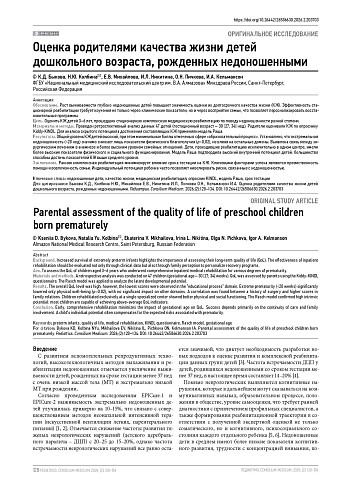
Оценка родителями качества жизни детей дошкольного возраста, рожденных недоношенными
Оценка родителями качества жизни детей дошкольного возраста, рожденных недоношенными
Быкова К.Д., Колбина Н.Ю., Михайлова Е.В., Никитина И.Л., Пичкова О.Н., Кельмансон И.А. Оценка родителями качества жизни детей дошкольного возраста, рожденных недоношенными. Педиатрия. Consilium Medicum. 2026;(2):128–134. DOI: 10.26442/26586630.2026.2.203703
________________________________________________
Материалы доступны только для специалистов сферы здравоохранения.
Чтобы посмотреть материал полностью
Авторизуйтесь
или зарегистрируйтесь.
Аннотация
Обоснование. Рост выживаемости глубоко недоношенных детей повышает значимость оценки их долгосрочного качества жизни (КЖ). Эффективность стационарной реабилитации требует изучения не только через клинические показатели, но и через восприятие семьи, что позволяет персонализировать восстановительные программы.
Цель. Оценить КЖ детей 3–6 лет, прошедших стационарную комплексную медицинскую реабилитацию по поводу недоношенности разной степени.
Материалы и методы. Проведен ретроспективный анализ данных 47 детей (гестационный возраст – 30 [27; 34] нед). Родители оценивали КЖ по опроснику Kiddy-KINDL. Для анализа скрытого потенциала достижения составляющих КЖ применяли модель Раша.
Результаты. Общий уровень КЖ детей высокий, при этом минимальные баллы отмечены в сфере «образовательный процесс». Установлено, что экстремальная недоношенность (<28 нед) значимо снижает лишь показатели физического благополучия (p=0,02), не влияя на остальные домены. Выявлена связь между хирургическим лечением в анамнезе и более высоким уровнем семейных отношений. Дети, проходившие реабилитацию исключительно в одном центре, имели более высокие показатели физического и социального функционирования. Модель Раша подтвердила высокий внутренний потенциал детей: большинство способны достичь показателей КЖ выше среднего уровня.
Заключение. Ранняя комплексная реабилитация минимизирует влияние срока гестации на КЖ. Ключевыми факторами успеха являются преемственность помощи и вовлеченность семьи. Индивидуальный потенциал ребенка часто позволяет нивелировать риски, связанные с недоношенностью.
Ключевые слова: недоношенные дети, качество жизни, медицинская реабилитация, опросник KINDL, модель Раша, срок гестации
Aim. To assess the QoL of children aged 3–6 years who underwent comprehensive inpatient medical rehabilitation for various degrees of prematurity.
Materials and methods. A retrospective analysis was conducted on 47 children (gestational age – 30 [27; 34] weeks). QoL was assessed by parents using the Kiddy-KINDL questionnaire. The Rasch model was applied to analyze the latent developmental potential.
Results. The overall QoL level was high; however, the lowest scores were observed in the "educational process" domain. Extreme prematurity (<28 weeks) significantly lowered only physical well-being (p=0.02), with no significant impact on other domains. A correlation was found between a history of surgery and higher scores in family relations. Children rehabilitated exclusively at a single specialized center showed better physical and social functioning. The Rasch model confirmed high intrinsic potential: most children are capable of achieving above-average QoL indicators.
Conclusion. Early, comprehensive rehabilitation minimizes the impact of gestational age on QoL. Success depends primarily on the continuity of care and family involvement. A child's individual potential often compensates for the expected risks associated with prematurity.
Keywords: preterm infants, quality of life, medical rehabilitation, KINDL questionnaire, Rasch model, gestational age
Цель. Оценить КЖ детей 3–6 лет, прошедших стационарную комплексную медицинскую реабилитацию по поводу недоношенности разной степени.
Материалы и методы. Проведен ретроспективный анализ данных 47 детей (гестационный возраст – 30 [27; 34] нед). Родители оценивали КЖ по опроснику Kiddy-KINDL. Для анализа скрытого потенциала достижения составляющих КЖ применяли модель Раша.
Результаты. Общий уровень КЖ детей высокий, при этом минимальные баллы отмечены в сфере «образовательный процесс». Установлено, что экстремальная недоношенность (<28 нед) значимо снижает лишь показатели физического благополучия (p=0,02), не влияя на остальные домены. Выявлена связь между хирургическим лечением в анамнезе и более высоким уровнем семейных отношений. Дети, проходившие реабилитацию исключительно в одном центре, имели более высокие показатели физического и социального функционирования. Модель Раша подтвердила высокий внутренний потенциал детей: большинство способны достичь показателей КЖ выше среднего уровня.
Заключение. Ранняя комплексная реабилитация минимизирует влияние срока гестации на КЖ. Ключевыми факторами успеха являются преемственность помощи и вовлеченность семьи. Индивидуальный потенциал ребенка часто позволяет нивелировать риски, связанные с недоношенностью.
Ключевые слова: недоношенные дети, качество жизни, медицинская реабилитация, опросник KINDL, модель Раша, срок гестации
________________________________________________
Aim. To assess the QoL of children aged 3–6 years who underwent comprehensive inpatient medical rehabilitation for various degrees of prematurity.
Materials and methods. A retrospective analysis was conducted on 47 children (gestational age – 30 [27; 34] weeks). QoL was assessed by parents using the Kiddy-KINDL questionnaire. The Rasch model was applied to analyze the latent developmental potential.
Results. The overall QoL level was high; however, the lowest scores were observed in the "educational process" domain. Extreme prematurity (<28 weeks) significantly lowered only physical well-being (p=0.02), with no significant impact on other domains. A correlation was found between a history of surgery and higher scores in family relations. Children rehabilitated exclusively at a single specialized center showed better physical and social functioning. The Rasch model confirmed high intrinsic potential: most children are capable of achieving above-average QoL indicators.
Conclusion. Early, comprehensive rehabilitation minimizes the impact of gestational age on QoL. Success depends primarily on the continuity of care and family involvement. A child's individual potential often compensates for the expected risks associated with prematurity.
Keywords: preterm infants, quality of life, medical rehabilitation, KINDL questionnaire, Rasch model, gestational age
Характеристики
| Авторы | Быкова К.Д. / Колбина Н.Ю. / Михайлова Е.В. / Никитина И.Л. и др. |
Полный текст
Список литературы
1. Costeloe KL, Hennessy EM, Haider S, et al. Short term outcomes after extreme preterm birth in England: comparison of two birth cohorts in 1995 and 2006 (the EPICure studies). BMJ. 2012;345:e7976. DOI:10.1136/bmj.e7976
2. Hutchinson EA, De Luca CR, Doyle LW, et al. School-age outcomes of extremely preterm or extremely low birth weight children. Pediatrics. 2013;131(4):e1053-61. DOI:10.1542/peds.2012-2311
3. Цечоева Т.К., Бурдукова Ю.А., Ленюшкина А.А., Дегтярев Д.Н. Сопоставление методов оценки психомоторного развития недоношенных детей, родившихся с экстремально низкой и очень низкой массой тела. Неонатология: Новости. Мнения. Обучение. 2025;13(1):32-40 [Tsechoeva TK, Burdukova YuA, Lenyushkina AA, Degtyarev DN. Comparison of methods for assessing the psychomotor development of preterm infants born with extremely low birth weight and very low birth weight. Neonatology: News, Opinions, Training. 2025;13(1):32-40 (in Russian)]. DOI:10.33029/2308-2402-2025-13-1-32-40
4. Song IG. Neurodevelopmental outcomes of preterm infants. Clin Exp Pediatr. 2023;66(7):281-7. DOI:10.3345/cep.2022.00822
5. Hee Chung E, Chou J, Brown KA. Neurodevelopmental outcomes of preterm infants: a recent literature review. Transl Pediatr. 2020;9(Suppl. 1):S3-8. DOI:10.21037/tp.2019.09.10
6. Bhutta AT, Cleves MA, Casey PH, et al. Cognitive and behavioral outcomes of school-aged children who were born preterm: a meta-analysis. JAMA. 2002;288(6):728-37. DOI:10.1001/jama.288.6.728
7. Cooke RW, Marlow N, Anderson V, et al. Neurologic and developmental disability after extremely preterm birth. N Engl J Med. 2005;1:9-19. DOI:10.1056/NEJMoa041367
8. Spittle A, Orton J, Anderson PJ, et al. Early developmental intervention programmes provided post hospital discharge to prevent motor and cognitive impairment in preterm infants. Cochrane Database Syst Rev. 2015;2015(11):CD005495. DOI:10.1002/14651858.CD005495.pub4
9. Zhang X, Kurtz M, Lee SY, Liu H. Early Intervention for Preterm Infants and Their Mothers: A Systematic Review. J Perinat Neonatal Nurs. 2021;35(4):E69-82. DOI:10.1097/JPN.0000000000000065
10. Ворошилина К.И., Ровда Ю.И. Качество жизни недоношенных детей, рожденных с низкой, очень низкой и экстремально низкой массой тела в 12-месячном скорректированном возрасте. Современные проблемы науки и образования. 2013;(5). Режим доступа: https://science-education.ru/article/view?id=23148. Ссылка активна на 12.01.2026 [Voroshilina KI, Rovda IuI. Kachestvo zhizni nedonoshennykh detei, rozhdennykh s nizkoi, ochen' nizkoi i ekstremal'no nizkoi massoi tela v 12-mesiachnom skorrektirovannom vozraste. Sovremennye problemy nauki i obrazovaniia. 2013;(5). Available at: https://science-education.ru/article/view?id=23148. Accessed: 12.01.2026 (in Russian)].
11. The World Health Organization Quality of Life assessment (WHOQOL): position paper from the World Health Organization. Soc Sci Med. 1995;41(10):1403-9. DOI:10.1016/0277-9536(95)00112-k
12. Gimigliano F, Negrini S. The World Health Organization "rehabilitation 2030: a call for action". Eur J Phys Rehabil Med. 2017;53(2):155-68.
13. Haile SR, Peralta GP, Adams M, et al. Health-related quality of life in children and adolescents born very preterm and its correlates: a cross-sectional study. BMJ Paediatr Open. 2024;8(1):bmjpo-2024-002885. DOI:10.1136/bmjpo-2024-002885
14. Vieira ME, Linhares MB. Quality of life of individuals born preterm: a systematic review of assessment approaches. Qual Life Res. 2016;25(9):2123-39. DOI:10.1007/s11136-016-1259-9
15. Панкратьева Л.Л., Володин Н.Н. Методологические проблемы реабилитации недоношенных детей. Педиатрия. Журнал им. Г.Н. Сперанского. 2019;98(2):14-8 [Pankrateva LL, Volodin NN. Methodological problems of rehabilitation of premature children. Pediatria named after G.N. Speransky. 2019;98(2):14-18 (in Russian)]. DOI:10.24110/0031-403X-2019-98-2-114-121
16. Щербатюк Е.С., Хмилевская С.А., Зрячкин Н.И. Особенности состояния здоровья и проблемы реабилитации детей раннего возраста, родившихся с экстремально низкой и очень низкой массой тела (обзор). Самарский научный медицинский журнал. 2017;13(2):245-51 [Scherbatyuk ES, Khmilevskaya SA, Zryachkin NI. Issues on health status and rehabilitation of young children born with extremely low and very low weight (review). Saratov Journal of Medical Scientific Research. 2017;13(2):245-51 (in Russian)].
17. KINDL-R Questionnaire. Manual. Available at: https://www.kindl.org/english/questionnaires/implementation-manual/. Accessed: 12.01.2026.
18. Natarajan G, Shankaran S. Short- and Long-Term Outcomes of Moderate and Late Preterm Infants. Am J Perinatol. 2016;33(3):305-17. DOI:10.1055/s-0035-1571150
19. Pinquart M. Associations of parenting dimensions and styles with externalizing problems of children and adolescents: an updated meta-analysis. Dev Psychol. 2017;53(5):873-932. DOI:10.1037/dev0000295
20. Treyvaud K, Anderson V, Howard K, et al. Parenting behavior at 2 years predicts school-age performance at 7 years in very preterm children. J Child Psychol Psychiatry. 2016;57(7):814-21. DOI:10.1111/jcpp.12489
21. Feldman R, Eidelman AI, Sirota L, Weller A. Comparison of skin-to-skin (kangaroo) and traditional care: parenting outcomes and preterm infant development. Pediatrics. 2002;110(1 Pt 1):16-26. DOI:10.1542/peds.110.1.16
22. Anderson PJ, Doyle LW. Cognitive and educational deficits in children born extremely preterm. Semin Perinatol. 2008;32(1):51-8. DOI:10.1053/j.semperi.2007.12.009
23. Kelmanson IA, Adulas EI. Massage therapy and sleep behaviour in infants born with low birth weight. Complement Ther Clin Pract. 2006;12(3):200-5. DOI:10.1016/j.ctcp.2005.11.007
24. Kelmanson I, Adulas E. Massage interventions and developmental skills in infants born with low birth weight. Early Child Development and Care. 2008;179(7):889-97. DOI:10.1080/03004430701538794
25. Orton J, Spittle A, Doyle L, et al. Do early intervention programmes improve cognitive and motor outcomes for preterm infants after discharge? A systematic review. Dev Med Child Neurol. 2009;51(11):851-9. DOI:10.1111/j.1469-8749.2009.03414.x
26. Vanderveen JA, Bassler D, Robertson CM, Kirpalani H. Early interventions involving parents to improve neurodevelopmental outcomes of premature infants: a meta-analysis. J Perinatol. 2009;29(5):343-51. DOI:10.1038/jp.2008.229
2. Hutchinson EA, De Luca CR, Doyle LW, et al. School-age outcomes of extremely preterm or extremely low birth weight children. Pediatrics. 2013;131(4):e1053-61. DOI:10.1542/peds.2012-2311
3. Tsechoeva TK, Burdukova YuA, Lenyushkina AA, Degtyarev DN. Comparison of methods for assessing the psychomotor development of preterm infants born with extremely low birth weight and very low birth weight. Neonatology: News, Opinions, Training. 2025;13(1):32-40 (in Russian). DOI:10.33029/2308-2402-2025-13-1-32-40
4. Song IG. Neurodevelopmental outcomes of preterm infants. Clin Exp Pediatr. 2023;66(7):281-7. DOI:10.3345/cep.2022.00822
5. Hee Chung E, Chou J, Brown KA. Neurodevelopmental outcomes of preterm infants: a recent literature review. Transl Pediatr. 2020;9(Suppl. 1):S3-8. DOI:10.21037/tp.2019.09.10
6. Bhutta AT, Cleves MA, Casey PH, et al. Cognitive and behavioral outcomes of school-aged children who were born preterm: a meta-analysis. JAMA. 2002;288(6):728-37. DOI:10.1001/jama.288.6.728
7. Cooke RW, Marlow N, Anderson V, et al. Neurologic and developmental disability after extremely preterm birth. N Engl J Med. 2005;1:9-19. DOI:10.1056/NEJMoa041367
8. Spittle A, Orton J, Anderson PJ, et al. Early developmental intervention programmes provided post hospital discharge to prevent motor and cognitive impairment in preterm infants. Cochrane Database Syst Rev. 2015;2015(11):CD005495. DOI:10.1002/14651858.CD005495.pub4
9. Zhang X, Kurtz M, Lee SY, Liu H. Early Intervention for Preterm Infants and Their Mothers: A Systematic Review. J Perinat Neonatal Nurs. 2021;35(4):E69-82. DOI:10.1097/JPN.0000000000000065
10. Voroshilina KI, Rovda IuI. Kachestvo zhizni nedonoshennykh detei, rozhdennykh s nizkoi, ochen' nizkoi i ekstremal'no nizkoi massoi tela v 12-mesiachnom skorrektirovannom vozraste. Sovremennye problemy nauki i obrazovaniia. 2013;(5). Available at: https://science-education.ru/article/view?id=23148. Accessed: 12.01.2026 (in Russian).
11. The World Health Organization Quality of Life assessment (WHOQOL): position paper from the World Health Organization. Soc Sci Med. 1995;41(10):1403-9. DOI:10.1016/0277-9536(95)00112-k
12. Gimigliano F, Negrini S. The World Health Organization "rehabilitation 2030: a call for action". Eur J Phys Rehabil Med. 2017;53(2):155-68.
13. Haile SR, Peralta GP, Adams M, et al. Health-related quality of life in children and adolescents born very preterm and its correlates: a cross-sectional study. BMJ Paediatr Open. 2024;8(1):bmjpo-2024-002885. DOI:10.1136/bmjpo-2024-002885
14. Vieira ME, Linhares MB. Quality of life of individuals born preterm: a systematic review of assessment approaches. Qual Life Res. 2016;25(9):2123-39. DOI:10.1007/s11136-016-1259-9
15. Pankrateva LL, Volodin NN. Methodological problems of rehabilitation of premature children. Pediatria named after G.N. Speransky. 2019;98(2):14-18 (in Russian). DOI:10.24110/0031-403X-2019-98-2-114-121
16. Scherbatyuk ES, Khmilevskaya SA, Zryachkin NI. Issues on health status and rehabilitation of young children born with extremely low and very low weight (review). Saratov Journal of Medical Scientific Research. 2017;13(2):245-51 (in Russian).
17. KINDL-R Questionnaire. Manual. Available at: https://www.kindl.org/english/questionnaires/implementation-manual/. Accessed: 12.01.2026.
18. Natarajan G, Shankaran S. Short- and Long-Term Outcomes of Moderate and Late Preterm Infants. Am J Perinatol. 2016;33(3):305-17. DOI:10.1055/s-0035-1571150
19. Pinquart M. Associations of parenting dimensions and styles with externalizing problems of children and adolescents: an updated meta-analysis. Dev Psychol. 2017;53(5):873-932. DOI:10.1037/dev0000295
20. Treyvaud K, Anderson V, Howard K, et al. Parenting behavior at 2 years predicts school-age performance at 7 years in very preterm children. J Child Psychol Psychiatry. 2016;57(7):814-21. DOI:10.1111/jcpp.12489
21. Feldman R, Eidelman AI, Sirota L, Weller A. Comparison of skin-to-skin (kangaroo) and traditional care: parenting outcomes and preterm infant development. Pediatrics. 2002;110(1 Pt 1):16-26. DOI:10.1542/peds.110.1.16
22. Anderson PJ, Doyle LW. Cognitive and educational deficits in children born extremely preterm. Semin Perinatol. 2008;32(1):51-8. DOI:10.1053/j.semperi.2007.12.009
23. Kelmanson IA, Adulas EI. Massage therapy and sleep behaviour in infants born with low birth weight. Complement Ther Clin Pract. 2006;12(3):200-5. DOI:10.1016/j.ctcp.2005.11.007
24. Kelmanson I, Adulas E. Massage interventions and developmental skills in infants born with low birth weight. Early Child Development and Care. 2008;179(7):889-97. DOI:10.1080/03004430701538794
25. Orton J, Spittle A, Doyle L, et al. Do early intervention programmes improve cognitive and motor outcomes for preterm infants after discharge? A systematic review. Dev Med Child Neurol. 2009;51(11):851-9. DOI:10.1111/j.1469-8749.2009.03414.x
26. Vanderveen JA, Bassler D, Robertson CM, Kirpalani H. Early interventions involving parents to improve neurodevelopmental outcomes of premature infants: a meta-analysis. J Perinatol. 2009;29(5):343-51. DOI:10.1038/jp.2008.229
2. Hutchinson EA, De Luca CR, Doyle LW, et al. School-age outcomes of extremely preterm or extremely low birth weight children. Pediatrics. 2013;131(4):e1053-61. DOI:10.1542/peds.2012-2311
3. Цечоева Т.К., Бурдукова Ю.А., Ленюшкина А.А., Дегтярев Д.Н. Сопоставление методов оценки психомоторного развития недоношенных детей, родившихся с экстремально низкой и очень низкой массой тела. Неонатология: Новости. Мнения. Обучение. 2025;13(1):32-40 [Tsechoeva TK, Burdukova YuA, Lenyushkina AA, Degtyarev DN. Comparison of methods for assessing the psychomotor development of preterm infants born with extremely low birth weight and very low birth weight. Neonatology: News, Opinions, Training. 2025;13(1):32-40 (in Russian)]. DOI:10.33029/2308-2402-2025-13-1-32-40
4. Song IG. Neurodevelopmental outcomes of preterm infants. Clin Exp Pediatr. 2023;66(7):281-7. DOI:10.3345/cep.2022.00822
5. Hee Chung E, Chou J, Brown KA. Neurodevelopmental outcomes of preterm infants: a recent literature review. Transl Pediatr. 2020;9(Suppl. 1):S3-8. DOI:10.21037/tp.2019.09.10
6. Bhutta AT, Cleves MA, Casey PH, et al. Cognitive and behavioral outcomes of school-aged children who were born preterm: a meta-analysis. JAMA. 2002;288(6):728-37. DOI:10.1001/jama.288.6.728
7. Cooke RW, Marlow N, Anderson V, et al. Neurologic and developmental disability after extremely preterm birth. N Engl J Med. 2005;1:9-19. DOI:10.1056/NEJMoa041367
8. Spittle A, Orton J, Anderson PJ, et al. Early developmental intervention programmes provided post hospital discharge to prevent motor and cognitive impairment in preterm infants. Cochrane Database Syst Rev. 2015;2015(11):CD005495. DOI:10.1002/14651858.CD005495.pub4
9. Zhang X, Kurtz M, Lee SY, Liu H. Early Intervention for Preterm Infants and Their Mothers: A Systematic Review. J Perinat Neonatal Nurs. 2021;35(4):E69-82. DOI:10.1097/JPN.0000000000000065
10. Ворошилина К.И., Ровда Ю.И. Качество жизни недоношенных детей, рожденных с низкой, очень низкой и экстремально низкой массой тела в 12-месячном скорректированном возрасте. Современные проблемы науки и образования. 2013;(5). Режим доступа: https://science-education.ru/article/view?id=23148. Ссылка активна на 12.01.2026 [Voroshilina KI, Rovda IuI. Kachestvo zhizni nedonoshennykh detei, rozhdennykh s nizkoi, ochen' nizkoi i ekstremal'no nizkoi massoi tela v 12-mesiachnom skorrektirovannom vozraste. Sovremennye problemy nauki i obrazovaniia. 2013;(5). Available at: https://science-education.ru/article/view?id=23148. Accessed: 12.01.2026 (in Russian)].
11. The World Health Organization Quality of Life assessment (WHOQOL): position paper from the World Health Organization. Soc Sci Med. 1995;41(10):1403-9. DOI:10.1016/0277-9536(95)00112-k
12. Gimigliano F, Negrini S. The World Health Organization "rehabilitation 2030: a call for action". Eur J Phys Rehabil Med. 2017;53(2):155-68.
13. Haile SR, Peralta GP, Adams M, et al. Health-related quality of life in children and adolescents born very preterm and its correlates: a cross-sectional study. BMJ Paediatr Open. 2024;8(1):bmjpo-2024-002885. DOI:10.1136/bmjpo-2024-002885
14. Vieira ME, Linhares MB. Quality of life of individuals born preterm: a systematic review of assessment approaches. Qual Life Res. 2016;25(9):2123-39. DOI:10.1007/s11136-016-1259-9
15. Панкратьева Л.Л., Володин Н.Н. Методологические проблемы реабилитации недоношенных детей. Педиатрия. Журнал им. Г.Н. Сперанского. 2019;98(2):14-8 [Pankrateva LL, Volodin NN. Methodological problems of rehabilitation of premature children. Pediatria named after G.N. Speransky. 2019;98(2):14-18 (in Russian)]. DOI:10.24110/0031-403X-2019-98-2-114-121
16. Щербатюк Е.С., Хмилевская С.А., Зрячкин Н.И. Особенности состояния здоровья и проблемы реабилитации детей раннего возраста, родившихся с экстремально низкой и очень низкой массой тела (обзор). Самарский научный медицинский журнал. 2017;13(2):245-51 [Scherbatyuk ES, Khmilevskaya SA, Zryachkin NI. Issues on health status and rehabilitation of young children born with extremely low and very low weight (review). Saratov Journal of Medical Scientific Research. 2017;13(2):245-51 (in Russian)].
17. KINDL-R Questionnaire. Manual. Available at: https://www.kindl.org/english/questionnaires/implementation-manual/. Accessed: 12.01.2026.
18. Natarajan G, Shankaran S. Short- and Long-Term Outcomes of Moderate and Late Preterm Infants. Am J Perinatol. 2016;33(3):305-17. DOI:10.1055/s-0035-1571150
19. Pinquart M. Associations of parenting dimensions and styles with externalizing problems of children and adolescents: an updated meta-analysis. Dev Psychol. 2017;53(5):873-932. DOI:10.1037/dev0000295
20. Treyvaud K, Anderson V, Howard K, et al. Parenting behavior at 2 years predicts school-age performance at 7 years in very preterm children. J Child Psychol Psychiatry. 2016;57(7):814-21. DOI:10.1111/jcpp.12489
21. Feldman R, Eidelman AI, Sirota L, Weller A. Comparison of skin-to-skin (kangaroo) and traditional care: parenting outcomes and preterm infant development. Pediatrics. 2002;110(1 Pt 1):16-26. DOI:10.1542/peds.110.1.16
22. Anderson PJ, Doyle LW. Cognitive and educational deficits in children born extremely preterm. Semin Perinatol. 2008;32(1):51-8. DOI:10.1053/j.semperi.2007.12.009
23. Kelmanson IA, Adulas EI. Massage therapy and sleep behaviour in infants born with low birth weight. Complement Ther Clin Pract. 2006;12(3):200-5. DOI:10.1016/j.ctcp.2005.11.007
24. Kelmanson I, Adulas E. Massage interventions and developmental skills in infants born with low birth weight. Early Child Development and Care. 2008;179(7):889-97. DOI:10.1080/03004430701538794
25. Orton J, Spittle A, Doyle L, et al. Do early intervention programmes improve cognitive and motor outcomes for preterm infants after discharge? A systematic review. Dev Med Child Neurol. 2009;51(11):851-9. DOI:10.1111/j.1469-8749.2009.03414.x
26. Vanderveen JA, Bassler D, Robertson CM, Kirpalani H. Early interventions involving parents to improve neurodevelopmental outcomes of premature infants: a meta-analysis. J Perinatol. 2009;29(5):343-51. DOI:10.1038/jp.2008.229
________________________________________________
2. Hutchinson EA, De Luca CR, Doyle LW, et al. School-age outcomes of extremely preterm or extremely low birth weight children. Pediatrics. 2013;131(4):e1053-61. DOI:10.1542/peds.2012-2311
3. Tsechoeva TK, Burdukova YuA, Lenyushkina AA, Degtyarev DN. Comparison of methods for assessing the psychomotor development of preterm infants born with extremely low birth weight and very low birth weight. Neonatology: News, Opinions, Training. 2025;13(1):32-40 (in Russian). DOI:10.33029/2308-2402-2025-13-1-32-40
4. Song IG. Neurodevelopmental outcomes of preterm infants. Clin Exp Pediatr. 2023;66(7):281-7. DOI:10.3345/cep.2022.00822
5. Hee Chung E, Chou J, Brown KA. Neurodevelopmental outcomes of preterm infants: a recent literature review. Transl Pediatr. 2020;9(Suppl. 1):S3-8. DOI:10.21037/tp.2019.09.10
6. Bhutta AT, Cleves MA, Casey PH, et al. Cognitive and behavioral outcomes of school-aged children who were born preterm: a meta-analysis. JAMA. 2002;288(6):728-37. DOI:10.1001/jama.288.6.728
7. Cooke RW, Marlow N, Anderson V, et al. Neurologic and developmental disability after extremely preterm birth. N Engl J Med. 2005;1:9-19. DOI:10.1056/NEJMoa041367
8. Spittle A, Orton J, Anderson PJ, et al. Early developmental intervention programmes provided post hospital discharge to prevent motor and cognitive impairment in preterm infants. Cochrane Database Syst Rev. 2015;2015(11):CD005495. DOI:10.1002/14651858.CD005495.pub4
9. Zhang X, Kurtz M, Lee SY, Liu H. Early Intervention for Preterm Infants and Their Mothers: A Systematic Review. J Perinat Neonatal Nurs. 2021;35(4):E69-82. DOI:10.1097/JPN.0000000000000065
10. Voroshilina KI, Rovda IuI. Kachestvo zhizni nedonoshennykh detei, rozhdennykh s nizkoi, ochen' nizkoi i ekstremal'no nizkoi massoi tela v 12-mesiachnom skorrektirovannom vozraste. Sovremennye problemy nauki i obrazovaniia. 2013;(5). Available at: https://science-education.ru/article/view?id=23148. Accessed: 12.01.2026 (in Russian).
11. The World Health Organization Quality of Life assessment (WHOQOL): position paper from the World Health Organization. Soc Sci Med. 1995;41(10):1403-9. DOI:10.1016/0277-9536(95)00112-k
12. Gimigliano F, Negrini S. The World Health Organization "rehabilitation 2030: a call for action". Eur J Phys Rehabil Med. 2017;53(2):155-68.
13. Haile SR, Peralta GP, Adams M, et al. Health-related quality of life in children and adolescents born very preterm and its correlates: a cross-sectional study. BMJ Paediatr Open. 2024;8(1):bmjpo-2024-002885. DOI:10.1136/bmjpo-2024-002885
14. Vieira ME, Linhares MB. Quality of life of individuals born preterm: a systematic review of assessment approaches. Qual Life Res. 2016;25(9):2123-39. DOI:10.1007/s11136-016-1259-9
15. Pankrateva LL, Volodin NN. Methodological problems of rehabilitation of premature children. Pediatria named after G.N. Speransky. 2019;98(2):14-18 (in Russian). DOI:10.24110/0031-403X-2019-98-2-114-121
16. Scherbatyuk ES, Khmilevskaya SA, Zryachkin NI. Issues on health status and rehabilitation of young children born with extremely low and very low weight (review). Saratov Journal of Medical Scientific Research. 2017;13(2):245-51 (in Russian).
17. KINDL-R Questionnaire. Manual. Available at: https://www.kindl.org/english/questionnaires/implementation-manual/. Accessed: 12.01.2026.
18. Natarajan G, Shankaran S. Short- and Long-Term Outcomes of Moderate and Late Preterm Infants. Am J Perinatol. 2016;33(3):305-17. DOI:10.1055/s-0035-1571150
19. Pinquart M. Associations of parenting dimensions and styles with externalizing problems of children and adolescents: an updated meta-analysis. Dev Psychol. 2017;53(5):873-932. DOI:10.1037/dev0000295
20. Treyvaud K, Anderson V, Howard K, et al. Parenting behavior at 2 years predicts school-age performance at 7 years in very preterm children. J Child Psychol Psychiatry. 2016;57(7):814-21. DOI:10.1111/jcpp.12489
21. Feldman R, Eidelman AI, Sirota L, Weller A. Comparison of skin-to-skin (kangaroo) and traditional care: parenting outcomes and preterm infant development. Pediatrics. 2002;110(1 Pt 1):16-26. DOI:10.1542/peds.110.1.16
22. Anderson PJ, Doyle LW. Cognitive and educational deficits in children born extremely preterm. Semin Perinatol. 2008;32(1):51-8. DOI:10.1053/j.semperi.2007.12.009
23. Kelmanson IA, Adulas EI. Massage therapy and sleep behaviour in infants born with low birth weight. Complement Ther Clin Pract. 2006;12(3):200-5. DOI:10.1016/j.ctcp.2005.11.007
24. Kelmanson I, Adulas E. Massage interventions and developmental skills in infants born with low birth weight. Early Child Development and Care. 2008;179(7):889-97. DOI:10.1080/03004430701538794
25. Orton J, Spittle A, Doyle L, et al. Do early intervention programmes improve cognitive and motor outcomes for preterm infants after discharge? A systematic review. Dev Med Child Neurol. 2009;51(11):851-9. DOI:10.1111/j.1469-8749.2009.03414.x
26. Vanderveen JA, Bassler D, Robertson CM, Kirpalani H. Early interventions involving parents to improve neurodevelopmental outcomes of premature infants: a meta-analysis. J Perinatol. 2009;29(5):343-51. DOI:10.1038/jp.2008.229
Авторы
К.Д. Быкова, Н.Ю. Колбина*, Е.В. Михайлова, И.Л. Никитина, О.Н. Пичкова, И.А. Кельмансон
ФГБУ «Национальный медицинский исследовательский центр им. В.А. Алмазова» Минздрава России, Санкт-Петербург, Российская Федерация
*nykolbina@mail.ru
Almazov National Medical Research Centre, Saint Petersburg, Russian Federation
*nykolbina@mail.ru
ФГБУ «Национальный медицинский исследовательский центр им. В.А. Алмазова» Минздрава России, Санкт-Петербург, Российская Федерация
*nykolbina@mail.ru
________________________________________________
Almazov National Medical Research Centre, Saint Petersburg, Russian Federation
*nykolbina@mail.ru
Цель портала OmniDoctor – предоставление профессиональной информации врачам, провизорам и фармацевтам.