

Материалы доступны только для специалистов сферы здравоохранения.
Чтобы посмотреть материал полностью
Авторизуйтесь
или зарегистрируйтесь.
Биобанк ФГБУ «НМИЦ онкологии» Минздрава России как ресурс для проведения исследований в области персонифицированной медицины
Биобанк ФГБУ «НМИЦ онкологии» Минздрава России как ресурс для проведения исследований в области персонифицированной медицины
Кит О.И., Тимофеева С.В., Ситковская А.О., Новикова И.А., Колесников Е.Н. Биобанк ФГБУ «НМИЦ онкологии» Минздрава России как ресурс для проведения исследований в области персонифицированной медицины. Современная Онкология. 2022;24(1):6–11. DOI: 10.26442/18151434.2022.1.201384
________________________________________________
Материалы доступны только для специалистов сферы здравоохранения.
Чтобы посмотреть материал полностью
Авторизуйтесь
или зарегистрируйтесь.
Аннотация
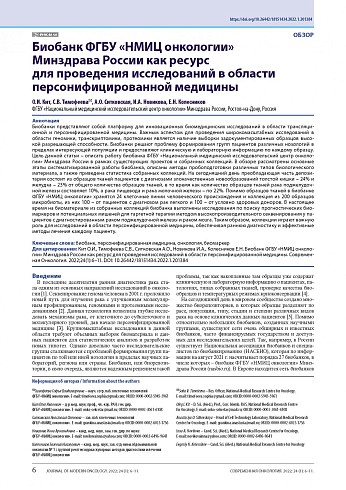
Биобанки представляют собой платформу для инновационных биомедицинских исследований в области трансляционной и персонифицированной медицины. Важным аспектом для проведения широкомасштабных исследований в области геномики, транскриптомики, протеомики является наличие выборки задокументированных образцов высокой разрешающей способности. Биобанки решают проблему формирования групп пациентов различных нозологий в пределах интересующей популяции и предоставляют клиническую и лабораторную информацию по каждому образцу. Цель данной статьи – описать работу биобанка ФГБУ «Национальный медицинский исследовательский центр онкологии» Минздрава России в рамках существующих проектов и собранных коллекций. В обзоре рассмотрены основные этапы систематизированной работы биобанка, описаны методы пробоподготовки различных типов биологического материала, а также приведена статистика собранных коллекций. На сегодняшний день преобладающая часть депозитария состоит из образцов тканей пациентов с диагнозами злокачественных новообразований толстой кишки – 24% и желудка – 23% от общего количества образцов тканей, в то время как количество образцов тканей рака поджелудочной железы составляет 10%, а рака пищевода и рака молочной железы – по 22%. Помимо образцов тканей в биобанке ФГБУ «НМИЦ онкологии» хранятся 24 клеточные линии человеческого происхождения и коллекция из 200 образцов микробиоты, из них 100 – от пациентов с диагнозом рак легкого и 100 – от условно здоровых доноров. В настоящее время на биоматериале из собранных коллекций биобанка выполнены исследования по поиску прогностических биомаркеров и потенциальных мишеней для таргетной терапии методом высокопроизводительного секвенирования у пациентов с диагностированным раком поджелудочной железы и раком мозга. Таким образом, коллекции играют важную роль для исследований в области персонифицированной медицины, обеспечивая раннюю диагностику и эффективные методы лечения каждому пациенту.
Ключевые слова: биобанк, персонифицированная медицина, онкология, биомаркер
Keywords: biobank, personalized medicine, oncology, biomarker, Russia
Ключевые слова: биобанк, персонифицированная медицина, онкология, биомаркер
________________________________________________
Keywords: biobank, personalized medicine, oncology, biomarker, Russia
Полный текст
Список литературы
1. Smittenaar CR, Petersen KA, Stewart K, Moitt N. Cancer incidence and mortality projections in the UK until 2035. Br J Cancer. 2016;115(9):1147-155.
DOI:10.1038/bjc.2016.304
2. Swede H, Stone CL, Norwood AR. National population-based biobanks for genetic research. Genet Med. 2007;9(3):141-9. DOI:10.1097/gim.0b013e3180330039
3. Goetz LH, Schork NJ. Personalized medicine: motivation, challenges, and progress. Fertil Steril. 2018;109(6):952-63. DOI:10.1016/j.fertnstert.2018.05.006
4. Драпкина О.М. Российская «Национальная ассоциация биобанков и специалистов по биобанкированию» – инструмент интеграции российских биобанков и повышения эффективности биомедицинских исследований. Кардиоваскулярная терапия и профилактика. 2020;19(6):2757 [Drapkina OM. Russian National Association of Biobanks and Biobanking Specialists – a tool for integrating Russian biobanks and increasing the efficiency of biomedical research. Cardiovascular Therapy and Prevention. 2020;19(6):2757 (in Russian)]. DOI:10.15829/1728-8800-2020-2757
5. Braun KL, Tsark JU, Powers A, et al. Cancer patient perceptions about biobanking and preferred timing of consent. Biopreserv Biobank. 2014;12(2):106-12. DOI:10.1089/bio.2013.0083
6. Patil S, Majumdar B, Awan KH, et al. Cancer oriented biobanks: A comprehensive review. Oncol Rev. 2018;12(1):357. DOI:10.4081/oncol.2018.357
7. Coppola L, Cianflone A, Grimaldi AM, et al. Biobanking in health care: evolution and future directions. J Transl Med. 2019;17(1):172. DOI:10.1186/s12967-019-1922-3
8. Liu A, Pollard K. Biobanking for Personalized Medicine. Adv Exp Med Biol. 2015;864:55-68. DOI:10.1007/978-3-319-20579-3_5
9. Самохина И.В., Сагакянц А.Б. Работа в условиях пандемии COVID-19 – опыт биобанка ФГБУ «НМИЦ онкологии» Минздрава России. Кардиоваскулярная терапия и профилактика. 2020;19(6):2741 [Samokhina IV, Sagakyants AB. Work within the COVID-19 pandemic – the experience of the biobank of the National Medical Research Center of Oncology. Cardiovascular Therapy and Prevention. 2020;19(6):2741 (in Russian)]. DOI:10.15829/1728-8800-2020-2741
10. Kotikalapudi R, Patel RK. Comparative study of the influence of EDTA and sodium heparin on long term storage of cattle DNA. Cell J. 2015;17(1):181-6.
DOI:10.22074/cellj.2015.526
11. Sidstedt M, Hedman J, Romsos EL, et al. Inhibition mechanisms of hemoglobin, immunoglobulin G, and whole blood in digital and real-time PCR. Anal Bioanal Chem. 2018;410(10):2569-83. DOI:10.1007/s00216-018-0931-z
12. UK Biobank, 2007. Protocol for A Large-Scale Prospective Epidemiological Resource. UK Biobank Coordinating Centre; Stockport, UK: Protocol No: UKBB‑PROT-09-06 (Main Phase).
13. Nagai A, Hirata M, Kamatani Y, et al. Overview of the BioBank Japan Project: Study design and profile. J Epidemiol. 2017;27(3S):S2-8. DOI:10.1016/j.je.2016.12.005
14. Victorian Cancer Biobank, 2020. Available at: https://viccancerbiobank.org.au/ Accessed: 30.10.2021.
15. Canadian Tissue Repository Network, 2020. Available at: https://www.ctrnet.ca/ Accessed: 30.10.2021.
16. Terveer EM, van Beurden YH, Goorhuis A, et al. How to: Establish and run a stool bank. Clin Microbiol Infect. 2017;23(12):924-30. DOI:10.1016/j.cmi.2017.05.015
17. Pel J, Leung A, Choi WWY, et al. Rapid and highly-specific generation of targeted DNA sequencing libraries enabled by linking capture probes with universal primers. PLoS One. 2018;13(12):e0208283. DOI:10.1371/journal.pone.0208283
18. Woo PC, Lau SK, Teng JL, et al. Then and now: use of 16S rDNA gene sequencing for bacterial identification and discovery of novel bacteria in clinical microbiology laboratories. Clin Microbiol Infect. 2008;14(10):908-34. DOI:10.1111/j.1469-0691.2008.02070.x
19. Thomas T, Gilbert J, Meyer F. Metagenomics – a guide from sampling to data analysis. Microb Inform Exp. 2012;2(1):3. DOI:10.1186/2042-5783-2-3
20. Salter SJ, Cox MJ, Turek EM, et al. Reagent and laboratory contamination can critically impact sequence-based microbiome analyses. BMC Biol. 2014;12:87.
DOI:10.1186/s12915-014-0087-z
21. Cuthbertson L, Rogers GB, Walker AW, et al. Time between collection and storage significantly influences bacterial sequence composition in sputum samples from cystic fibrosis respiratory infections. J Clin Microbiol. 2014;52(8):3011-6. DOI:10.1128/JCM.00764-14
22. Choo JM, Leong LE, Rogers GB. Sample storage conditions significantly influence faecal microbiome profiles. Sci Rep. 2015;5:16350. DOI:10.1038/srep16350
23. Smirnova DV, Zalomova LV, Zagainova AV, et al. Cryopreservation of the human gut microbiota: Current state and perspectives. Int J Med Microbiol. 2019;309(5):259‑69. DOI:10.1016/j.ijmm.2019.06.001
24. Межевова И.В., Ситковская А.О., Кит О.И. Первичные культуры опухолевых клеток: современные методы получения и поддержания in vitro. Южно-российский онкологический журнал. 2020;1(3):36-49 [Mezhevova IV, Sitkovskaya AO, Kit OI. Primary tumor cell cultures: сurrent methods of obtaining and subcultivation. South Russian Journal of Cancer. 2020;1(3):36-49 (in Russian)]. DOI:10.37748/2687-0533-2020-1-3-4
25. Шамова Т.В., Ситковская А.О., Росторгуев Э.Е., и др. Получение первичных клеточных линий глиальных опухолей. Пермский медицинский журнал. 2020;37(5):79-89 [Shamova TV, Sitkovskaya AO, Rostorguev EE, et al. Preparation of primary glial tumor cell lines. Permskii meditsinskii zhurnal. 2020;37(5):79-89 (in Russian)]. DOI:10.17816/pmj37579%89
26. Кит О.И., Гвалдин Д.Ю., Трифанов В.С., и др. Молекулярно-генетические особенности нейроэндокринных опухолей поджелудочной железы. Генетика. 2020;56(1):142-60 [Kit OI, Gvaldin DY, Trifanov VS, et al. Molecular-genetic features of pancreatic neuroendocrine tumors. Russian Journal of Genetics. 2020;56(1):142-60 (in Russian)]. DOI:10.31857/S001667582002006X
27. Кит О.И., Пушкин А.А., Росторгуев Э.Е., и др. Дифференциальная экспрессия 15-ти генов в глиальных опухолях различной степени злокачественности. Современные проблемы науки и образования. 2019;5:230 [Pushkin AA, Timoshkina NN, Rostorguev EЕ, et al. Expression status of 15th genes in glial tumors of the brain. Sovremennye problemy nauki i obrazovaniya. 2019;5:230 (in Russian)].
DOI:10.1038/bjc.2016.304
2. Swede H, Stone CL, Norwood AR. National population-based biobanks for genetic research. Genet Med. 2007;9(3):141-9. DOI:10.1097/gim.0b013e3180330039
3. Goetz LH, Schork NJ. Personalized medicine: motivation, challenges, and progress. Fertil Steril. 2018;109(6):952-63. DOI:10.1016/j.fertnstert.2018.05.006
4. Drapkina OM. Russian National Association of Biobanks and Biobanking Specialists – a tool for integrating Russian biobanks and increasing the efficiency of biomedical research. Cardiovascular Therapy and Prevention. 2020;19(6):2757 (in Russian). DOI:10.15829/1728-8800-2020-2757
5. Braun KL, Tsark JU, Powers A, et al. Cancer patient perceptions about biobanking and preferred timing of consent. Biopreserv Biobank. 2014;12(2):106-12. DOI:10.1089/bio.2013.0083
6. Patil S, Majumdar B, Awan KH, et al. Cancer oriented biobanks: A comprehensive review. Oncol Rev. 2018;12(1):357. DOI:10.4081/oncol.2018.357
7. Coppola L, Cianflone A, Grimaldi AM, et al. Biobanking in health care: evolution and future directions. J Transl Med. 2019;17(1):172. DOI:10.1186/s12967-019-1922-3
8. Liu A, Pollard K. Biobanking for Personalized Medicine. Adv Exp Med Biol. 2015;864:55-68. DOI:10.1007/978-3-319-20579-3_5
9. Samokhina IV, Sagakyants AB. Work within the COVID-19 pandemic – the experience of the biobank of the National Medical Research Center of Oncology. Cardiovascular Therapy and Prevention. 2020;19(6):2741 (in Russian). DOI:10.15829/1728-8800-2020-2741
10. Kotikalapudi R, Patel RK. Comparative study of the influence of EDTA and sodium heparin on long term storage of cattle DNA. Cell J. 2015;17(1):181-6.
DOI:10.22074/cellj.2015.526
11. Sidstedt M, Hedman J, Romsos EL, et al. Inhibition mechanisms of hemoglobin, immunoglobulin G, and whole blood in digital and real-time PCR. Anal Bioanal Chem. 2018;410(10):2569-83. DOI:10.1007/s00216-018-0931-z
12. UK Biobank, 2007. Protocol for A Large-Scale Prospective Epidemiological Resource. UK Biobank Coordinating Centre; Stockport, UK: Protocol No: UKBB‑PROT-09-06 (Main Phase).
13. Nagai A, Hirata M, Kamatani Y, et al. Overview of the BioBank Japan Project: Study design and profile. J Epidemiol. 2017;27(3S):S2-8. DOI:10.1016/j.je.2016.12.005
14. Victorian Cancer Biobank, 2020. Available at: https://viccancerbiobank.org.au/ Accessed: 30.10.2021.
15. Canadian Tissue Repository Network, 2020. Available at: https://www.ctrnet.ca/ Accessed: 30.10.2021.
16. Terveer EM, van Beurden YH, Goorhuis A, et al. How to: Establish and run a stool bank. Clin Microbiol Infect. 2017;23(12):924-30. DOI:10.1016/j.cmi.2017.05.015
17. Pel J, Leung A, Choi WWY, et al. Rapid and highly-specific generation of targeted DNA sequencing libraries enabled by linking capture probes with universal primers. PLoS One. 2018;13(12):e0208283. DOI:10.1371/journal.pone.0208283
18. Woo PC, Lau SK, Teng JL, et al. Then and now: use of 16S rDNA gene sequencing for bacterial identification and discovery of novel bacteria in clinical microbiology laboratories. Clin Microbiol Infect. 2008;14(10):908-34. DOI:10.1111/j.1469-0691.2008.02070.x
19. Thomas T, Gilbert J, Meyer F. Metagenomics – a guide from sampling to data analysis. Microb Inform Exp. 2012;2(1):3. DOI:10.1186/2042-5783-2-3
20. Salter SJ, Cox MJ, Turek EM, et al. Reagent and laboratory contamination can critically impact sequence-based microbiome analyses. BMC Biol. 2014;12:87.
DOI:10.1186/s12915-014-0087-z
21. Cuthbertson L, Rogers GB, Walker AW, et al. Time between collection and storage significantly influences bacterial sequence composition in sputum samples from cystic fibrosis respiratory infections. J Clin Microbiol. 2014;52(8):3011-6. DOI:10.1128/JCM.00764-14
22. Choo JM, Leong LE, Rogers GB. Sample storage conditions significantly influence faecal microbiome profiles. Sci Rep. 2015;5:16350. DOI:10.1038/srep16350
23. Smirnova DV, Zalomova LV, Zagainova AV, et al. Cryopreservation of the human gut microbiota: Current state and perspectives. Int J Med Microbiol. 2019;309(5):259‑69. DOI:10.1016/j.ijmm.2019.06.001
24. Межевова И.В., Ситковская А.О., Кит О.И. Первичные культуры опухолевых клеток: современные методы получения и поддержания in vitro. Южно-российский онкологический журнал. 2020;1(3):36-49 [Mezhevova IV, Sitkovskaya AO, Kit OI. Primary tumor cell cultures: сurrent methods of obtaining and subcultivation. South Russian Journal of Cancer. 2020;1(3):36-49 (in Russian)]. DOI:10.37748/2687-0533-2020-1-3-4
25. Shamova TV, Sitkovskaya AO, Rostorguev EE, et al. Preparation of primary glial tumor cell lines. Permskii meditsinskii zhurnal. 2020;37(5):79-89 (in Russian). DOI:10.17816/pmj37579%89
26. Kit OI, Gvaldin DY, Trifanov VS, et al. Molecular-genetic features of pancreatic neuroendocrine tumors. Russian Journal of Genetics. 2020;56(1):142-60 (in Russian). DOI:10.31857/S001667582002006X
27. Pushkin AA, Timoshkina NN, Rostorguev EЕ, et al. Expression status of 15th genes in glial tumors of the brain. Sovremennye problemy nauki i obrazovaniya. 2019;5:230 (in Russian).
DOI:10.1038/bjc.2016.304
2. Swede H, Stone CL, Norwood AR. National population-based biobanks for genetic research. Genet Med. 2007;9(3):141-9. DOI:10.1097/gim.0b013e3180330039
3. Goetz LH, Schork NJ. Personalized medicine: motivation, challenges, and progress. Fertil Steril. 2018;109(6):952-63. DOI:10.1016/j.fertnstert.2018.05.006
4. Драпкина О.М. Российская «Национальная ассоциация биобанков и специалистов по биобанкированию» – инструмент интеграции российских биобанков и повышения эффективности биомедицинских исследований. Кардиоваскулярная терапия и профилактика. 2020;19(6):2757 [Drapkina OM. Russian National Association of Biobanks and Biobanking Specialists – a tool for integrating Russian biobanks and increasing the efficiency of biomedical research. Cardiovascular Therapy and Prevention. 2020;19(6):2757 (in Russian)]. DOI:10.15829/1728-8800-2020-2757
5. Braun KL, Tsark JU, Powers A, et al. Cancer patient perceptions about biobanking and preferred timing of consent. Biopreserv Biobank. 2014;12(2):106-12. DOI:10.1089/bio.2013.0083
6. Patil S, Majumdar B, Awan KH, et al. Cancer oriented biobanks: A comprehensive review. Oncol Rev. 2018;12(1):357. DOI:10.4081/oncol.2018.357
7. Coppola L, Cianflone A, Grimaldi AM, et al. Biobanking in health care: evolution and future directions. J Transl Med. 2019;17(1):172. DOI:10.1186/s12967-019-1922-3
8. Liu A, Pollard K. Biobanking for Personalized Medicine. Adv Exp Med Biol. 2015;864:55-68. DOI:10.1007/978-3-319-20579-3_5
9. Самохина И.В., Сагакянц А.Б. Работа в условиях пандемии COVID-19 – опыт биобанка ФГБУ «НМИЦ онкологии» Минздрава России. Кардиоваскулярная терапия и профилактика. 2020;19(6):2741 [Samokhina IV, Sagakyants AB. Work within the COVID-19 pandemic – the experience of the biobank of the National Medical Research Center of Oncology. Cardiovascular Therapy and Prevention. 2020;19(6):2741 (in Russian)]. DOI:10.15829/1728-8800-2020-2741
10. Kotikalapudi R, Patel RK. Comparative study of the influence of EDTA and sodium heparin on long term storage of cattle DNA. Cell J. 2015;17(1):181-6.
DOI:10.22074/cellj.2015.526
11. Sidstedt M, Hedman J, Romsos EL, et al. Inhibition mechanisms of hemoglobin, immunoglobulin G, and whole blood in digital and real-time PCR. Anal Bioanal Chem. 2018;410(10):2569-83. DOI:10.1007/s00216-018-0931-z
12. UK Biobank, 2007. Protocol for A Large-Scale Prospective Epidemiological Resource. UK Biobank Coordinating Centre; Stockport, UK: Protocol No: UKBB‑PROT-09-06 (Main Phase).
13. Nagai A, Hirata M, Kamatani Y, et al. Overview of the BioBank Japan Project: Study design and profile. J Epidemiol. 2017;27(3S):S2-8. DOI:10.1016/j.je.2016.12.005
14. Victorian Cancer Biobank, 2020. Available at: https://viccancerbiobank.org.au/ Accessed: 30.10.2021.
15. Canadian Tissue Repository Network, 2020. Available at: https://www.ctrnet.ca/ Accessed: 30.10.2021.
16. Terveer EM, van Beurden YH, Goorhuis A, et al. How to: Establish and run a stool bank. Clin Microbiol Infect. 2017;23(12):924-30. DOI:10.1016/j.cmi.2017.05.015
17. Pel J, Leung A, Choi WWY, et al. Rapid and highly-specific generation of targeted DNA sequencing libraries enabled by linking capture probes with universal primers. PLoS One. 2018;13(12):e0208283. DOI:10.1371/journal.pone.0208283
18. Woo PC, Lau SK, Teng JL, et al. Then and now: use of 16S rDNA gene sequencing for bacterial identification and discovery of novel bacteria in clinical microbiology laboratories. Clin Microbiol Infect. 2008;14(10):908-34. DOI:10.1111/j.1469-0691.2008.02070.x
19. Thomas T, Gilbert J, Meyer F. Metagenomics – a guide from sampling to data analysis. Microb Inform Exp. 2012;2(1):3. DOI:10.1186/2042-5783-2-3
20. Salter SJ, Cox MJ, Turek EM, et al. Reagent and laboratory contamination can critically impact sequence-based microbiome analyses. BMC Biol. 2014;12:87.
DOI:10.1186/s12915-014-0087-z
21. Cuthbertson L, Rogers GB, Walker AW, et al. Time between collection and storage significantly influences bacterial sequence composition in sputum samples from cystic fibrosis respiratory infections. J Clin Microbiol. 2014;52(8):3011-6. DOI:10.1128/JCM.00764-14
22. Choo JM, Leong LE, Rogers GB. Sample storage conditions significantly influence faecal microbiome profiles. Sci Rep. 2015;5:16350. DOI:10.1038/srep16350
23. Smirnova DV, Zalomova LV, Zagainova AV, et al. Cryopreservation of the human gut microbiota: Current state and perspectives. Int J Med Microbiol. 2019;309(5):259‑69. DOI:10.1016/j.ijmm.2019.06.001
24. Межевова И.В., Ситковская А.О., Кит О.И. Первичные культуры опухолевых клеток: современные методы получения и поддержания in vitro. Южно-российский онкологический журнал. 2020;1(3):36-49 [Mezhevova IV, Sitkovskaya AO, Kit OI. Primary tumor cell cultures: сurrent methods of obtaining and subcultivation. South Russian Journal of Cancer. 2020;1(3):36-49 (in Russian)]. DOI:10.37748/2687-0533-2020-1-3-4
25. Шамова Т.В., Ситковская А.О., Росторгуев Э.Е., и др. Получение первичных клеточных линий глиальных опухолей. Пермский медицинский журнал. 2020;37(5):79-89 [Shamova TV, Sitkovskaya AO, Rostorguev EE, et al. Preparation of primary glial tumor cell lines. Permskii meditsinskii zhurnal. 2020;37(5):79-89 (in Russian)]. DOI:10.17816/pmj37579%89
26. Кит О.И., Гвалдин Д.Ю., Трифанов В.С., и др. Молекулярно-генетические особенности нейроэндокринных опухолей поджелудочной железы. Генетика. 2020;56(1):142-60 [Kit OI, Gvaldin DY, Trifanov VS, et al. Molecular-genetic features of pancreatic neuroendocrine tumors. Russian Journal of Genetics. 2020;56(1):142-60 (in Russian)]. DOI:10.31857/S001667582002006X
27. Кит О.И., Пушкин А.А., Росторгуев Э.Е., и др. Дифференциальная экспрессия 15-ти генов в глиальных опухолях различной степени злокачественности. Современные проблемы науки и образования. 2019;5:230 [Pushkin AA, Timoshkina NN, Rostorguev EЕ, et al. Expression status of 15th genes in glial tumors of the brain. Sovremennye problemy nauki i obrazovaniya. 2019;5:230 (in Russian)].
________________________________________________
DOI:10.1038/bjc.2016.304
2. Swede H, Stone CL, Norwood AR. National population-based biobanks for genetic research. Genet Med. 2007;9(3):141-9. DOI:10.1097/gim.0b013e3180330039
3. Goetz LH, Schork NJ. Personalized medicine: motivation, challenges, and progress. Fertil Steril. 2018;109(6):952-63. DOI:10.1016/j.fertnstert.2018.05.006
4. Drapkina OM. Russian National Association of Biobanks and Biobanking Specialists – a tool for integrating Russian biobanks and increasing the efficiency of biomedical research. Cardiovascular Therapy and Prevention. 2020;19(6):2757 (in Russian). DOI:10.15829/1728-8800-2020-2757
5. Braun KL, Tsark JU, Powers A, et al. Cancer patient perceptions about biobanking and preferred timing of consent. Biopreserv Biobank. 2014;12(2):106-12. DOI:10.1089/bio.2013.0083
6. Patil S, Majumdar B, Awan KH, et al. Cancer oriented biobanks: A comprehensive review. Oncol Rev. 2018;12(1):357. DOI:10.4081/oncol.2018.357
7. Coppola L, Cianflone A, Grimaldi AM, et al. Biobanking in health care: evolution and future directions. J Transl Med. 2019;17(1):172. DOI:10.1186/s12967-019-1922-3
8. Liu A, Pollard K. Biobanking for Personalized Medicine. Adv Exp Med Biol. 2015;864:55-68. DOI:10.1007/978-3-319-20579-3_5
9. Samokhina IV, Sagakyants AB. Work within the COVID-19 pandemic – the experience of the biobank of the National Medical Research Center of Oncology. Cardiovascular Therapy and Prevention. 2020;19(6):2741 (in Russian). DOI:10.15829/1728-8800-2020-2741
10. Kotikalapudi R, Patel RK. Comparative study of the influence of EDTA and sodium heparin on long term storage of cattle DNA. Cell J. 2015;17(1):181-6.
DOI:10.22074/cellj.2015.526
11. Sidstedt M, Hedman J, Romsos EL, et al. Inhibition mechanisms of hemoglobin, immunoglobulin G, and whole blood in digital and real-time PCR. Anal Bioanal Chem. 2018;410(10):2569-83. DOI:10.1007/s00216-018-0931-z
12. UK Biobank, 2007. Protocol for A Large-Scale Prospective Epidemiological Resource. UK Biobank Coordinating Centre; Stockport, UK: Protocol No: UKBB‑PROT-09-06 (Main Phase).
13. Nagai A, Hirata M, Kamatani Y, et al. Overview of the BioBank Japan Project: Study design and profile. J Epidemiol. 2017;27(3S):S2-8. DOI:10.1016/j.je.2016.12.005
14. Victorian Cancer Biobank, 2020. Available at: https://viccancerbiobank.org.au/ Accessed: 30.10.2021.
15. Canadian Tissue Repository Network, 2020. Available at: https://www.ctrnet.ca/ Accessed: 30.10.2021.
16. Terveer EM, van Beurden YH, Goorhuis A, et al. How to: Establish and run a stool bank. Clin Microbiol Infect. 2017;23(12):924-30. DOI:10.1016/j.cmi.2017.05.015
17. Pel J, Leung A, Choi WWY, et al. Rapid and highly-specific generation of targeted DNA sequencing libraries enabled by linking capture probes with universal primers. PLoS One. 2018;13(12):e0208283. DOI:10.1371/journal.pone.0208283
18. Woo PC, Lau SK, Teng JL, et al. Then and now: use of 16S rDNA gene sequencing for bacterial identification and discovery of novel bacteria in clinical microbiology laboratories. Clin Microbiol Infect. 2008;14(10):908-34. DOI:10.1111/j.1469-0691.2008.02070.x
19. Thomas T, Gilbert J, Meyer F. Metagenomics – a guide from sampling to data analysis. Microb Inform Exp. 2012;2(1):3. DOI:10.1186/2042-5783-2-3
20. Salter SJ, Cox MJ, Turek EM, et al. Reagent and laboratory contamination can critically impact sequence-based microbiome analyses. BMC Biol. 2014;12:87.
DOI:10.1186/s12915-014-0087-z
21. Cuthbertson L, Rogers GB, Walker AW, et al. Time between collection and storage significantly influences bacterial sequence composition in sputum samples from cystic fibrosis respiratory infections. J Clin Microbiol. 2014;52(8):3011-6. DOI:10.1128/JCM.00764-14
22. Choo JM, Leong LE, Rogers GB. Sample storage conditions significantly influence faecal microbiome profiles. Sci Rep. 2015;5:16350. DOI:10.1038/srep16350
23. Smirnova DV, Zalomova LV, Zagainova AV, et al. Cryopreservation of the human gut microbiota: Current state and perspectives. Int J Med Microbiol. 2019;309(5):259‑69. DOI:10.1016/j.ijmm.2019.06.001
24. Межевова И.В., Ситковская А.О., Кит О.И. Первичные культуры опухолевых клеток: современные методы получения и поддержания in vitro. Южно-российский онкологический журнал. 2020;1(3):36-49 [Mezhevova IV, Sitkovskaya AO, Kit OI. Primary tumor cell cultures: сurrent methods of obtaining and subcultivation. South Russian Journal of Cancer. 2020;1(3):36-49 (in Russian)]. DOI:10.37748/2687-0533-2020-1-3-4
25. Shamova TV, Sitkovskaya AO, Rostorguev EE, et al. Preparation of primary glial tumor cell lines. Permskii meditsinskii zhurnal. 2020;37(5):79-89 (in Russian). DOI:10.17816/pmj37579%89
26. Kit OI, Gvaldin DY, Trifanov VS, et al. Molecular-genetic features of pancreatic neuroendocrine tumors. Russian Journal of Genetics. 2020;56(1):142-60 (in Russian). DOI:10.31857/S001667582002006X
27. Pushkin AA, Timoshkina NN, Rostorguev EЕ, et al. Expression status of 15th genes in glial tumors of the brain. Sovremennye problemy nauki i obrazovaniya. 2019;5:230 (in Russian).
Авторы
О.И. Кит, С.В. Тимофеева*, А.О. Ситковская, И.А. Новикова, Е.Н. Колесников
ФГБУ «Национальный медицинский исследовательский центр онкологии» Минздрава России, Ростов-на-Дону, Россия
*timofeeva.sophia@gmail.com
National Medical Research Centre for Oncology, Rostov-on-Don, Russia
*timofeeva.sophia@gmail.com
ФГБУ «Национальный медицинский исследовательский центр онкологии» Минздрава России, Ростов-на-Дону, Россия
*timofeeva.sophia@gmail.com
________________________________________________
National Medical Research Centre for Oncology, Rostov-on-Don, Russia
*timofeeva.sophia@gmail.com
Цель портала OmniDoctor – предоставление профессиональной информации врачам, провизорам и фармацевтам.