

Ожирение без сахарного диабета: особенности гормональной регуляции углеводного обмена - Журнал Терапевтический архив №10 Вопросы эндокринологии 2020
Ожирение без сахарного диабета: особенности гормональной регуляции углеводного обмена
Шестакова Е.А., Скляник И.А., Паневина А.С. и др. Ожирение без сахарного диабета: особенности гормональной регуляции углеводного обмена. Терапевтический архив. 2020; 92 (10): 15–22. DOI: 10.26442/00403660.2020.10.000750
________________________________________________
Материалы доступны только для специалистов сферы здравоохранения.
Чтобы посмотреть материал полностью
Авторизуйтесь
или зарегистрируйтесь.
Аннотация
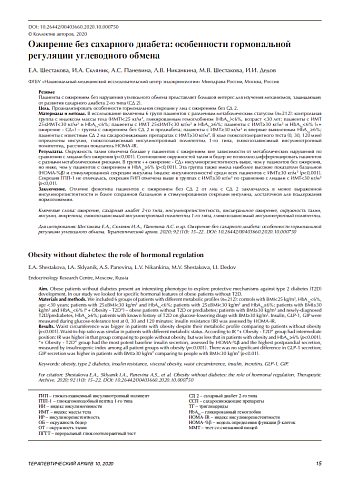
Пациенты с ожирением без нарушений углеводного обмена представляет большой интерес для изучения механизмов, защищающих от развития сахарного диабета 2-го типа (СД 2).
Цель. Проанализировать особенности гормональной секреции у лиц с ожирением без СД 2.
Материалы и методы. В исследование включены 6 групп пациентов с различным метаболическим статусом (n=212): контрольная группа с индексом массы тела (ИМТ)<25 кг/м2, гликированным гемоглобином (HbA1c)<6%, возраст <30 лет; пациенты с ИМТ 25≤ИМТ<30 кг/м2 и HbA1c<6%; пациенты с ИМТ 25≤ИМТ<30 кг/м2 и HbA1c≥6%; пациенты с ИМТ≥30 кг/м2 и HbA1c<6% («+ ожирение - СД») – группа с ожирением без СД 2 и предиабета; пациенты с ИМТ≥30 кг/м2 и впервые выявленным HbA1c≥6%; пациенты с известным СД 2 на сахароснижающих препаратах с ИМТ≥30 кг/м2. В ходе глюкозотолерантного теста (0, 30, 120 мин) определены инсулин, глюкозозависимый инсулинотропный полипептид 1-го типа, глюкозозависимый инсулинотропный полипептид, рассчитан показатель HOMA-IR.
Результаты. Окружность талии отмечена больше у пациентов с ожирением вне зависимости от метаболических нарушений по сравнению с лицами без ожирения (p<0,001). Соотношение окружностей талии и бедер не позволяло дифференцировать пациентов с разными метаболическими рисками. В группе «+ ожирение - СД» инсулинорезистентность выше, чем у пациентов без ожирения, но ниже, чем у пациентов с ожирением и HbA1c≥6% (p<0,001). Эта группа также имела наиболее высокие показатели базальной (НОМА-%β) и стимулированной секреции инсулина (индекс инсулиногенности) среди всех пациентов с ИМТ≥30 кг/м2 (p<0,001). Секреция ГПП-1 не отличалась, секреция ГИП отмечена выше в группах с ИМТ≥30 кг/м2 по сравнению с лицами с ИМТ<30 кг/м2 (p<0,01).
Заключение. Отличие фенотипа пациентов с ожирением без СД 2 от лиц с СД 2 заключалось в менее выраженной инсулинорезистентности и более сохранной базальной и стимулированной секреции инсулина, достаточной для поддержания нормогликемии.
Ключевые слова: ожирение, сахарный диабет 2-го типа, инсулинорезистентность, висцеральное ожирение, окружность талии, инсулин, инкретины, глюкозозависимый инсулинотропный полипептид 1-го типа, глюкозозависимый инсулинотропный полипептид.
Materials and methods. We included 6 groups of patients with different metabolic profiles (n=212): controls with BMI<25 kg/m2, HbA1c<6%, age <30 years; patients with 25≤BMI<30 kg/m2 and HbA1c<6%; patients with 25≤BMI<30 kg/m2 and HbA1c≥6%; patients with BMI≥30 kg/m2 and HbA1c<6% (“+ Obesity - T2D”) – obese patients without T2D or prediabetes; patients with BMI≥30 kg/m2 and newly-diagnosed T2D/prediabetes, HbA1c≥6%; patients with known history of T2D on glucose-lowering drugs with BMI≥30 kg/m2. Insulin, GLP-1, GIP were measured during glucose-tolerance test at 0, 30 and 120 minutes; insulin resistance (IR) was assessed by HOMA-IR.
Results. Waist circumference was bigger in patients with obesity despite their metabolic profile comparing to patients without obesity (p<0.001). Waist-to-hip ratio was similar in patients with different metabolic status. According to IR “+ Obesity - T2D” group had intermediate position: IR was higher in that group comparing to people without obesity, but was less that in patients with obesity and HbA1c≥6% (p<0.001). “+ Obesity - T2D” group had the most potent baseline insulin secretion, assessed by НОМА-%b and the highest postprandial secretion, measured by insulinogenic index among all patient groups with obesity (p<0.001). There was no significant difference in GLP-1 secretion; GIP secretion was higher in patients with BMI≥30 kg/m2 comparing to people with BMI<30 kg/m2 (p<0.01).
Keywords: obesity, type 2 diabetes, insulin resistance, visceral obesity, waist circumference, insulin, incretins, GLP-1, GIP.
Цель. Проанализировать особенности гормональной секреции у лиц с ожирением без СД 2.
Материалы и методы. В исследование включены 6 групп пациентов с различным метаболическим статусом (n=212): контрольная группа с индексом массы тела (ИМТ)<25 кг/м2, гликированным гемоглобином (HbA1c)<6%, возраст <30 лет; пациенты с ИМТ 25≤ИМТ<30 кг/м2 и HbA1c<6%; пациенты с ИМТ 25≤ИМТ<30 кг/м2 и HbA1c≥6%; пациенты с ИМТ≥30 кг/м2 и HbA1c<6% («+ ожирение - СД») – группа с ожирением без СД 2 и предиабета; пациенты с ИМТ≥30 кг/м2 и впервые выявленным HbA1c≥6%; пациенты с известным СД 2 на сахароснижающих препаратах с ИМТ≥30 кг/м2. В ходе глюкозотолерантного теста (0, 30, 120 мин) определены инсулин, глюкозозависимый инсулинотропный полипептид 1-го типа, глюкозозависимый инсулинотропный полипептид, рассчитан показатель HOMA-IR.
Результаты. Окружность талии отмечена больше у пациентов с ожирением вне зависимости от метаболических нарушений по сравнению с лицами без ожирения (p<0,001). Соотношение окружностей талии и бедер не позволяло дифференцировать пациентов с разными метаболическими рисками. В группе «+ ожирение - СД» инсулинорезистентность выше, чем у пациентов без ожирения, но ниже, чем у пациентов с ожирением и HbA1c≥6% (p<0,001). Эта группа также имела наиболее высокие показатели базальной (НОМА-%β) и стимулированной секреции инсулина (индекс инсулиногенности) среди всех пациентов с ИМТ≥30 кг/м2 (p<0,001). Секреция ГПП-1 не отличалась, секреция ГИП отмечена выше в группах с ИМТ≥30 кг/м2 по сравнению с лицами с ИМТ<30 кг/м2 (p<0,01).
Заключение. Отличие фенотипа пациентов с ожирением без СД 2 от лиц с СД 2 заключалось в менее выраженной инсулинорезистентности и более сохранной базальной и стимулированной секреции инсулина, достаточной для поддержания нормогликемии.
Ключевые слова: ожирение, сахарный диабет 2-го типа, инсулинорезистентность, висцеральное ожирение, окружность талии, инсулин, инкретины, глюкозозависимый инсулинотропный полипептид 1-го типа, глюкозозависимый инсулинотропный полипептид.
________________________________________________
Materials and methods. We included 6 groups of patients with different metabolic profiles (n=212): controls with BMI<25 kg/m2, HbA1c<6%, age <30 years; patients with 25≤BMI<30 kg/m2 and HbA1c<6%; patients with 25≤BMI<30 kg/m2 and HbA1c≥6%; patients with BMI≥30 kg/m2 and HbA1c<6% (“+ Obesity - T2D”) – obese patients without T2D or prediabetes; patients with BMI≥30 kg/m2 and newly-diagnosed T2D/prediabetes, HbA1c≥6%; patients with known history of T2D on glucose-lowering drugs with BMI≥30 kg/m2. Insulin, GLP-1, GIP were measured during glucose-tolerance test at 0, 30 and 120 minutes; insulin resistance (IR) was assessed by HOMA-IR.
Results. Waist circumference was bigger in patients with obesity despite their metabolic profile comparing to patients without obesity (p<0.001). Waist-to-hip ratio was similar in patients with different metabolic status. According to IR “+ Obesity - T2D” group had intermediate position: IR was higher in that group comparing to people without obesity, but was less that in patients with obesity and HbA1c≥6% (p<0.001). “+ Obesity - T2D” group had the most potent baseline insulin secretion, assessed by НОМА-%b and the highest postprandial secretion, measured by insulinogenic index among all patient groups with obesity (p<0.001). There was no significant difference in GLP-1 secretion; GIP secretion was higher in patients with BMI≥30 kg/m2 comparing to people with BMI<30 kg/m2 (p<0.01).
Keywords: obesity, type 2 diabetes, insulin resistance, visceral obesity, waist circumference, insulin, incretins, GLP-1, GIP.
Список литературы
1. Шестакова Е.А., Лунина Е.Ю., Галстян Г.Р. и др. Распространенность нарушений углеводного обмена у лиц с различными сочетаниями факторов риска сахарного диабета 2 типа в когорте пациентов исследования NATION. Сахарный диабет. 2020;23(1):4-11 [Shestakova EA, Lunina EY, Galstyan GR, et al. Type 2 diabetes and prediabetes prevalence in patients with different risk factor combinations in the NATION study. Diabetes Mellitus. 2020;23(1):4-11 (In Russ.)]. doi: 10.14341/DM12286
2. Muñoz-Garach A, Cornejo-Pareja I, Tinahones FJ. Does Metabolically Healthy Obesity Exist? Nutrients. 2016;8(6):320. doi: 10.3390/nu8060320
3. Ortega FB, Cadenas-Sanchez C, Migueles JH, et al. Role of Physical Activity and Fitness in the Characterization and Prognosis of the Metabolically Healthy Obesity Phenotype: A Systematic Review and Meta-analysis. Prog Cardiovasc Dis. 2018;61(2):190-205. doi: 10.1016/j.pcad.2018.07.008
4. Nilsson PM, Korduner J, Magnusson M. Metabolically Healthy Obesity (MHO)-New Research Directions for Personalised Medicine in Cardiovascular Prevention. Curr Hypertens Rep. 2020;22(2):18. doi: 10.1007/s11906-020-1027-7
5. Дедов И.И., Шестакова М.В., Майоров А.Ю. и др. Алгоритмы специализированной медицинской помощи больным сахарным диабетом. Сахарный диабет. 2019;22(S1) [Dedov II, Shestakova MV, Mayorov AYu, et al. Standards of specialized diabetes care. 9th edition. Diabetes mellitus. 2019;22(S1) (In Russ)]. doi: 10.14341/DM221S1144
6. Rotar O, Boyarinova M, Orlov A, et al. Metabolically healthy obese and metabolically unhealthy non-obese phenotypes in a Russian population. Eur J Epidemiol. 2017;32(3):251-4. doi: 10.1007/s10654-016-0221-z
7. Островская Е.В., Романцова Т.И., Герасимов А.Н., Новоселова Т.Е. Распространенность метаболически здорового ожирения по данным выборки Московского региона. Ожирение и метаболизм. 2017;14(4):51-6 [Ostrovskaya EV, Romantsova TI, Gerasimov AN, Novoselova TE. The prevalence of metabolically healthy obesity according to the sample of the Moscow region. Obesity and metabolism. 2017;14(4):51-6 (In Russ.)]. doi: 10.14341/OMET2017451-56
8. Мустафина C.В., Щербакова Л.В., Козупеева Д.А. и др. Распространенность метаболически здорового ожирения по данным эпидемиологического обследования выборки 45–69 лет г. Новосибирска. Ожирение и метаболизм. 2018;15(4):31-7 [Mustafina SV, Shcherbakova LV, Kozupeeva DA, et al. Тhe prevalence of metabolically healthy obesity: data from the epidemiological survey in of Novosibirsk. Obesity and metabolism. 2018;15(4):31-7 (In Russ.)]. doi: 10.14341/OMET9615
9. de Mutsert R, Gast K, Widya R, et al. Associations of Abdominal Subcutaneous and Visceral Fat with Insulin Resistance and Secretion Differ Between Men and Women: The Netherlands Epidemiology of Obesity Study. Metab Syndr Relat Disord. 2018;16(1):54-63. doi: 10.1089/met.2017.0128
10. Bays H. Central obesity as a clinical marker of adiposopathy; increased visceral adiposity as a surrogate marker for global fat dysfunction. Curr Opin Endocrinol Diabetes Obes. 2014;21(5):345-51. doi: 10.1097/MED.0000000000000093
11. Титов В.Н., Ширинский В.П. Резистентность к инсулину – конфликт между биологическими настройками энергетического метаболизма и образом жизни человека (взгляд на проблему с эволюционных позиций). Сахарный диабет. 2016;19(4):286-94 [Titov VN, Shirinsky VP. Insulin resistance: the conflict between biological settings of energy metabolism and human lifestyle (a glance at the problem from evolutionary viewpoint). Diabetes mellitus. 2016;19(4):286-94 (In Russ.)]. doi: 10.14341/DM7959
12. Fang H, Berg E, Cheng X, Shen W. How to best assess abdominal obesity. Curr Opin Clin Nutr Metab Care. 2018;21(5):360-5. doi: 10.1097/MCO.0000000000000485
13. Брель Н.К., Коков А.Н., Груздева О.В. Достоинства и ограничения различных методов диагностики висцерального ожирения. Ожирение и метаболизм. 2018;15(4):3-8 [Brel NK, Kokov AN, Gruzdeva OV. Advantages and disadvantages of different methods for diagnosis of visceral obesity. Obesity and metabolism. 2018;15(4):3-8 (In Russ.)]. doi: 10.14341/OMET9510
14. Маркова Т.Н., Кичигин В.А., Диомидова В.Н. и др. Оценка объема жировой ткани антропометрическими и лучевыми методами и его связь с компонентами метаболического синдрома. Ожирение и метаболизм. 2013;2:23-7 [Markova TN, Kichigin VA, Diomidova VN, et al. Evaluation of adipose tissue mass with anthropometric and visualization methods; its relation to the components of the metabolic syndrome. Obesity and metabolism. 2013;2:23-7 (In Russ.)].
15. Pieńkowska J, Brzeska B, Kaszubowski M, et al. The correlation between the MRI-evaluated ectopic fat accumulation and the incidence of diabetes mellitus and hypertension depends on body mass index and waist circumference ratio. PLoS One. 2020;15(1):e0226889. doi: 10.1371/journal.pone.0226889
16. Thondam SK, Cuthbertson DJ, Wilding JPH. The influence of Glucose-dependent Insulinotropic Polypeptide (GIP) on human adipose tissue and fat metabolism: Implications for obesity, type 2 diabetes and Non-Alcoholic Fatty Liver Disease (NAFLD). Peptides. 2020;125:170208. doi: 10.1016/j.peptides.2019.170208
17. Færch K, Torekov SS, Vistisen D, et al. GLP-1 Response to Oral Glucose Is Reduced in Prediabetes, Screen-Detected Type 2 Diabetes, and Obesity and Influenced by Sex: The ADDITION-PRO Study. Diabetes. 2015;64(7):2513-25. doi: 10.2337/db14-1751
18. European Association for the Study of the Liver (EASL); European Association for the Study of Diabetes (EASD); European Association for the Study of Obesity (EASO). EASL-EASD-EASO Clinical Practice Guidelines for the management of non-alcoholic fatty liver disease. Diabetologia. 2016;59(6):1121-40. doi: 10.1007/s00125-016-3902-y
19. Руяткина Л.А., Руяткин Д.С., Исхакова И.С. Возможности и варианты суррогатной оценки инсулинорезистентности. Ожирение и метаболизм. 2019;16(1):27-32 [Ruyatkina LA, Ruyatkin DS, Iskhakova IS. Opportunities and options for surrogate assessment of insulin resistance. Obesity and metabolism. 2019;16(1):27-32 (In Russ.)]. doi: 10.14341/omet10082
2. Muñoz-Garach A, Cornejo-Pareja I, Tinahones FJ. Does Metabolically Healthy Obesity Exist? Nutrients. 2016;8(6):320. doi: 10.3390/nu8060320
3. Ortega FB, Cadenas-Sanchez C, Migueles JH, et al. Role of Physical Activity and Fitness in the Characterization and Prognosis of the Metabolically Healthy Obesity Phenotype: A Systematic Review and Meta-analysis. Prog Cardiovasc Dis. 2018;61(2):190-205. doi: 10.1016/j.pcad.2018.07.008
4. Nilsson PM, Korduner J, Magnusson M. Metabolically Healthy Obesity (MHO)-New Research Directions for Personalised Medicine in Cardiovascular Prevention. Curr Hypertens Rep. 2020;22(2):18. doi: 10.1007/s11906-020-1027-7
5. Dedov II, Shestakova MV, Mayorov AYu, et al. Standards of specialized diabetes care. 9th edition. Diabetes mellitus. 2019;22(S1) (In Russ) doi: 10.14341/DM221S1144
6. Rotar O, Boyarinova M, Orlov A, et al. Metabolically healthy obese and metabolically unhealthy non-obese phenotypes in a Russian population. Eur J Epidemiol. 2017;32(3):251-4. doi: 10.1007/s10654-016-0221-z
7. Ostrovskaya EV, Romantsova TI, Gerasimov AN, Novoselova TE. The prevalence of metabolically healthy obesity according to the sample of the Moscow region. Obesity and metabolism. 2017;14(4):51-6 (In Russ.) doi: 10.14341/OMET2017451-56
8. Mustafina SV, Shcherbakova LV, Kozupeeva DA, et al. Тhe prevalence of metabolically healthy obesity: data from the epidemiological survey in of Novosibirsk. Obesity and metabolism. 2018;15(4):31-7 (In Russ.) doi: 10.14341/OMET9615
9. de Mutsert R, Gast K, Widya R, et al. Associations of Abdominal Subcutaneous and Visceral Fat with Insulin Resistance and Secretion Differ Between Men and Women: The Netherlands Epidemiology of Obesity Study. Metab Syndr Relat Disord. 2018;16(1):54-63. doi: 10.1089/met.2017.0128
10. Bays H. Central obesity as a clinical marker of adiposopathy; increased visceral adiposity as a surrogate marker for global fat dysfunction. Curr Opin Endocrinol Diabetes Obes. 2014;21(5):345-51. doi: 10.1097/MED.0000000000000093
11. Titov VN, Shirinsky VP. Insulin resistance: the conflict between biological settings of energy metabolism and human lifestyle (a glance at the problem from evolutionary viewpoint). Diabetes mellitus. 2016;19(4):286-94 (In Russ.) doi: 10.14341/DM7959
12. Fang H, Berg E, Cheng X, Shen W. How to best assess abdominal obesity. Curr Opin Clin Nutr Metab Care. 2018;21(5):360-5. doi: 10.1097/MCO.0000000000000485
13. Brel NK, Kokov AN, Gruzdeva OV. Advantages and disadvantages of different methods for diagnosis of visceral obesity. Obesity and metabolism. 2018;15(4):3-8 (In Russ.) doi: 10.14341/OMET9510
14. Markova TN, Kichigin VA, Diomidova VN, et al. Evaluation of adipose tissue mass with anthropometric and visualization methods; its relation to the components of the metabolic syndrome. Obesity and metabolism. 2013;2:23-7 (In Russ.)
15. Pieńkowska J, Brzeska B, Kaszubowski M, et al. The correlation between the MRI-evaluated ectopic fat accumulation and the incidence of diabetes mellitus and hypertension depends on body mass index and waist circumference ratio. PLoS One. 2020;15(1):e0226889. doi: 10.1371/journal.pone.0226889
16. Thondam SK, Cuthbertson DJ, Wilding JPH. The influence of Glucose-dependent Insulinotropic Polypeptide (GIP) on human adipose tissue and fat metabolism: Implications for obesity, type 2 diabetes and Non-Alcoholic Fatty Liver Disease (NAFLD). Peptides. 2020;125:170208. doi: 10.1016/j.peptides.2019.170208
17. Færch K, Torekov SS, Vistisen D, et al. GLP-1 Response to Oral Glucose Is Reduced in Prediabetes, Screen-Detected Type 2 Diabetes, and Obesity and Influenced by Sex: The ADDITION-PRO Study. Diabetes. 2015;64(7):2513-25. doi: 10.2337/db14-1751
18. European Association for the Study of the Liver (EASL); European Association for the Study of Diabetes (EASD); European Association for the Study of Obesity (EASO). EASL-EASD-EASO Clinical Practice Guidelines for the management of non-alcoholic fatty liver disease. Diabetologia. 2016;59(6):1121-40. doi: 10.1007/s00125-016-3902-y
19. Ruyatkina LA, Ruyatkin DS, Iskhakova IS. Opportunities and options for surrogate assessment of insulin resistance. Obesity and metabolism. 2019;16(1):27-32 (In Russ.) doi: 10.14341/omet10082
2. Muñoz-Garach A, Cornejo-Pareja I, Tinahones FJ. Does Metabolically Healthy Obesity Exist? Nutrients. 2016;8(6):320. doi: 10.3390/nu8060320
3. Ortega FB, Cadenas-Sanchez C, Migueles JH, et al. Role of Physical Activity and Fitness in the Characterization and Prognosis of the Metabolically Healthy Obesity Phenotype: A Systematic Review and Meta-analysis. Prog Cardiovasc Dis. 2018;61(2):190-205. doi: 10.1016/j.pcad.2018.07.008
4. Nilsson PM, Korduner J, Magnusson M. Metabolically Healthy Obesity (MHO)-New Research Directions for Personalised Medicine in Cardiovascular Prevention. Curr Hypertens Rep. 2020;22(2):18. doi: 10.1007/s11906-020-1027-7
5. Дедов И.И., Шестакова М.В., Майоров А.Ю. и др. Алгоритмы специализированной медицинской помощи больным сахарным диабетом. Сахарный диабет. 2019;22(S1) [Dedov II, Shestakova MV, Mayorov AYu, et al. Standards of specialized diabetes care. 9th edition. Diabetes mellitus. 2019;22(S1) (In Russ)]. doi: 10.14341/DM221S1144
6. Rotar O, Boyarinova M, Orlov A, et al. Metabolically healthy obese and metabolically unhealthy non-obese phenotypes in a Russian population. Eur J Epidemiol. 2017;32(3):251-4. doi: 10.1007/s10654-016-0221-z
7. Островская Е.В., Романцова Т.И., Герасимов А.Н., Новоселова Т.Е. Распространенность метаболически здорового ожирения по данным выборки Московского региона. Ожирение и метаболизм. 2017;14(4):51-6 [Ostrovskaya EV, Romantsova TI, Gerasimov AN, Novoselova TE. The prevalence of metabolically healthy obesity according to the sample of the Moscow region. Obesity and metabolism. 2017;14(4):51-6 (In Russ.)]. doi: 10.14341/OMET2017451-56
8. Мустафина C.В., Щербакова Л.В., Козупеева Д.А. и др. Распространенность метаболически здорового ожирения по данным эпидемиологического обследования выборки 45–69 лет г. Новосибирска. Ожирение и метаболизм. 2018;15(4):31-7 [Mustafina SV, Shcherbakova LV, Kozupeeva DA, et al. Тhe prevalence of metabolically healthy obesity: data from the epidemiological survey in of Novosibirsk. Obesity and metabolism. 2018;15(4):31-7 (In Russ.)]. doi: 10.14341/OMET9615
9. de Mutsert R, Gast K, Widya R, et al. Associations of Abdominal Subcutaneous and Visceral Fat with Insulin Resistance and Secretion Differ Between Men and Women: The Netherlands Epidemiology of Obesity Study. Metab Syndr Relat Disord. 2018;16(1):54-63. doi: 10.1089/met.2017.0128
10. Bays H. Central obesity as a clinical marker of adiposopathy; increased visceral adiposity as a surrogate marker for global fat dysfunction. Curr Opin Endocrinol Diabetes Obes. 2014;21(5):345-51. doi: 10.1097/MED.0000000000000093
11. Титов В.Н., Ширинский В.П. Резистентность к инсулину – конфликт между биологическими настройками энергетического метаболизма и образом жизни человека (взгляд на проблему с эволюционных позиций). Сахарный диабет. 2016;19(4):286-94 [Titov VN, Shirinsky VP. Insulin resistance: the conflict between biological settings of energy metabolism and human lifestyle (a glance at the problem from evolutionary viewpoint). Diabetes mellitus. 2016;19(4):286-94 (In Russ.)]. doi: 10.14341/DM7959
12. Fang H, Berg E, Cheng X, Shen W. How to best assess abdominal obesity. Curr Opin Clin Nutr Metab Care. 2018;21(5):360-5. doi: 10.1097/MCO.0000000000000485
13. Брель Н.К., Коков А.Н., Груздева О.В. Достоинства и ограничения различных методов диагностики висцерального ожирения. Ожирение и метаболизм. 2018;15(4):3-8 [Brel NK, Kokov AN, Gruzdeva OV. Advantages and disadvantages of different methods for diagnosis of visceral obesity. Obesity and metabolism. 2018;15(4):3-8 (In Russ.)]. doi: 10.14341/OMET9510
14. Маркова Т.Н., Кичигин В.А., Диомидова В.Н. и др. Оценка объема жировой ткани антропометрическими и лучевыми методами и его связь с компонентами метаболического синдрома. Ожирение и метаболизм. 2013;2:23-7 [Markova TN, Kichigin VA, Diomidova VN, et al. Evaluation of adipose tissue mass with anthropometric and visualization methods; its relation to the components of the metabolic syndrome. Obesity and metabolism. 2013;2:23-7 (In Russ.)].
15. Pieńkowska J, Brzeska B, Kaszubowski M, et al. The correlation between the MRI-evaluated ectopic fat accumulation and the incidence of diabetes mellitus and hypertension depends on body mass index and waist circumference ratio. PLoS One. 2020;15(1):e0226889. doi: 10.1371/journal.pone.0226889
16. Thondam SK, Cuthbertson DJ, Wilding JPH. The influence of Glucose-dependent Insulinotropic Polypeptide (GIP) on human adipose tissue and fat metabolism: Implications for obesity, type 2 diabetes and Non-Alcoholic Fatty Liver Disease (NAFLD). Peptides. 2020;125:170208. doi: 10.1016/j.peptides.2019.170208
17. Færch K, Torekov SS, Vistisen D, et al. GLP-1 Response to Oral Glucose Is Reduced in Prediabetes, Screen-Detected Type 2 Diabetes, and Obesity and Influenced by Sex: The ADDITION-PRO Study. Diabetes. 2015;64(7):2513-25. doi: 10.2337/db14-1751
18. European Association for the Study of the Liver (EASL); European Association for the Study of Diabetes (EASD); European Association for the Study of Obesity (EASO). EASL-EASD-EASO Clinical Practice Guidelines for the management of non-alcoholic fatty liver disease. Diabetologia. 2016;59(6):1121-40. doi: 10.1007/s00125-016-3902-y
19. Руяткина Л.А., Руяткин Д.С., Исхакова И.С. Возможности и варианты суррогатной оценки инсулинорезистентности. Ожирение и метаболизм. 2019;16(1):27-32 [Ruyatkina LA, Ruyatkin DS, Iskhakova IS. Opportunities and options for surrogate assessment of insulin resistance. Obesity and metabolism. 2019;16(1):27-32 (In Russ.)]. doi: 10.14341/omet10082
________________________________________________
2. Muñoz-Garach A, Cornejo-Pareja I, Tinahones FJ. Does Metabolically Healthy Obesity Exist? Nutrients. 2016;8(6):320. doi: 10.3390/nu8060320
3. Ortega FB, Cadenas-Sanchez C, Migueles JH, et al. Role of Physical Activity and Fitness in the Characterization and Prognosis of the Metabolically Healthy Obesity Phenotype: A Systematic Review and Meta-analysis. Prog Cardiovasc Dis. 2018;61(2):190-205. doi: 10.1016/j.pcad.2018.07.008
4. Nilsson PM, Korduner J, Magnusson M. Metabolically Healthy Obesity (MHO)-New Research Directions for Personalised Medicine in Cardiovascular Prevention. Curr Hypertens Rep. 2020;22(2):18. doi: 10.1007/s11906-020-1027-7
5. Dedov II, Shestakova MV, Mayorov AYu, et al. Standards of specialized diabetes care. 9th edition. Diabetes mellitus. 2019;22(S1) (In Russ) doi: 10.14341/DM221S1144
6. Rotar O, Boyarinova M, Orlov A, et al. Metabolically healthy obese and metabolically unhealthy non-obese phenotypes in a Russian population. Eur J Epidemiol. 2017;32(3):251-4. doi: 10.1007/s10654-016-0221-z
7. Ostrovskaya EV, Romantsova TI, Gerasimov AN, Novoselova TE. The prevalence of metabolically healthy obesity according to the sample of the Moscow region. Obesity and metabolism. 2017;14(4):51-6 (In Russ.) doi: 10.14341/OMET2017451-56
8. Mustafina SV, Shcherbakova LV, Kozupeeva DA, et al. Тhe prevalence of metabolically healthy obesity: data from the epidemiological survey in of Novosibirsk. Obesity and metabolism. 2018;15(4):31-7 (In Russ.) doi: 10.14341/OMET9615
9. de Mutsert R, Gast K, Widya R, et al. Associations of Abdominal Subcutaneous and Visceral Fat with Insulin Resistance and Secretion Differ Between Men and Women: The Netherlands Epidemiology of Obesity Study. Metab Syndr Relat Disord. 2018;16(1):54-63. doi: 10.1089/met.2017.0128
10. Bays H. Central obesity as a clinical marker of adiposopathy; increased visceral adiposity as a surrogate marker for global fat dysfunction. Curr Opin Endocrinol Diabetes Obes. 2014;21(5):345-51. doi: 10.1097/MED.0000000000000093
11. Titov VN, Shirinsky VP. Insulin resistance: the conflict between biological settings of energy metabolism and human lifestyle (a glance at the problem from evolutionary viewpoint). Diabetes mellitus. 2016;19(4):286-94 (In Russ.) doi: 10.14341/DM7959
12. Fang H, Berg E, Cheng X, Shen W. How to best assess abdominal obesity. Curr Opin Clin Nutr Metab Care. 2018;21(5):360-5. doi: 10.1097/MCO.0000000000000485
13. Brel NK, Kokov AN, Gruzdeva OV. Advantages and disadvantages of different methods for diagnosis of visceral obesity. Obesity and metabolism. 2018;15(4):3-8 (In Russ.) doi: 10.14341/OMET9510
14. Markova TN, Kichigin VA, Diomidova VN, et al. Evaluation of adipose tissue mass with anthropometric and visualization methods; its relation to the components of the metabolic syndrome. Obesity and metabolism. 2013;2:23-7 (In Russ.)
15. Pieńkowska J, Brzeska B, Kaszubowski M, et al. The correlation between the MRI-evaluated ectopic fat accumulation and the incidence of diabetes mellitus and hypertension depends on body mass index and waist circumference ratio. PLoS One. 2020;15(1):e0226889. doi: 10.1371/journal.pone.0226889
16. Thondam SK, Cuthbertson DJ, Wilding JPH. The influence of Glucose-dependent Insulinotropic Polypeptide (GIP) on human adipose tissue and fat metabolism: Implications for obesity, type 2 diabetes and Non-Alcoholic Fatty Liver Disease (NAFLD). Peptides. 2020;125:170208. doi: 10.1016/j.peptides.2019.170208
17. Færch K, Torekov SS, Vistisen D, et al. GLP-1 Response to Oral Glucose Is Reduced in Prediabetes, Screen-Detected Type 2 Diabetes, and Obesity and Influenced by Sex: The ADDITION-PRO Study. Diabetes. 2015;64(7):2513-25. doi: 10.2337/db14-1751
18. European Association for the Study of the Liver (EASL); European Association for the Study of Diabetes (EASD); European Association for the Study of Obesity (EASO). EASL-EASD-EASO Clinical Practice Guidelines for the management of non-alcoholic fatty liver disease. Diabetologia. 2016;59(6):1121-40. doi: 10.1007/s00125-016-3902-y
19. Ruyatkina LA, Ruyatkin DS, Iskhakova IS. Opportunities and options for surrogate assessment of insulin resistance. Obesity and metabolism. 2019;16(1):27-32 (In Russ.) doi: 10.14341/omet10082
Авторы
Е.А. Шестакова, И.А. Скляник, А.С. Паневина, Л.В. Никанкина, М.В. Шестакова, И.И. Дедов
ФГБУ «Национальный медицинский исследовательский центр эндокринологии» Минздрава России, Москва, Россия
Endocrinology Research Centre, Moscow, Russia
ФГБУ «Национальный медицинский исследовательский центр эндокринологии» Минздрава России, Москва, Россия
________________________________________________
Endocrinology Research Centre, Moscow, Russia
Цель портала OmniDoctor – предоставление профессиональной информации врачам, провизорам и фармацевтам.